Roof challenge
Design of car roof in NX CAD
Objective: To design a car roof by using the given styling surface and master sections.
Introduction: An automobile roof or a car roof top is the portion of an automobile that sits above the passenger compartment, protecting the vehicle occupants from sun, wind, rain and other external elements.
The roof is made up of several components. One is the outer surface and the other is the reinforcements which are provided to add strength to the roof and also to help accomodate the roof on the car body. These reinforcements also support the back door of the car.
Materials used for car roof:The roof material is same as that of the car body.
- Aluminium
- Steel
- Carbon-fibre are some of the materials used.
Design aspects/criteria for designing a roof:
- The outer surface of the roof which is aslo known as the styling surface is provided with a curvature so as to increase the strength.
- This outer surface is the attached with several reinforcements to improve the strength and stability of the part.
- Reinforcements such as roof bows are provided. The number of roof bows provided depends on the length of the roof or car.
- The reinforcements are designed by keeping in mind the tolerances that are required to accomodate other parts and also the drawing angle of the sheet metal.Clearance for sealants which are used to attach the reinforcements to the outer surface is also provided.
- Visibility criteria and headroom clearances are also considered while designing the roof and its reinforcements.
- The front roof rail is an reinforcement provided which also acts as a supporting member for bracket map lamp and the room lamp which is mounted on the inner surface of the roof.
- The flanges of the front roof rail have clearances for windshield and also for the rubber mountings/paste which is applied to fit the windshield.
- The rear roof rail has flanges and hinges on which the back door is mounted.
Head room clearance and field of vision
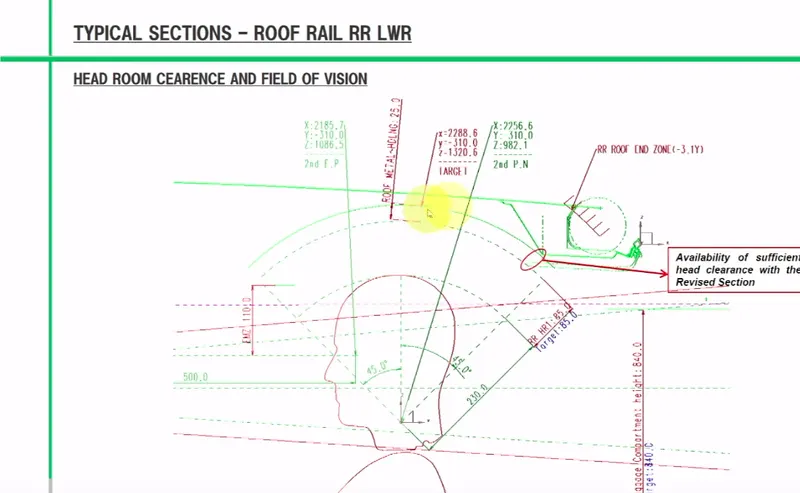
The above criteria might vary for different regions.
Mastic points
The mastics are the sealants which provide a tight seal between the outer surface and the reinforcements. These mastics also help to reduce NVH levels.
Provisions and clearances are provided to accomodate these mastic seals.
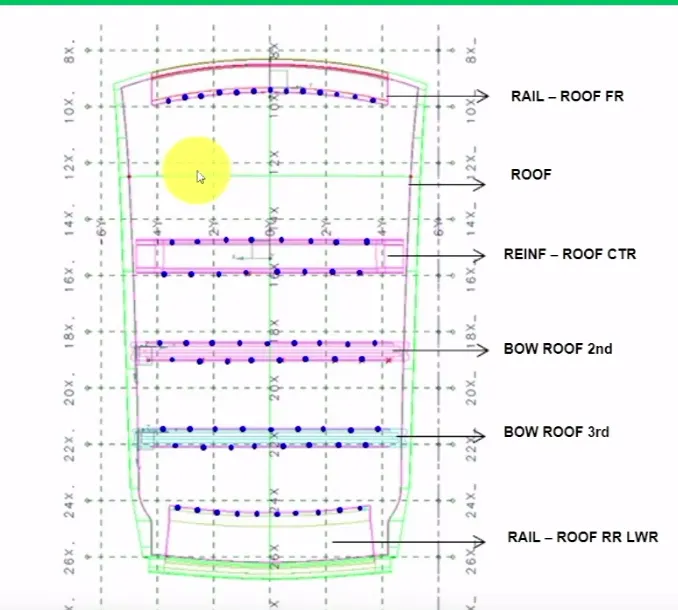
The above image shows the mastic points.
Test procedures conducted on a car roof
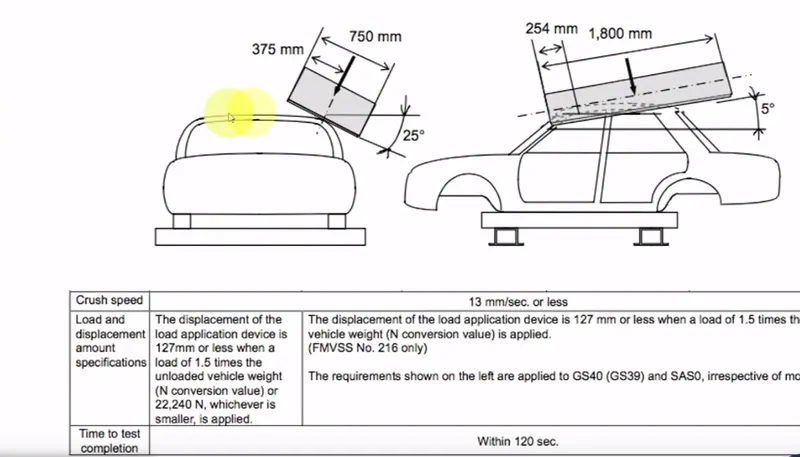
- Roof crush test: The criteria for this test is given by the Institute of highway safety after analysing various accidents that have been occured.This test determines how fast the roof rebounds after the impact or how deep is the protrusion due to the impact.
- The test is conducted only on the BIW of the car. The car is fixed in a horizontal position with all its doors and windows closed.
- The image shows the setup to cunduct a roof crush test.
- Roll - over test: A roll - over test is usually conducted on taller cars such as SUV's, minivans etc, which are more likely to roll over after a collision or sudden curving movment than smaller cars due to their high centre of gravity.
- A roll - over happens when there is a dramatic effect on the vehicle balance after vehicle traverses a curve which eventually shifts the vehicle centre of gravity to one side.
- A car's reliability including the strength of the vehicle pillars holding the roof is determined. The pillars should resist the load they recieve during the dynamic impact or when rolling after severe turning maneuvers.
The above image shows the roll - over test.
Design methodology
- Download all the data provided
- Create an assembly file
- Create roof bows
- Calculate the heat distortion and snow load criteria.
Given master data:
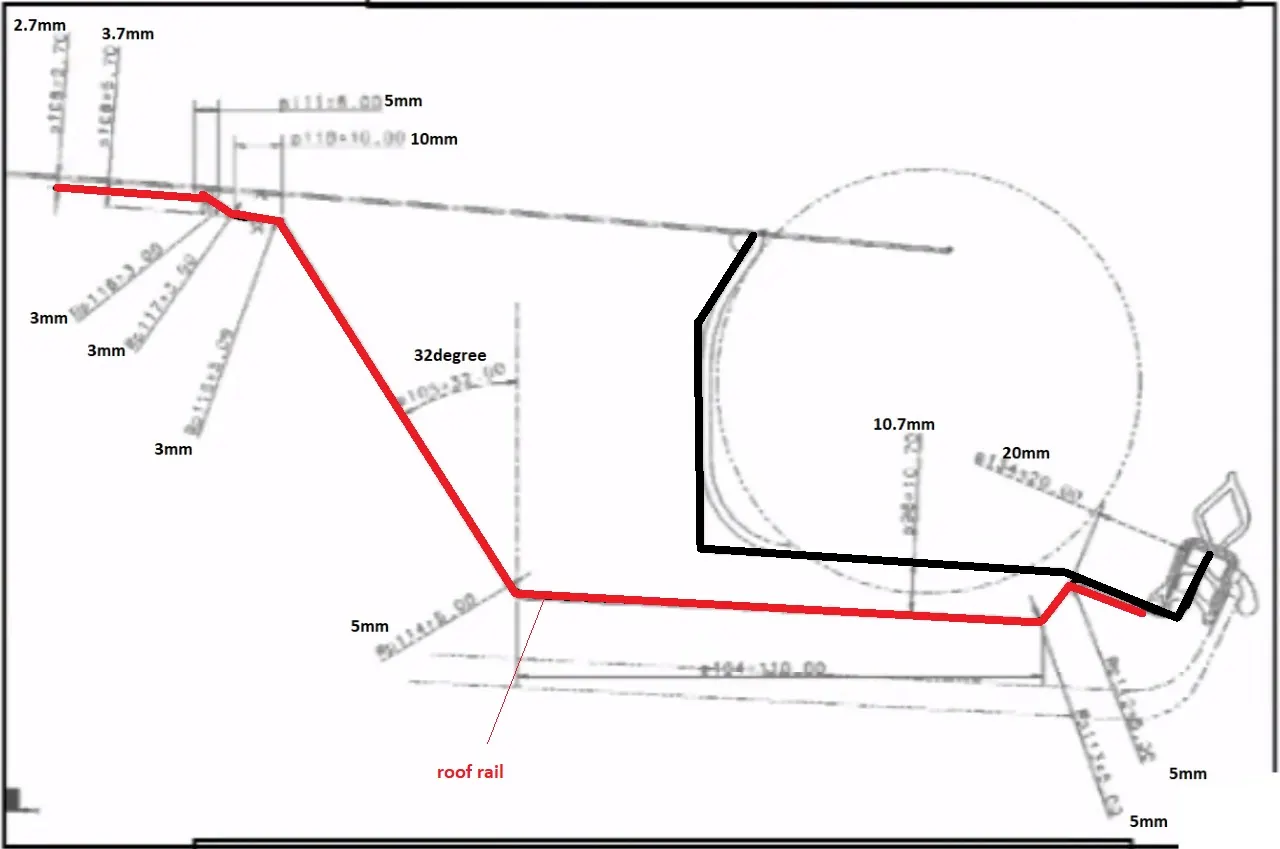
Master data for front roof rail
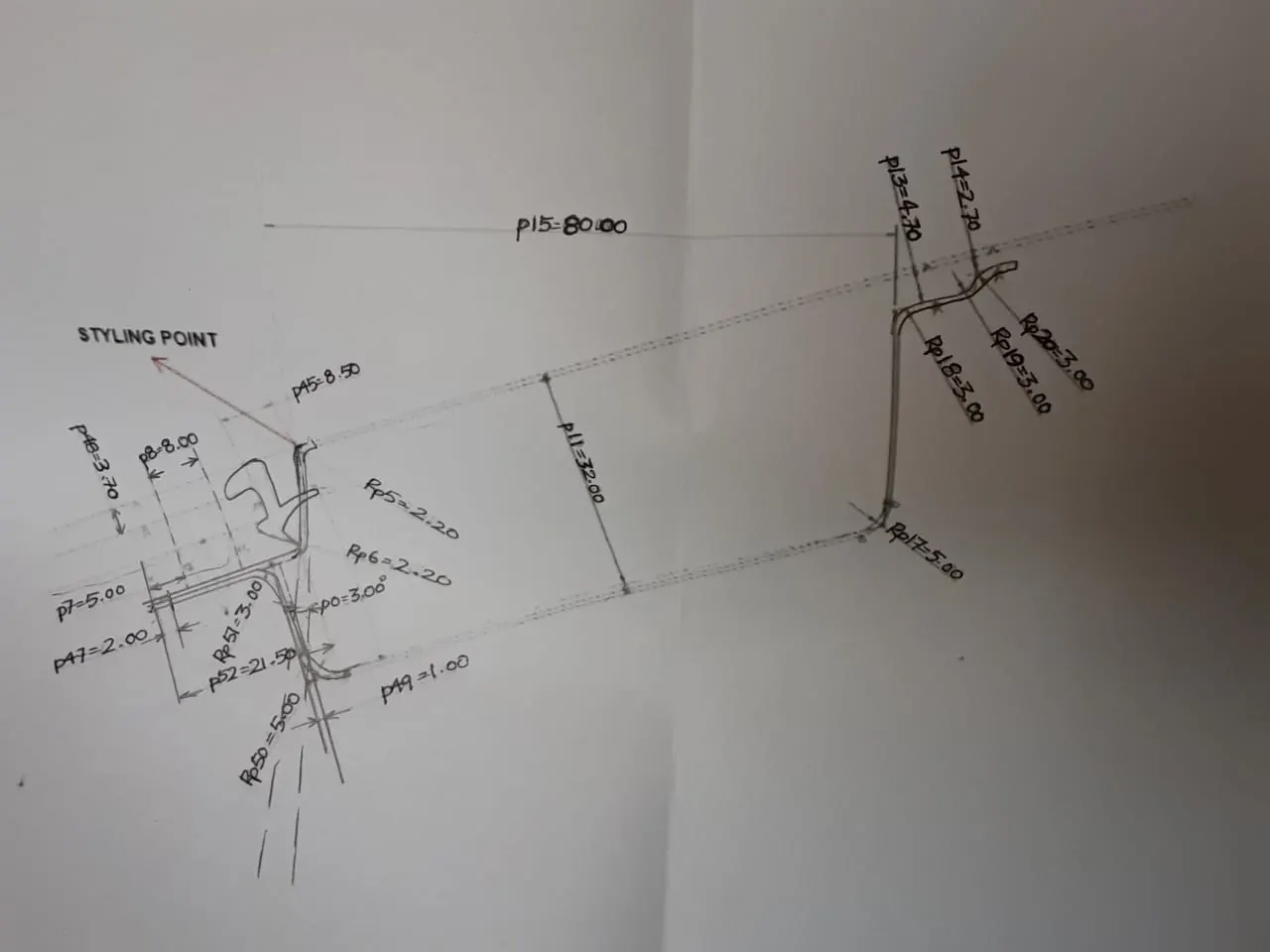
Master data for rear roof rail
Front roof rail
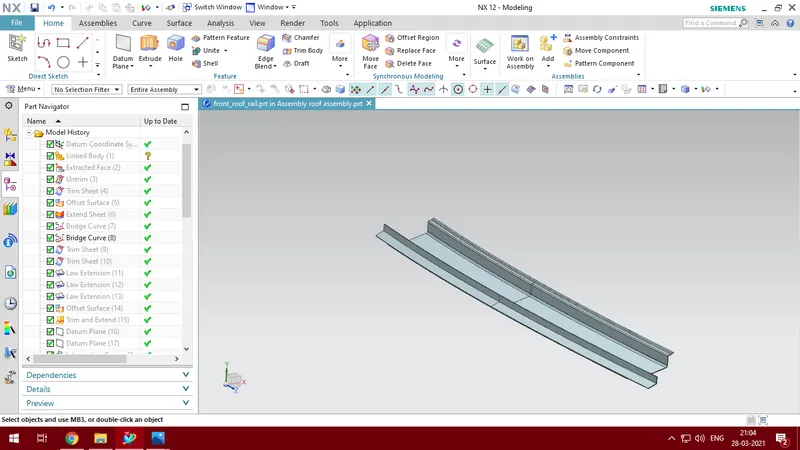
- The front roof rail is created using the given master data and also by considering the design criterias.
- The front roof rail is an reinforcement provided which also acts as a supporting member for bracket map lamp and the room lamp which is mounted on the inner surface of the roof.
- The flanges of the front roof rail have clearances for windshield and also for the rubber mountings/paste which is applied to fit the windshield.
Rear roof rail
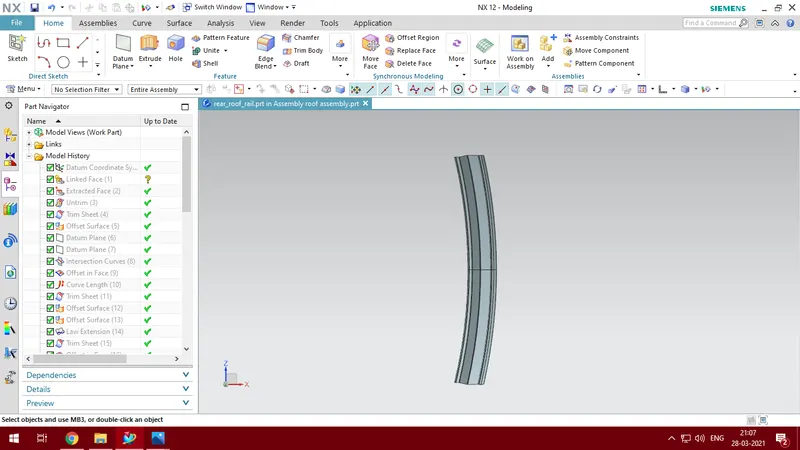
- The rear roof rail is created as per the given master section
- The rear roof rail has flanges and hinges on which the back door is mounted.
Bow roof 1
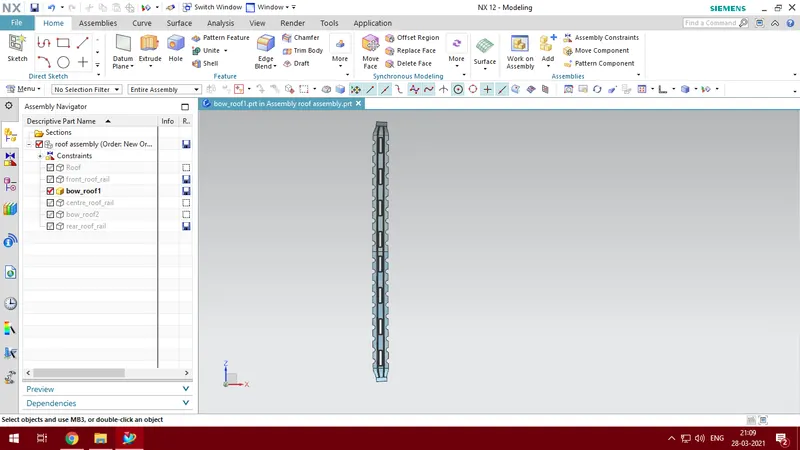
- Embosses are provided to improve the strength of the part.
- Mastic points are provided to accomodate the mastic seals.
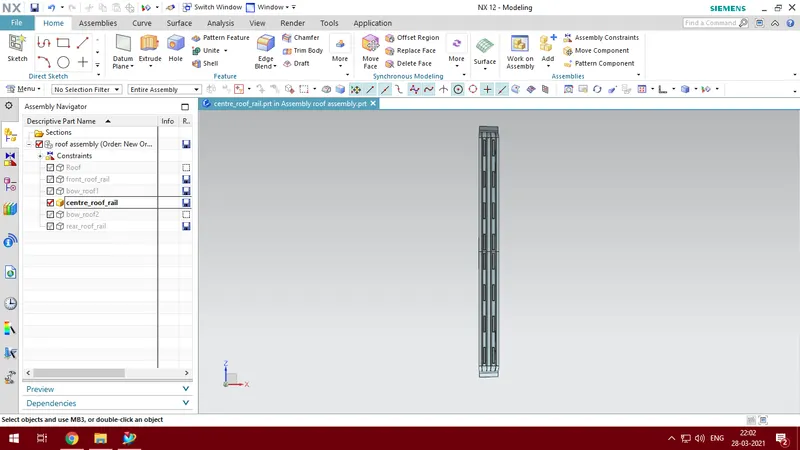
Centre roof rail
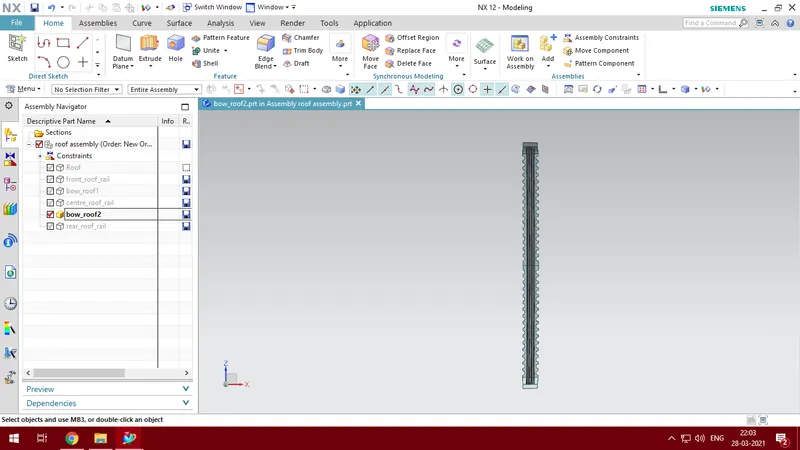
Bow roof 2
Heat distortion criteria
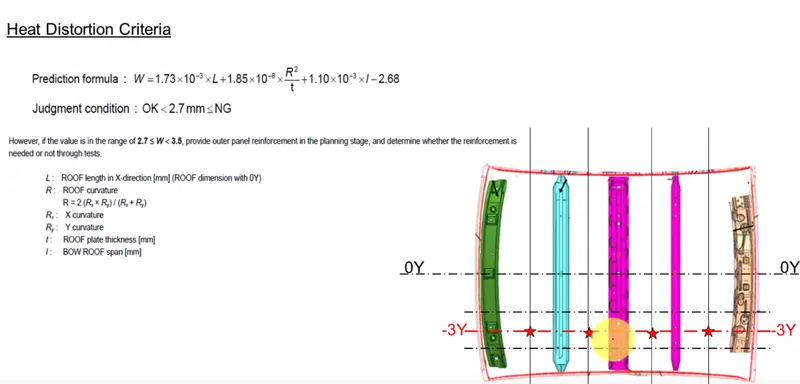
Calculation of heat distortion criteria
| BOW's |
Rx - X curvature |
Ry- Y curvature | R=2(Rx*Ry)/(Rx+Ry) | Bow roof span 'I' | Roof length 'L' | Thickness ' t' | R^2/t | W | OK/NG | |
| 1 | F.R & Bow 1 | 10203.08 | 2318.3 | 3778.14 | 432.3 | 2038.35 | 0.75 | 1.9*10^7 | 1.67 | OK |
| 2 | 1st & centre bow roof | 5077.18 | 5844.18 | 5433.97 | 484.9 | 2038.35 | 0.75 | 3.93*10^7 | 2.10 | OK |
| 3 | Centre bow roof & 2nd | 4061.45 | 10127.55 | 5797.80 | 500.2 | 2033.7 | 0.75 | 4.48*10^7 | 2.26 | OK |
| 4 | 2nd & rear roof | 2646.50 | 6950.44 | 3833.39 | 532.8 | 2033.7 | 0.75 | 1.95*10^7 | 1.79 | OK |
Calculation of section modulus
Bow roof 1
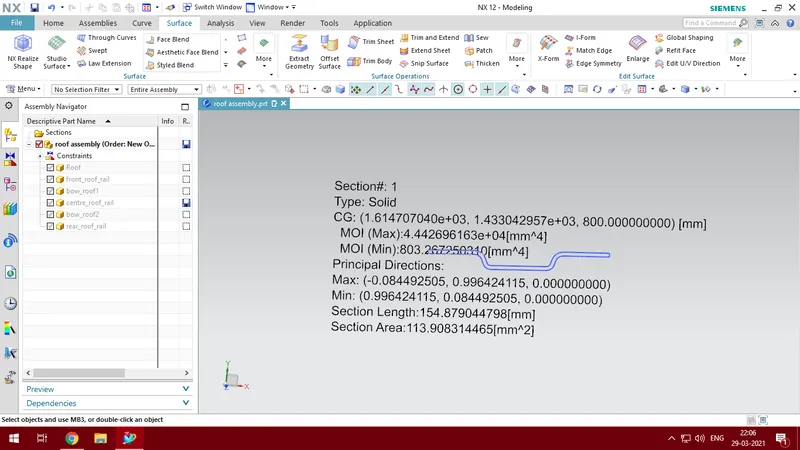
Centre roof rail
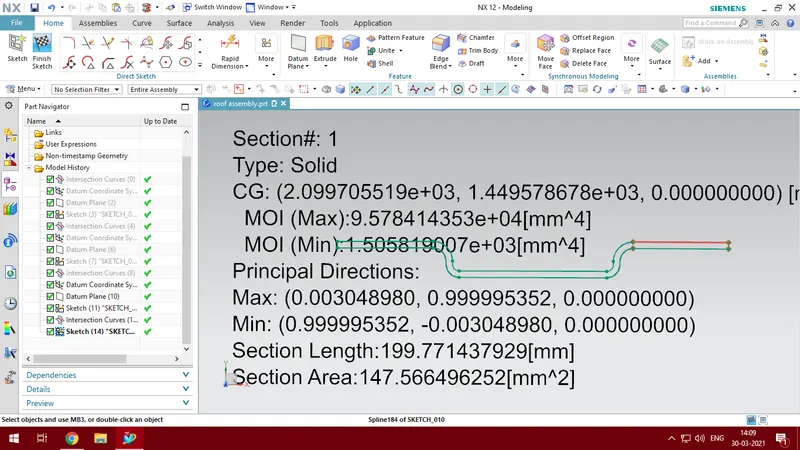
BOW roof 2
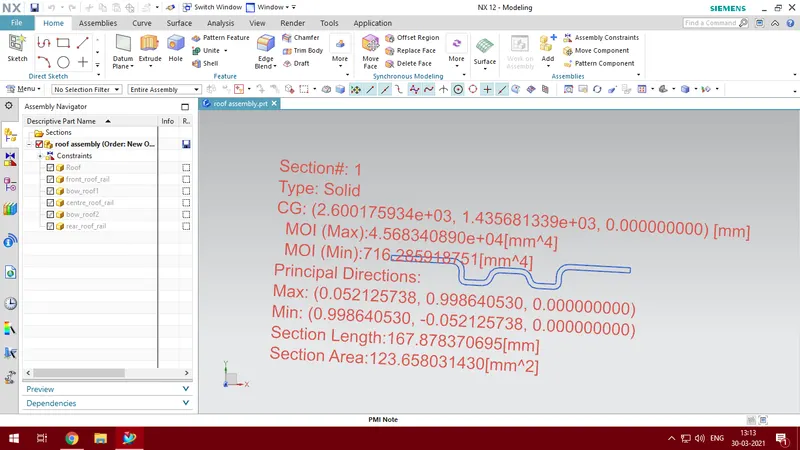
Snow load criteria
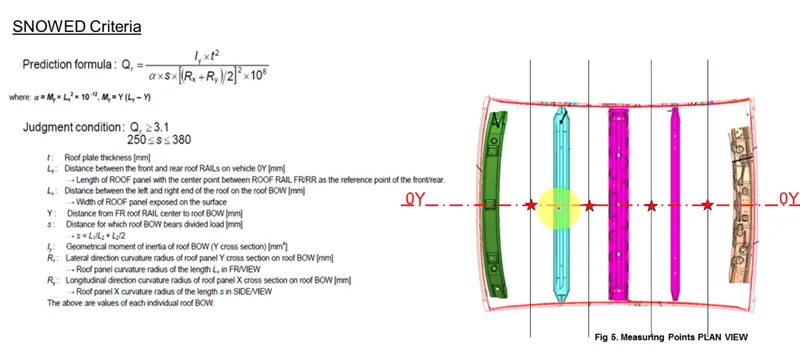
calculation of snow load criteria
| BOW's | Iy | `alpha` | Lx | Ly | Y | S | Rx | Ry | Thickness 't' | Qr | OK/Not OK | |
| 1 | F.R & 1st | 806.67 | 0.927 | 1188.93 | 1950 | 432.3 | 243.34 | 4691.34 | 2906.86 | 0.75 | 13.88 | Ok |
| 2 | 1st & centre | 1505.81 | 0.916 | 1135.84 | 1950 | 484.9 | 251.06 | 2410.50 | 3088.77 | 0.75 | 48.71 | Ok |
| 3 | Centre & 2nd | 716.28 | 0.887 | 1106.20 | 1950 | 500.2 | 267.33 | 2582.92 | 4064.28 | 0.75 | 15.38 | Ok |
Conclusion
The car roof is designed as per the given master sections and heat distortion and snowed load criteria is calculated.