Roof challenge
Note: Model is in skill center and i don;t have any back up, so i cant submit the model.
Aim:
- Study the curvature of the roof and perform calculations for bow roof positions.
- Develop the flanges and reinforcements like Ditch area, First bow roof, Second bow roof, Centre roof rail, Third bow roof and Rear roof.
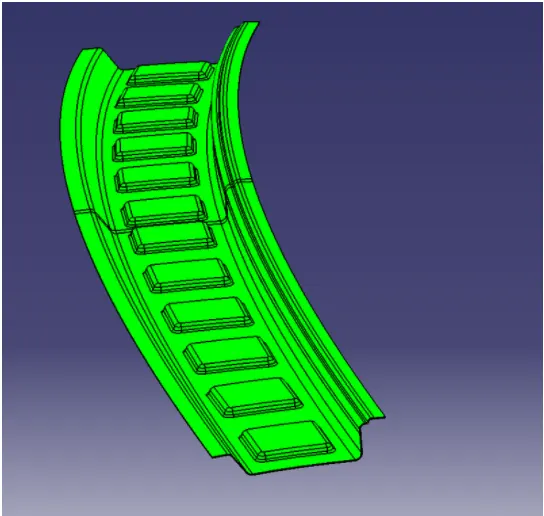
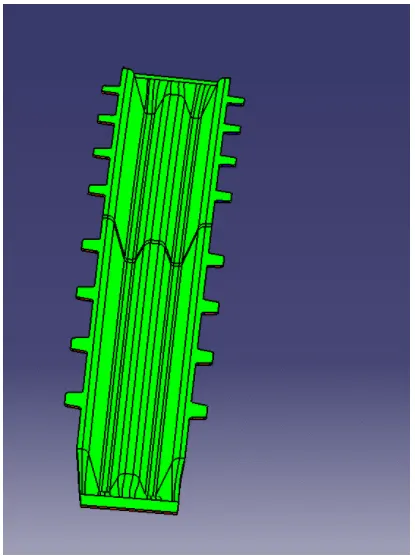
- Perform the Draft Analysis for each of the parts.
Theory:
An automobile roof or car top is the portion of an automobile that sits above the passenger compartment, protecting the vehicle occupants from sun, wind, rain, and other external elements. Earlier car roof is made up of different materials like steel etc. The substitution of the steel roof panel by a lightweight aluminium alloy roof panel is an attractive option to optimize the mass distribution in a car. However, if the remainder of the vehicle body structure continues to be fabricated in steel, two major hurdles have to be overcome.
- The first problem is the realization of a reliable joint between the different materials.
- The other problem is the different thermal expansion coefficient of aluminium and steel.
An aluminium roof on a steel body structure is also found on the Range Rover Evoque (L538) which was introduced into the market in 2012. The use of aluminium for the bonnet and the roof, thermoplastic fenders and a polymeric composite, one-piece tailgate helped to produce a vehicle weighing 100 kg less than the steel Freelander. Aluminium is used for the roof to help lower the car’s centre-of-gravity and save about 7 kg against steel.
The integration of structural aluminium components into the roof of a steel car body was first attempted in the Ford THINK, a small electric city car. The cant rail of this vehicle, i.e. the structural member which runs over the top of the doors, is designed as a visible aluminium component. The extruded aluminium profile (alloy EN AW-6060) includes the A pillar and ends at the top rear end. The length of the beam is about 2.2 m, the profile has a hollow cross section with flanges and it is 3-dimensionally formed. The beam upper face is exposed to the atmosphere and the surface is untreated.
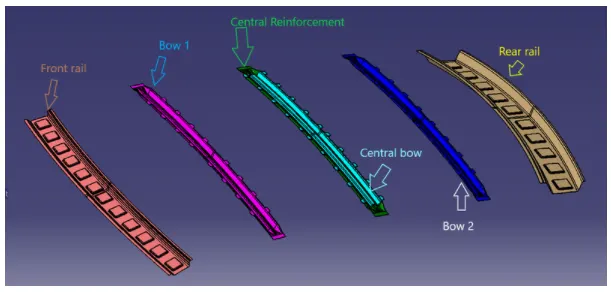
Roof Components:
1.Roof
2.Front Rail
3.Bow Roofs
4.Central Bow and Reinforcement
5.Rear Rail
METHODOLOGY:
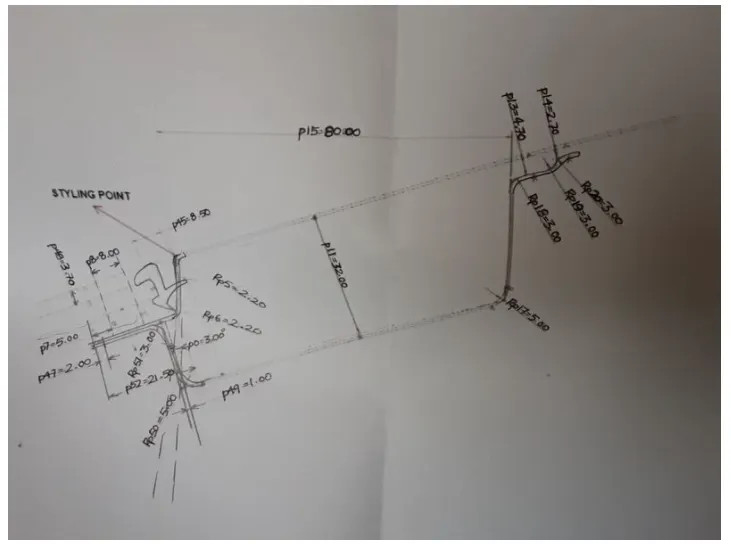
1.Create the roof with a ditch area ( flanges used for mounting) from the Styling surface by extraction by following the Master section.
2.Create the Front Rail from the Master section where the Windshield Glass will be fixed at the ditch area as shown and rubberised material will lock the Windshield.It should be also designed in a way so that the driver will get the Maximum VIsibility of the road.
3.Create the Bow roofs and Central reinforcement to strengthen the roof at the flat surface as the curvature area of the roof will be strong when compared to the flat surface by following the Master section and also designed in a way that the driver and the passengers will have Good Headroom Clearance.
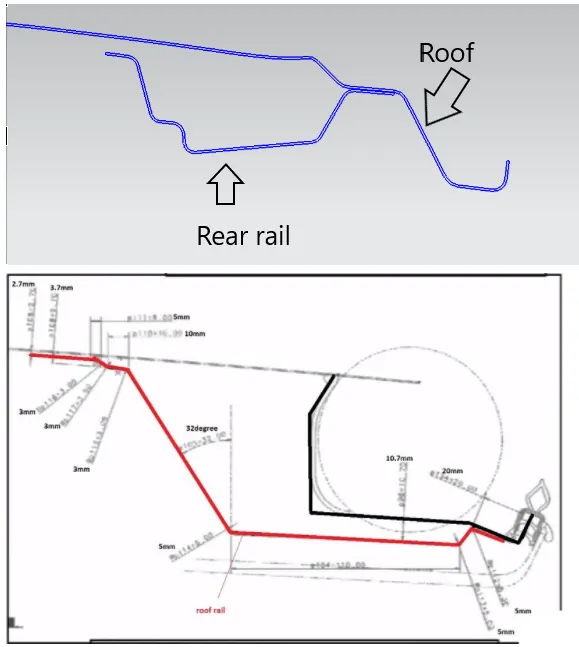
4.Create the Rear rails at the Rear side of the roof by following the Master section and it is designed in a way that when opening the back door it should open without any collision to the roof.
- The thickness data for Roof are:
- Roof:0.75mm
- Bow Roof Rails:1.2mm
- Central Reinforcement:1.5mm
- Front and Rear Rails:0.65mm
- Draft angle for Sheet Metal is 7°
PROCEDURE:
ROOF:
1.Extract the Roof surface from the Styling surface using the Extract option and Split the surface with the XYplane and then Untrim the surface.
2.Create the Ditch area by Sweep option by following the Master section.
3.Avoid the sharp edges by creating a curvature at the Ditch area using Spline.
FRONT RAIL:
1.From the Master section, create a surface with an offset of 32mm using Offset option at the Front side of the roof and follow the master section.
2.The Sweep Draft angle should be more than 7°.
3.The gap between the Roof ditch area and Front Rail should be 0.2mm (with thickness) for welding.
4.Fillet the edges as per the Master section.
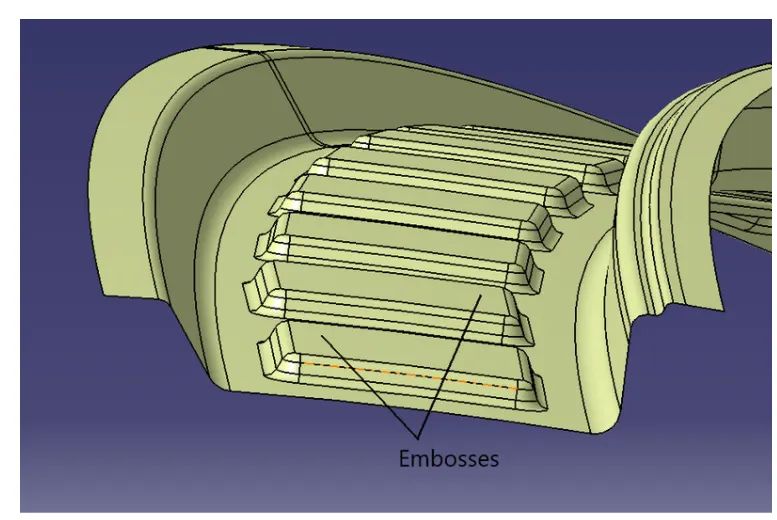
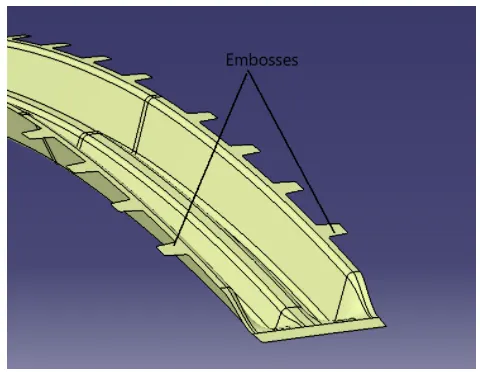
5.Create embossments on the rail to strengthen the rail.
6.The Roof area (open surface) and the Rail surface are attached using the Mastic sealants rather than spot welding because the welding spots on the Roof surface does not appear to be good to the customer.
CENTRAL REINFORCEMENT:
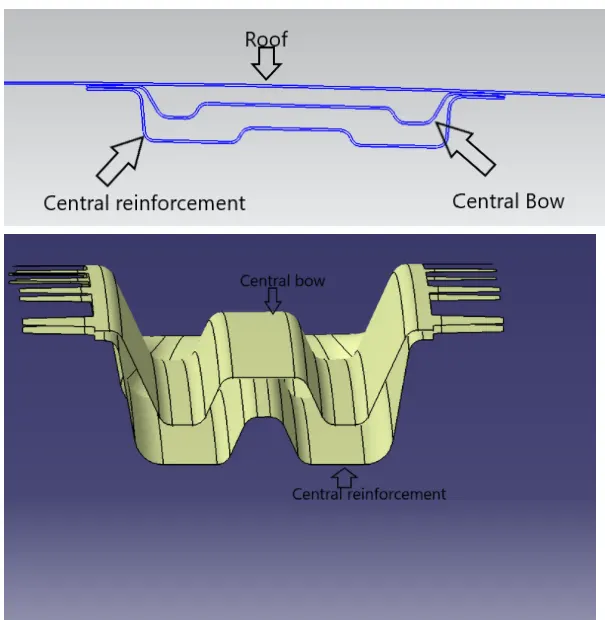
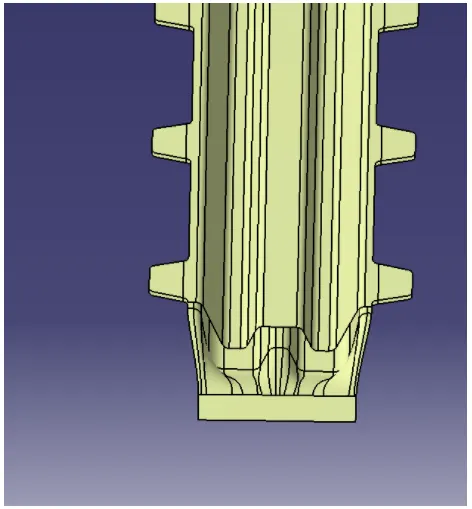
1.Create the reinforcement at the center of the Roof from the total length in X section to strengthen the roof surface with a length of 90-95mm (in X-section) and offset to 40-45mm ( with thickness) which will be the height from the Roof as shown.
2.From the Master section create the reinforcement using the Offset and Sweep option where the draft angle will be 20-25°
3.Central bow and reinforcement are attached with the spot welding where the central bow is attached to the roof surface using Mastic sealants.
4.The clearance gap for spot welding should be 0.2mm and 4-5mm for Mastic sealants.
CENTRAL BOW:
1.Central Bow should be positioned above the Central reinforcement where the length of the central bow should be 75-80mm (in X-section) and offset to 20-30mm ( with thickness) which will be the height from the Roof as shown.
2.From the Master section create the central bow using the Offset and Sweep option where the draft angle will be 20-25°.
BOW ROOF:
1.Bow roofs add strength to the roof at curvature surface.
2.Create the Bow roof from the Master section with a length of 75-80mm (in X-section) and offset to 20-30mm ( with thickness) which will be the height from the Roof as shown.
3.From the Master section create the Bow roof using the Offset and Sweep option where the draft angle will be 20-25°.
4.The number of bow roofs that should be placed on the roof depends on the Heat distortion and Snow load calculations, type of roof, size of roof and strength of the roof.
REAR RAIL:
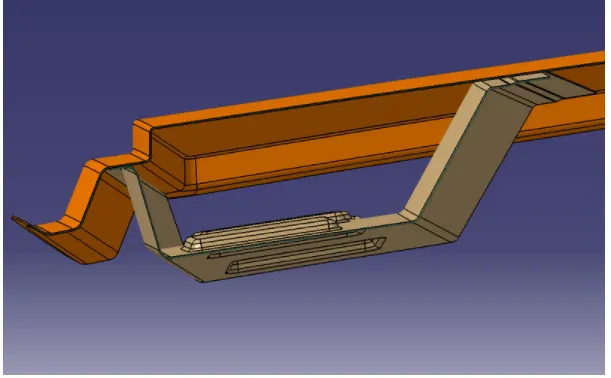
1.Rear rail gives the support to the C-pillar and rear side of the roof.
2.From the Master section create the rear rail at the rear side of the roof using the Offset and Sweep option where the draft angle will be 20-25°.
3.Create the embossments on the rear rail to strengthen the rail.
HEAT DISTORTION:( Bow-roof Prediction)
Heat distortion temperature is the temperature at which the metal tends to deform at higher temperature conditions under a specified load.
From the heat distortion temperature calculation, the Bow roofs position, number of bow roofs and the strength of the roof can be known.
*W = [1.73 x 10^(-3) x L] + [1.85 x 10^(-8) x (R^2)/t] + [ 1.10x10^(-3) x l] - 2.68
Judgement Condition : OK< 2.7> 3.1
Where
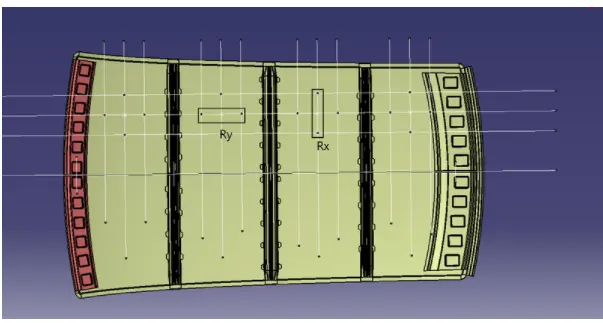
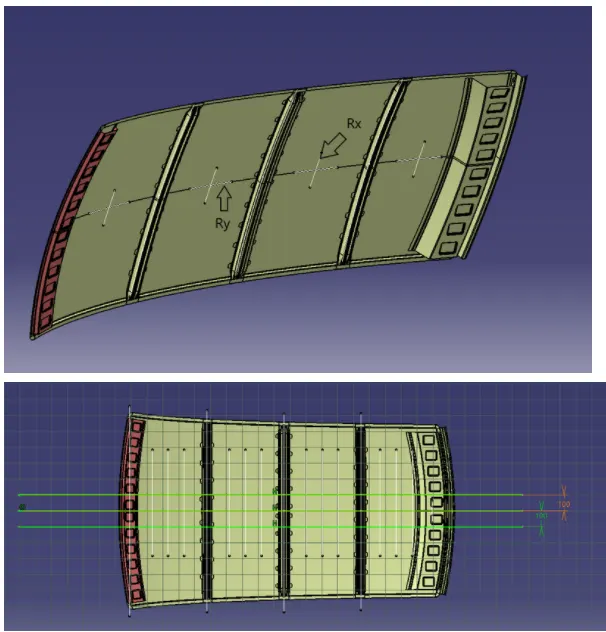
L = Roof Length in X-Direction from styling points [mm](Roof dimension in 0-Y)
R = Roof curvature => R = 2(Rx*Ry)/(Rx+Ry)
Rx = X curvature
Ry = Y curvature
t = Roof plate thickness [mm]
l = Bow Roof Span [mm]
|
S.No |
RAILS |
Rx |
Ry |
R |
(R^2)/t |
L |
l |
t |
W |
OK/NG |
|
1. |
FRR&BR1 |
5738.494 |
2552.191 |
3533.057 |
16643325.542 |
2033.705 |
487.231 |
0.75 |
1.682 |
OK |
|
2. |
BR1&CRR |
4934.825 |
6348.163 |
5552.974 |
41114037.420 |
2033.705 |
485.782 |
0.75 |
2.133 |
OK |
|
3. |
CRR&BR2 |
3998.66 |
10473.454 |
5787.652 |
44662558.076 |
2033.705 |
482.056 |
0.75 |
2.194 |
OK |
|
4. |
BR2&RR |
3291.989 |
141510.59 |
5366.492 |
38398987.911 |
2033.705 |
448.215 |
0.75 |
2.215 |
OK |
From the above calculations, it can be observed that the designed roof passes the Heat distortion criteria.
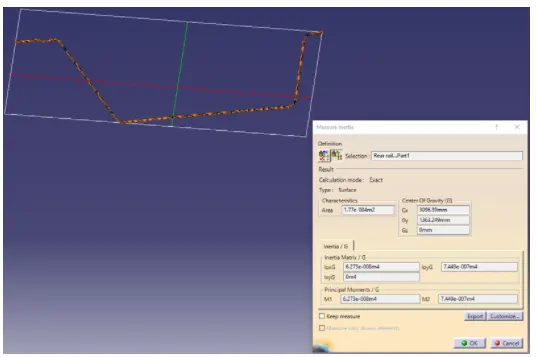
SECTION MODULUS:
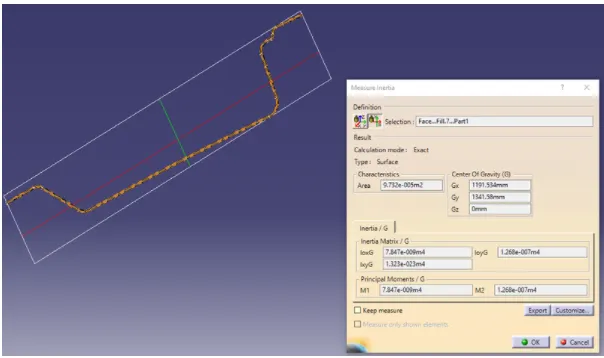
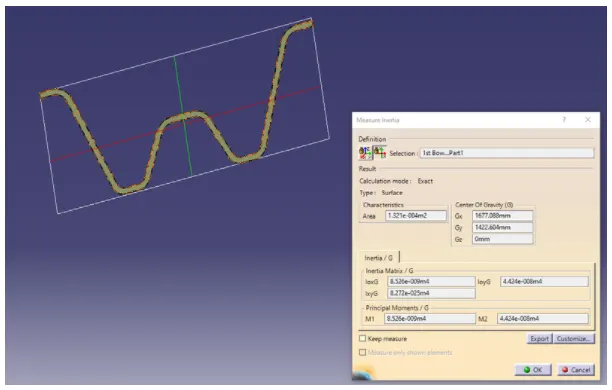
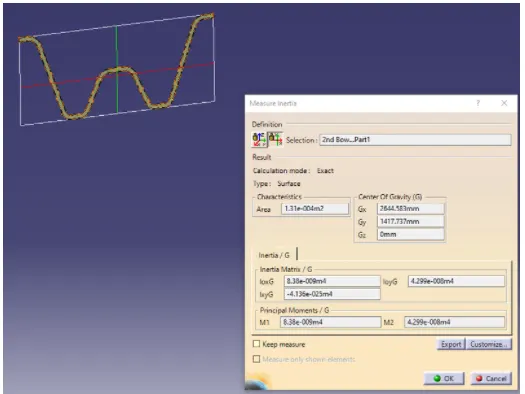
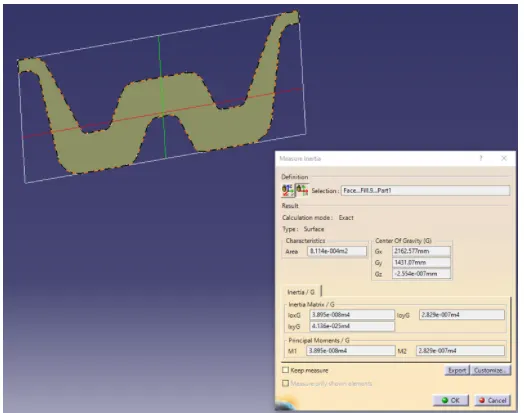
Section modulus is a geometric property of the cross section used for designing beams and flexural members.
Section modulus S=I/y
S = Section Modulus
I = Moment of Inertia
y = distance between the neutral axis and the extreme end of the object
Front rail
Bow roof 1&2
Central Bow and reinforcement
Rear rail
|
S.No |
RAILS |
I(mm^4) |
y(mm) |
S(mm^3) |
|
1. |
Front rail |
7847 |
60.1785 |
130.39 |
|
2. |
Bow roof 1 |
8526 |
31.6415 |
269.45 |
|
3. |
Central bow and reinforcement |
38950 |
35.4965 |
1097.29 |
|
4. |
Bow roof 2 |
3380 |
31.152 |
108.50 |
|
5. |
Rear rail |
62730 |
104.511 |
600.22 |
SNOW LOAD:
Snow load criteria is the test used to exhibit no permanent deflection due to the snow load on the roof.
*Qr = [Iy x t2] / [α x s x [(Rx + Ry)/2]2 x 10-8]
Where
*α = My x Lx2 x 10-12 , My = Y(Ly-Y)
*Judgement condition = Qr ≥ 3.1
*250 ≤ s ≤ 380
t = Roof plate thickness [mm]
Ly = Distance between the front and rear roof Rails on the Vehicle along with 0Y[mm]
Length of Roof panel with the center point between Roof rail Front /Rear as the reference point of the front and the rear.
Lx = Distance between the Left and Right end of the roof on the Roof BOW [mm]
Width of the roof panel exposed on the surface.
Y = Distance front Front Roof Rail to Roof BOW[mm]
s = Distance for which Roof BOW bears divided load [mm]
s = L1/2 + L2/2
Iy = Geometrical moment of inertia of Roof BOW (Y cross-section )[mm4]
Rx = Lateral direction curvature radius of roof panel Y cross-section on Roof BOW [mm]
Roof panel curvature Radius of the Length Lx in Front view
Ry = Longitudinal Direction curvature radius of the Roof panel X cross-section on Roof BOW [mm]
Roof panel X curvature radius of length s in Side view
|
S.No |
RAILS |
Lx |
Ly |
L1 |
L2 |
s |
My |
Iy(mm^4) |
t |
Rx |
Ry |
α |
Qr |
Determination |
|
1. |
FRR&BR1 |
1112.158 |
2033.705 |
487.231 |
485.782 |
486.5065 |
753490.073 |
8526 |
0.75 |
4525.528 |
2607.697 |
0.9319 |
83.180 |
OK |
|
2. |
BR1&CRR |
1076.222 |
2033.705 |
485.782 |
482.055 |
483.9185 |
751953.131 |
38950 |
0.75 |
3722.041 |
6262.487 |
0.8709 |
206.516 |
OK |
|
3. |
CRR&BR2 |
1057.06 |
2033.705 |
482.055 |
448.215 |
465.135 |
747980.641 |
3380 |
0.75 |
4265.629 |
10949.05 |
0.8357 |
8.170 |
OK |
|
4. |
BR2&RR |
2033.705 |
448.215 |
710640.4 |
0.75 |
4025.009 |
16285.88 |
From the above calculations,it can be observed that the designed roof passes the Snow Load criteria.
FINAL COMPONENT:
DRAFT ANALYSIS:
Front rail
Bow roof 1&2
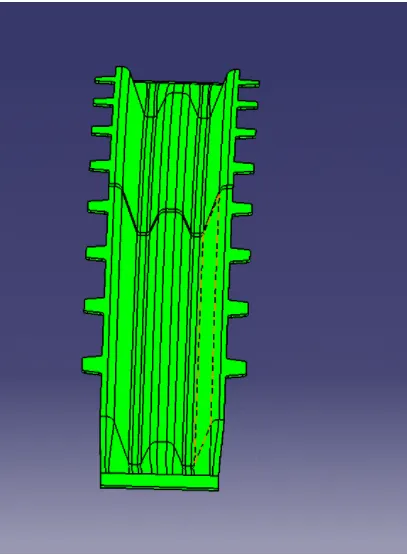
Central Bow and reinforcement
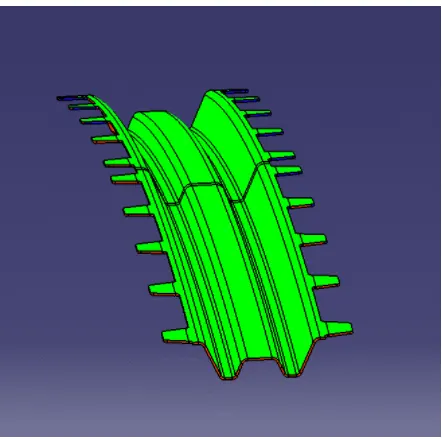
Rear rail
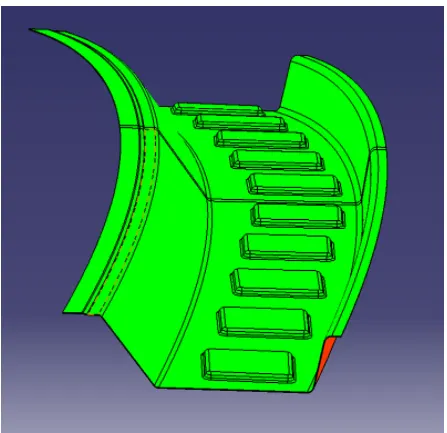
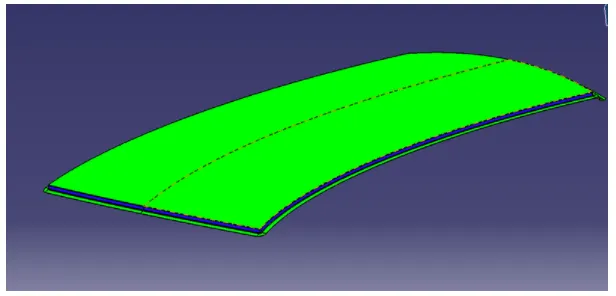
Roof
RESULT:
Developed the Roof from Master section and done the curvature study on the roof.