Rayleigh Taylor Instability Challenge
Abstract:
In the present study, Rayleigh-Taylor instability was investigated by simulating it Ansys Fluent, with two different pairs of fluids. Atwood number for both the cases was found. The effect grid size on the simulation was also investigated.
Introduction:
The instability observed at the interface between two different fluids of two different densities with heavier fluid on the top, is called as the Reynolds Taylor instability. This is phenomenon that is generally observed in some natural events, for example, Examples include the behavior of water suspended above oil in the gravity of Earth, mushroom clouds like those from volcanic eruptions and atmospheric nuclear explosions, supernova explosions in which expanding core gas is accelerated into denser shell gas, instabilities in plasma fusion reactors and inertial confinement fusion. G. I. Taylor realized that this phenomenon is equivalent to the situation when the fluids are accelerated, with the fluid having lower density accelerating into the denser fluid.
some practical CFD models that have been based on the mathematical analysis of Rayleigh Taylor waves
Richtmyer–Meshkov instability:
It is observed in case of two fluids having different densities accelerate towards each other, it is due to the passage of shockwave. When denser fluid penetrate into lighter fluids spikes can be observed, when lighter fluids penetrate into denser fluid bubbles appear.
Kelvin–Helmholtz Instability:
this is generally observed when two different fluids or two streams of same fluid moving with different velocities, it occurs at the interface between the two fluids.
Diesel spray/breakup models:
In order to simulate the breakup mechanism of liquid droplets in gas, a robust three dimensional formulation of instabilities are required, usually resulted in Rayleigh – Taylor instability
Solving and modelling approach:
The present model involves two different fluids, for that model to be generated with two independent surfaces having a common interface this can be done either in space claim using pull tool and share option or in design modular using freeze option. After that meshing can be done. After meshing, setup is initialized which opens fluent. Since we are observing a phenomenon which is occurring over a period of time, the analysis should be transient, and we are not dealing with the fluid which is having any initial momentum we can use pressure-based solver. The entire phenomenon is mainly due to the presence of gravity so it should be enabled. Since the fluid is initially at rest, and the depth of the container is small, there is no possibility of turbulence within system. Hence the flow can be solved by using laminar equations. Since it involves two different fluids and that too of two different phases, multiphase model should be used. The present problem is solved using implicit formulation(discretization).
Geometry:
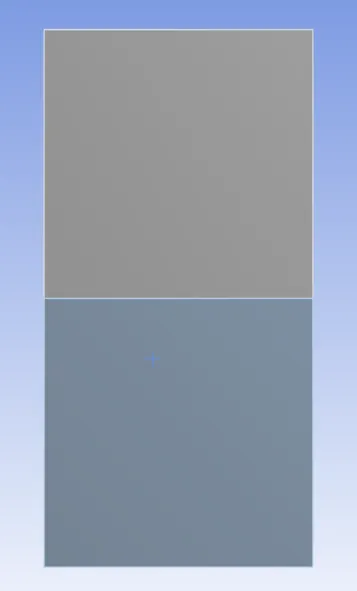
the geometry is 2d model which involves two squares each of 20*20 mm2. There is a common edge which is the interface between the two fluids need to be shared. This can be done using share option in space claim.
Meshing:
The elements used in the meshing are rectangular, using face meshing helps in decreasing the warping of the faces.
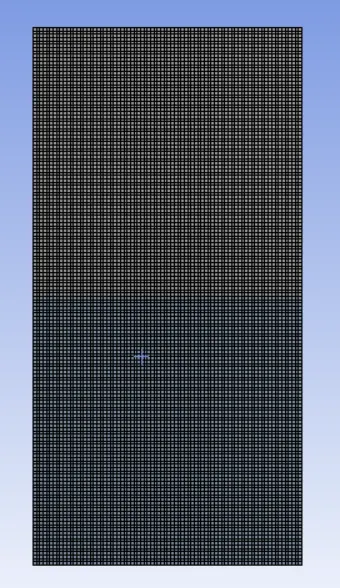
meshed geometry
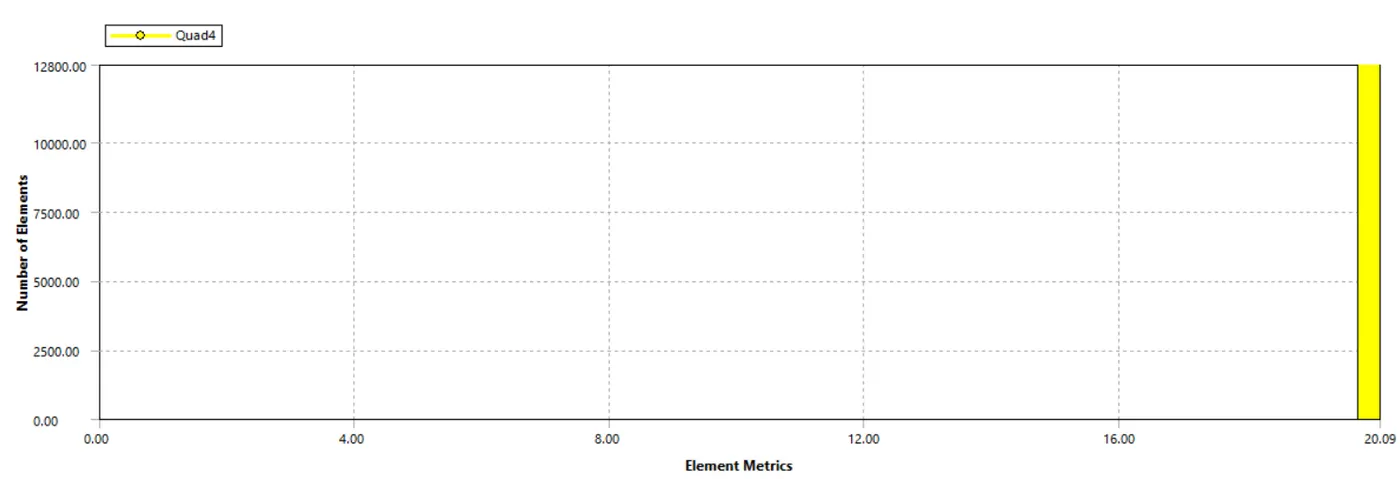
element quality
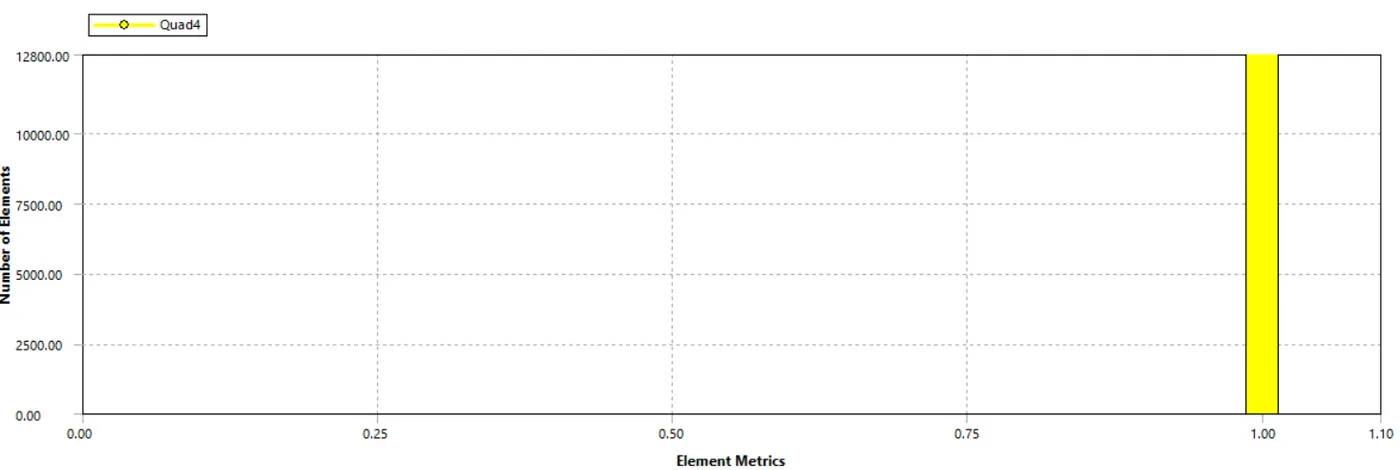
aspect ratio
Governing equations:
The fluid domain considered to be incompressible and governing equations satisfying the fluid domain are given below:
Continuity equation:

X-momentum equation:
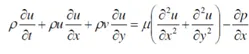
Y-momentum equation:

For non-dimensionalization considering following parameters,

By Non-dimensionlising the governing equations becomes:
Continuity equation:
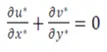
X-momentum equation:

Y-momentum equation:

Where, Re = Reynolds number (𝜌𝑢𝑑/𝜇)
Boundary conditions:
The outer walls of the model are considered adiabatic and no slip condition is also applied
Grid independence test:
With pressure along the vertical central line taken as the parameter to study the grid independency, the following plot compares the pressures for grid size 3200and 12800.
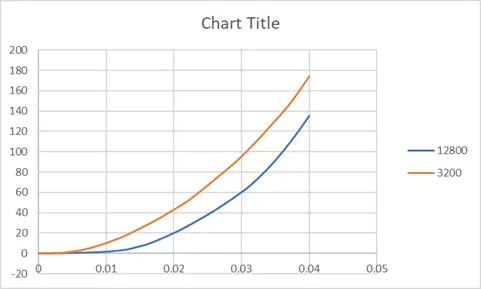
From the above two graphs the difference in pressures is too high and hence the finer grid is used (here I have not proceeded with further refinement because it is diverging with the bigger time steps. And decreasing the time steps resulting in more no of iterations)
Results:
case 1:
with element size of 0.5mm
case 2:
with an element size of 0.25mm
with finer the grid the smaller vortices will get noticed which can be cearl seen from the videos and comparing them to each other, with coarser grid if the vortice fall inside the element(since it involves interpolation ) it wont get identifed, this also effects the diffusion of water into air, the green portion indicates the diffusion region.
Case 3:
with the user defined fluid
in all of these cases we have used transient simulation, this is because it is an phenominon that is going to be observed over a period of time. for solving the conservation equations during transient condition, a partial derivative term with respect to time will be there in every equation.
Atwood number:
Atwood number is a dimensionless number which is used in the study of hydrodynamical instabities, basically in density stratified fluids.

where
A=atwood number
 = density of heavier fluid
 = density of lighter fluid
for case 1,2
A=0.99755
for case 3
A =0.4285
With the increase in the Atwood number, the instabilty decreases, the stabilization effect of initial density stratification decreases, and the instability caused by the expansion-compression effect becomes more significant. The flow structures of bubbles and spikes are quite different at medium Atwood number. compressabilty will have larger effect on bubbles formed for larger A.
Conclusion:
the Rayleigh taylor instabilities for two different fluid pairs were studied,
the atwood number was also calculated for the above cases.