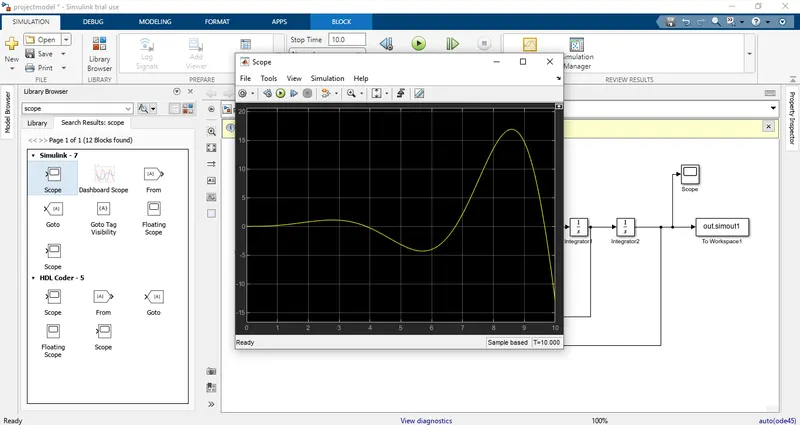
Project - Position control of mass spring damper system
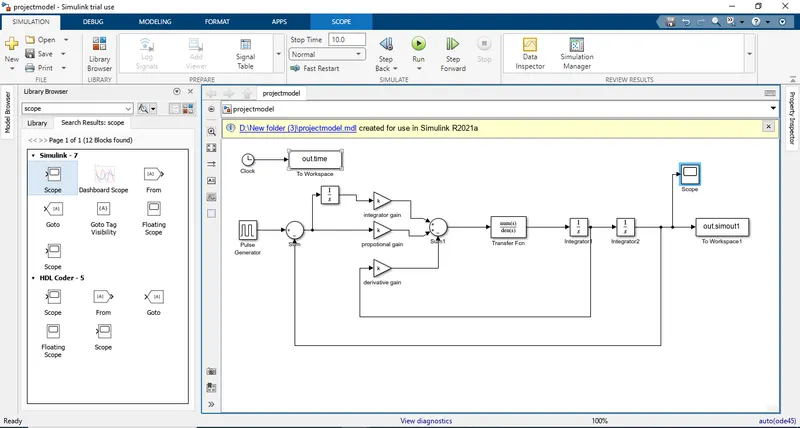
-
Clock: The Clock block generates a periodic signal that can be used as a time reference for your model.
-
Workspace: The Workspace block allows you to import data from the MATLAB workspace into your Simulink model.
-
Pulse Generator: The Pulse Generator block generates a periodic rectangular pulse signal.
-
Sum: The Sum block allows you to add or subtract signals. It is often used in control systems to combine the output of multiple controllers.
-
Integrator: The Integrator block performs numerical integration of a signal. It is commonly used to model systems that involve calculus.
-
Gain: The Gain block multiplies its input signal by a constant value.
-
Transfer Function: The Transfer Function block models a linear time-invariant system using a transfer function. It takes the Laplace transform of the input signal, multiplies it by the transfer function, and then takes the inverse Laplace transform to obtain the output signal.
-
Scope: The Scope block displays the output of a signal in a graph. It is commonly used to visualize simulation results.