Project on Concrete Mix Design for various grades of Concrete
Project 1: Calculate the Concrete Mix Design for M35 grade concrete with fly ash & M50 grade concrete without Fly ash
Case:1 Calculation of concrete mix design for M35 grade concrete with fly ash:
- Aim: The main aim of this project is to calculate Mix Design for M35 grade concrete with fly ash.
- Introduction:
Concrete is multipurpose and globally recognized construction material. To produce a good quality concrete, the ingredients should be properly measured according to standards. Concrete is a homogeneous mixture of raw materials such as; cement, course aggregate, fine aggregate, admixtures and water. It is universally used construction material. In Mix design type of concrete the proportions of ingredients are decided based on desired strength. Performance of concrete like workability and performance are considered in such type of concretes. The materials are tested to ensure their quality. M-25, M-30, M-35, M-40 etc. are design mixed concretes.
Mix design method is a scientific method of preparing concrete mixture in this type, concrete is prepared using step by step procedure prescribed in given in Indian standard, IS10262(2009).
- Advantages:
- Quantity of cement, Fine aggregate and Corse aggregate are calculated in weight.
- Based on construction needs different types of concrete can be designed.
- Environmental factors and properties are considered for mix design.
- High strength concrete and high-performance concrete can be designed
- Quantities are more accurate compared to Nominal Mix Concrete.
- Cost-effective
- Disadvantages:
- Scientific method, thus requires a deeper understanding and elaborate calculation.
- Time-consuming
- Skilled workers are required.
- Quality of ingredients should be maintained same throughout the batch
Material type, moisture content in material, material suitability and the other properties affect the design mix of concrete. The material properties considered for mix design are as follows:
- Cement:
- Grade of cement: Cements are available in different grades, the selection of desired grade is important based on the purpose and strength required.
- Consistency of cement: The ability of cement paste to flow is termed as consistency. Optimum water-cement ratio should be maintained to get good workable paste.
- Initial and final setting time: Cement when mixed with other ingredients attains plasticity in first 30 min this time is called initial setting time and loses its plasticity within nest 10hrs this time is called final setting time.
- Specific gravity of cement: It is the ratio of weight of given volume of material to weight of equal volume of water. The specific gravity should be maintained to attain quality.
- Aggregates:
- Density: It is defined as the quantity of aggregate required to fill unit volume of a container. Density of aggregate depends on:
- Degree of compaction
- Grading of aggregates
- Shape of aggregate particles
- Bulking of fine aggregate: The ratio of volume of wet sand to volume of dry sand is termed as bulking ratio. The volume of dry sand is more compared to wet sand. It is better to use dry aggregates.
- Specific gravity: It is the ratio of weight of given volume of material to weight of equal volume of water. Low specific gravity indicates low quality of material and high specific quality in range (2.6 to 2.9) the quality is maintained; Thus the specific gravity should be maintained to attain quality.
- Shape and size: The shape and size greatly influence the quality of concrete required, influencing the strength of concrete. Size and shape of aggregate influence the freshly mixed concrete compared to hardened concrete.
- Silt content: The aggregates shouldn’t contain any harmful substance which internally affects the strength of concrete. The silt in aggregate may be: Organic impurities, Clay and dust and salt contamination.
- Water absorption: The more the water content is more the volume of aggregate, thus there is need for less water absorption aggregate.
- Unit weight: Unit weight should be high which lessens the pours and voids in aggregates.
- Crushing value: This gives the ability of the aggregate to resist to crushing.
- Impact value: This gives the ability of the aggregate to resist to sudden shock and impact.
- Procedure:
Step-1: Stipulations for proportioning
- Grade designation: M35
- Type of cement: OPC 53 Grade conforming IS 12269
- Type of Mineral admixture: Fly ash conforming to IS 3812 (Part-1)
- Maximum nominal size of aggregate: 20mm
- Minimum cement content: 320 kg/m3(Table 5 of IS 456:2000)
- Maximum water-cement ratio: 0.45 (Table 5 of IS 456:2000)
- Workability: 100 slump for pumpable concrete
- Exposure condition: Sevier 9for reinforced concrete)
- Method of concrete placing: Pumping
- Degree of supervision: Good
- Type of aggregate: Crushed Angular Aggregates
- Maximum cement content: 450 kg/m3
- Chemical admixture type: Superplasticizer.
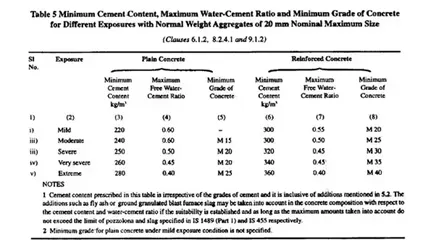 Table 5 of IS 456:2000
Step-2: Test data for materials
- Cement used: OPC 53 Grade conforming IS 12269
- Fly ash: Conforming to IS 3812 Part-1.
- Specific gravity of cement: 3.15
- Specific gravity of fly ash: 2.2
- Chemical admixture: Superplasticizer conforming to IS 9103
- Specific gravity of
- Coarse aggregate 20mm: 2.74
- Fine aggregate: 2.74
- Free (surface) moisture:
- Coarse aggregate: 0.5 %
- Fine aggregate: 1.0 %
- Water absorption:
- Coarse aggregate: Nil
- Fine aggregate: Nil
- Sieve analysis:
- Coarse aggregate: Conforming to all in aggregates of Table 2 of IS 383
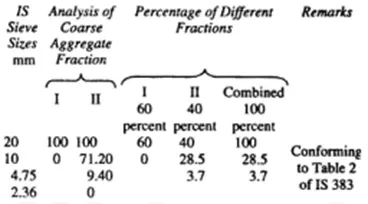 Table 2 of IS 383
- Fine aggregate: Conforming to Grading Zone I of Table 4 of IS 383
Step:3 Target strength for mix proportioning
The target strength is calculated using the formula:`f'ck =fck + (1.65*S)`
Where: f’ck = target average compressive strength at 28 days,
fck = characteristics compressive strength at 28 days, and
s = standard deviation.
Since the grade of design concrete is M35, From Table-1 of IS 10262:2009 the Standard Deviation, s = 5 N/mm2.
Therefore,
f’ck = 35 + (5*1.65)
f’ck = 43.25 N/mm2
Thus the Target strength = 43.25 N/mm2.
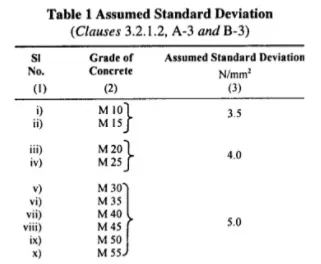 Table-1 of IS 10262:2009
Step:4 Selection of water-cement ratio
From the Table 5 of IS 456:2000 for severe Exposure Maximum Water Cement Ratio is 0.45.
Based on experience 0.40 is selected
o.4< 0.45
Hence ok.
Table 5 of IS 456:2000
Step:5 Selection of water content
From Table 2 of IS 10262:2009,
Maximum water content for 20 mm aggregate = 186 litres /m3 (for 25 to 50 mm slump range)
We have selected slump as 100, Estimated water content for 100 mm slump = 186+ (6/186) = 197 litres /m3
Based on trials with Superplasticizer water content reduction of 30% has been achieved, Thus the required water content = 197-[197* (28/100)] = 142 litres /m3
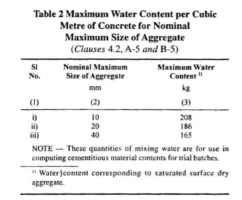 Table 2 of IS 383
Step: 6 Calculation of cement content
Adopted w/c Ratio = 0.4
Cementitious material (Cement + Fly ash) = 142/0.4 = 355 kg/m3
From Table 5 of IS 456, Minimum cement content for Sevier exposure conditions 320kg/m3
= 355 kg/m3 > 320 kg/m3
Hence ok.
Calculation of proportion of mixing Cement and fly ash:
The percentage of fly ash in cementitious material are based on requirement and quality of concrete. The percentage of fly ash is based on trials and experiences.
10% extra cementitious material is used in the concrete, thus the cementitious content = 355 + ((355 *10)/100) = 390.5 kg/m3
Water-cement ratio for 390kg cementitious content = 140/390 = 0.358
Fly ash is 30% of cementitious content,
Thus fly ash content = (390*30)/100 = 117 kg/m3
Cement (OPC) Content = 390 -117 = 273 kg/m3
Thus saving of cement = 355 – 273 = 82 kg/m3.
Table 5 of IS 456:2000
Step:7 Volume of coarse aggregate and fine aggregate
From Table 3 of (IS 10262:2009) Volume of coarse aggregate corresponding to 20 mm size aggregate and fine aggregate (Zone I) is = 0.60.
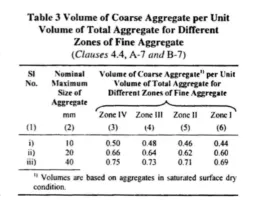 Table 3 of (IS 10262:2009)
In the present case considered water-cement ratio is 0.4. Therefore, volume of coarse aggregate is required to be increased to decrease the fine aggregate content. As the water-cement ratio is lower by 0.05. The proportion of volume of coarse aggregate is increased by 0.02 (at the rate of -/+ 0.01 for every ± 0.05 change in water-cement ratio).
Therefore, corrected proportion of volume of coarse aggregate for the water-cement ratio of 0.40 = 0.64
For pumpable concrete these values should be reduced up to 10%. Therefore, volume of coarse aggregate =0.64 x 0.9 =0.576.
Volume of fine aggregate content = 1 – 0.558 = 0.424.
Step:8 Mix calculations
The mix calculations per unit volume of concrete shall be as follows:
a) Volume of concrete = 1 m3
b) Volume of cement = [Mass of Cement /Specific Gravity of cement] x [1/ 1000]
= (273/3.15)*(1/1000) = 0.086m3
c) Volume of fly ash = [Mass of fly ash /Specific Gravity of fly ash] x [1/ 1000]
= (117/2.2)*(1/1000)
= 0.053m3
d) Volume of water = [Mass of water /Specific Gravity of water] x [1/ 1000]
= (142/1)*(1 x 1000)
= 0.142m3
e) Volume of chemical admixture = [Mass of chemical admixyure /Specific Gravity of chemical admixture] x [1/ 1000]
=(7.6/1.145)*(1/1000) =0.006
f) Volume of all in aggregate = [a-(b+c+d+e)]
= [1-(0.086+0.053+0.142+0.006)]
= 0.713m3
g) Mass of coarse aggregate= f x Volume of Coarse Aggregate x Specific Gravity of Fine Aggregate x 1000
= 0.713x 0.576 x 2.74 x 1000
= 1125.3 kg/m3
h) Mass of fine aggregate= e x Volume of Fine Aggregate x Specific Gravity of Fine Aggregate x 1000
= 0.713x 0.424 x 2.74 x 1000
= 828.3 kg/m3
Step: 9 Mix proportions
Cement = 273 kg/m3
Fly ash = 117 kg/m3
Water = 142 l/m3
Fine aggregate = 828.3 kg/m3
Coarse aggregate 20mm = 1125.3 kg/m3
Chemical admixture = 7 kg/m3
Water-cement ratio = 0.358 kg/m3
Mix Proportion By weight = 1:2.12:2.89
Step: 10
The slump shall he measured and the water content and dosage of admixture shall be adjusted for achieving the required s lump based on trial, if required. The mix proportions shall he reworked for the actual water content and checked for durability requirements.
Step: 11
Two more trials having variation of ± 10 percent of water-cement ratio in A-10 shall be carried out and a graph between three water-cement ratios and their corresponding strengths shall he plotted to work out the mix proportions for the given target strength for field trials. However, durability requirement shall be met.
- Result:
From the above Mix Design calculation for M35 grade concrete with fly ash, the ratio of cementitious : fine aggregate : coarse aggregate is 1 : 2.12 : 2.89. It can be seen that by adding 30% of fly ash the cement content is reduce by 82 kg/m3 and it is found that:
Cement content in the Mix design is: 273 kg/m3
Fly ash content in the Mix design is : 117 kg/m3
Water content in the Mix design is : 142 kg/m3
Fine Aggregates in the Mix design is : 828.3 kg/m3
Coarse Aggregates in the Mix design is : 1125.3 kg/m3
Case:2 Calculation of concrete mix design for M50 grade concrete without fly ash:
- Aim: The main aim of this project is to calculate Mix Design for M50 grade concrete without fly ash.
- Introduction:
Concrete is multipurpose and globally recognized construction material. To produce a good quality concrete, the ingredients should be properly measured according to standards. Concrete is a homogeneous mixture of raw materials such as; cement, course aggregate, fine aggregate, admixtures and water. It is universally used construction material. In Mix design type of concrete the proportions of ingredients are decided based on desired strength. Performance of concrete like workability and performance are considered in such type of concretes. The materials are tested to ensure their quality. M-25, M-30, M-35, M-40 etc. are design mixed concretes.
Mix design method is a scientific method of preparing concrete mixture in this type, concrete is prepared using step by step procedure prescribed in given in Indian standard, IS10262(2009).
- Advantages:
- Quantity of cement, Fine aggregate and Corse aggregate are calculated in weight.
- Based on construction needs different types of concrete can be designed.
- Environmental factors and properties are considered for mix design.
- High strength concrete and high-performance concrete can be designed
- Quantities are more accurate compared to Nominal Mix Concrete.
- Cost-effective
- Disadvantages:
- Scientific method, thus requires a deeper understanding and elaborate calculation.
- Time-consuming
- Skilled workers are required.
- Quality of ingredients should be maintained same throughout the batch
Material type, moisture content in material, material suitability and the other properties affect the design mix of concrete. The material properties considered for mix design are as follows:
- Cement:
- Grade of cement: Cements are available in different grades, the selection of desired grade is important based on the purpose and strength required.
- Consistency of cement: The ability of cement paste to flow is termed as consistency. Optimum water-cement ratio should be maintained to get good workable paste.
- Initial and final setting time: Cement when mixed with other ingredients attains plasticity in first 30 min this time is called initial setting time and loses its plasticity within nest 10hrs this time is called final setting time.
- Specific gravity of cement: It is the ratio of weight of given volume of material to weight of equal volume of water. The specific gravity should be maintained to attain quality.
- Aggregates:
- Density: It is defined as the quantity of aggregate required to fill unit volume of a container. Density of aggregate depends on:
- Degree of compaction
- Grading of aggregates
- Shape of aggregate particles
- Bulking of fine aggregate: The ratio of volume of wet sand to volume of dry sand is termed as bulking ratio. The volume of dry sand is more compared to wet sand. It is better to use dry aggregates.
- Specific gravity: It is the ratio of weight of given volume of material to weight of equal volume of water. Low specific gravity indicates low quality of material and high specific quality in range (2.6 to 2.9) the quality is maintained; Thus the specific gravity should be maintained to attain quality.
- Shape and size: The shape and size greatly influence the quality of concrete required, influencing the strength of concrete. Size and shape of aggregate influence the freshly mixed concrete compared to hardened concrete.
- Silt content: The aggregates shouldn’t contain any harmful substance which internally affects the strength of concrete. The silt in aggregate may be: Organic impurities, Clay and dust and salt contamination.
- Water absorption: The more the water content is more the volume of aggregate, thus there is need for less water absorption aggregate.
- Unit weight: Unit weight should be high which lessens the pours and voids in aggregates.
- Crushing value: This gives the ability of the aggregate to resist to crushing.
- Impact value: This gives the ability of the aggregate to resist to sudden shock and impact.
- Procedure:
Step-1: Stipulations for proportioning
- Grade designation: M50
- Type of cement: OPC 53 Grade conforming IS 12269
- Maximum nominal size of aggregate: 20mm
- Minimum cement content: 340 kg/m3(Table 5 of IS 456:2000)
- Maximum water-cement ratio: 0.45 (Table 5 of IS 456:2000)
- Workability: 100 slump for pumpable concrete
- Exposure condition: Very Sevier (for reinforced concrete)
- Method of concrete placing: Pumping
- Degree of supervision: Good
- Type of aggregate: Crushed Angular Aggregates
- Maximum cement content: 450 kg/m3
- Chemical admixture type: Superplasticizer.
Table 5 of IS 456:2000
Step-2: Test data for materials
- Cement used: OPC 53 Grade conforming IS 12269
- Specific gravity of cement: 3.15
- Chemical admixture: Superplasticizer conforming to IS 9103
- Specific gravity of
- Coarse aggregate 20mm: 2.74
- Fine aggregate: 2.74
- Free (surface) moisture:
- Coarse aggregate: 0.5 %
- Fine aggregate: 1.0 %
- Water absorption:
- Coarse aggregate: Nil
- Fine aggregate: Nil
- Sieve analysis:
- Coarse aggregate: Conforming to all in aggregates of Table 2 of IS 383
Table 2 of IS 383
- Fine aggregate: Conforming to Grading Zone I of Table 4 of IS 383
Step:3 Target strength for mix proportioning
The target strength is calculated using the formula: `f'ck = fck + (1.65 * S)`
Where: f’ck = target average compressive strength at 28 days,
fck = characteristics compressive strength at 28 days, and
s = standard deviation.
Since the grade of design concrete is M50, From Table-1 of IS 10262:2009 the Standard Deviation, s = 5 N/mm2.
Therefore,
f’ck = 50 + (5*1.65)
f’ck = 58.25 N/mm2
Thus the Target strength = 58.25 N/mm2.
Table-1 of IS 10262:2009
Step:4 Selection of water-cement ratio
From the Table 5 of IS 456:2000 for severe Exposure Maximum Water Cement Ratio is 0.45.
Based on experience 0.40 is selected
0.40 < 0.45
Hence ok.
Table 5 of IS 456:2000
Step:5 Selection of water content
From Table 2 of IS 10262:2009,
Maximum water content for 20 mm aggregate = 186 litres (for 25 to 50 mm slump range)
We have selected slump as 100, Estimated water content for 100 mm slump = 186+ (6/186) = 197 litres.
Based on trials with Super plasticizer water content reduction of 30% has been achieved, Thus the required water content = 197-[197* (28/100)] = 143 litres.
Table 2 of IS 383
Step: 6 Calculation of cement content
Adopted w/c Ratio = 0.4
Cement material = 143/0.4 = 357.3 kg/m3
From Table 5 of IS 456, Minimum cement content for very sevier exposure conditions 320kg/m3
= 357.3 kg/m3 > 320 kg/m3
Hence ok.
Table 5 of IS 456:2000
Step:7 Volume of coarse aggregate and fine aggregate
From Table 3 of (IS 10262:2009) Volume of coarse aggregate corresponding to 20 mm size aggregate and fine aggregate (Zone I) is = 0.60.
Table 3 of (IS 10262:2009)
In the present case considered water-cement ratio is 0.4. Therefore, volume of coarse aggregate is required to be increased to decrease the fine aggregate content. As the water-cement ratio is lower by 0.05. The proportion of volume of coarse aggregate is increased by 0.02 (at the rate of -/+ 0.01 for every ± 0.05 change in water-cement ratio).
Therefore, corrected proportion of volume of coarse aggregate for the water-cement ratio of 0.40 = 0.62
For pumpable concrete these values should be reduced up to 10%. Therefore, volume of coarse aggregate =0.62 x 0.9 =0.558.
Volume of fine aggregate content = 1 – 0.558 = 0.442.
Step:8 Mix calculations
The mix calculations per unit volume of concrete shall be as follows:
a) Volume of concrete = 1 m3
b) Volume of cement =
= (357/3.15)*(1/1000)
= 0.113m3
c) Volume of water = [Mass of water] / {[Specific Gravity of water] x 1000}
= (143/1)*{1 x 1000}
= 0.143m3
d) Volume of chemical admixture =(7.6/1.145)*(1/1000) =0.006
e) Volume of all in aggregate = [a-(b+c+d)]
= [1-(0.113+0.143+0.006)]
= 0.738m3
f) Mass of coarse aggregate= f x Volume of Coarse Aggregate x Specific Gravity of Fine Aggregate x 1000
= 0.738x 0.558 x 2.74 x 1000
= 1128.3 kg/m3
g) Mass of fine aggregate= e x Volume of Fine Aggregate x Specific Gravity of Fine Aggregate x 1000
= 0.738x 0.442 x 2.74 x 1000
= 893.7 kg/m3
Step: 9 Mix proportions
Cement = 357.3 kg/m3
Water = 143 l/m3
Fine aggregate = 893.7 kg/m3
Coarse aggregate 20mm = 1128.3 kg/m3
Chemical admixture = 7 kg/m3
Water-cement ratio = 0.4 kg/m3
Mix Proportion By weight = 1:2.5:3.15
Step: 10
The slump shall he measured and the water content and dosage of admixture shall be adjusted for achieving the required s lump based on trial, if required. The mix proportions shall he reworked for the actual water content and checked for durability requirements.
Step: 11
Two more trials having variation of ± 10 percent of water-cement ratio in A-10 shall be carried out and a graph between three water-cement ratios and their corresponding strengths shall he plotted to work out the mix proportions for the given target strength for field trials. However, durability requirement shall be met.
- Result:
From the above Mix Design calculation for M50 grade concrete without fly ash, the ratio of cement : fine aggregate : coarse aggregate is 1:2.5:3.15. It is found that:
Cement content in the Mix design is: 357.3 kg/m3
Water content in the Mix design is : 143 kg/m3
Fine Aggregates in the Mix design is : 893.7 kg/m3
Coarse Aggregates in the Mix design is : 1128.7 kg/m3