Project - Analysis of a practical automotive wiring circuit
QUESTION 1:
AIM:-
To Identify each of the major elements in the above automotive wiring diagram.
ANSWER:-
- GENERATOR
- STARTER
- BATTERY
- IGNITION COIL
- CURRENT AND VOLTAGE REGULATOR
- AMMETER
- FUEL GAUGE
- BREAKER
- FUSE
QUESTION 2:
AIM:-
To Explain the purpose and working of any three elements briefly.
ANSWER:-
1.GENERATOR:
A Dynamo/Generator is a device that converts mechanical energy into electrical energy.
- provides a constant and continuous battery charge when the engine is running;
- provides power to all systems during engine start, when the starter consumes a large amount of electricity.
PURPOSE:
In a modern car, almost every system is controlled by sensors that record their different modes of operation. If all these elements worked due to the battery charge, then the car would not even have time to warm up, as the battery is completely discharged. So that during the operation of the motor, each system would not be powered by a battery, a generator is installed. It works exclusively when the internal combustion engine is on and is needed for:
- To Recharge the battery;
- Provide sufficient energy for each unit of the machine's electrical system;
- In emergency mode or at maximum load, perform both functions - and feed the battery, and provide energy to the vehicle's electrical system.
WORKING PRINCIPLE:
Electric generators work on the principle of electromagnetic induction. A conductor coil (a copper coil tightly wound onto a metal core) is rotated rapidly between the poles of a horseshoe type magnet. The conductor coil along with its core is known as an armature. The armature is connected to a shaft of a mechanical energy source such as a motor and rotated. Generators are basically coils of electric conductors, normally copper wire, that is tightly wound onto a metal core and is mounted to turn around inside an exhibit of large magnets. An electric conductor moves through a magnetic field, the magnetism will interface with the electrons in the conductor to induce a flow of electrical current inside it.The conductor coil and its core are called the armature, connecting the armature to the shaft of a mechanical power source, for example, a motor, the copper conductor can turn at exceptionally increased speed over the magnetic field.
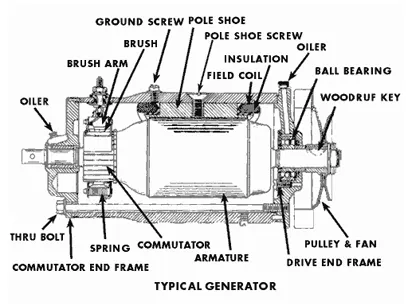
when the key is turned in the ignition lock, the mains is turned on. The voltage from the battery goes to the regulator, which in turn transfers it to the copper slip rings, the final consumer is the rotor excitation winding.
From the moment the engine crankshaft rotates, the rotor shaft begins to rotate through the belt drive, an electromagnetic field is created. The rotor generates an alternating current, when a certain speed is reached, the excitation winding is powered from the generator itself and not from the battery.
BATTERY:
In automotive engines require an electrical power to rotate its starter motor, the battery must be employed. it is a rechargeable battery that is used to supply electrical current to a vehicle’s electrical components. apart from starting the engine, it’s one of the major components of an automobile charging system, as it stores currently for further usage.
PURPOSE:
The first purpose of an auto battery is to provide power for starting your vehicle. It also acts as a surge protector for the car's computer and provides power for short-term use of things like lights, stereo, GPS or wipers,Infotainment systems when the engine is off.The car battery is part of the starting system.
WORKING:
The main function of an automotive battery is to store and distribute the electric current to various systems in the vehicle. A modern vehicle needs an automotive battery to operate many electrical components/gadgets such as electrical gauges, digital gadgets, power windows, central locking mechanism, and , etc.The main function of an automotive battery is to store and distribute the electric current to various systems in the vehicle. A modern vehicle needs an automotive battery to operate many electrical components/gadgets such as electrical gauges, digital gadgets, power windows, central locking mechanism, and air-conditioning, etc.
FUSE:
Car fuses are components designed to protect electrical wiring in cars and vehicles. They offer protection against overcurrent and short-circuiting, disconnecting the circuit if they detect a potentially dangerous level of current. They are also commonly known as automotive fuses.
QUESTION 3:
AIM:-
To find If the total load is 10A from battery, what should be the fuse rating.
ANSWER:-
Given that,
Total load (I)= 10A
Fuse rating=?
P=V*I
The recommended fuse rating for 10 A Total load is 13A.the fuse rating is equal to 1.25 times the full load current.
QUESETION 5:
AIM:-
To Identify any two elements which are connected parallel to each other. Why they are connected in parallel.
ANSWER:
1. ALL LIGHTS:
Headlights of a car are connected in parallel. In parallel connection, every headlight is presented to the maximum capacity difference provided by the car's electrical framework, giving maximum brightness.
- Another reason is that assuming one headlight wears out, the other one continues to sparkle.
- If in series, your other option, if one failed, they would both fail, the circuit would be opened by the burnt out filament.
2. SPARK PLUG:
These are connected parallelly because it requires more voltage, and it is accumulated and released once to the spark plug. These are connected in series due to rise in breakdown voltage.
QUESTION 6:
AIM:-
To Identify any two elements which are connected in series. Why they are connected in series
ANSWER:
1.AMMETER:
It is used to measure the current in the circuit. So it is connected in series so that the same current that is there in the circuit flows through it and gets measured.The ammeter must have a very low resistance because it is connected in series. We want all the circuit current to go through the ammeter to measure the current accurately.
2.FUSE:
Fuse are always connected in series with the components to be protected from over current so that when the fuse blows it will open the entire circuit and stop current through the components.