Project - Analysis of a practical automotive wiring circuit
1).
The major elements in the above automotive Wiring diagram are,
i) Battery Unit
ii) Starter unit
a) Starter Switch
b) Starter(Motor)
iii) Ignition System
a) Ignition Switch
b) Ignition Coil
c) Distributor
d) Breaker
e) Spark Plug
iv) Generator unit
a) Generator
b) Current and voltage regulator
v) Fuse
vi) Ammeter
vii) Fuel Gauge
viii) Plate Light & Tail Light unit
a) Stop light switch
ix) Horn unit
a) Horn Switch
b) Horn
x) Sealed light unit
a) Foot Selector Switch
xi) Parking Lamp
xii) Dome Light
a) Dome light switch
xiii) Gas Tank unit
2).
a). Starter: A starter is a mechanical device, which is used to rotate the IC engine, to initiate the Engine operation under its own Power. It can be an Electric motor, Pneumatic, or Hydraulic.
Working Principle:
- If the engine is not turning, Fuel can't enter the Engine.
- The engine can't move if the Fuel is not entering, so the Starter motor is required to rotate the Engine upto the Engine starts its own.
- When the Ignition is ON, the starter motor engages and turns the Engine to allow the Air inside. On the Engine, a flywheel with the Ring gear is attached to the edge.
- On the Starter, the Pinion is attached to engage, and detach with the groove of the Ring gear of the Engine.
- When the Ignition is turned ON, the electromagnet inside it engages and pushes out a Rod to which the Pinion is connected.
- The Pinion then touches the flywheel and the starter runs.
- This turns the engine over, which makes sucking the Air-Fuel mixture.
- As the Engine turns over, the Starter motor disengages and the Electromagnet stops.
- Then the Rod retracts once more, taking the Pinion out of contact with the Flywheel and preventing Physical damage.
b). Ignition system:-
It is a system in the IC Engine which is used to produce the spark to ignite the Fuel-Air mixture. It consists of Battery, Ignition Coil, Circuit Breaker, Distributor, Spark plug, and corresponding wiring.
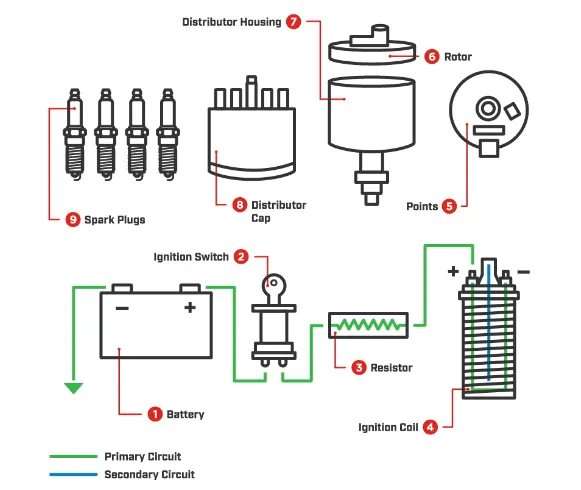
Working:
- After turning the ignition switch, the circuit between the 12V Battery and the Ignition system closes, then the circuit allows the Battery to flow the current.
- First the current flows to the Primary coil through the Ballast register.
- Now current passes through the Primary winding of the Ignition coil. The flowing current induces over the Primary winding.
- Then the magnetic field induces the current in the Soft iron, which is connected to the Distributor( which is used to distribute the current to the different spark plugs at each time).
- The current from the Primary winding is allowed to flow through the Circuit Breaker. The circuit breaker consists of a Capacitor, it takes more current from the Battery and generates high voltage around up to 20,000V. When the Capacitor charges, then the current through the Primary winding stops, resulting in the disappearance the magnetic field.
- Then the capacitor starts delivering the current towards the battery. This induces reverse flowing of the current. Also there is an already induced magnetic field in the primary winding. It overall results in a very high voltage of 20000V is generated in the secondary winding.
- This high-voltage current is then transferred to the distributor.
- When it starts rotating then at a certain stage it opens the contact breaker point which allows the high voltage current to transfer to the spark plug. So when the high voltage current reaches the spark plug then its generates a high-intensity of spark inside the engine cylinder, which allows the combustion fuel to burn.
c). Generator:
A machine that converts Mechanical energy to Electrical energy, is called a Generator. It is also called an Alternator and a Dynamo.
Working:
- When the engine rotates, the generator armature begins to rotate, When the generator armature begins to rotate, there is a weak residual magnetic field in the iron pole shoes.
- As the armature rotates, it begins to gain voltage. Some of this voltage is impressed on the field windings through the generator regulator.
- This impressed voltage builds up a stronger winding current and increases the strength of the magnetic field.
- This field produces a voltage in the armature.
- This current is used for the operation of the ignition system, the lighting system, and all other electrical parts when the engine is running and to replenish the battery after it has supplied current for starting and other purposes when the engine is at rest.
3).
If the Battery rating is 10A, the circuit should be rated at least 25% greater than the Battery rating.
If Battery Current 'i' = 10A
Fuse rating = Battery Current x 125%
therefore, Fuse rating = 12.5A
So, the Fuse rating should be greater than the 12.5A
4).
Given,
Power per hour = 500 W.h
Voltage = 12 V
We know,
Power per hour = Voltage x Capacity
=> 500 W.h = 12V x Current per hour
=> Current per hour = 500/12 A.h
=> Capacity = 41.66 A.h
Therefore, the Capacity of the battery required is 41.66 A.h
5).
The two elements connected in the Parallel are,
a) Horn Unit and
b) Sealed Beam
because in a Parallel circuit, every element possesses the same Voltage, and if any element has stopped working, the remaining units have no effect. So, the Horn unit and Sealed beam are connected Parallaly. Here, the Horn unit and the sealed beam are having the same voltage and if the Horn unit is not working, there is no effect on Sealed Beam.
6).
The two elements connected in the Series are,
a) the Ignition coil, and
b) the Distributor
because in the Series circuit, the total circuit is having the same Current, if the change in one element occurs, the following element undergoes changes and the Voltage changes from element to element. Here, the Ignition Coil, and Distributor are connected in Series because, both are interlinked to each other, so the same current should be passed in them to occur changes between them. So, they are connected in Series.