Project
Explanation,
All terrain vehicle,
An all-terrain vehicle is defined as a motorized off-highway vehicle desidned to travel on foyr low-pressure or non-pneumatic tires,having a seat designed to be straddled by the poerator and handlebars for sreering control.
CVT,
continuously variable transmission is an autimatic,signal-speed,and gearless transmission that can shift through an infinite number og bear ratios.
a CVT is a transmission that operates on an ingenious,pulley system that automatically varies the transmission ratio,allowing an infinite variability between higest and lowest gears with no discrete steps or shifts.CVT provide more useable power,better fuel economy and smooth drive experience than tridetional transmissions.
BAJA ATV model,
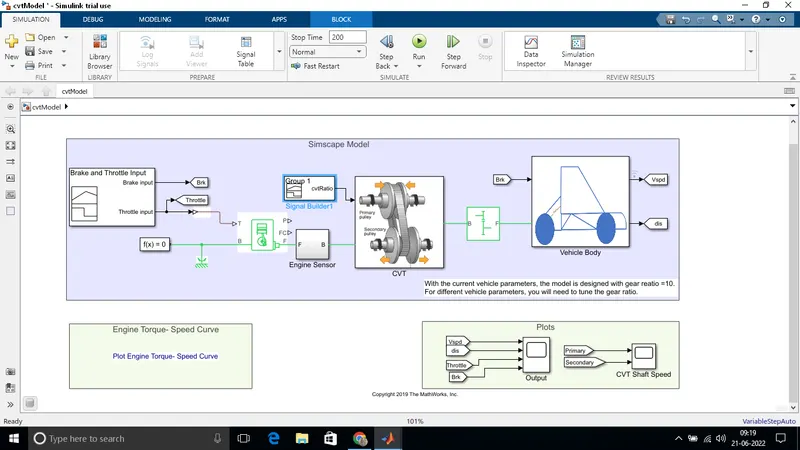
signal builder,
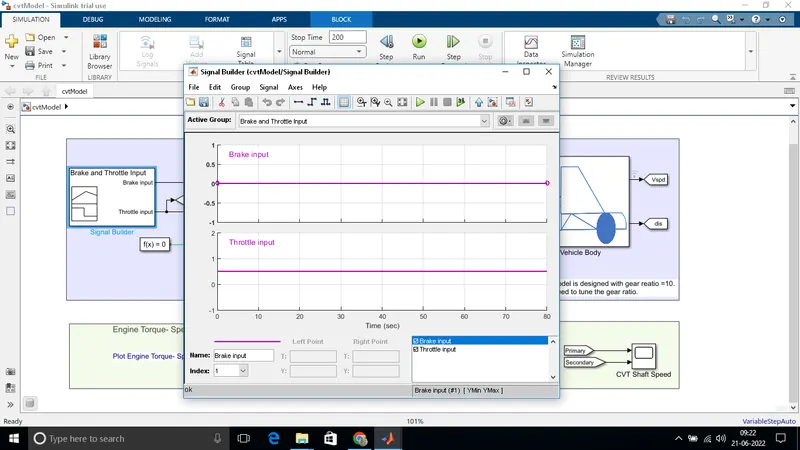
The signal builder block allows you to create interchangable group of piecewise linear signal source and use them in a model,and we can quickly switch the signal group into and out of a model to faclitate testing.
Generic engine,
Represents a system-level model of spark-ignition and diesel engine suitablefor use at initial stage of modeling when only the basic parameters are available.
connections F and B are mechanical rotational conserving ports associated with the engine crankshaft and engine block,respectively.connections P and FC are physical signal output port through which engine power and fuel consumption rate.
Engine sensor,
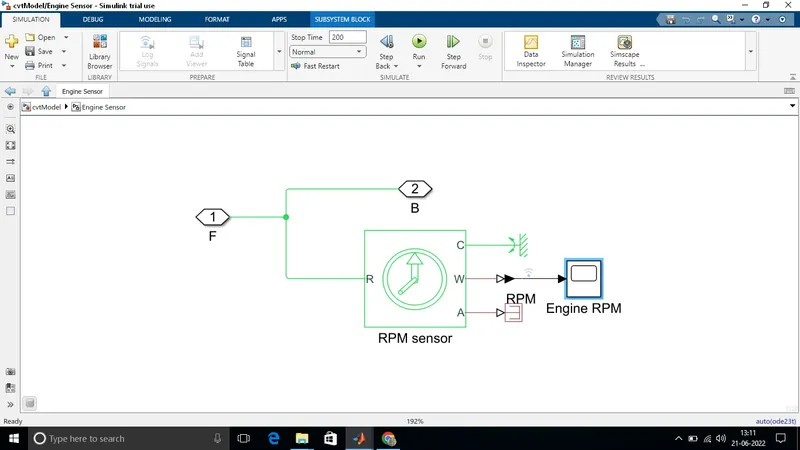
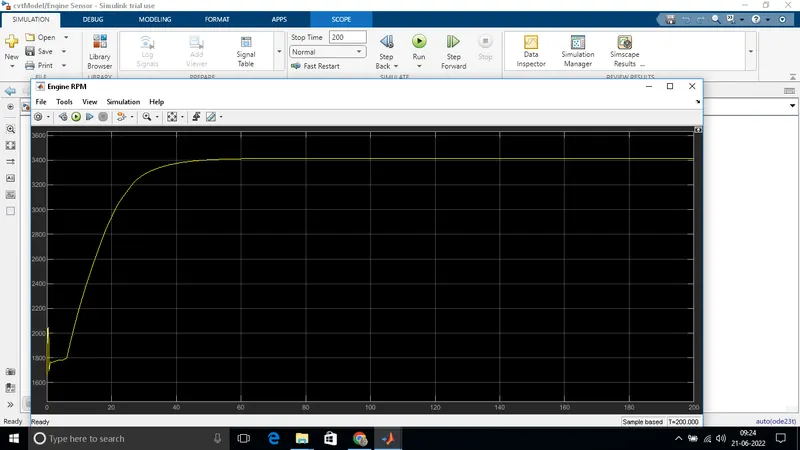
ldeal rotational motion sensor
The block represents an ideal mechanical rotational motion sensor,a device that convwrts an across variable measured between two mechanical rotational nodes into a control signal propotional to angular velocity.the sensor is ideal since it does not account for inertia ,friction,delays,energy consumptions and so on.
connection R&C are mechanical rotational cocerving ports and connections W & A physical signal output ports for velocity and angular displacements.
simple gear,
The Simple Gear block represents a gearbox that constrains the connected driveline axes of the base gear, B, and the follower gear, F, to corotate with a fixed ratio that you specify. You choose whether the follower axis rotates in the same or opposite direction as the base axis. If they rotate in the same direction, the angular velocity of the follower, ωF, and the angular velocity of the base, ωB, have the same sign. If they rotate in opposite directions, ωF and ωB have opposite signs. You can easily add and remove backlash, faults, and thermal effects.
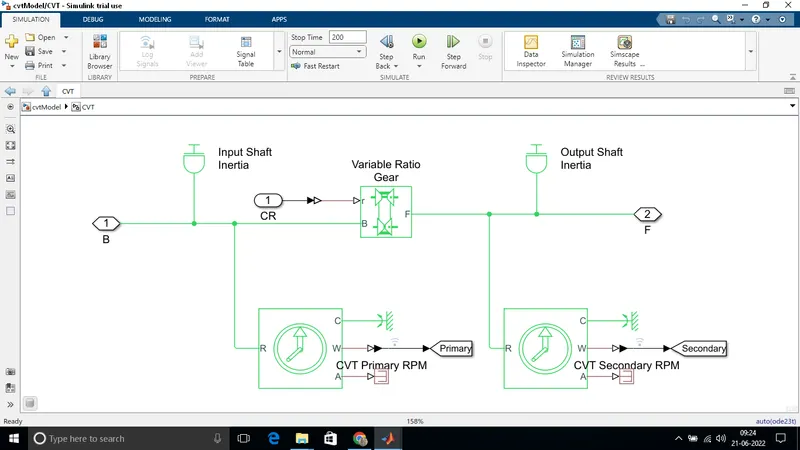
CVT subsystem,
Vehicle body subsystem,
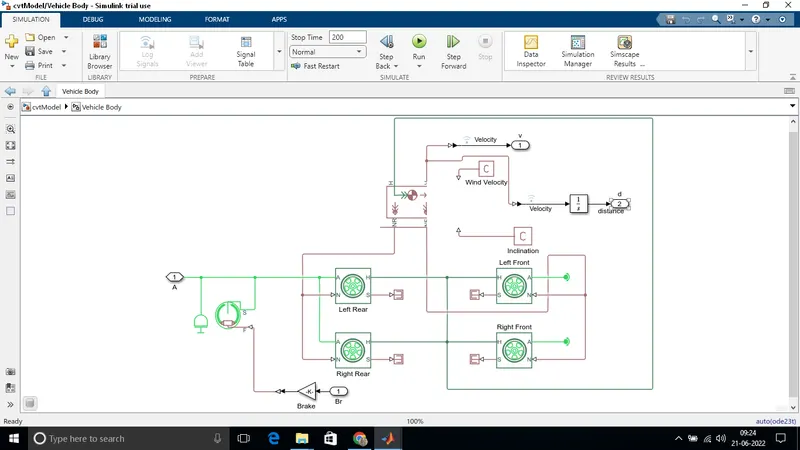
The Vehicle Body block represents a two-axle vehicle body in longitudinal motion. The vehicle can have the same or a different number of wheels on each axle. For example, two wheels on the front axle and one wheel on the rear axle. The vehicle wheels are assumed identical in size. The vehicle can also have a center of gravity (CG) that is at or below the plane of travel.
The block accounts for body mass, aerodynamic drag, road incline, and weight distribution between axles due to acceleration and road profile. Optionally include pitch and suspension dynamics. The vehicle does not move vertically relative to the ground.
The block has an option to include an externally-defined mass and an externally-defined inertia. The mass, inertia, and center of gravity of the vehicle body can vary over the course of simulation in response to system changes.
Tire,
The Tire (Simple) block represents a simple, no-slip model of a tire that you parameterize by tire radius.
You can optionally add inertia, stiffness, or damping. These dynamics require additional computation that tends to make models less suitable for real-time simulation.
Double shoe brake,
The Double-Shoe Brake block represents a frictional brake with two pivoted rigid shoes that press against a rotating drum to produce a braking action. The rigid shoes sit inside or outside the rotating drum in a diametrically opposed configuration.
Double-shoe brakes provide high braking torque with small actuator deflections in applications that include motor vehicles and some heavy machinery. The model employs a simple parameterization with readily accessible brake geometry and friction parameters.
Torque-speed curve,
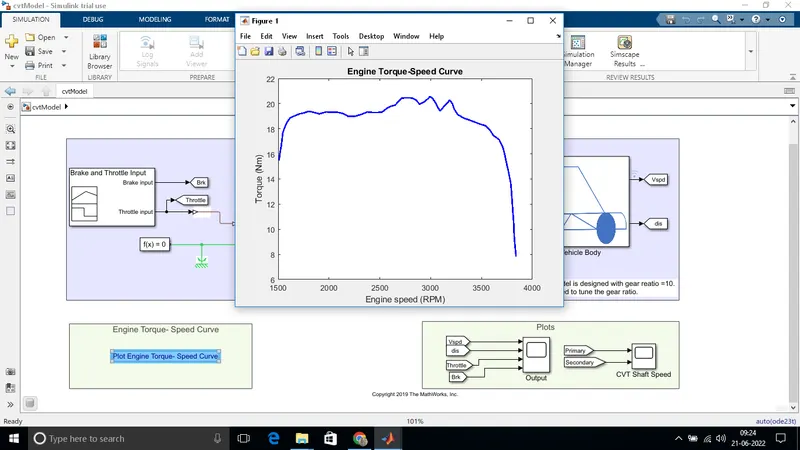
Brake & throttle inputs,
brake input is 0,and throttle input value is 0.5.
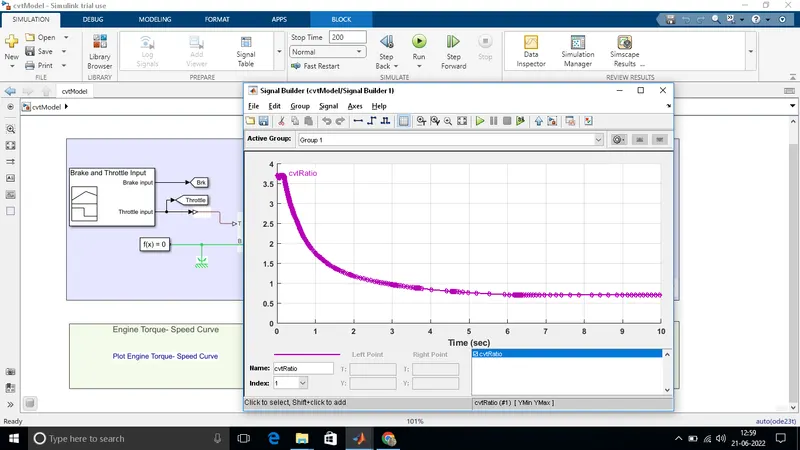
CV ratio,
outputs,
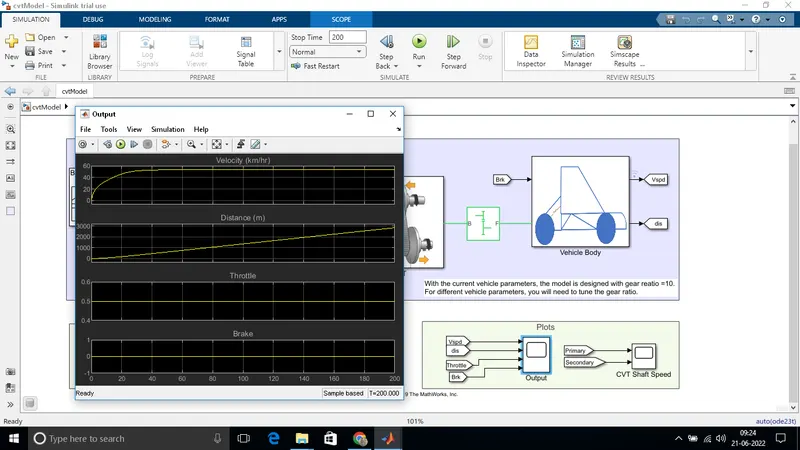
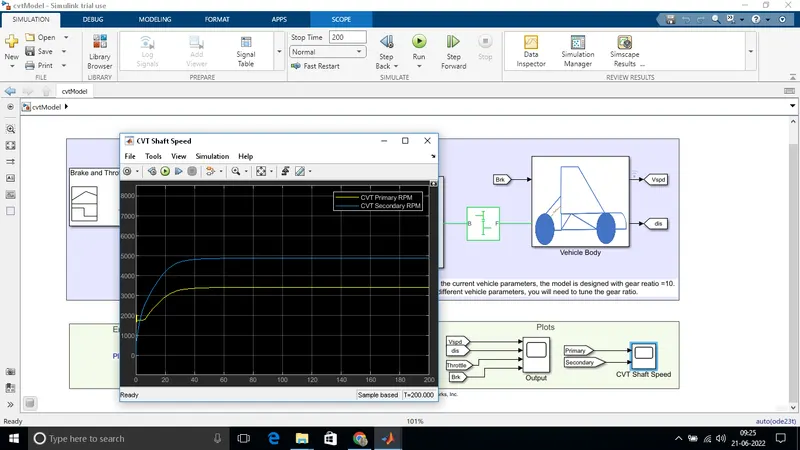
CVT shaft speed,
with dashboard,
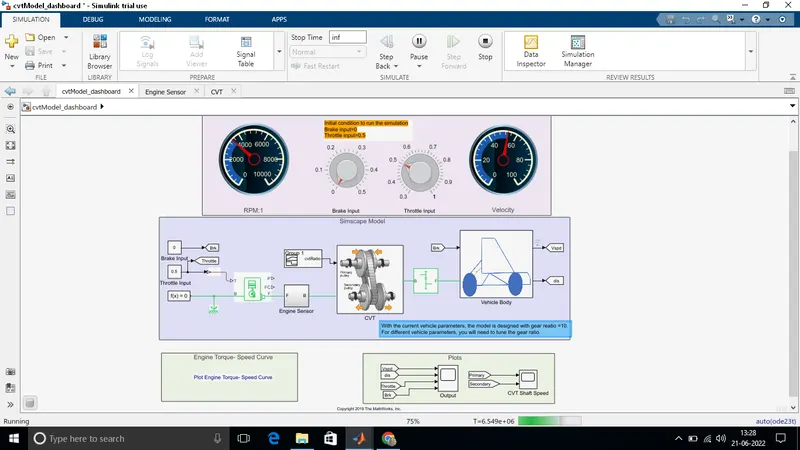
if we give different value to brake input and throttle input it shows differnt different speed ranges of vehical running, if give brake input it affect the vehical speed.
Conclusion,
The given BAJA ATV model was simulated sucessfully,velocity,CVT speed,engine speed are directly proportional to the throttle input, and inveresely proportional to brake input.
CVT primary speed is greater then the CVT secondary speed as they directly proportional to the shaft dia.
if increase the brake input value it decerease the vehical speed,if increase the throttle leads to increase vehical velocity.