Project
Objective: To Carry out a system-level simulation of an all-terrain vehicle with a technical report.
Solution-
All-Terrain Vehicle (ATV): This is a quadricycle type vehicle with low-pressure tires having handlebars to control the steering.
Modeling: 1. BAJA ATV with CVT:
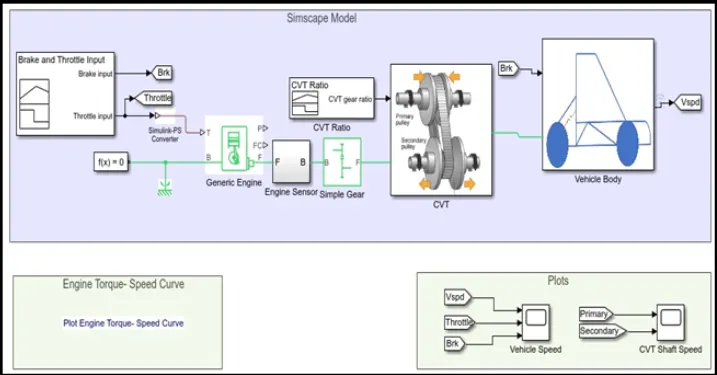
The above diagram shows the simscape model of BAJA ATV comprising the components which includes the engine, CVT (continuously variable transmission drive), vehicle, gear and sensors. The components are discussed as follows:
a) CVT Block:
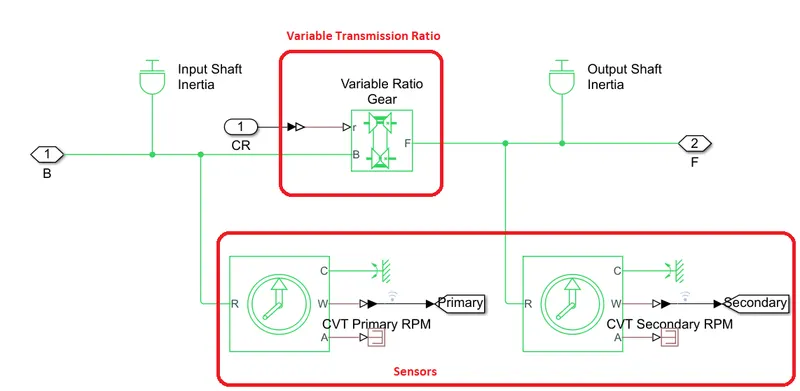
The continuous variable transmission drive block is an automatic gearbox that can seamlessly change through different gear ratios. It is also known as pulley transmission or step-less transmission. It helps the engine to run at its most efficient RPM independent of the car speed. It has a cone shaped pulley connected by a steel or composite belt. One side of the pulley is fixed and the other side moves and operated by a hydraulic cylinder. The space between the pulleys can be increased or decreased by the cylinder and thus, the belt moves higher or lower walls of the pulley. This way the gear ratio is varied.
b) Generic Engine Block:
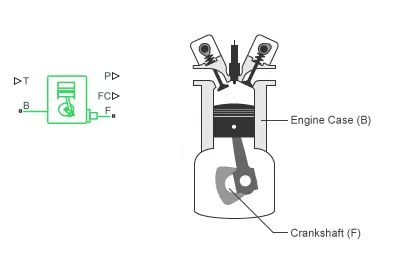
It is a general internal combustion engine. The throttle physical signal input specifies the normalized engine torque. A physical signal port outputs engine fuel consumption rate based on the choice of fuel consumption model.
c) Variable Transmission Ratio Block:
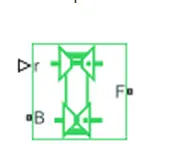
Base (B) and follower (F) are the two connected driveshaft axes through which the motion and torque are transferred dynamically. It is a gearbox but with a time delay and hence it does not act as a kinematics constraint like a gear.
d) Input signal:
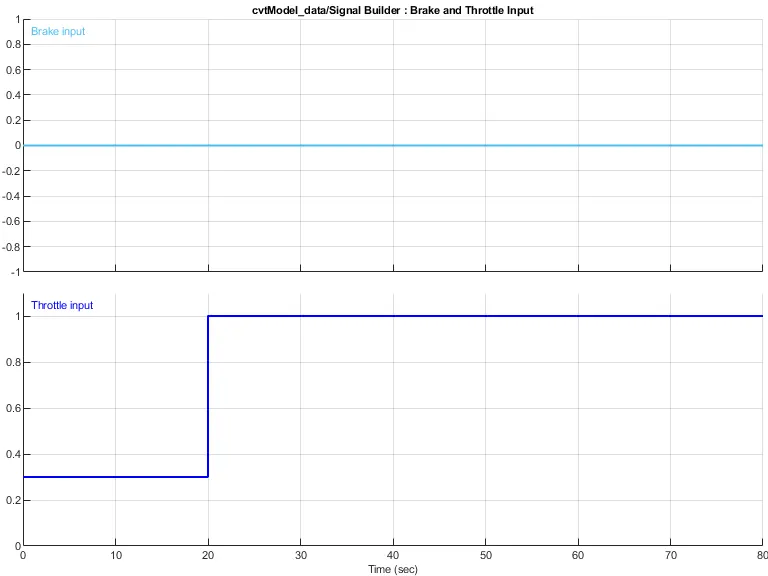
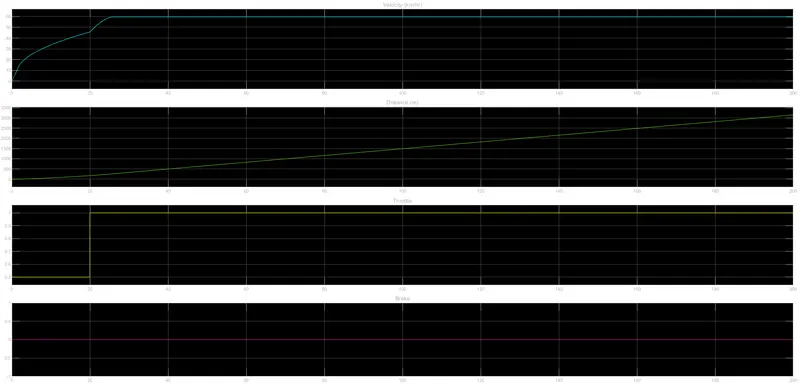
To give input to the brake and throttle, a signal building block is used where the throttle input is changing from 0.35 to 1 at 20 seconds while the brake input is zero. The input in the signal builder is shown as below
e) CVT Gear Ratio Input:
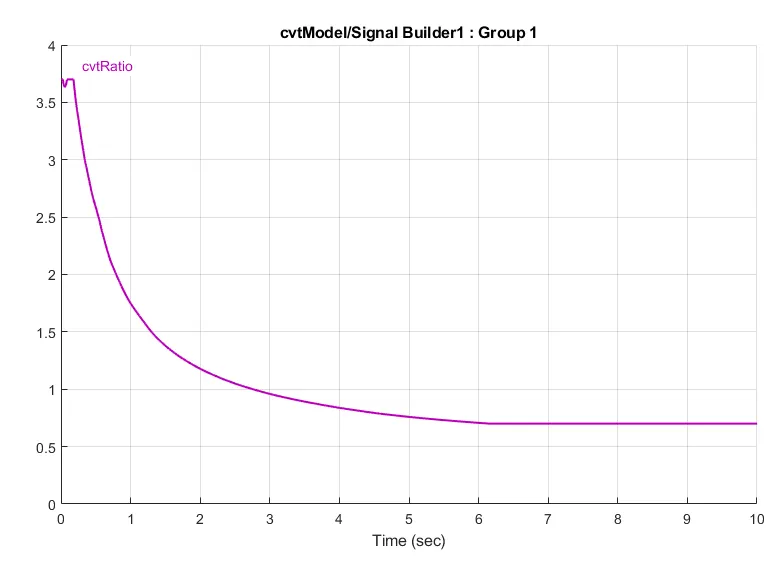
The CVT signal input is 3.7 initially, fluctuates, and then decreases gradually till 6 seconds and finally settles on 0.7 at 6 seconds.
f) Sensors:
The sensors are used to detect the speed in rpm of the primary and secondary side shafts.
Vehicle Body:
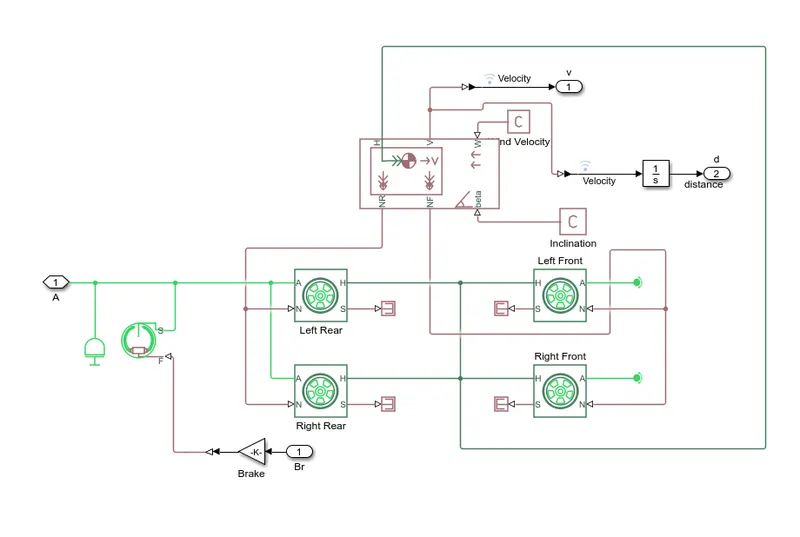
This consists of four wheels of the vehicle, tires, and double drum brakes. The distance and velocity are the output of the vehicle body subsystem. Two axles are connected to the four wheels and the mass of the vehicle is 250kg. The initial speed of the engine is 2100 rpm.
Results:
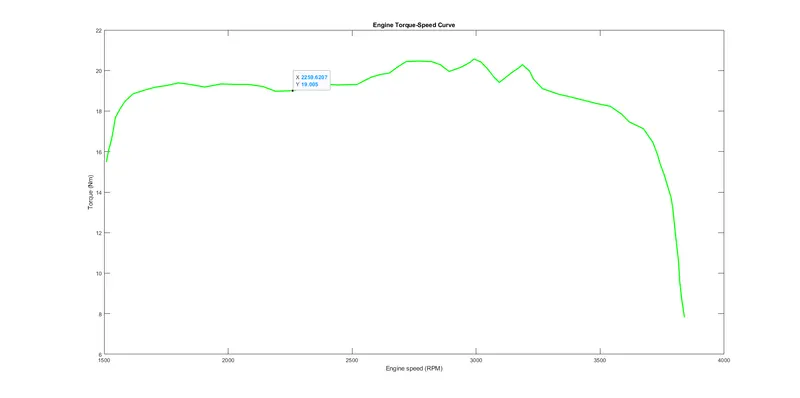
The engine torque-speed curve is plotted as shown below. We can see that as the gear ratio and velocity increase, the torque varies and then decreases.
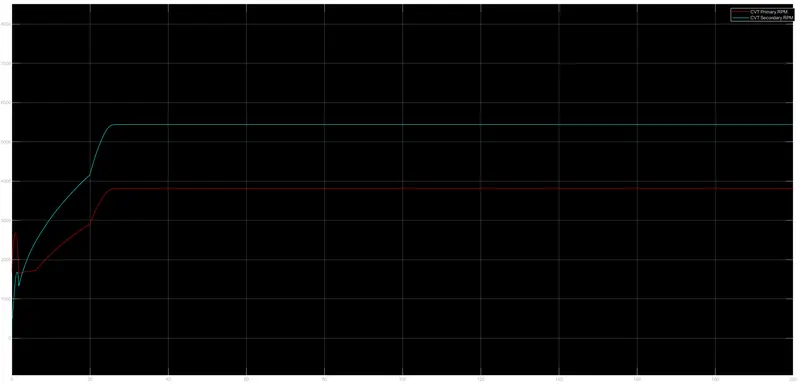
The sensors detect the speed in rpm and is shown through the figure below.
The velocity, distance variation with the change in the value of throttle and no brakes applied is shown through the figure below.
2. BAJA ATV with Dashboard:
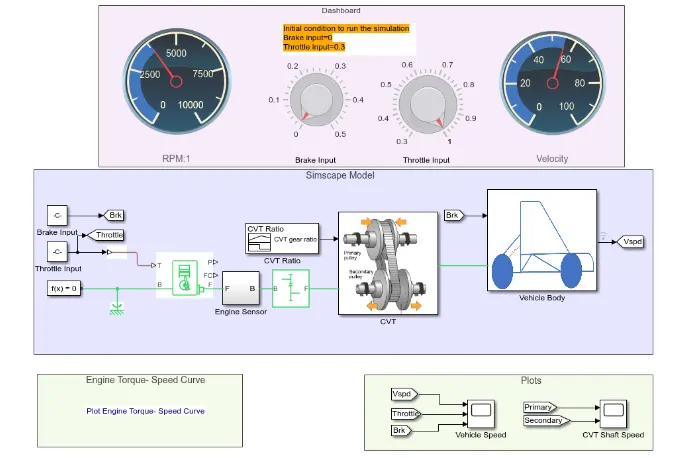
If the signal builder block is removed and the input in the form of throttle and brake is to be given, then a dashboard signal block can be used. The remaining model is exactly similar to the previous case.