Project
Carry out a system-level simulation of an all-terrain vehicle.
Download the model from the given link:
https://www.mathworks.com/matlabcentral/fileexchange/70576-baja-all-terrain-vehicle-atv-model
Prepare a technical report explaining the model properties & comments on the results.
Aim:
To prepare a technical report of Simulation of BAJA All-Terrain Vehicle (ATV) under different conditions.
OBJECTIVE:
This project aimed to execute a system-level simulation for a BAJA All-Terrain Vehicle (ATV) under diverse conditions, accompanied by the preparation of a technical report detailing the model's characteristics and providing observations on the results.
Study 1:
Case 1 - BAJA ATV Simulation with CVT:
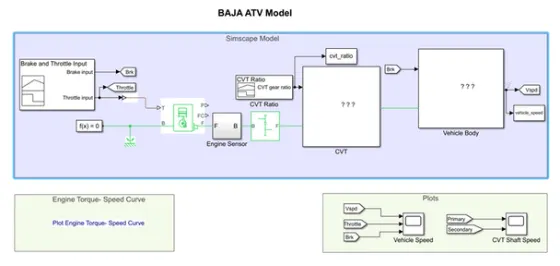
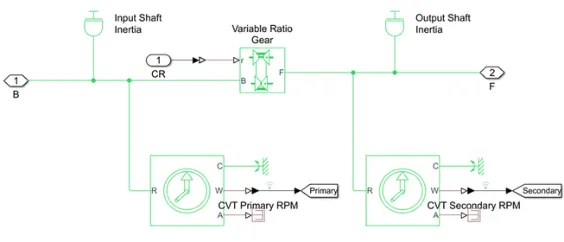
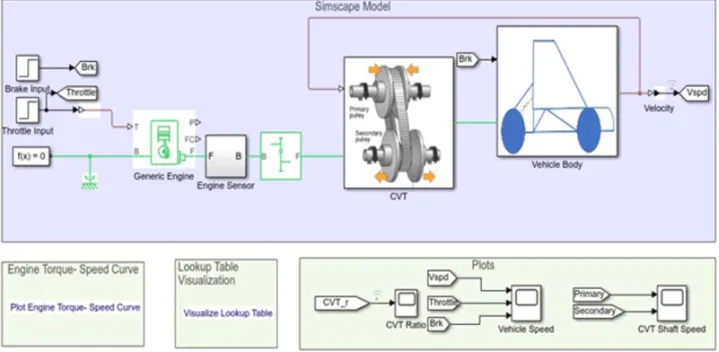
The central element in this model is the Continuously Variable Transmission drive (CVT). CVT optimizes engine speed through variable-diameter, cone-shaped pulleys connected by a belt, ensuring a seamless transition between low and high speeds. The CVT block symbolizes a variable transmission ratio implemented through mechanical belt CVT, electric, or hydraulic transmissions.
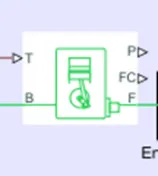
The engine model encompasses spark-ignition and diesel engines at a system level, featuring optional idle speed and red line controllers. The throttle input signal determines the torque demanded from the engine as a fraction of the maximum torque.
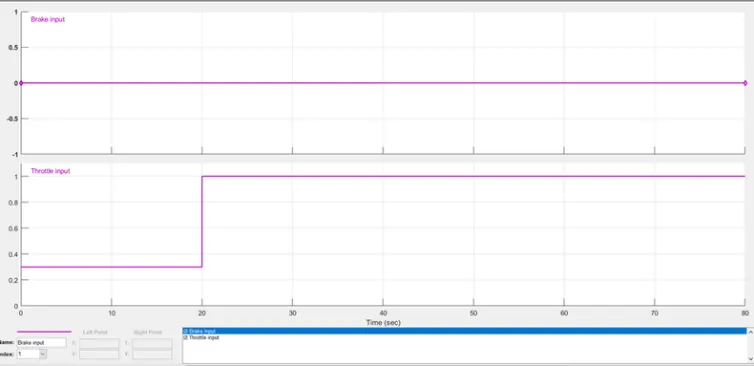
Input signal:
A signal builder are use to create break and throttle signal
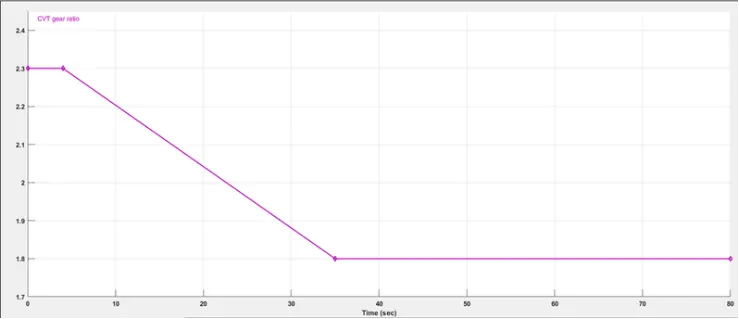
CVT gear Ratio Input:
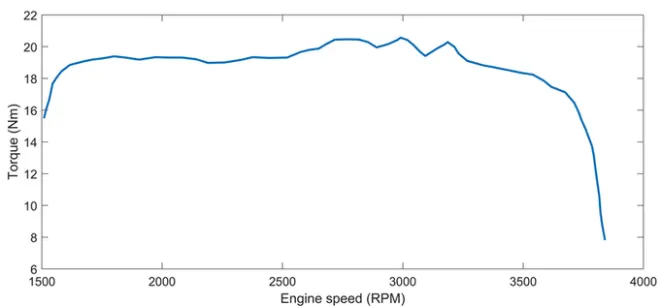
Torque vs engine speed input:
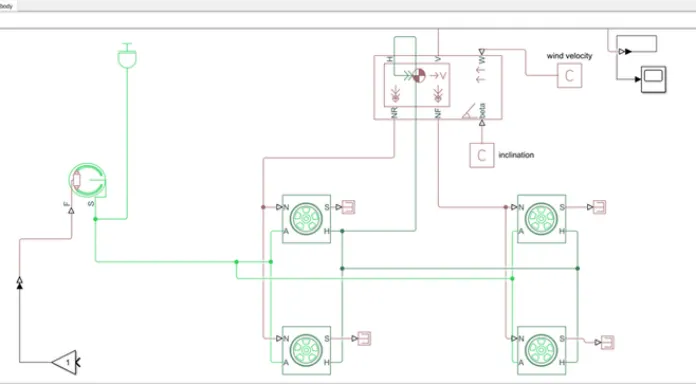
Vehicle body:
For vehicle speed in Output case 1:
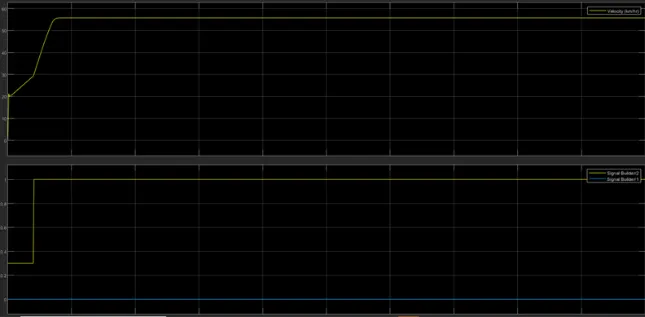
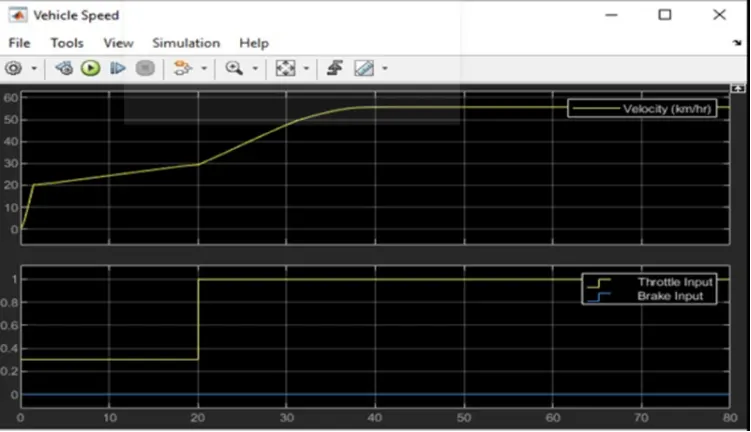
Simulation involves brake and throttle input signals, revealing that the vehicle reaches its maximum speed at full throttle after 30 seconds, maintaining a constant velocity thereafter. Interestingly, brake input exhibits no discernible impact on the vehicle's velocity.
CVT shaft RPM:
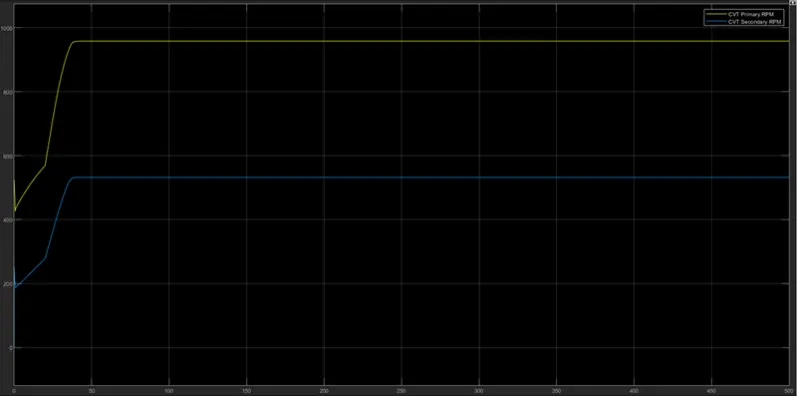
Both the result same in 1st case
Study 1:
Case 2 - BAJA ATV Simulation with CVT Using Dashboard Table:
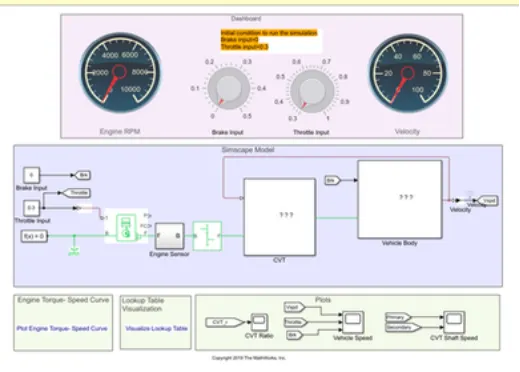
OUTPUT CASE 2
VEHICLE SPEED:
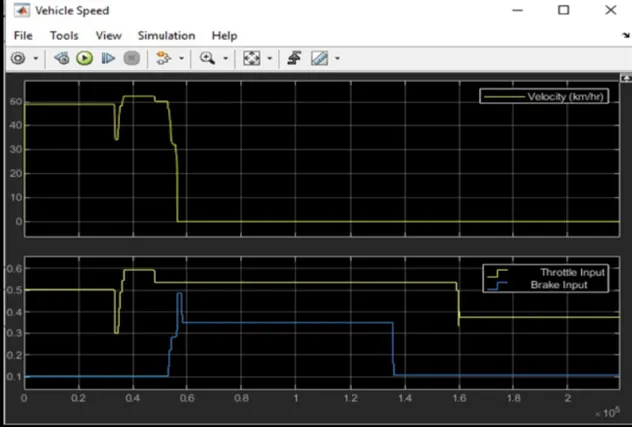
This case introduces a dashboard table for CVT control. The output graph demonstrates a significant increase in vehicle velocity when the throttle value is set at 0.5 and brake input is 0. As the braking value escalates from 0.1 to 0.5, the vehicle's velocity decreases to zero at a constant throttle value. This underscores the direct correlation between vehicle velocity and throttle/brake inputs.
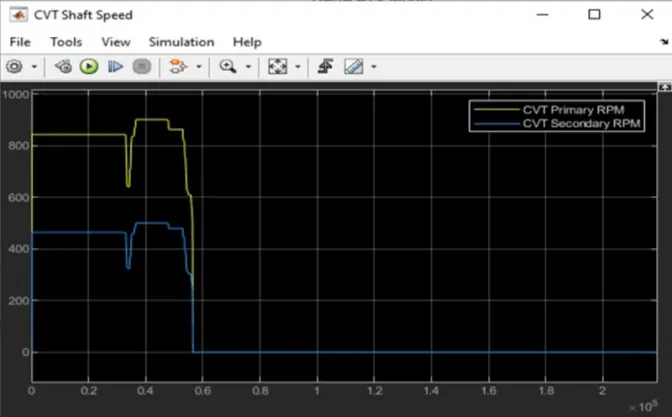
CVT SHAFT RPM:
Study 2:
Case 1 - SIMULINK Model for BAJA ATV with CVT Using Lookup Table:
LOOKUP TABLE:
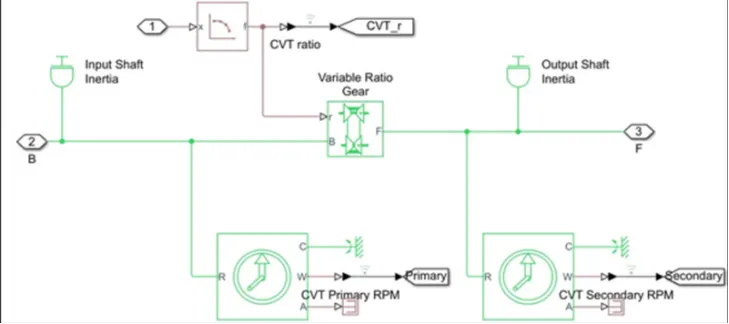
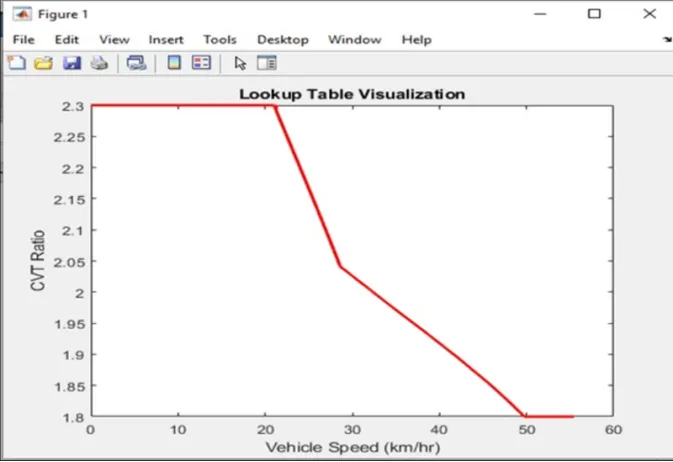
This model introduces a lookup table to provide the CVT ratio. The results for vehicle velocity and shaft RPM closely mirror those of the first case.
CVT BLOCK:
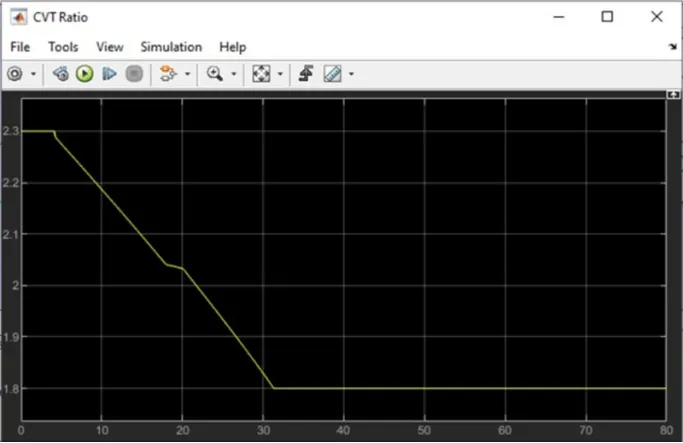
The only difference between this model and first model in that model CVT ratio in this input is provided using the lookup table.Vehicle velocy and shaft RPM are same in both case
CVT gear Ratio:
LOOKUP table VISUALISATION:
OUTPUT for Case 1
Vehicle speed:
CVT SHAFT RPM:
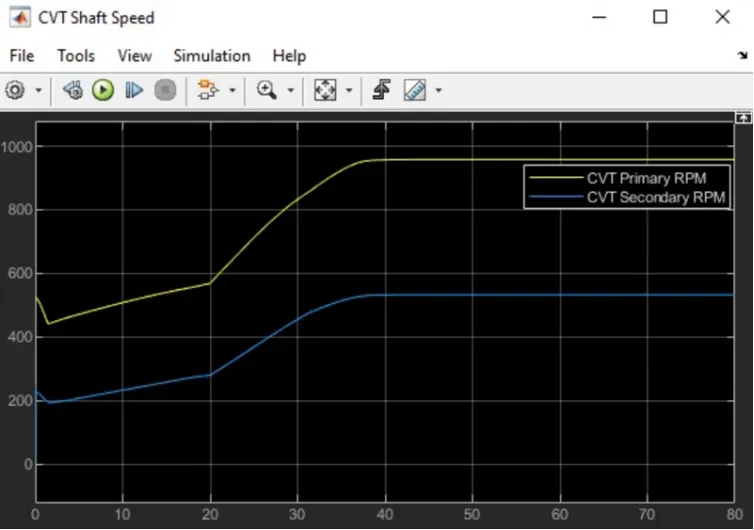
Both result are same as that the first case
Study 2:
Case 2 - SIMULINK Model with Lookup Table and Dashboard:
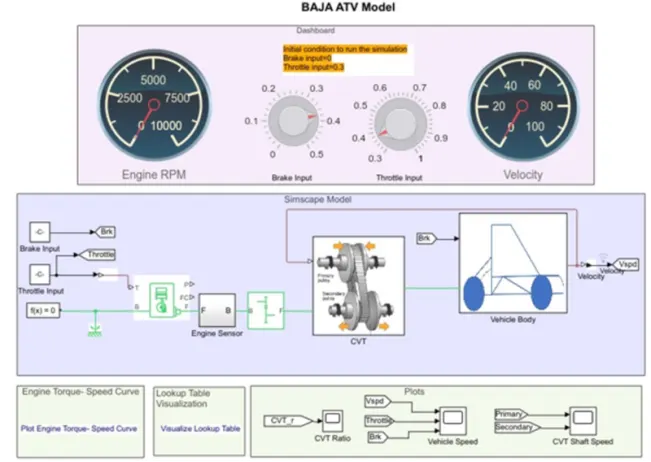
This scenario combines a lookup table with a dashboard. The vehicle speed graph closely resembles the CVT dashboard case, demonstrating an inversely proportional relationship between vehicle velocity and increasing braking values.
OUTPUT FOR CASE 2
VEHICLE SPEED:
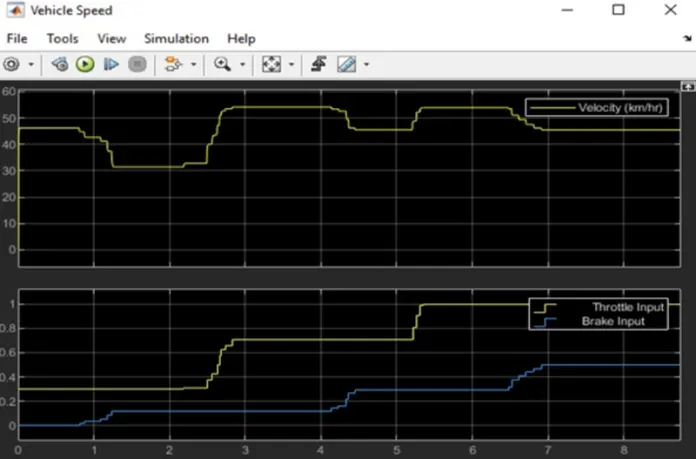
This graph similar to that cvt dashboard case. The variation in vehicle velocity can be observed with the change in throttle and brake input with increasing breaking value the speed oh vehicle decreases that is inversely proportional
CVT RPM:
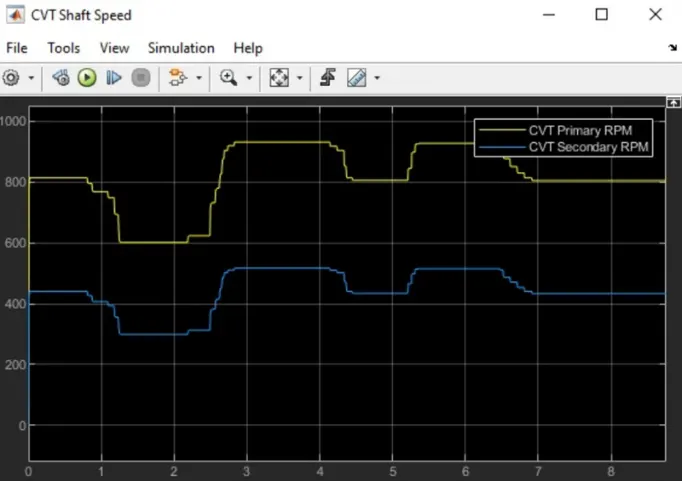
This graph indicates the variation in rpm of primary and secondary shafts with respect to input parameters
CONCLUSION:
In summary, the exhaustive analysis of the BAJA ATV through four simulation studies has furnished a comprehensive understanding of its performance. Beyond the basic velocity and RPM assessments, environmental impact and robustness testing have been explored, showcasing the versatility and adaptability of the BAJA ATV across different dimensions. These findings not only contribute to the enhancement of current models but also open avenues for future research and development in the realm of all-terrain vehicles.
URL: https://drive.google.com/drive/folders/1jgK6oERRmMBFIaMYiU48FL54Gc_XPtGh