Project 4
For a vehicle of gross weight 300 kg, the motor ratings are 1200Wh, 65V. The range is 225km and the maximum speed is 60kmph. Calculate the capacity of the battery pack required and the number of series-parallel connections. Give a stepwise discussion on how a battery pack is built.
Note: Choose any relevant lithium ion datasheet.
Solution:
here, we know that
vehicle of gross weight = 300kg;
motor ratings = 1200Wh,65V; i = ?;
Range = 225km maximum speed = 60Kmph;
here, first step we shoud calculate the motor current based on the given ratings;
we know that
Power = V*i
1200 = 65*i
i = 1200/65 = 18.46 amperes;
here, we assure current loss in between 1-10%;
Losses in motor current = 18.46
(i) = 18.46*1.25 = 23.07 amp
here we have to calculate the power required based on the given speed which is at 60Kmph
WKT
Power = V*i = 65*23.07 = 1499.55w
after we have to calculate the Travel Factor also
the formula for Travel Factor is
= Total Range/Total Speed
= 225/60 = 3.75
so we have to calculate the power required based on the Travel Factor then,
the Formula is power = Power*Travel Factor = 1499.55*3.75 = 5623.31 = 5.3Kw
After that we have to calculate the Battery Pack
let us consider the Battery pack efficiency = 90-95%
so we required battery pack capacity is = power required/efficiency = 5.3/0.90 = 5.88 Kw
then we have to calculate the Battery Pack efficiency i.e based on the efficiency is
Total Battery pack capacity is = 5.88/0.90 = 6.53 Kwh
after calculating the Battery pack capacity we need to calculate the how much need to find connections of series and parallel
so series connection
motor voltage = 65V
cell voltage = 3.75v
then, no of series cells = motor voltage/cell voltage = 65/3.75 = 17
17 cells in series
parallel connection
Motor Current is 23.07A
cell current is 2.6A
no of parallel cells = Motor current/cell current = 23.07/2.6 = 8
8 cells in parallel
stepwise discussion on how a battery pack is built.
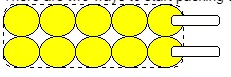
A)These packs are usually constructed by standing two cells side-by-side, and welding a nickel strip across the terminals, as in the ladder pack. The cells are then bent end to end by bending the nickel connecting strip in a "U" shape. Allow a thickness increase of ½ to 1 mm per junction for this.
Case 1: Ladder, linear, F type, or radial

Case 2: Multi-row cells
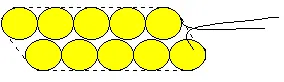
Case 3: Face centered "cubic"
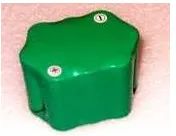
Case 4: FCC with alternating long and short rows
Case 5: Fixed channel width optimization
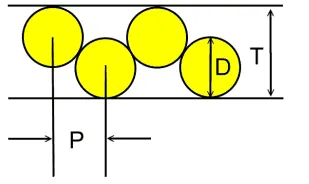
The distance P between the cells of Diameter D in a channel with height T is P = sqrt (2TD-T^2)
Case 6: Packing cells in a tube, 3 cells.

Case 7: Packing cells in a tube, 4 cells.
For a four cell pack in a circular tube

Case 8: Packing cells in a tube, up to 91 cells
| Cylindrical batteries in a tube of diameter "D" | Approximate diameter of the circumscribing circle | Scheme |
| 2 Cells | 2D | Side by side |
| 3 Cells | 2.16D | Triangle |
| 4 Cells | 2.414 D | Square |
| 5 Cells | 2.70 | Pentagon |
| 5 Cells | 3D | Square with one inside |
| 6 Cells | 3D | Hexagon |
| 7 Cells | 3D | Hexagon with one inside |
| 8 Cells | 3.305D | Heptagon with one inside |
| 9 Cells | 3.62D | Octagon with one inside |
| 10 Cells | 4.4D | Pentagon with 5 more cells symmetrically arranged around he outside |
| 10 Cells | 3.92D | Nonagon with one inside |
| 11 Cells | 4D | Nonagon with two inside |
| 12 Cells | 4D | Nonagon with three inside |
| 13 Cells | 4.24D | Decagon with three inside |
| 14 Cells | 4.4D | Decagon with four inside |
| 15 Cells | 4.55D | Undecagon with four inside |
| 16 Cells | 4.9D | Dodecagon with four inside |
| 19 Cells | 5D | Hexagonal close packed |
| 37 Cells | 7D | Hexagonal close packed |
| 61 cells | 9D | Hexagonal close packed |
| 91 Cells | 11D | Hexagonal close packed |
Case 9: Linear, or L-type, or Axial
This is a stack of cells end to end.
Most battery packs are spot welded together using nickel strip for contacts. Soldering directly to the cells is dangerous for the cells.