Project
AIM:To carry out a system level simulation of an all-terrain vehicle(ATV).
To study and analyse the BAJA ATV model using simulink.
Objective:To prepare a technical report of BAJA ATV model with and without dashboard & with lookuptable.
Introduction:
ATV also known as a light utility vehicle(LUV) ,a quad bike or simply quad.As defined by the American national standards institute(ANSI) is a vehicle that travels on low pressure tires with a seat that is straddled by the operator ,along with handlebars for steering control. As the name implies ,it is designed to handle a wider variety of terrain than most other vehicles .Although it is a street-legal vehicle in some countries ,it is not street legal within some state & countries.
BAJA ATV MODEL WITHOUT DASHBOARD:Simulation File attached.
Major components used in the simulation:
Generic Engine:Represents a system level model of spark ignition and diesel engines suitable for use at initial stages of modeling when onlythe basic parameters are available.Optional idle speed and red line controllers are included.
The throttle input signal T lies between zero and one and specifies the torque demanded from the engine as a fraction of the maximum possible torque .If the engine speed falls below the stall speed ,the engine torque is blended to zero .If the engine speed exceeds the maximum speed ,the simulation stops and issues an error message. Connection F & B are mechanical rotational conserving ports associated with the engine crankshaft and engine block respectively.Connection P & FC physical signal output ports through which engine power and fuel consumption rate are reported.
CVT Transmission:
In continous variable transmission(CVT) the variable diameter pulley plays a vital role in transmission .It always comes in pairs.One is known as drive pulley which is connected to the crank shaft of the engine.It is also calledinput pulley.The second pulley known as driven pulley .The driven pulley transmit the energy to the drive shaft.
Vehicle Body:
Two axel vehicle with longitudinal dynamics and motion with adjustable mass, geometry and drag properties. The vehivle can have the same or adifferent number of wheels on each axle .
BLOCK USED:
1)SIGNAL BUILDER :Used to input the break ,throttle and CVT ratio.
2)Simulink to PS converter
3)Solver configuration
4)Mechanical referance
5)Generic Engine
6)Display
7)Scope
8) Inertia
9)Variable gear ratio
10)PS Termination
11)Double shoe brake
12)Constant
13)Tire
14)Lookup table :To insert the CVT values from the workspace
15)Step:To increase or decrease an input value for a difined time interval.
Flow Process:
1.The throttle signal is generated by the signal builder block and inputed to the generic engine.
2)The troque and speed vector are inputed from the MATLAB workspace
3)The engine will generate the ouput rpm which we can taken from the carnk shaft ouput .
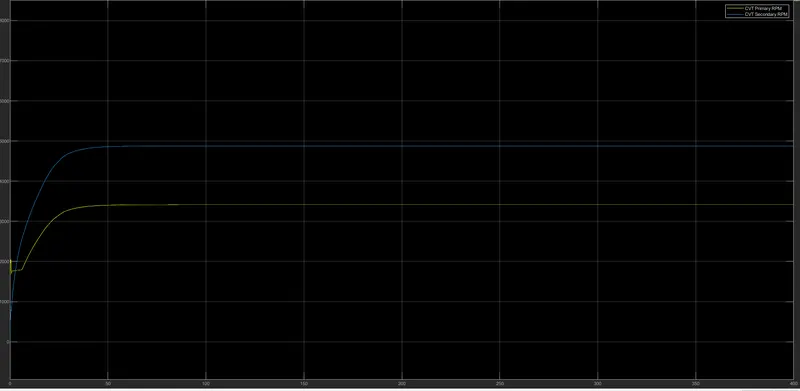
4)Further this will be given into ideal rotational motion sensor to sense the output rpm .
5)The same ouput is given to a simple gear mechanisim to reduce the speed where the gear ratio taken is 4.
6)The ouput speed from gear reducer will be given to the variable ratio transmission block.
7)Using the signal builder the CVT ratios and the controlled output speed is inputed to the axel.
8)The speed is controlled by the variable CVT ratios and the controlled output speed is inputed to the axel .
9)The barke signal is generated by the signal builder and inputed to the vehicle body for applying the barke.
10)The power from the CVT is inputed to the axle and hence vehicle get accelarated according to the speed .
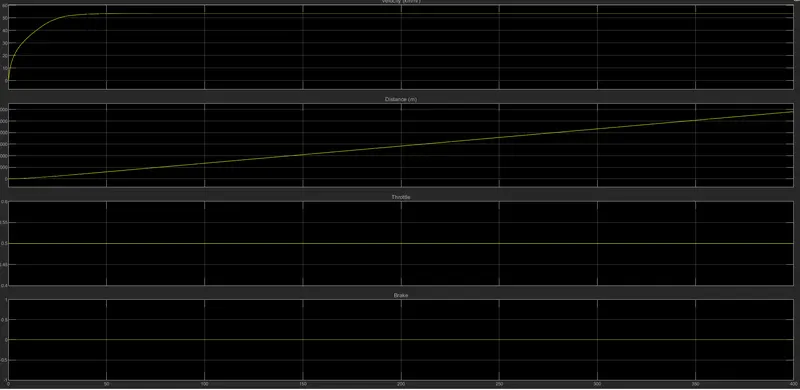
11)The velocity is taken as the output for further analysis
OUTPUT:Attached
BAJA MODEL WITH DASHBOARD: Simulation model attached
Flow Process:
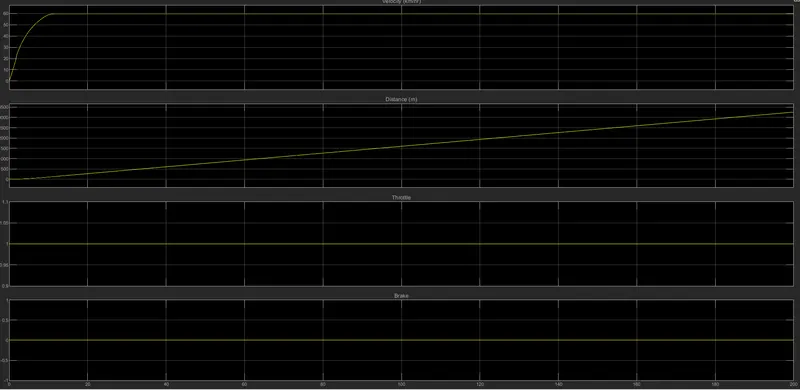
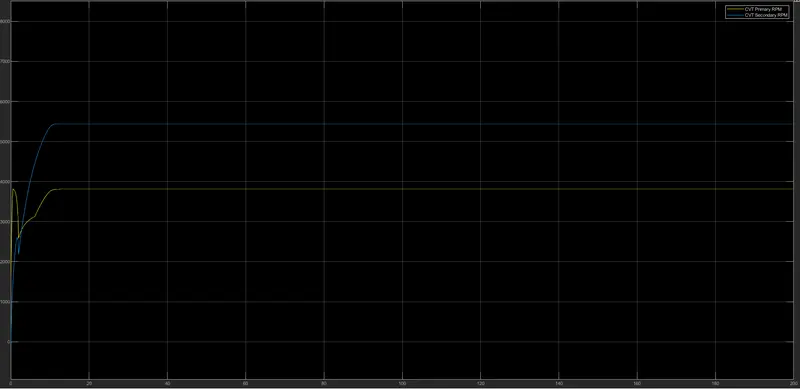
The model work flow process is same as the process of BAJA ATV model without dashboard but the throttle and barke inputs are controlled by the user with the knob provided .We can change the inputs barke and throttle by changing the knob values provided.
Output:Attached
BAJA ATV MODEL-DATA EXTRACTION LOOK UP TABLE:
Flow process: The model workflow process is same as the process of BAJA ATV MODEL WITHOUT DASHBOARD ,the change here is that the CVT ratio and vehicle speed data are extracting from the base workspace .
The output is same as the BAJA ATV model without dashboard.
BAJA ATV MODEL-MAPPED LOOKUP TABLE WITHOUT DASHBOARD:
FLOW PROCESS:Instead of signal builder blocks for brake and throttle inputs ,the step blocks are used At 35sec the brake input will take a step value of 0 and at 20 sec throttle input will increase from o.3 to 1 then reamains constant through out.
Instead of signal builder block for CVT ratio the 2D Look up table is used.
BAJA ATV MODEL-MAPPED LOOKUP TABLE WITH DASHBOARD:
BAJA ATV model mapped lookup table with dashboard is also similar as the process of mapped lookup table without dashboard .
Here the throttle and break inputs are controlled by the knobs provided in the dashboard .