Project 3
Design and simulation of Buck converter for Auxiliary load in EV.
- Input voltage is 48V, Output voltage is 12 V
- Load current is 10A
- Calculate Duty ratio and Load(use Resistor as Load)
- Calculate L,C
Ans:-
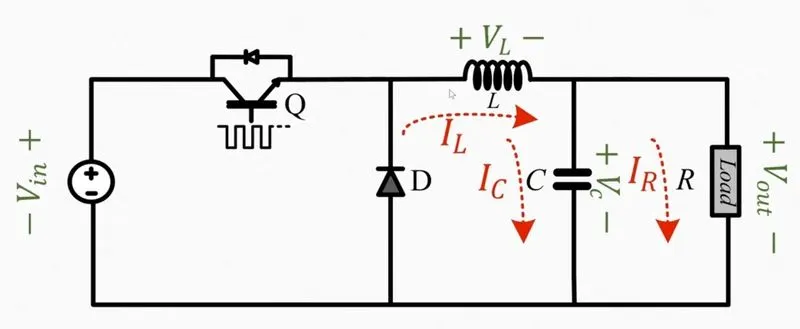
A Buck DC/DC converter is a device convert an unregulated input voltage into an regulated output voltage lower than the input voltage (step-down, Vout < Vin).
The buck converter is composed of a switch driven by a wave square, a diode, and an LC filter. The value of the frequency of the PWM, with the value of L and C, determine the output voltage in the circuit.
It is Contained following components
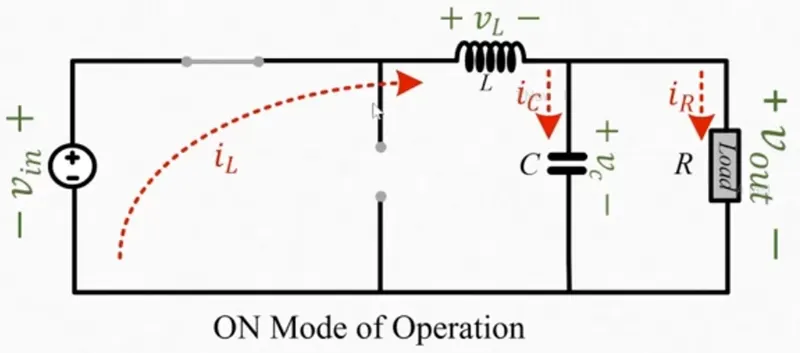
- Switching power supply unit which, can turn ON/OFF switching elements that can be turned ON/OFF at high frequency to convert a dc input voltage Vin into a dc output voltage Vout.
- Control unit, which is used to control the ON/OFF operation of the switching element. We use MOSFET as switching element where the pulse generator is a control unit for MOSFET.
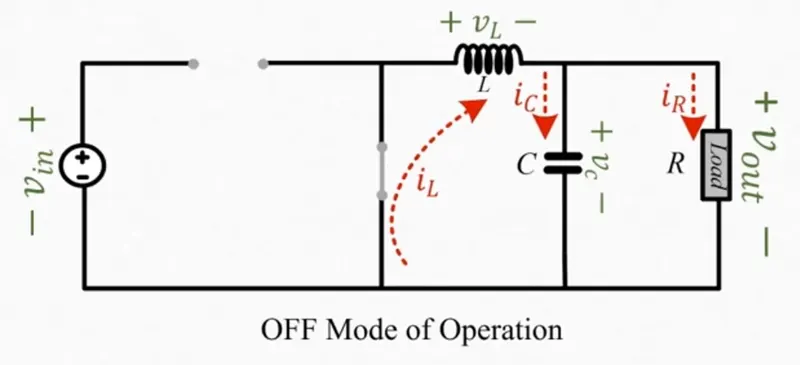
- Inductor - It stores the energy during ON period & dissipates during OFF period.
- Capacitor- It bypass the ripple content in the output voltage
- Freewheeling diode- It freewheel the current through the resistor from the inductor & circuilate it in circuit during OFF period.
- Load Resistor- Across it we can measure the output voltage & current through it.
Now design Buck converter
Given data,
Input Voltage Vin = 48 V
Output Voltage Vout = 12 V
Load current iL = 10 A
Mathematical Formulae-
Output Voltage = Load resistor * Load current
Vout = R * iL
Load Resistor = Output Voltage / Load current
%Duty ratio D = (Vout / Vin) * 100
Minimum Inductance Lmin = [(1-D)*R] / (2*f)
Maximum Inductance L = 1.25 * Lmin
Capacitance C = (1-D) / (8*L*r*f^2)
Ripple factor r = Change in output voltage / rated output voltage
Assumptions:
- The switching frequency(f) of the buck convertes is taken to be 40 KHz.
- Ripple factor (r) is assume to be 0.5%
Calculations-
Load resistor R = Vout / iL = 12/10 = 1.2 ohm.
Duty ratio(cycle) D = Vout / Vin = 12 / 48 = 0.25
% D = = 0.25*100 = 25%
Minimum Inductance Lmin = [(1-D)*R] / (2*f)
Lmin = [(1.025)*1.2] / (2*40000) = 11.25 micro henry
Maximum Inductance L = 1.25 * Lmin = 14 micro henry
Capacitance C = (1-D) / (8*L*r*f^2)
C = (1-0.25) / (8*14*10^-6*r*40000^2) = 837 micro farad.
Simulink model block description
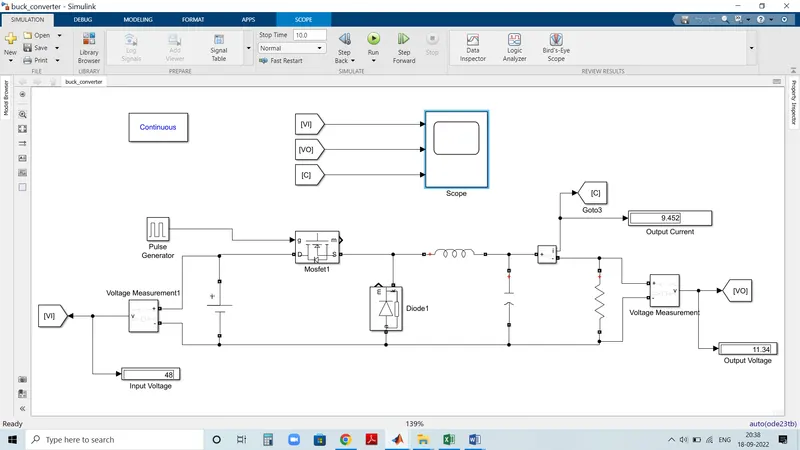
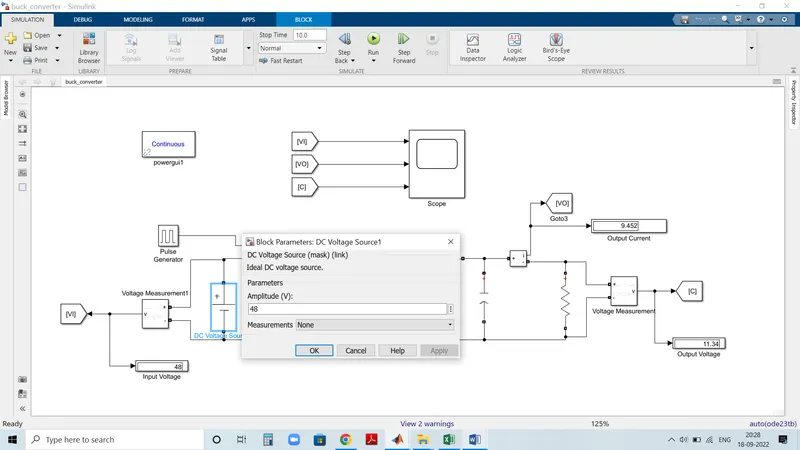
1. we set the value of DC voltage source to be 48 V. It can be measured by voltage measurement.
2. Switching device -
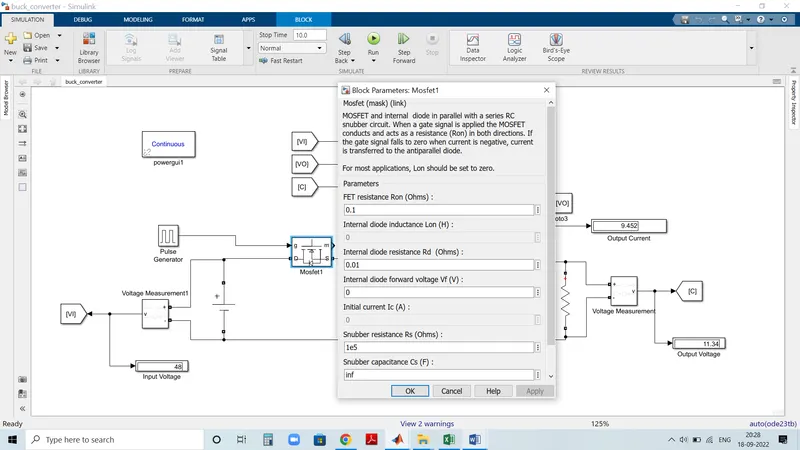
MOSFET and internal diode in parallel with a series RC circuit. When a gate signal is applied the MOSFET conducts and acts as a resistance in both directions. If the gate signal falls to zero when the current is negative, the current is transferred to the antiparallel diode.
3. Control unit- We use the pulse generator as Control unit.
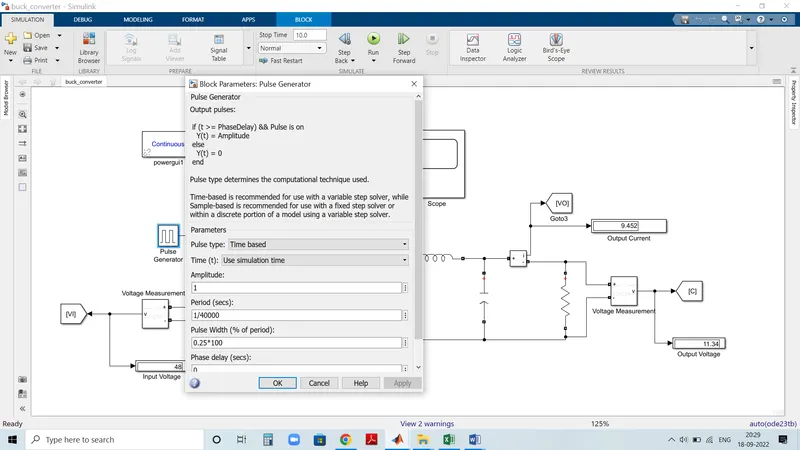
Control unit parameter input is given through duty cycle.
Duty ratio(D): It is nothing but the ratio of the input voltage source to Output voltage is known as duty ratio its formula is shown below and find out the value.
duty ratio (D) = Vo/Vs
= 12/48
= 1/4
=0.25
4. Diode:-
Implements a diode in parallel with a series RC snubber circuit. In on-state, the Diode model has an internal resistance (Ron) and inductance (Lon). For most applications, the internal inductance should be set to zero. The Diode impedance is infinite in off-state mode.
Inductor:- Use the 'Branch type' parameter to add or remove elements from the branch.
Capacitor:- a symbol of a capacitor this block is used for the storage of the electric energy for providing Output voltage when required.
Output of the model
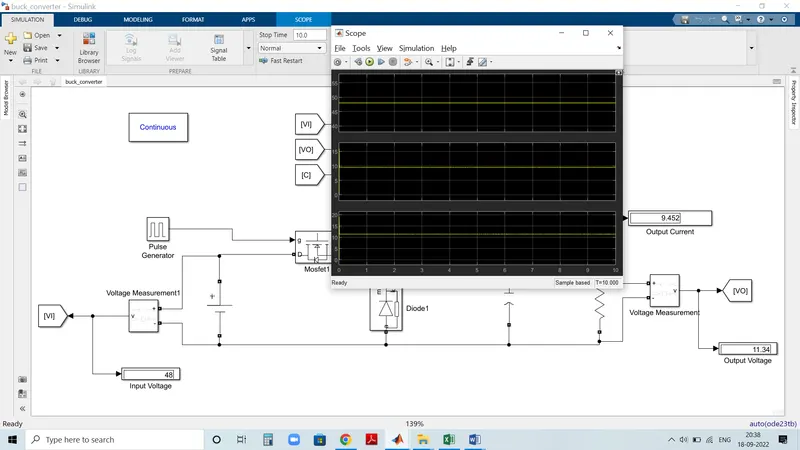
in the scope we can see first graph is for input voltage, second plot is for output voltage & third graph is for output current.
from the waveform & display block we get the required output voltage= 11.34V, Load current=9.45A In the observation little bit variation which may due to chemistry of battery & losses.