Project
Aim:To carryout system level simulation of all terrian vehicle using simulink.
Scope: To prepare a technical report on Baja ATV using model properties with lookup table and without lookup table.
Theroy: an terrian vehicle refers to a motorized single seated tri or quadricycle bike and buggy that is designed for off road travel and activitites. The vehicle consists of handlebars and low pressure tries that have deep threaded structures. which assists in driving over muddy, rocky, wetlands and dune topologies. in comparision to other utility vehicles (UTV), ATVs offer excellent off road capabilities and can carry heavy equipment over long distance and narrow access points. They can also be customized for high performance riding, owing to which they can also be extensive application across various industries, including sports, entertainment, agriculture, militry and defence.
| Type | Application | Engine,Type | No.of Wheels | Driver Type | Fuel Type | Seating Capacity |
| Utility ATV | Sports | Below 400 CC | Three Wheels | 2WD | Gasloine ATV | One seat |
| Sport ATV | Entertainment | 400-800CC | 4 wheels | 4WD | Electric ATV | Two or more seat |
| Recreational ATV | Agriculture | above 800 cc | > 4 wheels |
Continously Variable Transmission (CVT) is an automatic single speed and gearless transmission that can shift through an infinite number of gear ratios. A CVTs is a transmission that operates on an ingenious pully system that automatically varies the transmission ratio ,allowing an infinite variability between highest and lowest gears with no discreate steps or shifts, CVTs provide more useable power, better fuel economy and smoother driving experience than traditional transmission that uses gearboxes with fixed number of gear sets.
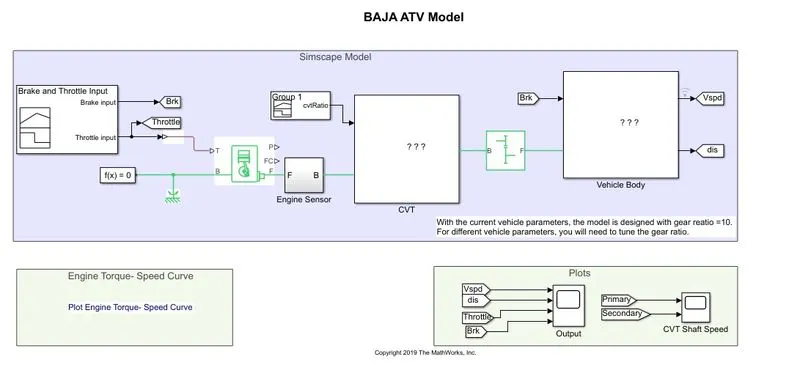
The model consits of common blocks as follows:
Signal Builder: The signal builder block allows you to create interchangeble groups of linear signal sources and use them in a model.you can switch of the signal groups into and out of a model to facilitate testing.
Generic Engine: Represents a system level model of spark ignition and disel engine suitable for use at initial stages of modelling when only the basic parameters are avaliable. optional idle speed and red line controllers are includeed. The throttle input signal T lies between zero and one and specifies the torque demanded from the engine as a fraction of the maximum possible torque. if the engine speed falls below the stall speed, the engine torque is blended to zero. if the engine speed exceeds the maximum speed, the simulation stops and issues an error message. Connections F and B Are mechanical rotational conserving ports associated with engine crankshaft and engine block respectively. connection p and fc are physical signal output ports through which engine power and fuel rate are reported.
speed vector and torque vector are the assigned parameters.
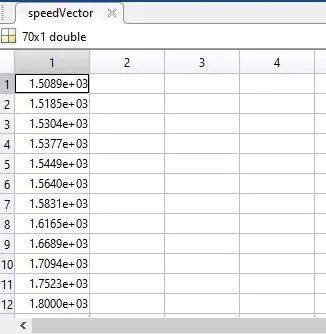
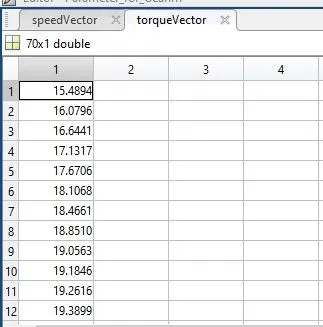
Engine Sensor: Ideal Rotational Motion Sensor
the block represents an ideal mechanical rotational sensor, that is a device that converts an across variable between two mechanical rotational nodes into a control signal proportional to angular velocity or angle. The sensor is ideal since it does not account for inertia, friction, delays, energy consumption, and so on. Connections R and C are mechanical rotational conserving ports and connections W and A are physical signal output ports for velocity and angular displacement respectively.
Simple Gear: Represents a fixed ratio gear or Gearbox. No inertia or compliance is modeled in this block. we can optionally include gear meshing and viscous bearing losses. Connection B and F are mechanical rotational conserving ports. Specify the relation between base and follower rotation directions with the output shaft rotates parameter. Usaully include thermal effects and expose thermal conserving port H by right click on the block and selecting Simscape to switch between variants.
Gear Ratio=4 (Follower/Gear)
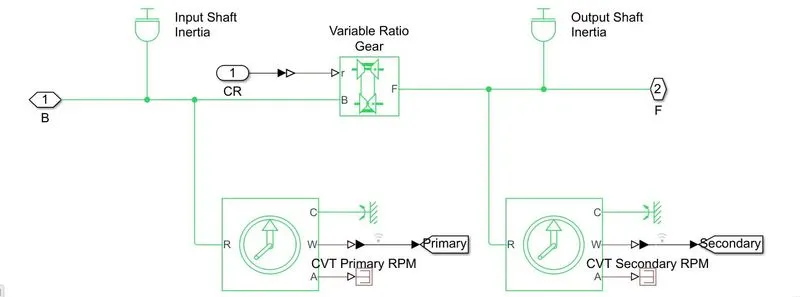 The CVT of Subsystem consists of the following blocks:
Inertia: The block represents an ideal mechanical rotational inertia. The block has one mechanical rotational conserving port. The block postive direction is from its port to the refernce point. This means that the inertia torque is postive if the inertia is accelerated in a postive direction.
Variable Ratio Transmission: Represents a variavble gearbox ratio such as implemented by mechanical belt CVT, electric, or hydraulic transmissions. The physical signal input are defined the ratio of input to output angualr velocities. Connection B And F are Mechanical rotational conserving ports, specify the realtion between follower and base with respect to output roational velocity parameters.
Vehicle Body Subsystem: The Simulink subsystem model is as shown below
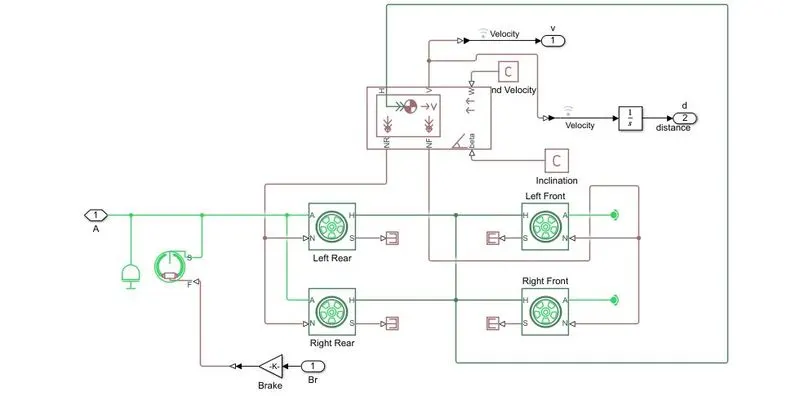
The vehicle body subsystem consists of the following blocks:
Vehicle Body:
Represents a two axle vehicle body on longitudinal motion. The block accounts for body mass, aerodynamic drag, road incline, and weight distribution between axles due to acceleration and road profile. The vehicle can have the same or a different number of wheels on each axle. usually include pitch and suspension dynamics or additional variable mass and inertia. The vehicle dones move vertically relative to the ground.
Connection H is the mechanical translation conserving port associated with horizontal motion of the vehicle body. The resulting traction motion developed by tries should be connected to this port. Connections V, NF, and NR Physical signal output ports for vehicle velocity and front and rear normal wheel forces respectively. Wheels forces are consideread postive if acting downwards. Connection W and Beta are physical signal input ports corresponding to headwind speed and road inclination angle respectively. If the variable mass is modeled, the physical signal input ports CG and M are exposed. CG accepts a two element vector representing the X and Y distance offsets from vehicle CG to additional Load mass CG. M represents the additional mass. If both variable mass and pitch dynamics are inclueded, the physics signal port J accepts the inertia of the additional mass about its ownCG.
Parameters are:
Mass: 250 Kg
number of wheels per axle:2
Horizontal distance from CG to front axle:1m
Horizontal distance from Cg to rear axle=0.35m
CG height above the ground=0.7m
acceleartion due to gravity:9.8 m/s^2;
Tyre:
Represents the longitudinal behaviour of a highway tyre charactersitics by the formula, the block is built from tyre road interaction and simscape foundation library wheel and axle blocks. optionally the effect of tyre inertia, stiffness, and damping can be included.
Connection A is the mechanical rotational conserving port for the wheel axle. Connection H is the mechanical translation conserving port for the wheel hub through which thrust developed by the tyre is applied to the vehicle. Connection N is a physical signal input port that applies the normal face acting on the tyre. The force is consideread postive if acts downwards. Connection S is a physical signal output port that reports the accepts a four element vector corresponding to the B C D and E magic formula coefficients.
Parameters of tyre:
Magic formula B coefficient:10;
Magic formula C coefficient:1.9;
Magic formula D coefficient:1;
Magic formula E coefficient:0.97;
Double Shoe Brake:
Represents a brake arranged as two pivoted rigid shoes symmetrically installed inside or outside a drum and operated by one actuator. The actuator force causes the shoes to exert a friction torque on a shaft connected to the drum. Connection S ia a conserving rotational terminal associated with drum shaft. Connection F is a physical signal port representing the force input to the actuator. Postive force creats friction torque that resists the roatation shaft. usually include thermal effects and expose thermal conserving port H by setting thermal port to Model.
Parameters are:
Drum radius: 150 mm
Actuator location radius:100mm;
pin location radius:125 mm;
pin location angle:15 deg;
shoe begginning angle:5 deg;
shoe span angle: 120 deg;
Torque Vs Speed Characteristics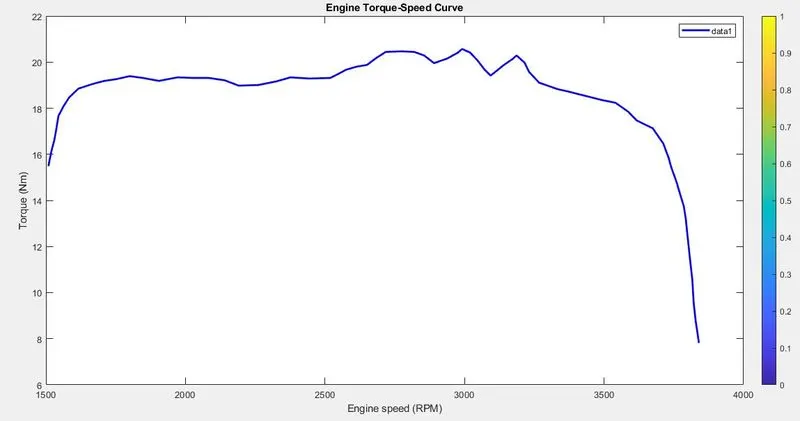
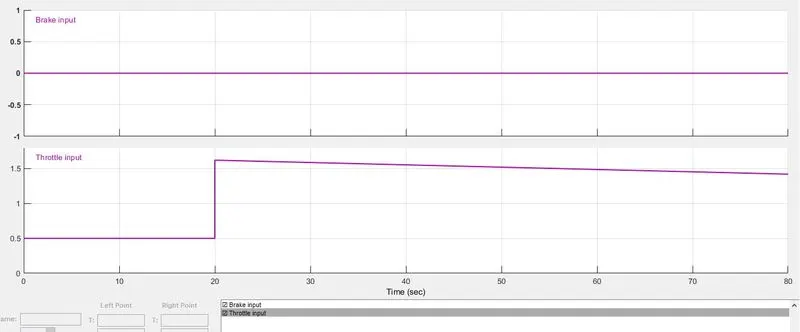
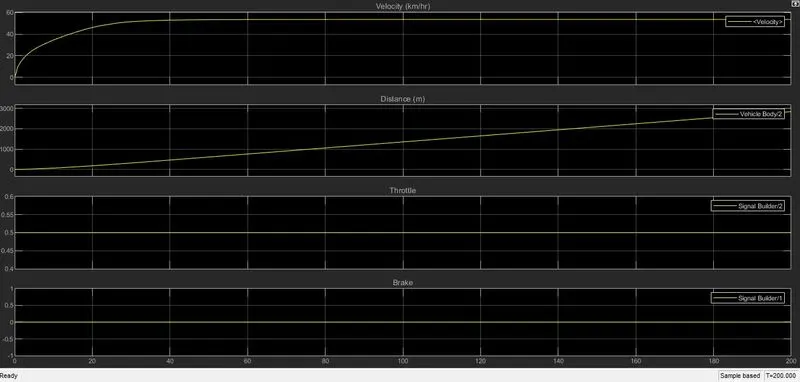
#1.1 Input: Brake and Throttle Input
Brake input is zero maintained throught constant for a period of time. throttle input 0.5 for a period of time 20 seconds and again increased to 1.5 -1.3 for a period of 80 seconds.
CVT gear ratio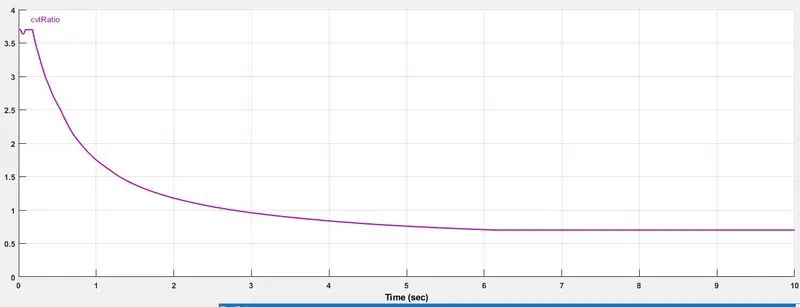
the CVT gear ratio 3.57 for time period of 0.2 seconds and then decreased to 3.52 and then maintain constant .98 for 8 seconds.
#1.1 Shaft Speed
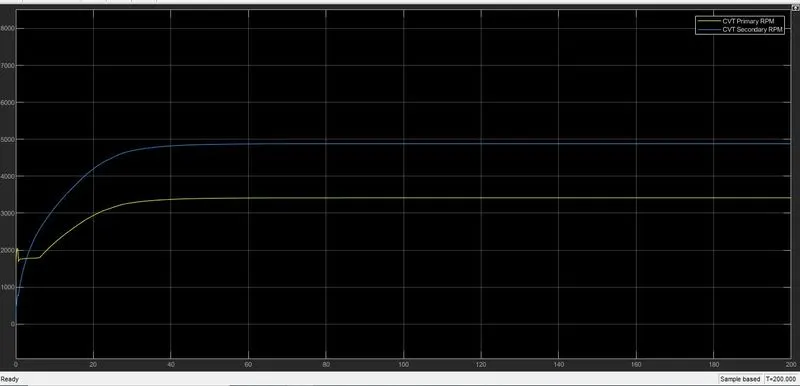
CVT Velocity.Throttle, Brake and distance
1.2 With Dashboard
A simulink model for the Baja ATV model including the dashboard is shown below. The rest of the parts and subsystem are common in the above Part#1.1
Dashboard: A dashboard (also called dash, instrument panel(IP), or fascia) is a control panel usually located directly ahead of a vehicles driver displaying instrumention and controls for the vehicle opeartion.
The intial condition as follows
Brake input = 0;
Throttle Input=0.3
#1.2 Input
in comprises throttle and brake input through knob, the engine RPM gauge and velocity gauge displays the colour.
Lookup Table
lookup table is an array of data that maps input values to output values, thereby approximating a mathematical function. Given a set of input values, a lookup opeartion retrives the corresponding output values from the table. if the lookup table does not explicitly define the input values, simulink can estimate an output value using interpolation , extrapolation or rounding where
-Interpolation is a process for estimating values that lie between known data points.
Extrapolation is a process for estimation values that lie beyond the range of known data points
Conclusion
The given Baja ATV model was simulated succesfuly and from the above results we can infer that
- Velocity, CVT Shaft speed and Engine Speed are directly proportional to the throttle input and inversely proportional to the brake input.
-CVT Ratio is dirctly proportional to the torque and inversely proportional to the throttle input.
-The speed might get null at a particular braking resiatnce.
-CVT primary speed is greater than CVT seconadry speed as they directly to their input shaft diameter.
-The shaft speed as comapred to shaf