Project
AIM:
To prepare a technical report on a ATV (all-terrain vehicle) simulation under given conditons.
OBJECTIVE
Carry out a system level simulation of a BAJA ATV and prepare a technical report explaining the simulation results and modelling the ATV.
ALL-TERRAIN VEHICLE:
An all-terrain vehicle (ATV) is defined as a motorized off- highway vehicle designed to travel on four low-pressure or non-pneumatic tires, having a seat designed to straddled by the operator and handlebars for steering control. BAJA ATV differs from the other ATV’s. BAJA ATV follows certain rules and regulation implemented by SAE (society of automotive engineers).
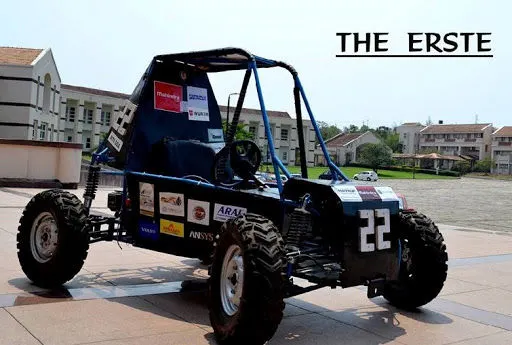
Case 1:
Simulink model of a BAJA CVT
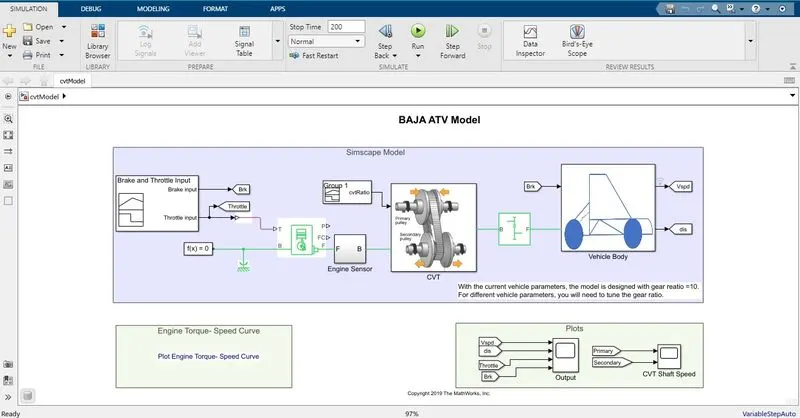
The above picture shows the model of a BAJA ATV which uses CVT (continues variable transmission). A combination of Simulink and Simscape blocks are used to build this model.
ENGINE
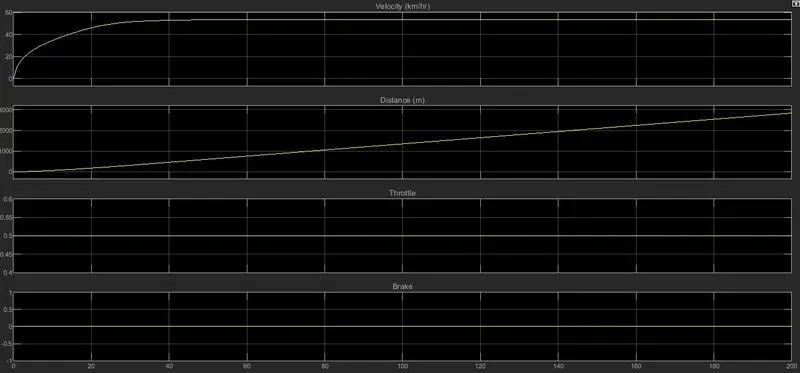
Generic engine Simulink is used here. Brake and throttle input is acquired from the signal builder block.
CVT MODEL
CVT is considered as the most pre-dominant in ATV’s because of its tenability, ease of use, simplicity and performance advantages. The CVT transmission is arguably the most popular amongst all types of users and in all kinds of applications, the CVT transmission utilizes a drive and driven clutch system connected by a V-belt drive.
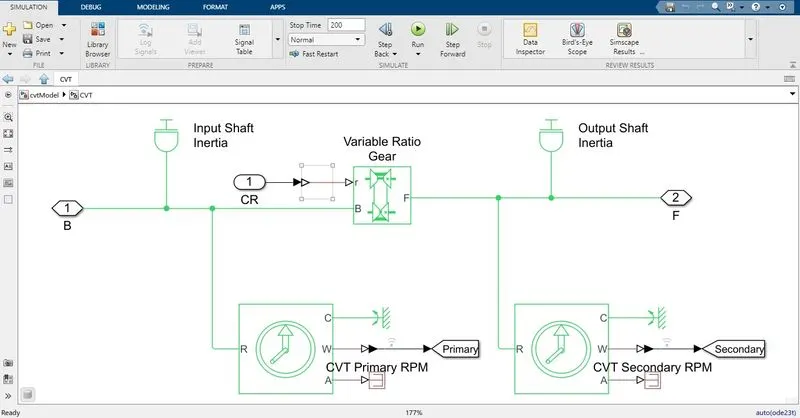
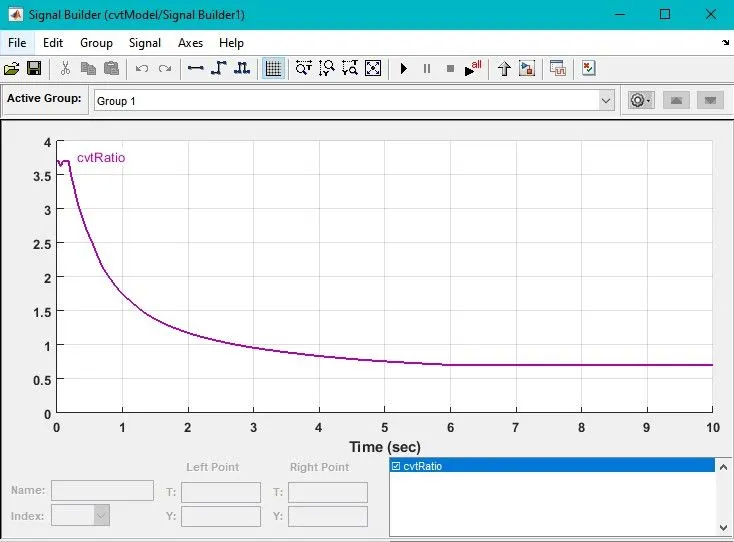
CVT gear ratio input
ENGINE
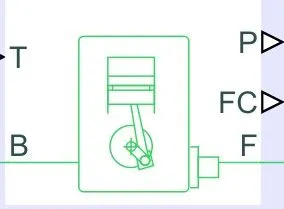
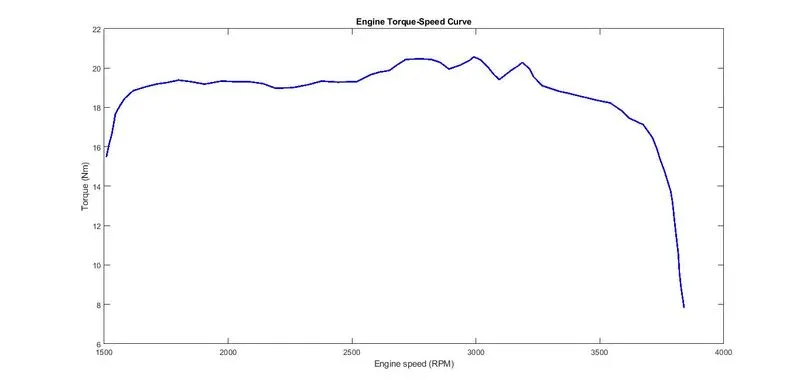
The throttle input signal T lies between zero and one and specifies the torque demanded from the engine as a fraction of the maximum possible torque. If the engine speed falls below the Stall speed, the engine torque is blended to zero. If the engine speed exceeds the Maximum speed, the simulation stops and issues an error message.
Connections F and B are mechanical rotational conserving ports associated with the engine crankshaft and engine block, respectively. Connections P and FC are physical signal output ports through which engine power and fuel consumption rate are reported.
VEHICLE BODY
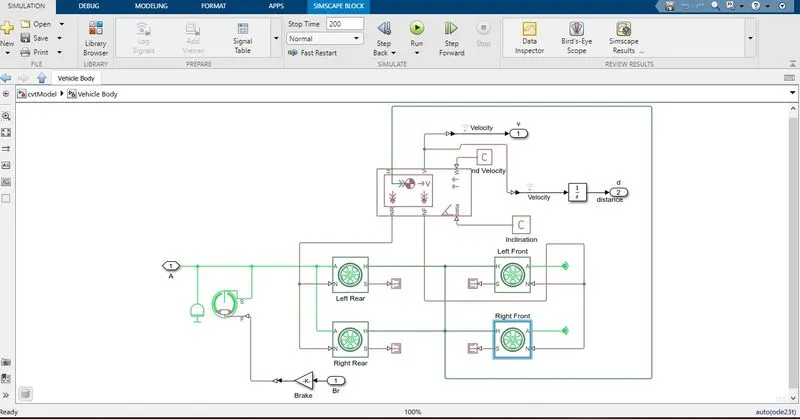
Represents a two-axle vehicle body in longitudinal motion. The block accounts for body mass, aerodynamic drag, road incline, and weight distribution between axles due to acceleration and road profile. The vehicle can have the same or a different number of wheels on each axle. Optionally include pitch and suspension dynamics or additional variable mass and inertia. The vehicle does not move vertically relative to the ground.
Connection H is the mechanical translational conserving port associated with the horizontal motion of the vehicle body. The resulting traction motion developed by tires should be connected to this port. Connections V, NF, and NR are physical signal output ports for vehicle velocity and front and rear normal wheel forces, respectively. Wheel forces are considered positive if acting downwards. Connections W and beta are physical signal input ports corresponding to headwind speed and road inclination angle, respectively. If variable mass is modeled, the physical signal input ports CG and M are exposed. CG accepts a two- element vector representing the x and y distance offsets from vehicle CG to additional load mass CG. M represents the additional mass. If both variable mass and pitch dynamics are included, the physical signal port J accepts the inertia of the additional mass about its own CG
ENGINE TORQUE AND SPEED CURVE
OUTPUT SIGNALS VEHICLE
CONCLUSION
The BAJA ATV model is analysed. The simulation results are recorded as per the given inputs.