Project
AIM:
To study and analyse the BAJA all terrain vehicle (ATV) model using simulink and compare between difference models.
OBJECTIVES:
Carry out a system-level simulation of all-terrain vehicle and prepare report explaning the model properties&comment on the results.
ALL TERRAIN VEHICLE:
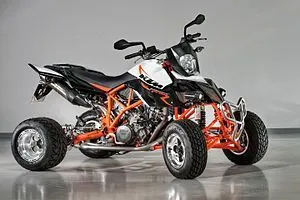
An all-terrain vehicle (ATV), also known as a light utility vehicle (LUV),[1] a quad bike, or simply a quad, as defined by the American National Standards Institute (ANSI); is a vehicle that travels on low-pressure tires, with a seat that is straddled by the operator, along with handlebars for steering control. As the name implies, it is designed to handle a wider variety of terrain than most other vehicles. Although it is a street-legal vehicle in some countries, it is not street-legal within most states, territories, and provinces of Australia, the United States or Canada.
By the current ANSI definition, ATVs are intended for use by a single operator, although some companies have developed ATVs intended for use by the operator and one passenger. These ATVs are referred to as tandem ATVs.[2]
The rider sits on and operates these vehicles like a motorcycle, but the extra wheels give more stability at slower speeds. Although most are equipped with three or four wheels, six-wheel models exist for specialized applications. Multiple-user analogues with side-by-side seating are called utility terrain vehicles (UTVs) or side-by-sides to distinguish the classes of vehicle. Both classes tend to have similar powertrain parts. Engine sizes of ATVs currently for sale in the United States (as of 2008 products) range from 49 to 1,000 cc (3.0 to 61 cu in).
CASE1:
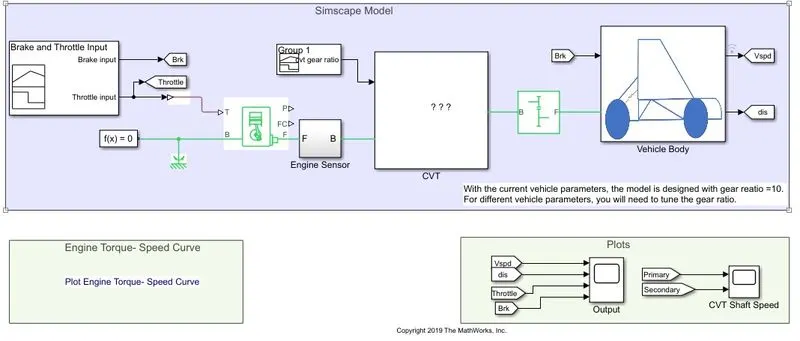
SIMULINK MODEL FOR BAJA AVT WITH CVT:
MAJOR COMPONENTS IN THE MODEL:
Continuously variable transmission:
A continuously variable transmission (CVT) is an automatic transmission that can change seamlessly through a continuous range of gear ratios. This contrasts with other transmissions that provide a limited number of gear ratios in fixed steps. The flexibility of a CVT with suitable control may allow the engine to operate at a constant RPM while the vehicle moves at varying speeds.
CVTs are used in automobiles, tractors, motor scooters, snowmobiles, and earthmoving equipment.
The most common type of CVT uses two pulleys connected by a belt or chain, however, several other designs have also been used at times.
Pulley-based:

The most common type of CVT uses a V-belt which runs between two variable diameter pulleys.[1] The pulleys consist of two cone-shaped halves that move together and apart. The V-belt runs between these two-halves, so the effective diameter of the pulley is dependent on the distance between the two-halves of the pulley. The V-shaped cross section of the belt causes it to ride higher on one pulley and lower on the other, therefore the gear ratio is adjusted by moving the two sheaves of one pulley closer together and the two sheaves of the other pulley farther apart.[2]
As the distance between the pulleys and the length of the belt does not change, both pulleys must be adjusted (one bigger, the other smaller) simultaneously in order to maintain the proper amount of tension on the belt. Simple CVTs combining a centrifugal drive pulley with a spring loaded driven pulley often use belt tension to effect the conforming adjustments in the driven pulley.[2] The V-belt needs to be very stiff in the pulley's axial direction in order to make only short radial movements while sliding in and out of the pulleys.
The pulley-radial thickness of the belt is a compromise between maximum gear ratio and torque. Steel reinforced v-belts are sufficient for low-mass low-torque applications like utility vehicles and snowmobiles but higher mass and torque applications such as automobiles require a chain. Each element of the chain must have conical sides that fit the pulley when the belt is running on the outermost radius. As the chain moves into the pulleys the contact area gets smaller. As the contact area is proportional to the number of elements, chain belts require many very small elements.
GENERIC ENGINE:
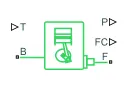
The Generic Engine block represents a general internal combustion engine. This block is a suitable generic engine for spark-ignition and diesel. Speed-power and speed-torque parameterizations are provided. A throttle physical signal input specifies the normalized engine torque. Optional dynamic parameters include crankshaft inertia and response time lag. A physical signal port outputs the engine fuel consumption rate based on the fuel consumption model that you choose. Optional speed and redline controllers prevent engine stall and enable cruise control.
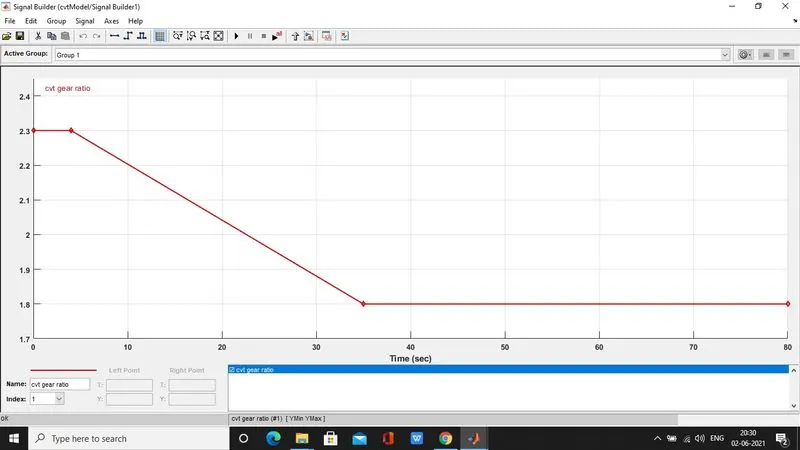
CVT GEAR RATIO:
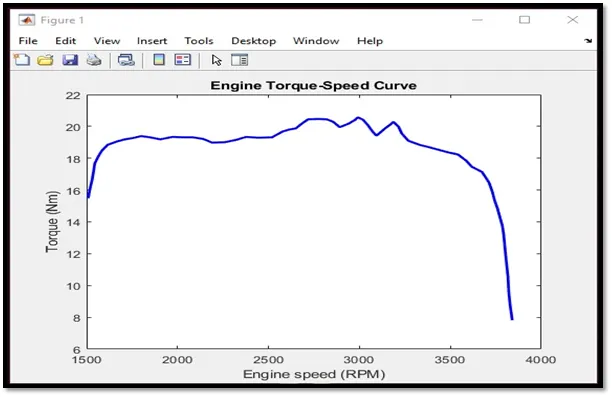
TORQUE VS ENGINE SPEED OUTPUT:
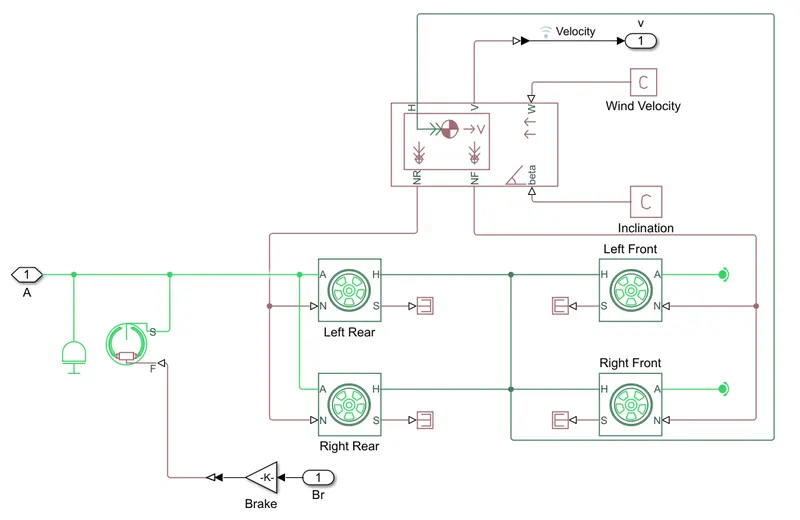
VEHICLE BODY:
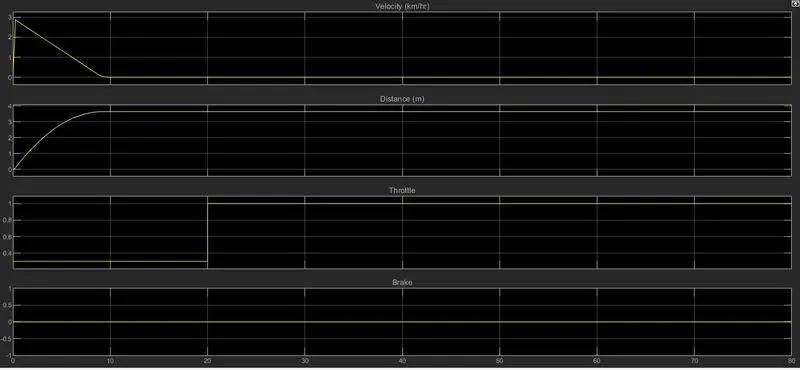
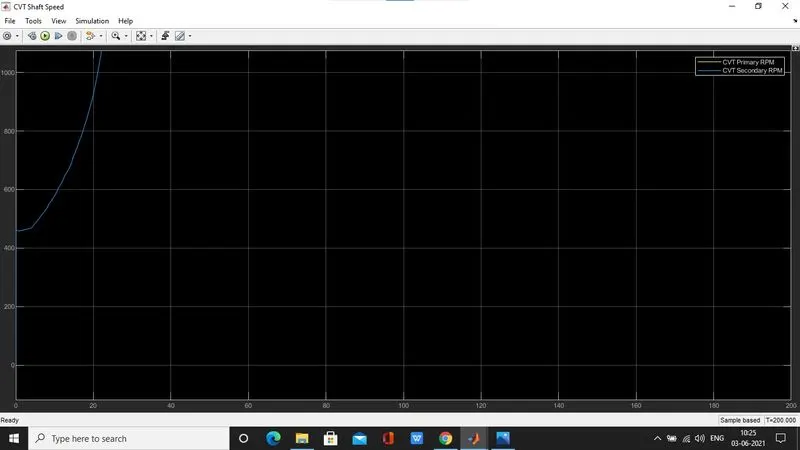
VEHICLE SPEED:
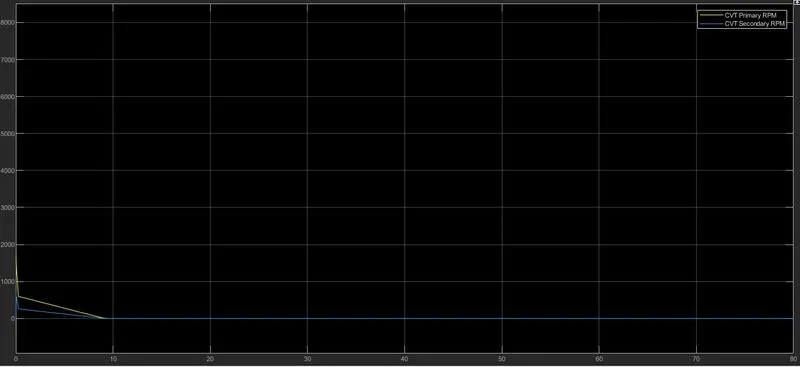
CVT SHAFT RPM:
CASE2:
SIMULINK MODEL FOR BAJA AVT WITH CVT USING DASHBOARD:
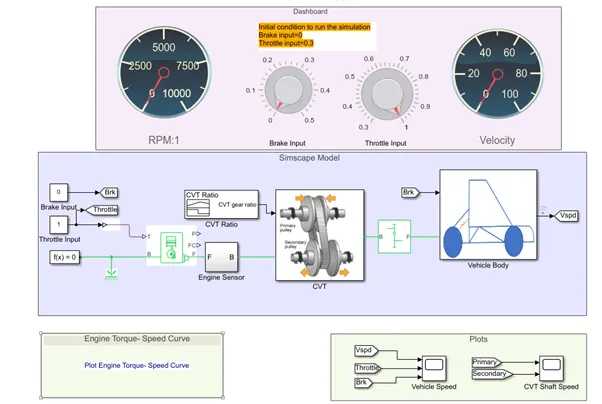
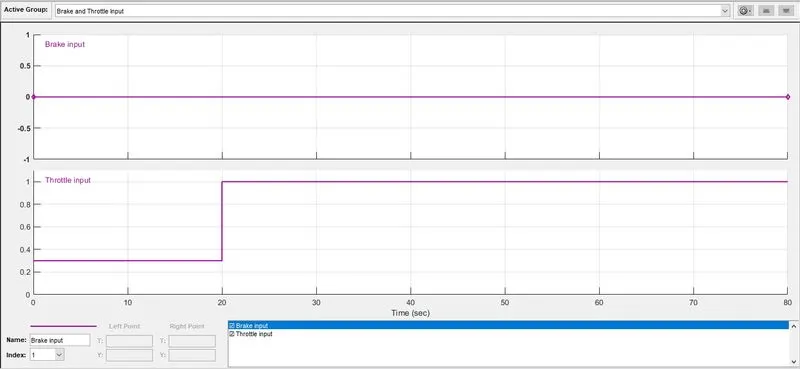
WE ARE GIVING THE THROTTLE INPUT AS 1.
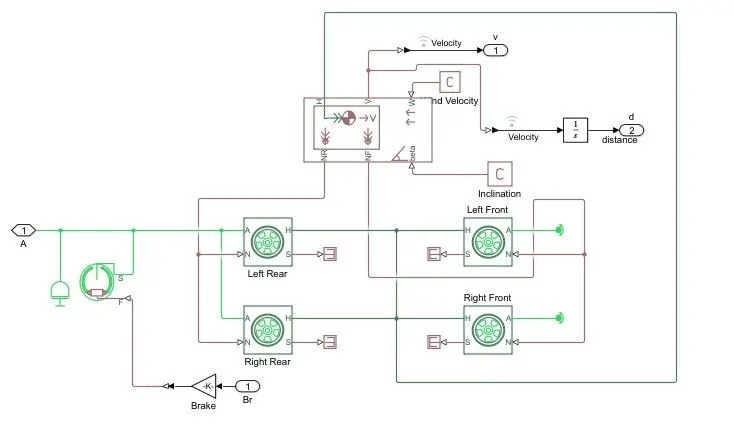
VEHICLE BODY:
VEHICLE SPEED:
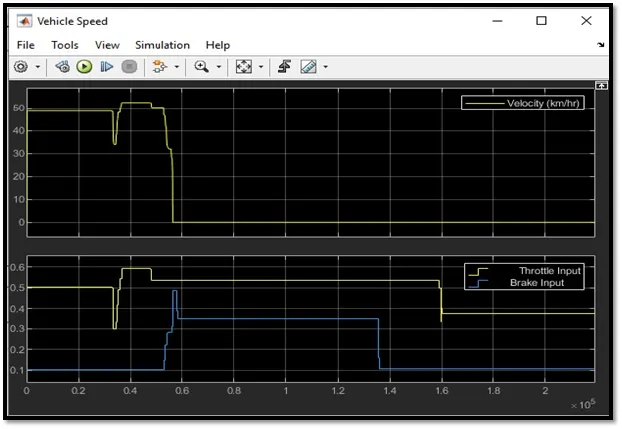
SIMULINK MODEL FOR BAJA AVT WITH CVT USING LOOKUP TABLE:
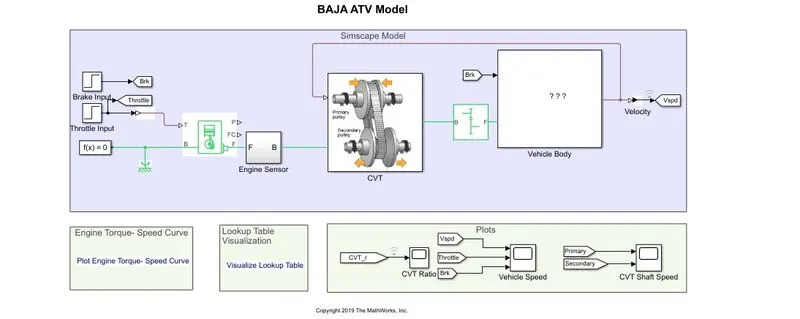
VEHICLE SPEED:
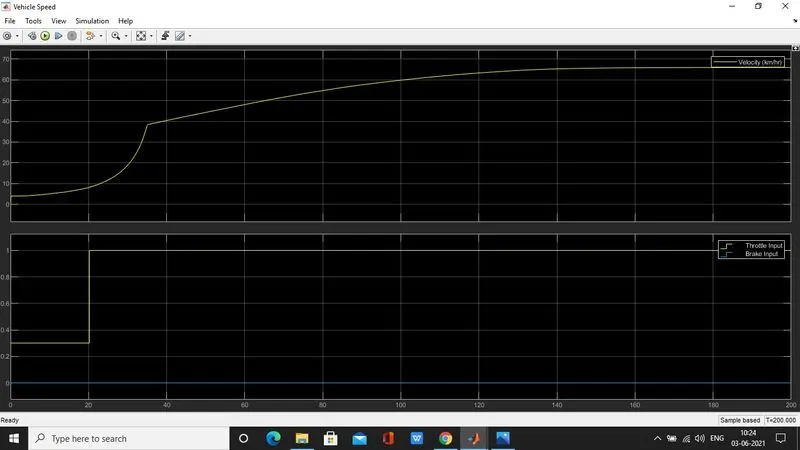
CVT RATIO:
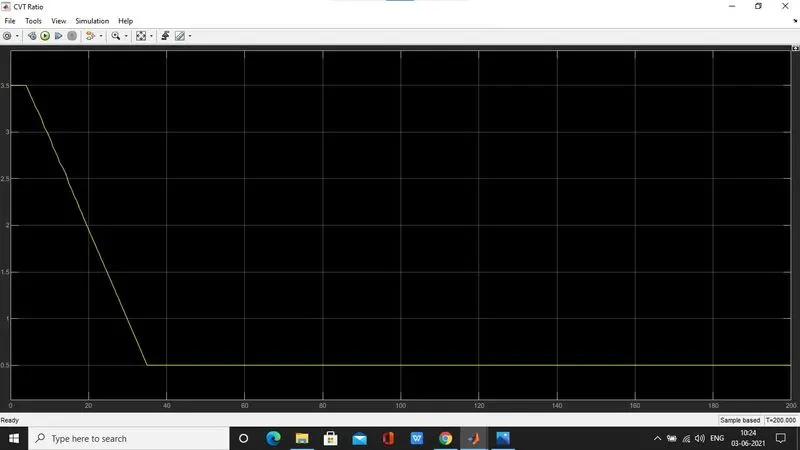
CVT SHAFT SPEED:
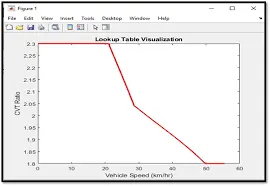
LOOKUP TABLE VISUALIZATION:
CONCLUSION:
We are successfully analysed the models of baja all terrian vehicle.