Project 2 Thermal modeling of battery pack
Introduction
Thermal management of battery systems in electric vehicles is critical for maintaining energy storage capacity, driving range, cell longevity and system safety. The thermal control will provide better cell/module temperature uniformity, less complicated design and a safer system. The heat generation phenomena and critical thermal issues of lithium-ion batteries along with thermal modelling of battery is explained in the following paragraphs.
Thermal Modeling
This example shows how to simulate a Lithium-ion battery pack consisting of 10 cells connected in series . It also shows how a fault can be introduced into one of the cells to see the impact on battery performance and cell temperatures during charging and discharging. For efficiency, identical series-connected cells are not just simply modeled by connecting cell models in series. Instead a single cell is used, and the terminal voltage scaled up by the number of cells. The fault is represented by changing the parameters for the Cell 4 Fault subsystem, reducing both capacity and open-circuit voltage, and increasing the resistance values.
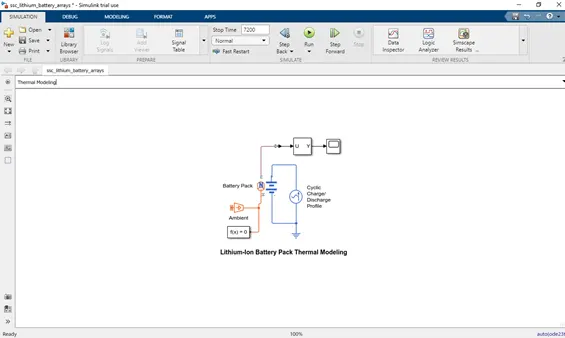
Cell Configuration
10 Cells in series are number of cells used
Fault of postion is on cell number 4
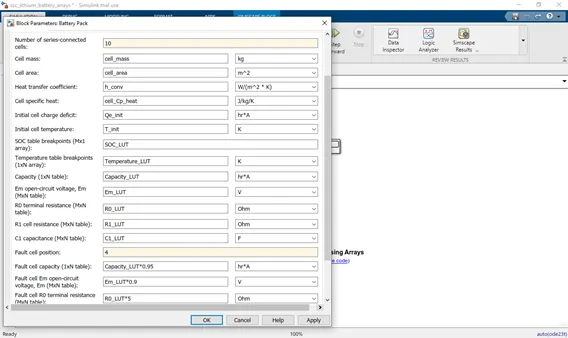
Simulink circuit model in MATLAB illustrating the effect of temperature on the performance of a 10 cells Lithium-Ion battery pack. The model (which includes the impact of cell/ambient temperature on the voltage, capacity and resistance) is submitted to a variable ambient temperature during a discharge and charge process. Its performance is compared to the case where the impact of temperature is neglected. As observed from the Scope, the temperature dependent battery model performs close to reality. As the cell/internal temperature increases/decreases due to charge(or discharge) heat losses and ambient temperature variations, the output voltage and capacity also increase/decrease
Cyclic configaration Temperature Source Conductor Temperature Sensor Thermal Reference Scope


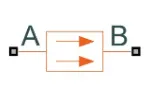
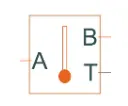


Convector Heat Transfer Temperature Sensor Subsystem

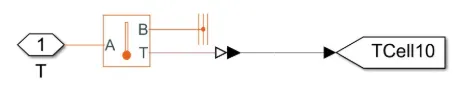
The blocks above were used to build a Thermal modeling circuit
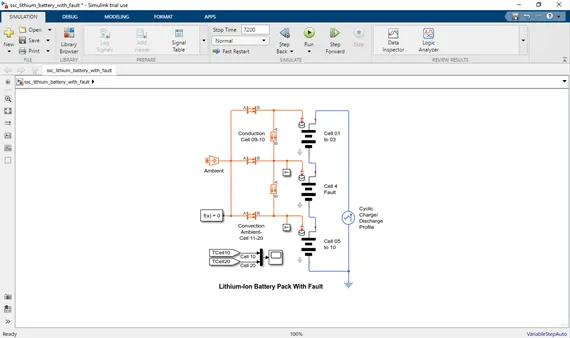
Results Analysis
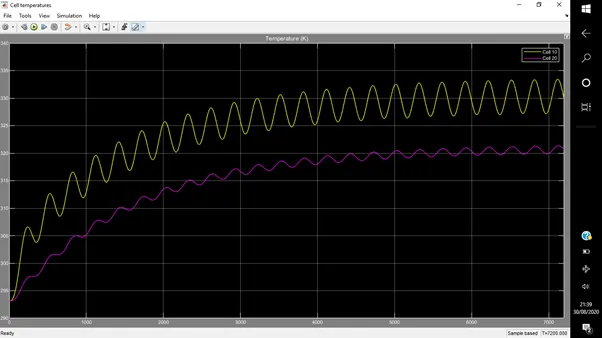
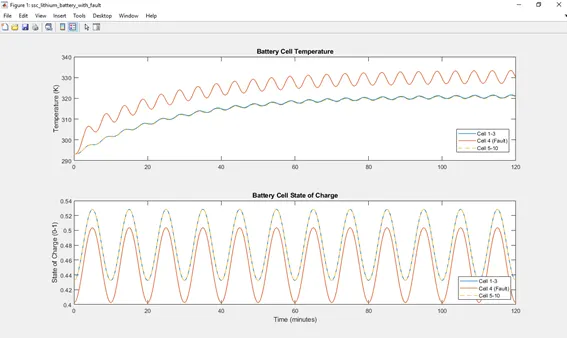
In Simulink the faulty 10 cell battery pack is simulated, the scope results below showing a yellow graph with high temperature plotted on cell 4 and the rest of the cells in purple with uniform operating temperature desired as per manufacturer's specification.
Conclusion
Balancing cells is not only important for improving the performance and life cycles of the battery, it adds an element of safety to the battery. One of the emerging technologies for enhancing battery safety and extending battery life is advanced balancing. Since new cell technologies track the amount of balancing needed by individual cells, the usable life of battery packs is increased, and overall battery safety is enhanced.