Project 2 Thermal modeling of battery pack
1.AIM
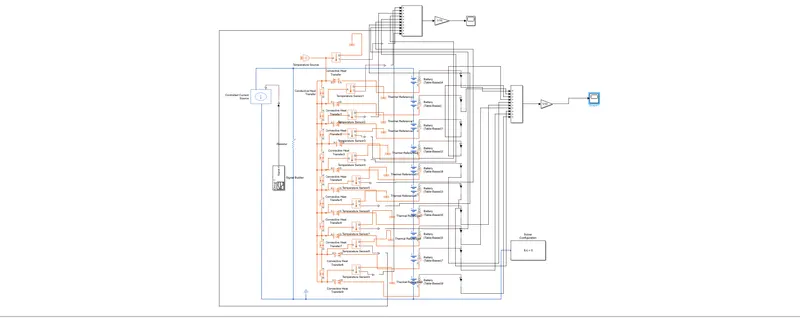
To simulate the thermal effects and compare life cycle performance at various temperatures, charge & discharge rates for a 10 cell series lithium ion battery model, using MATLAB.
2.Objective
To analyze temperature and life cycle parameters of the 10 cell series battery pack.
- Connect 10 cells in series analyze the response to a cyclic charge and discharge source.
- Change the ambient temperatures of the battery pack and compare the performances.
- Add the fading parameters of the battery and analyse the performance after each charge/discharge cycles.
3.Simulink Modelling of Battery pack
3.1 Need of Battery Modelling
An accurate forecast of the remaining driving range of an electric vehicle (EV) is crucial to avoid range anxiety. Drivers need to know how much further they would travel before their vehicle batteries require a recharge. In addition, the battery management system should predict when batteries need replacement. The remaining charge calculation must be precise to utilize the battery’s full capability. The state of charge (SOC) of a battery or pack of batteries is analogous to a fuel gauge of a conventional vehicle.
3.2 Battery Modelling
The Battery modeling procedure followed in the MATLAB is explained below. The MATLAB model is available from the library given below.
Battery (Table-Based)
Library:
Simscape / Electrical / Sources
The Battery (Table-Based) block represents a high-fidelity battery model. The block calculates no-load voltage as a function of charge level and optional temperature using lookup tables and includes several modeling options:
- Self-discharge
- Battery fade
- Charge dynamics
The Battery (Table-Based) block has four modeling variants, accessible by right-clicking the block in your block diagram and then selecting the appropriate option from the context menu, under Simscape > Block choices:
- Uninstrumented | No thermal port — Basic model that does not output battery charge level and simulates at a fixed temperature. This modeling variant is the default.
- Uninstrumented | Show thermal port — Model with exposed thermal port. This model does not output internal charge level of the battery.
- Instrumented | No thermal port — Model with exposed charge output port. This model uses a fixed temperature throughout the simulation.
- Instrumented | Show thermal port — Model that lets you output internal charge level of the battery. Both the thermal port and the charge output port are exposed.
The instrumented variants have an extra physical signal port that outputs the internal state of charge. Use this functionality to change load behavior as a function of state of charge, without the complexity of building a charge state estimator.
The thermal port variants expose a thermal port, which represents the battery thermal mass.
The battery equivalent circuit is made up of the fundamental battery model, the self-discharge resistance RSD, the charge dynamics model, and the series resistance R0.
BATTERY MODEL WITH 10 cell series
TEMPERATURE SCOPE
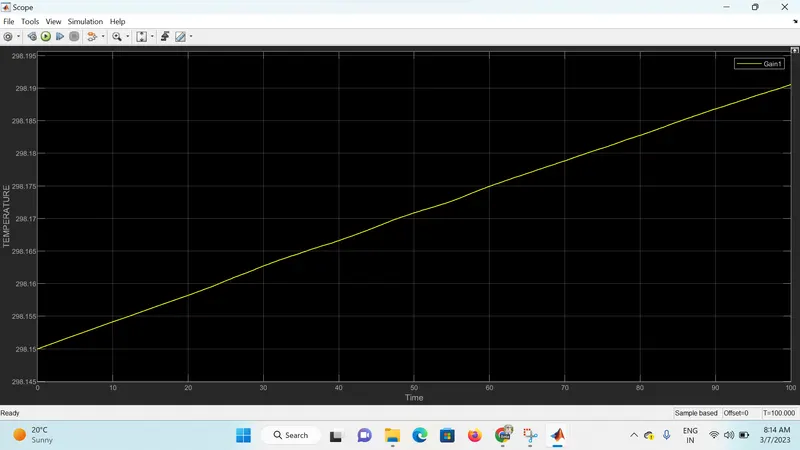
- Temperature is raising with respect to time
SOC SCOPE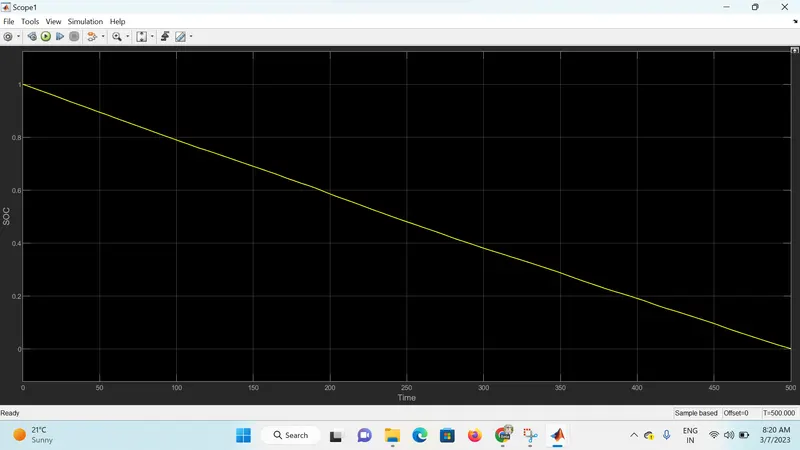
- SOC is decreasing with respect to time.
Conclusion
MATLAB library model parameters were evaluated for its life cycle and thermal effects parameters. A battery pack with 10 cells connected in series also made with a source of charging and discharging cycle.
The thermal effects of battery pack at different ambient temperatures for cycling charging/discharging has been analysed and plotted. The life cycle performance also evaluated for individual cells and overall battery pack.