Project 2 Thermal modeling of battery pack
Thermal modelling of the battery pack
A} The following blocks are used to build the battery pack
- Battery (Table-Based):
A battery is a device that converts chemical energy contained within its active materials directly into electric energy by means of an electrochemical oxidation-reduction (redox) reaction.
This block models a battery based on tabulated characteristics as functions of the state of charge (SOC) and optional temperature (T).
- Controlled current source:
The block represents an ideal current source that is powerful enough to maintain the specified current through it regardless of the voltage across it. The output current is I = Is, where Is is the numerical value presented at the physical signal port.
- Current sensor:
The block represents an ideal current sensor, that is, a device that converts current measured in any electrical branch into a physical signal proportional to the current.
Connections + and - are conserving electrical ports through which the sensor is inserted into the circuit. Connection I is a physical signal port that outputs the current value.
- Voltage Sensor:
The block represents an ideal voltage sensor, that is, a device that converts voltage measured between any electrical connections into a physical signal proportional to the voltage.
Connections + and - are conserving electrical ports through which the sensor is connected to the circuit. Connection V is a physical signal port that outputs voltage value.
- Temperature Sensor:
This block measures temperature in a thermal network. There is no heat flow through the sensor. The physical signal port T reports the temperature difference across the sensor. The measurement is positive when the temperature at port A is greater than the temperature at port B.
- Convective Heat Transfer:
This block models heat transfer in a thermal network by convection due to fluid motion. The rate of heat transfer is proportional to the temperature difference, heat transfer coefficient, and surface area in contact with the fluid.
- Temperature Source:
This block represents an ideal energy source in a thermal network that can maintain a constant absolute temperature at the port regardless of the heat flow rate.
Other blocks also used for building the model are scope, constant, goto, PS-Simulink converter, solver configuration, etc.
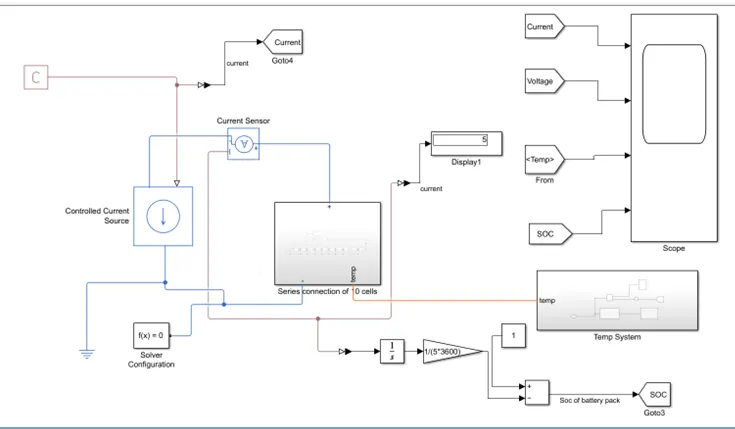
Simulink battery pack model:
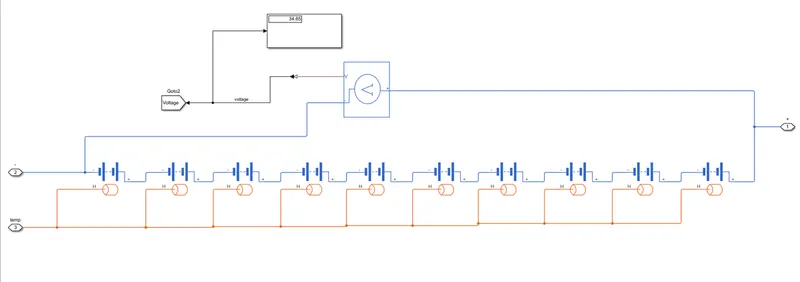
Cells Series connection:
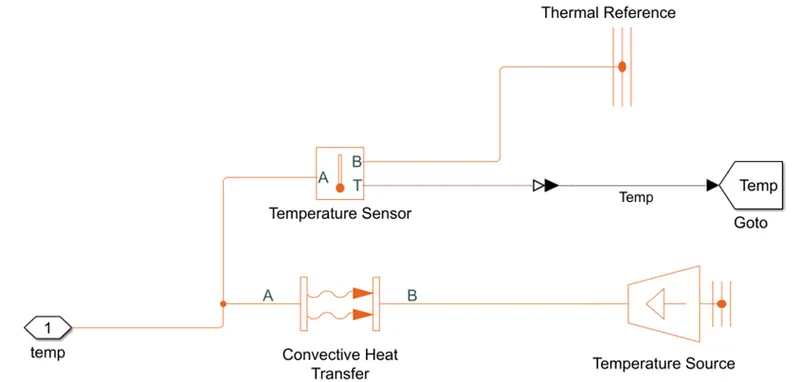
Thermal Sub System:
B} The steps involved to build the circuit should be explained below:
- Ten batteries are connected in a series after that connected voltage sensor block is for sensing the voltage of cells/ batteries.
- Current sensor blocks and controlled current source blocks are connected in series
- Constant block is connected to a controlled current source for constant current supply.
- Temperature subsystem which contains temperature source, convective heat transfer, and temperature sensing blocks are thermal blocks used.
- measuring the SOC of the battery pack using the Coulomb counting method (The Coulomb counting method measures the discharging current of a battery and integrates the discharging current over time in order to estimate SOC )
- goto block used for inputs to the scope.
C} Simulation results ( simulation results check by changing the input parameters)
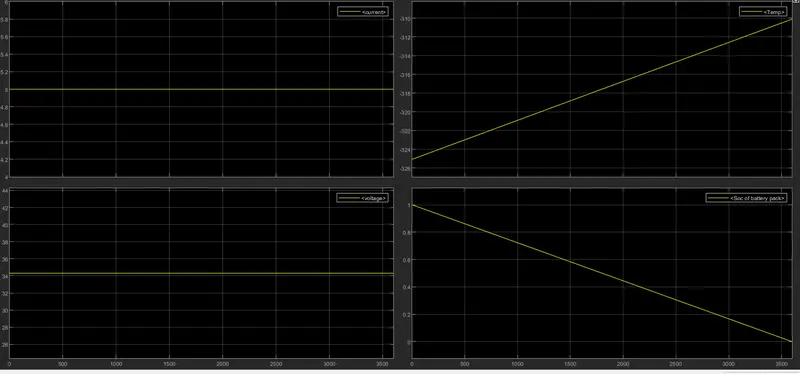
Case 1st: input parameters are as follows
Current:5A
Area of convective heat transfer:1e-4 m^2
temperature:298 K
Result :
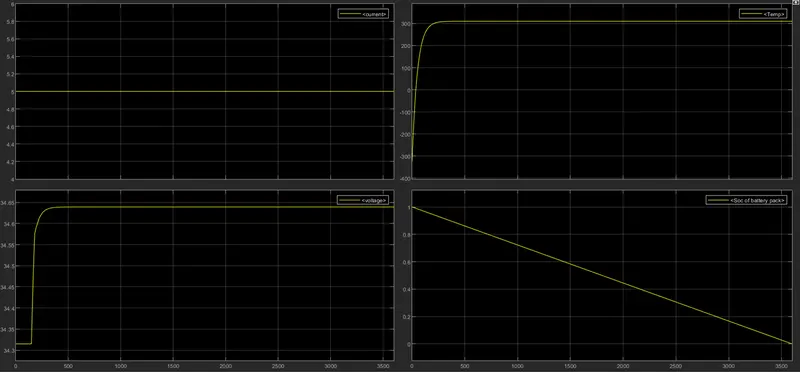
Case 1st: input parameters are as follows
Current:5A
Area of convective heat transfer:1 m^2
temperature: 310 K
Result :
Conclusion:
By considering the above two cases following observations were seen :
1. when we provide temperature to the battery pack by using convective heat transfer block of area 1e-4 m^2 its very small area of heat transfer due to that there is no effect on voltage.
2. after changing the paramerts its observed that, area increaed change in voltage occurs and also temperature effects on the life of battery.