Project 2 Thermal modeling of battery pack
For a 10-cell series lithium-ion battery model, simulate the thermal effects and compare life cycle performance at various temperatures, charge & discharge rates using MATLAB.
AIM: Creating 10-cell series lithium-ion model & compare the results at various temperatures, discharge rate.
To prepare model of 10-cell series Lithium-ion model, me considered battery parameters as follows:
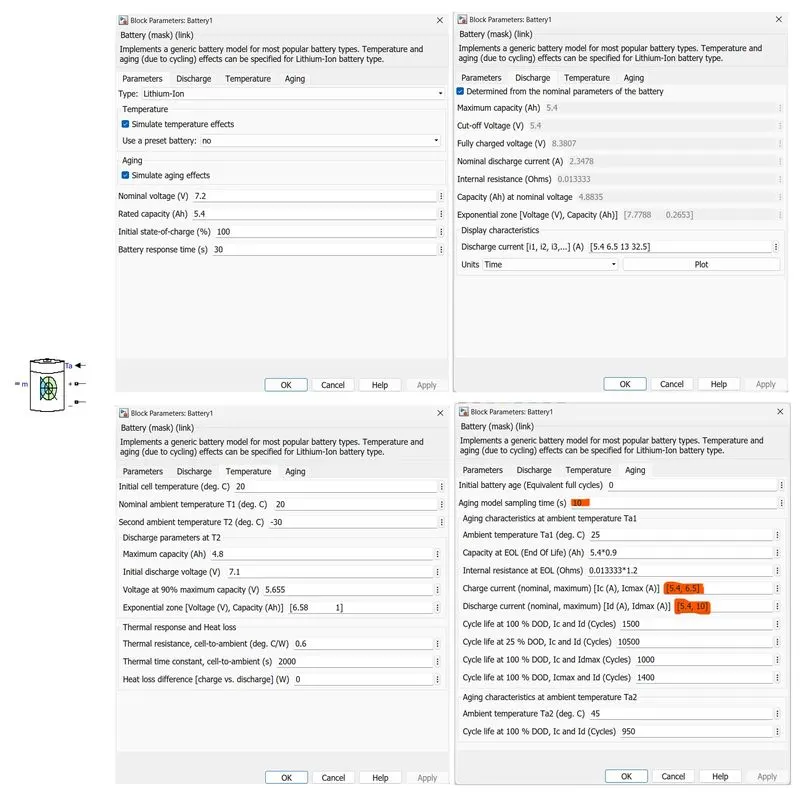
For cell all the parameters considered as default except aging tab of sample time, charge current, discharge current.
By using the above battery block of 10nos the model created with series connection of these batteries and the model as follows:
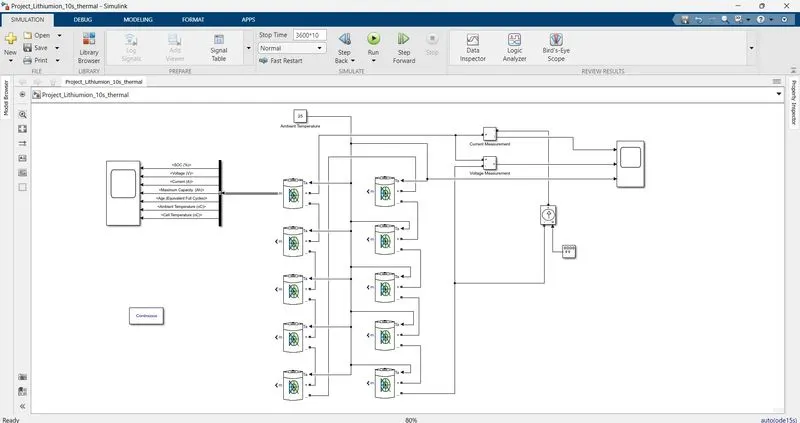
The model contains the battery blocks in series ( means one battery negetive terminal is connected positive terminal of second) and also enabled temerature effect also. The all temperature terminal are connected to constant block which represents of ambient temperature. Initially taken as 250 C.
Controlled current source in series with battery terminals to charge or discharge of desire.
current and voltage measurement for overall current and voltage measurement at terminals added to the model.
Signal generator block is connected to Controlled current source, can give any type of wave either standard (square, sin, triangular) or customized. For this model square wave considered as input signal.
For charging and discharging of battery pack we are going to provide a square wave with amplitude such that battery charging and discharging currents are in 0.1C, 0.25C, 0.5C and 1C rates.
As per our battery data battery take 7200 sec (2 hour) to complete one cycle (One cycle includes complete charge and discharge), the square wave one cycle must match with this so that setting of the frequency of square wave such that it takes 7200 secs (2 hours).
As all 10 cells are connected in series, we are taking one cell m-port and from this port the values like SOC, Age, cell temperature, ambient temperature, Cell Voltage, Current and Maximum capacity of cell can be taken and observed in scope.
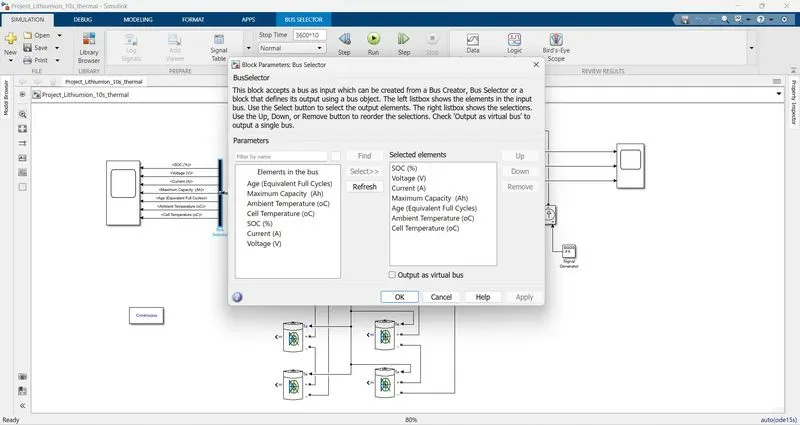
Take a bus selector and then connect a scope after it.
Open bus selector to select the parameters and choose values to be observed in scope window.
One cycle is taking 7200sec to complete so that we are going to set simulation time such that we can get 5 such cycles to observe aging and temperature effects. We are running simulation for 3600*10 Secs.
RESULTS:
First of all, we are going to take a constant 1C charge and discharge rate with varying temperature.
- At 5.4A, 25deg ambient temperature:
Give Amplitude of 5.4 and frequency 1/7200 in square wave generator and a value 25 in constant block then run the simulation.
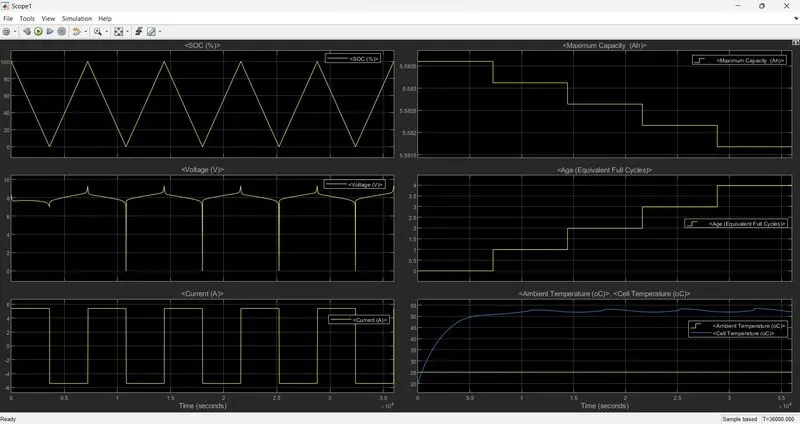
Initially, SOC was 100% but we are discharging the battery pack at 1C rate so it is taking 3600 sec for discharging and 3600 sec for charging as well, a total of 7200 secs for one complete cycle.
Battery maximum capacity was nearly 5.584 Ah and it will remain same till once complete cycle. As this is new battery pack so Aging factor was initially at 0.
Initial Temperature was at 20 Deg Celsius, when battery started charging temperature started increasing from 20 deg and it keeps on increasing till charging and discharging takes place. After each discharging cell temperature gets slight down and after each charging cell temperature is slightly increasing. At the end of 5 cycles temperature becomes 52.13 degrees.
Maximum charging voltage is 8.3V and till discharging takes place voltage also drop and goes up to 7.13V. And when charging takes place voltage started building from 7.13V to Max voltage of 8.4V.
After each cycles aging effect is increasing insteps (one step in one complete cycle) and the maximum capacity of battery keeps on decreasing and at the end of 5 cycles the battery remained maximum capacity is 5.582Ah (a very small reduction of 0.00192Ah).
- At 5.4A, 30deg ambient temperature:
Give Amplitude of 5.4 and frequency 1/7200 in square wave generator and a value 30 in constant block then run the simulation.
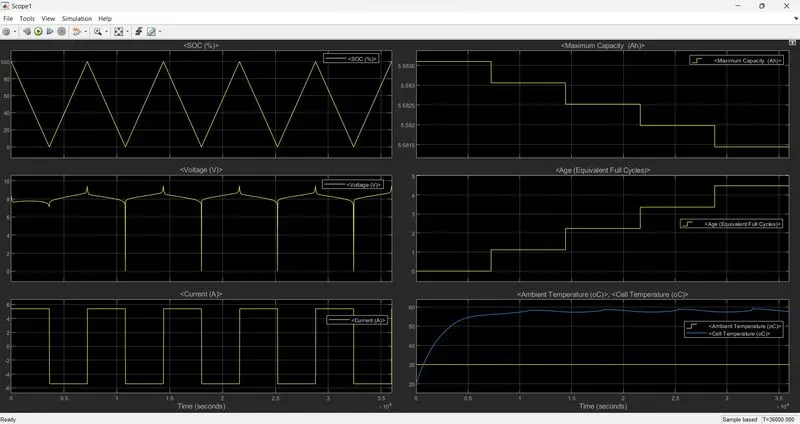
Initially, SOC was 100% but we are discharging the battery pack at 1C rate so it is taking 3600 sec for discharging and 3600 sec for charging as well, a total of 7200 secs for one complete cycle.
Battery maximum capacity was nearly 5.584Ah and it will remain same till once complete cycle. As this is new battery pack so Aging factor was initially at 0.
Initial Temperature was at 20 Deg Celsius, when battery started charging temperature started increasing from 20 deg and it keeps on increasing till charging and discharging takes place. After each discharging cell temperature gets slight down and after each charging cell temperature is slightly increasing. At the end of 5 cycles temperature becomes 57.58degrees.
Maximum charging voltage is 8.3V and till discharging takes place voltage also drop and goes up to 7.255V. And when charging takes place voltage started building from 7.255V to Max voltage of 9.3V. This is because of temperature raise.
After each cycles aging effect is increasing insteps (1.12step in one complete cycle) and the maximum capacity of battery keeps on decreasing and at the end of 5 cycles the battery remained maximum capacity is 5.581Ah (a very small reduction of 0.002162Ah).
This time maximum capacity dropped more than previous case because of high ambient temperature and also the aging factor increasing more rapidly.
- At 5.4 A, 45 deg ambient temperature:
Give Amplitude of 5.4 and frequency 1/7200 in square wave generator and a value 45 in constant block then run the simulation.
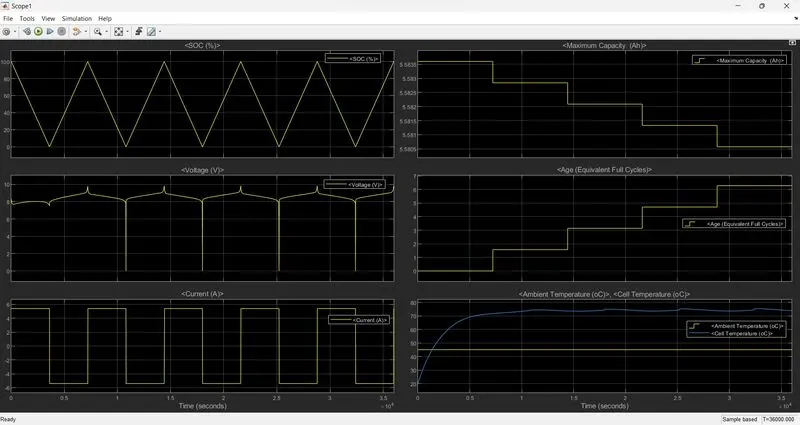
Initially, SOC was 100% but we are discharging the battery pack at 1C rate so it is taking 3600 sec for discharging and 3600 sec for charging as well, a total of 7200 secs for one complete cycle.
Battery maximum capacity was nearly 5.584Ah and it will remain same till once complete cycle. As this is new battery pack so Aging factor was initially at 0.
Initial Temperature was at 20 Deg Celsius, when battery started charging temperature started increasing from 20 deg and it keeps on increasing till charging and discharging takes place. After each discharging cell temperature gets slight down and after each charging cell temperature is slightly increasing. At the end of 5 cycles temperature becomes 73.92degrees.
Maximum charging voltage is 8.3V and till discharging takes place voltage also drop and goes up to 7.634V. And when charging takes place voltage started building from 7.634V to Max voltage of 9.645V. This is because of temperature raise.
After each cycles aging effect is increasing insteps (1.568step in one complete cycle) and the maximum capacity of battery keeps on decreasing and at the end of 5 cycles the battery remained maximum capacity is 5.581Ah (a very small reduction of 0.003029Ah).
This time maximum capacity dropped more than previous cases because of high ambient temperature and also the aging factor increasing more rapidly.
Now we are going to take a constant temperature of 25-degree Celsius and charge and discharge battery at different C rates.
- At 0.5 C (1/2) rate and 25 deg Celsius:
For 0.5C rate, we provide 2.7 amplitude in square wave generator and frequency of 1/ (7200*2) to get Full charge and discharge cycle (one complete cycle).
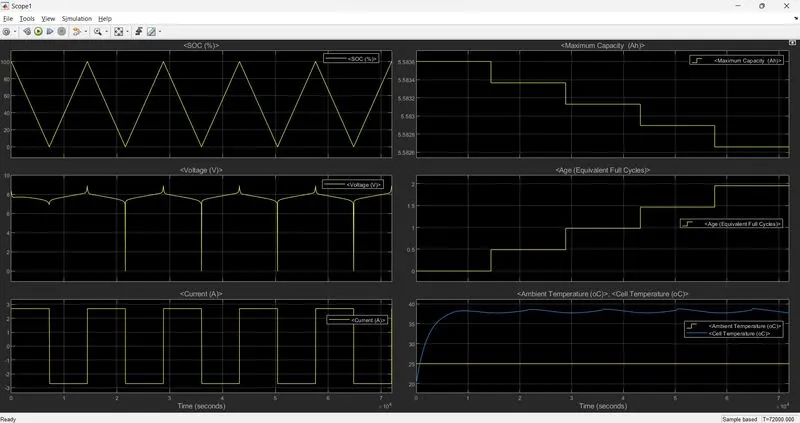
Run simulation for 3600*10*2 secs to get five full cycles. Because of current rate recued to 0.5.
Initially maximum capacity was 5.584Ah but after one complete cycle it goes on decreasing in a very small step of 0.0002354, at the end of simulation it became 5.583Ah. (a very small reduction of 0.000924Ah)
As battery is new, aging effect is zero till the one complete cycle but after that it started increasing in step of 0.488, this value is still small because the C rate is still low.
Battery is discharging and discharging gradually so that SOC is going from 100 to 0 in 2 hours and again to 100 in 2 hours, a total of 4 hrs for a complete cycle.
Initially Cell temperature keeps on increasing from 20 deg to almost 38.80degree Celsius while charging and again it fell down to 37.8 deg Celsius while discharging.
Cell voltage is dropping from 8.345V to nearly 6.990V but as cell temperature increases voltage is also increasing very slowly after each complete cycle, at the end of five cycles cell voltage becomes 8.831V.
Current is changing from +2.7 to - 2.7 Amperes.
- At 0.25 C (1/4) rate and 25 deg Celsius:
For 0.25C, we provide 1.35 amplitude in square wave generator and frequency of 1/ (7200*4) to get Full charge and discharge cycle (one complete cycle).
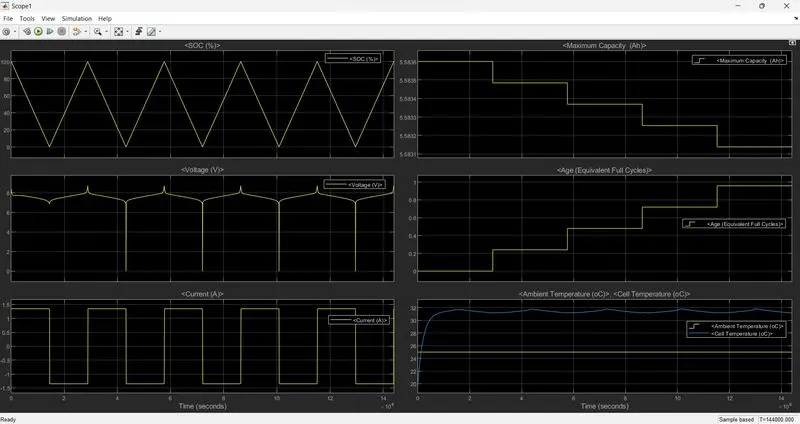
Run simulation for 3600*10*4 secs to get five full cycles. Because of current rate recued to 0.25.
Initially maximum capacity was 5.584Ah but after one complete cycle it goes on decreasing in a very small step of 0.0002354, at the end of simulation it became 5.583Ah. (a very small reduction of 0.000462Ah)
As battery is new, aging effect is zero till the one complete cycle but after that it started increasing in step of 0.2394, this value is still small because the C rate is still low.
Battery is discharging and discharging gradually so that SOC is going from 100 to 0 in 4 hours and again to 100 in 4 hours, a total of 8 hrs for a complete cycle.
Initially Cell temperature keeps on increasing from 20 deg to almost 31.83degree Celsius while charging and again it fell down to 31.22deg Celsius while discharging.
Cell voltage is dropping from 8.363V to nearly 6.876V but as cell temperature increases voltage is also increasing very slowly after each complete cycle, at the end of five cycles cell voltage becomes 8.666V.
Current is changing from +1.35 to - 1.35 Amperes.
CONCLUSION:
1.The cell performance depends upon both ambient temperature as well as charging, discharging rates.
2.If we put very low C rates there is less temperature rise in cells and also the ageing effect increases slowly, also the maximum capacity decays slowly.
3.Giving high ambient temperature keeping C rate same as low there will be large decay in maximum capacity and also aging effect will increase quickly.
4.Similarly, if putting high C rate and Low ambient temperature and vice versa there will be more aging effect as well as voltage will rise with rise in cell temperature. Also, the maximum capacity will decay at faster rate.
So, conclusion is that if want more capacity and less ageing effect we need to give low C rate with low ambient temperature.