Project 2 Thermal modeling of battery pack
Project 2 Thermal modeling of battery pack.
Aim: Create a 10 cell series lithium-ion battery pack model and observe the thermal effect and life cycle performance.
OBJECTIVE:
- Simulate the model and observe the thermal effect at various temperatures, charge & discharge rates.
- Similarly observe the life cycle performance at various temperatures, charge & discharge rates.
Barttery pack:
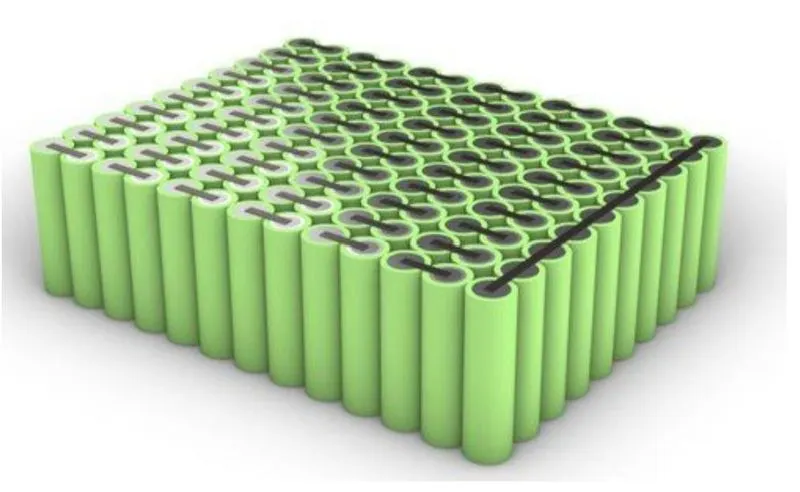
A battery pack is a set of any number of identical batteries or individual battery cells.They may be configured in a series,parallel or a mixture if both to deliver the desired voltage,capacity or power density.Rechargable battery packs often contain a temperature sensor,which the battery charger uses to detect the end of charging.Interconnectors are also found in batteries as they are the part which connects each cell,as per our requirements battery connections configuration made.If we want more voltage than the individual one cell then series connection is made and if we want more current capacity then connect cells in parallel manner.And it looks similar to the fig below.
MATLAB Simulink Model:
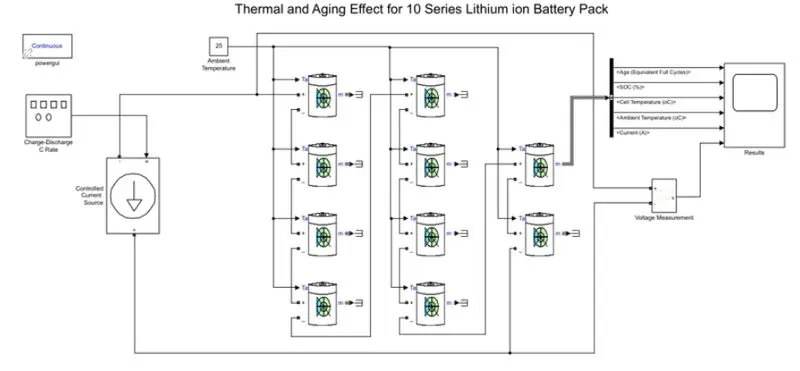
The above fig shows the 1P10S configuration of the lithium-ion battery pack.These are all battery cells connected in series.This battery pack charges adn discharges by using the controlled current source adn square wave generator.For this cell enables the temperature effect and aging effect option for observing and estimating the temperature effect signal effects.So in this model I estimate the age of the cell,SOC of the battery pack,battery pack temperature,ambient temperature,battery pack current by using a bus selector from any one cell of the battery pack,because this battery pack is made from connecting from the cells in series.So,current,temperature,SOC and age of the cell is similar to other cells.The battery pack voltage is calculated by using a voltage measurement block is connected across the battery packi.e,first cell positive terminal connected to the positive terminal of voltage measurement block and last cell negative terminal connected to negative terminal of voltage measurement block.Also by using constant blocks,it provides ambient temperature to the cells.
Signal generator:
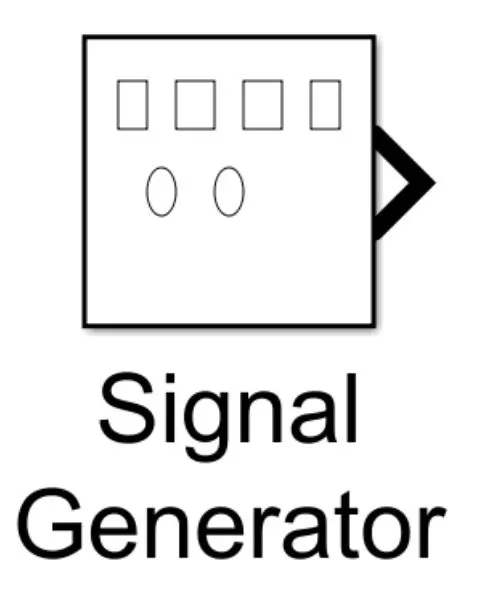
The signal generator block can produce one of four different waveforms:Sine,square,sawtooth adn random.We can express signal parameters in hertz or radians per sec.For this model I used square waveform with -Ia variable as amplitude and 1/(2*3600) Hz frequency.This signal is provided to the current controlled source.
Controlled Current Source:
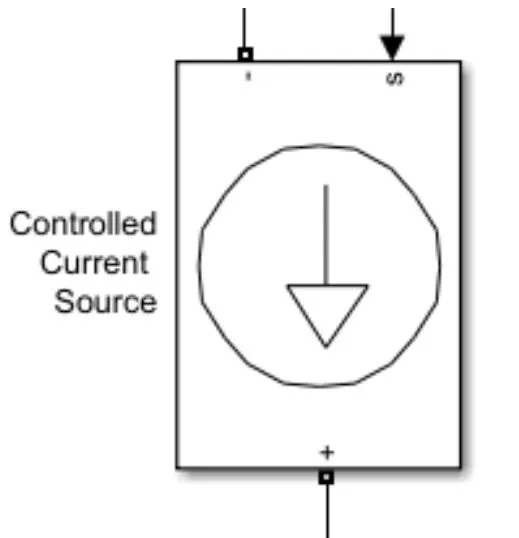
The Controlled Current Source block converts the simulink input signal into an equivalent current source.The generated current is driven by the input signal of the block.The positive current direction is as shown by the arrow in the block icon.We can initialize the Controlled Current Source block with a specific AC to DC current.If you want to start the simulation in steady state,the block input must be connected to a signal starting as a sinusoidal or DC waveform corresponding to the initial value.For this model I used the default value.
Generic Battery:
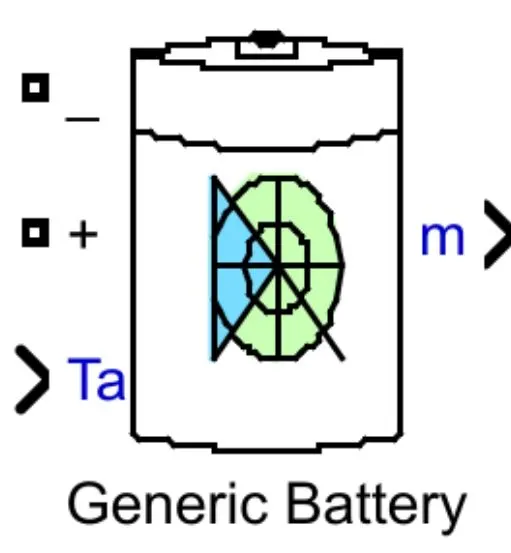
The battery block implements a generic dynamic model that represents most popular types of rechargable batteries.For this model enables the temperature effects and aging effects options.So cell nominal voltage 7.2 V,Capacity 5.4 Ah,initial SOC 100%,in aging section aging model aging sample time is 20 sec,aging characteristics at cell ambient temperature of the cell 25℃ and nominal charge and discharge currents take as Ia variable(I take variable because every simulating time with different current value,it tedious process to change the all cell charge-discharge) which is similar to the input current signal.And all other parameters are default values.So,now our battery pack voltage is 72V and capacity is 5.4 Ah.
So all these blocks are connected as per shown in the above model figure.And this model runs for 10 hours,so we can charge and discharge the battery pack multiple times.
Results:
So,this simulation model simulates multiple times at various different ambient temperatures and different charge-discharge current rate.The ambient temperature varies by changing the ambient temperature constant block and charge-discharge value varies by using the MATLAB command window as shown in below figure.
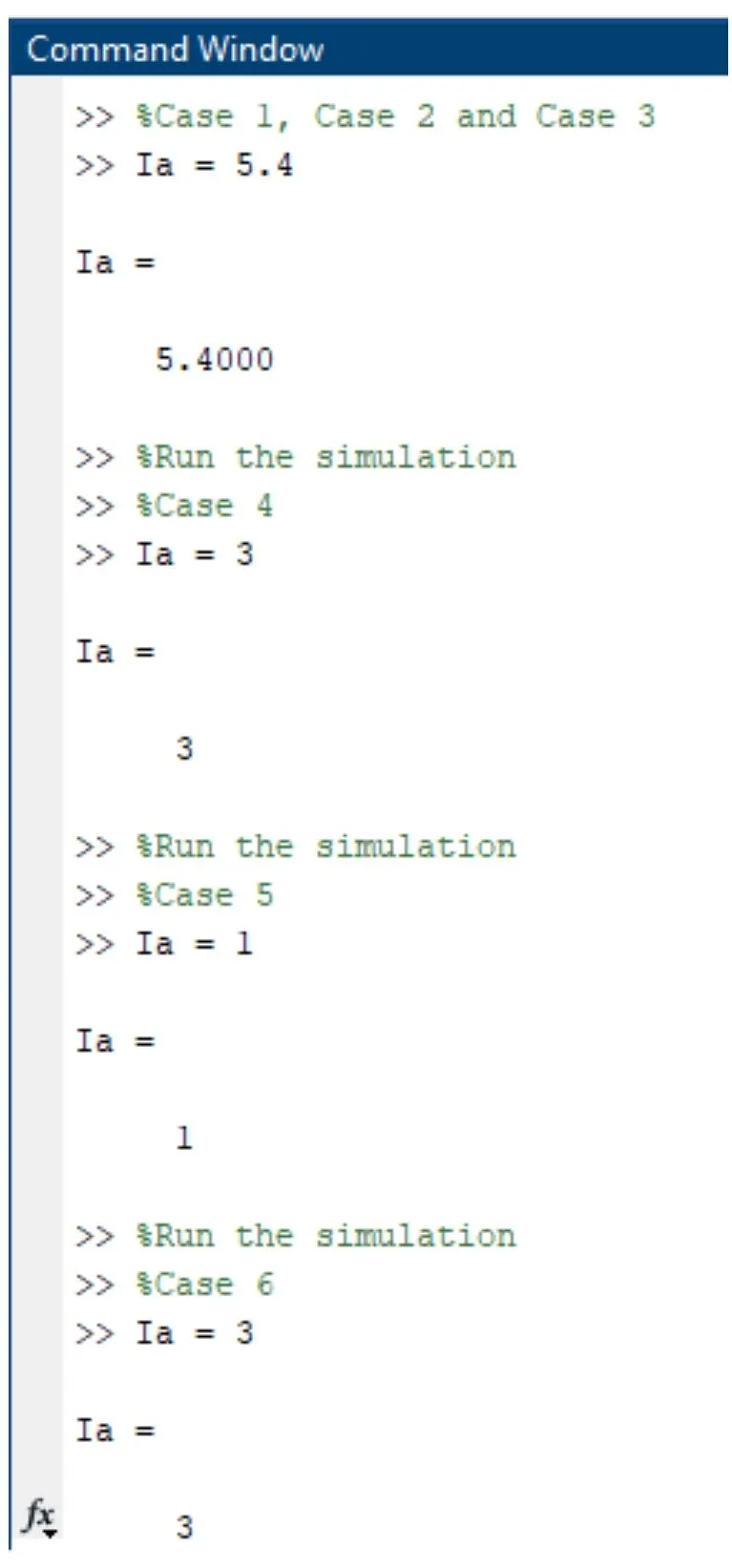
Case 1:- Ambient temperature :25℃ and Charge-Discharge:5.4 A
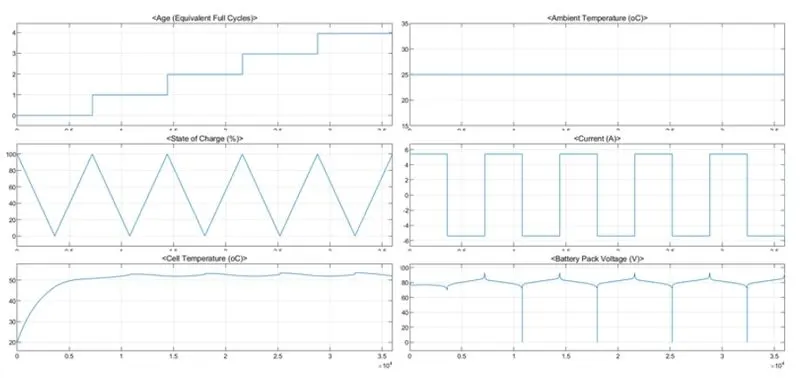
The above figure shows the results, in this case ambient temperature is similar to he cell ambient temperature and similarly the charge-discharge current is also similar to cel maximum current capacity i.e, cells charge-discharge at 1C rate.Therefore the battery pack SOC completely reduces or packs full charge within 1 hour.Thus in 2 hours the battery pack completed 1 life cycle and if we see in the age plot,teh age of the battery pack increases exactely by 1 age,it is because the ambient temperature and aging characteristics at cell the ambient temperature is same.So,in the 10 hours,the battery pack uses 5 life cycles and the age of the battery pack increases upto 5.If we observe the cell tempearture at starting it gradually increases and settels at 52.5℃ and fluctuates within the 52-53℃.When the battery starts charging,temperature starts increasing upto 53℃ and when battery starts discharging,temperature starts reducing upto 52℃.
Case 2:- Ambient temperature: 45℃ and Cgharge-Dioscharge Current: 5.4 A.
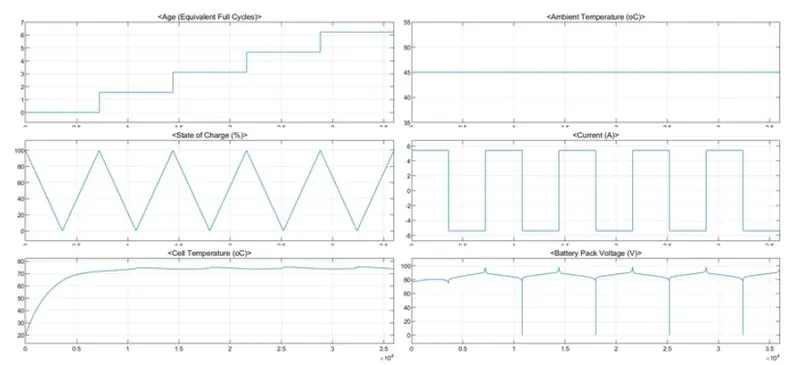
In this case I change the ambient temperatur eto 45℃ and charge-discharge C rate keeps the same i.e, 1C.Due to this reason battery pack SOC and voltage is same but this ambient tempearture adverse effect replicates in the age of cycle and ofcourcde cell temperature also increases.In 2 hours the battery uses 1 life cycle but at the same time the age of the battery increases approximately 1.5 instead of 1.After completing the 5 life cycle,the battery age is approximately 7.5 and the cell temperature reaches 75℃.
Case 3:- Ambient temperature: 10℃ and Charge-Dioscharge Current: 5.4 A.
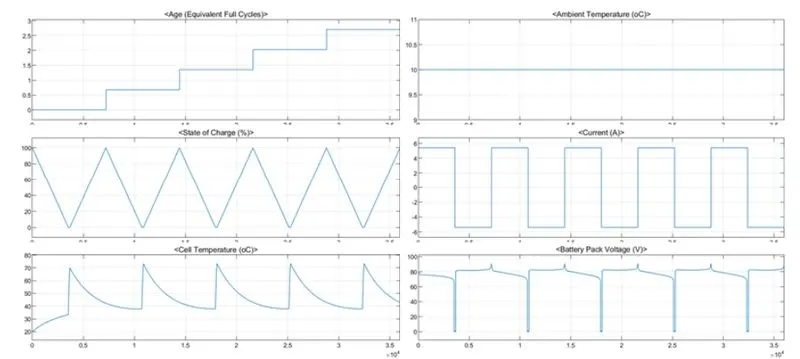
Now in this case anmbient temperature is decreases upto 10℃ and charge-discharge rate is same i.e, 1C.Because of these two reasons battery SOC is same and in the age of the battery favourable results shows.After completing the 1 life cycle of the battery,the age of the battery increases only 0.75.But in the temperature plot,huge spikes are present because of the significant difference between ambient temperatur eand cell tempearture.The cell temperature varies between 38 to 70℃.
Case 4:- Ambient temperature: 25℃ and Charge-Dioscharge Current: 3 A.
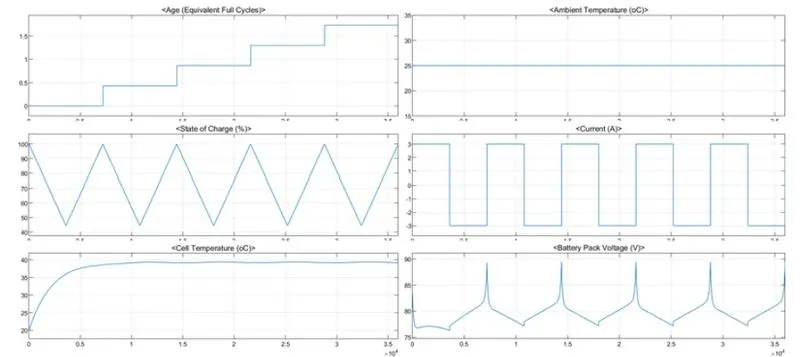
In this model the ambient temperature is kept the same as like in case 1 and charge-discharge current is reduced to 3A i.e,0.56C rate.Due to the reduction in the C rate,now our battery does not discharge beyond 45%.Because of this reason,the voltage of the battery pack plots also changes after completing the two hours in simulation,the age of the battery is below 0.5 and reaching 1 age of the cycle requires 5 hours.In this case charge-discharge rate decreases,therefore cell temperature is also less i.e, 49℃ as compared to case 1.
Case 5:- Ambient temperature: 25℃ and Charge-Dioscharge Current: 1A.
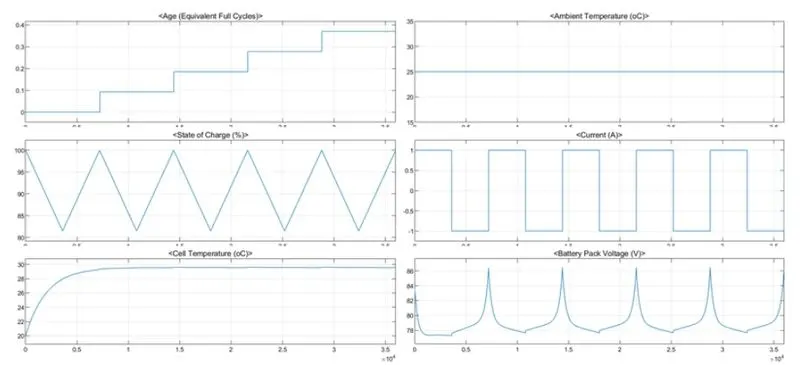
This case scenerio is similar to the case 4 scenerio,In this case I change the charge-discharge current to 1 A i.e, 0.18 C rate.That is why these battery packs do not charge beyond 82%.This effect replicates in the age of battery,cell temperature and battery pack voltage.After completing the 2 hours of simulation,the age of the battery only increases to 0.1.In the battery pack voltage plot voltage spike amplitude is increased as compare to case 4.Because the C rate is very small,the cell temperature is 49℃ and it is stable and does not fluctuate widely.
Case 6:- Ambient temperature: 40℃ and Charge-Dioscharge Current: 3A.
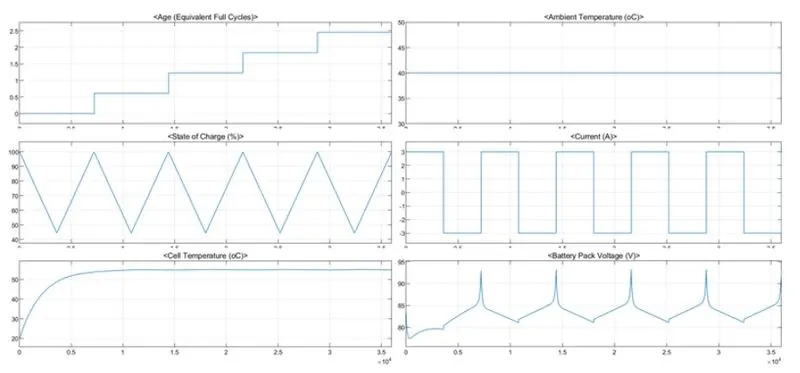
This case is different from other cases because in this case I changed both teh parameters.The ambient temperature is 40℃ and charge-discharge current is 3 A i.e, 0.56 C rate.Because our C rate is lower than the 1C our battery pack does not discharge beyond 45%.Therefore reaching 1age of the battery requires more than 3 hours,in the battery pack voltage spikes are present and cell tremperature is stable at 55℃.
Conclusion:
From these different case studies I conclude that
- When we increase the ambient temperature then obviously cell temprerature increased also this ambient temperature adverse effect reflects on the age of the battery pack and vice versa.
- Similarly when we decrease C rate then shows the favourable and unfavourable effects on the age,SOC,temperature and voltage of the battery pack.
- The age of the battery increases slowly,SOC is not able to charge or discharge completely,cell temperature is less and in the voltage spikes are present.