Project 2 Thermal modeling of battery pack
Question:
For a 10 cell series lithium ion battery model, simulate the thermal effects and compare life cycle performance at various temperatures, charge & discharge rates using MATLAB.
Aime:
The aime of this project is to calculate the thermal effect on a 10 series battery pack, We will be evaluating its life cycle performance at different temperatures during charging and discharging.
Intro:
Just like ICE vehicle knowing the range of drive of your vehicle is also very important for Electric vehicle or hybrid electric vehicle. Hoever for Electric vehicle and Hybrid Electric vehicle its a little differnt. The enery to drive the motor or drive range of the vehicle is affected by so many factors.
-External temperature of the sorounding and Internal temperature of the battery pack, hence the need of a BMS for control.
-The drivers driving styl. frequent hard acceleration and decceleration will drasticaly reduce battery capacity.
-Frequent charging on high voltage as nominal voltage will reduce the battery capacity.
For this project we want to see how the temperature of the battery affects the life clycle and performance of the battery.
This is very important because connecting cells in series increases the total voltage of the pack but in the case of 1 or more cell malfunction or defect the battery pack becomes faulty.It might lead to increase in tempereture in the pack beacuse the energy of the cell will be decipated as heat to its sorounding. It might brake the connection with other cells in series. So a BMS is always needed to control the voltage, current and temperature and thereby influencing the voltage and the energy capacity of the battery pack.
Batter cell:
The tobe used battery cell for this simulation will be the battery (table-Based) block.
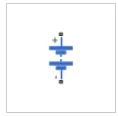

The Battery (Table-Based) block represents a high-fidelity battery model. The block calculates no-load voltage as a function of charge level and optional temperature using lookup tables and includes several modeling options:
-
Self-discharge
-
Battery fade
-
Charge dynamics
-
Calendar aging
Use this block to parameterize batteries with complex no-load voltage behavior from datasheets or experimental results. For a simpler representation of a battery, see the Battery block.
The Battery (Table-Based) block has four modeling variants, accessible by right-clicking the block in your block diagram and then selecting the appropriate option from the context menu, under Simscape > Block choices:
-
Uninstrumented | No thermal port — Basic model that does not output battery charge level and simulates at a fixed temperature. This modeling variant is the default.
-
Uninstrumented | Show thermal port — Model with exposed thermal port. This model does not output internal charge level of the battery.
-
Instrumented | No thermal port — Model with exposed charge output port. This model uses a fixed temperature throughout the simulation.
-
Instrumented | Show thermal port — Model that lets you output internal charge level of the battery. Both the thermal port and the charge output port are exposed.
The instrumented variants have an extra physical signal port that outputs the internal state of charge. Use this functionality to change load behavior as a function of state of charge, without the complexity of building a charge state estimator.
The thermal port variants expose a thermal port, which represents the battery thermal mass.
Model:
Each battery cell has a voltage of 3.51V hence giving a total voltage of 36V
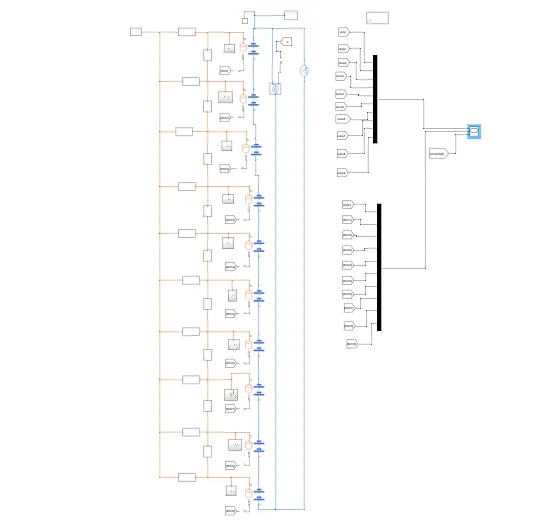
* more detailed pictures of the model
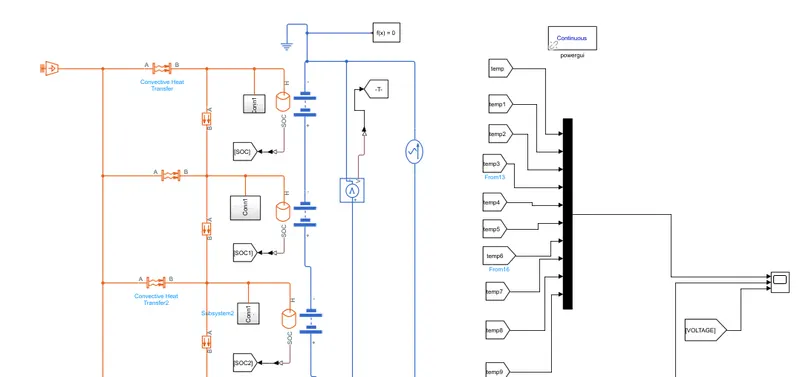
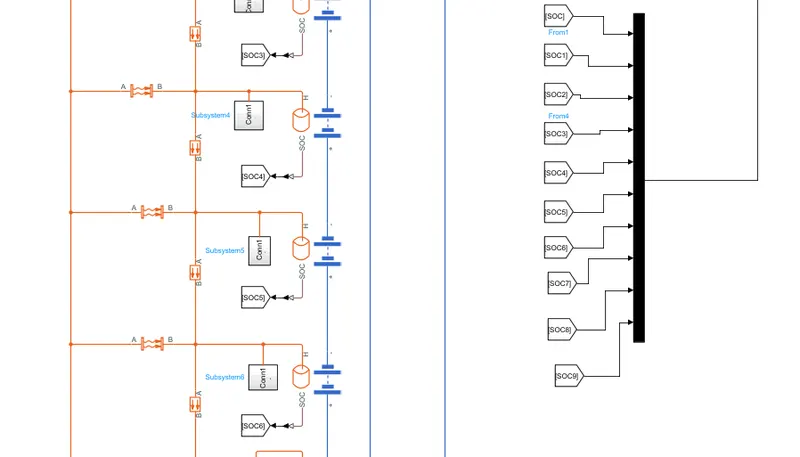
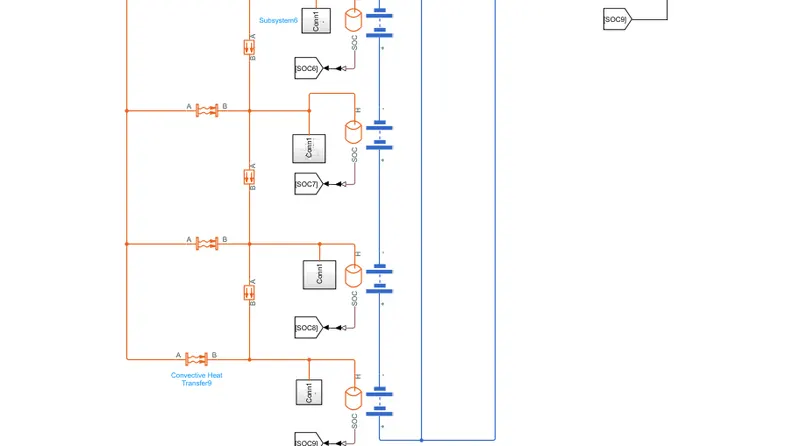
*the battery cells used for this model is the above discribed matlab Battery (table-Based)
-The battery was given following parameters
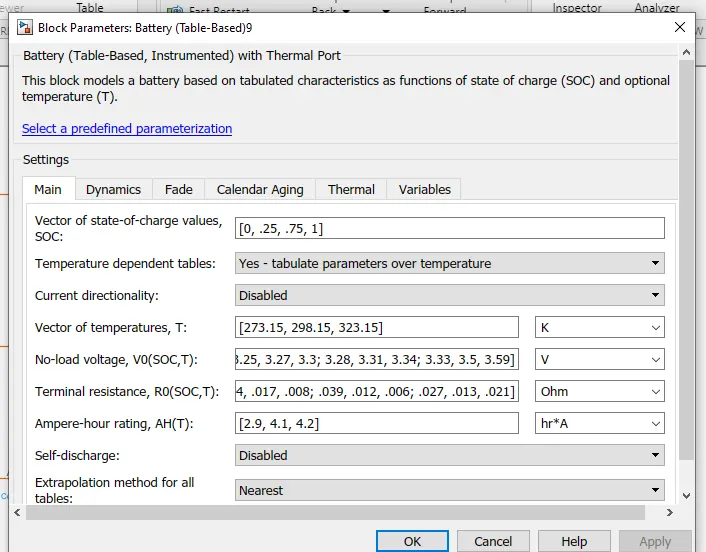
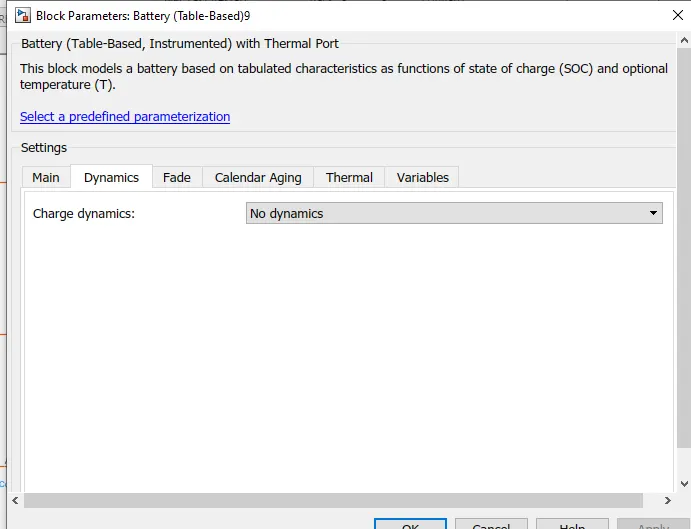
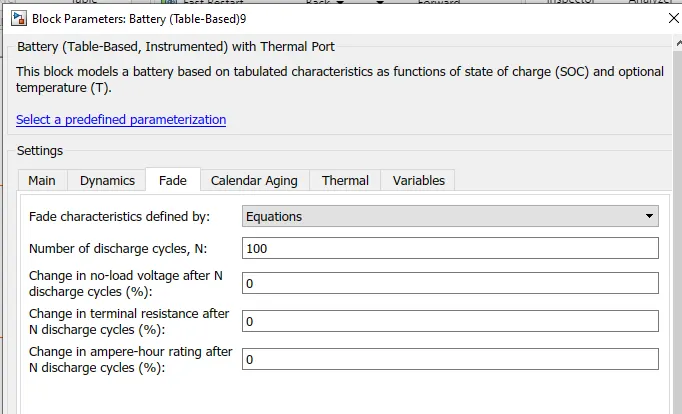
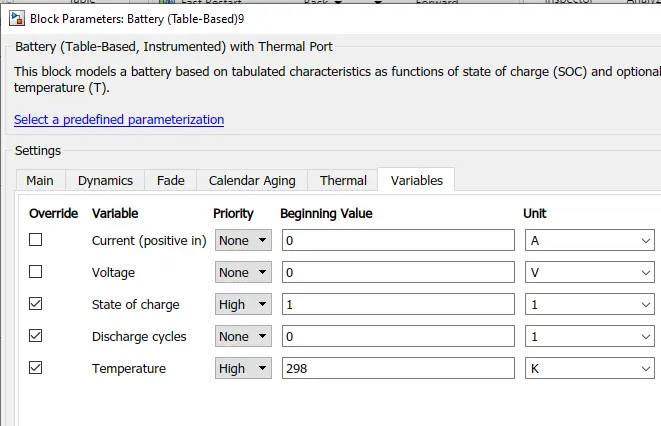
the following blow were also used for the simulation
1) Temperature source :

The Temperature Source block represents an ideal source of thermal energy that is powerful enough to maintain specified temperature at its outlet regardless of the heat flow consumed by the system.
The source generates constant absolute temperature, defined by the Temperature parameter value.
2) Conductive and Convective Heat transfer:
-Both this blocks were used to simulate extrenal thermal transfer onto the battery cells
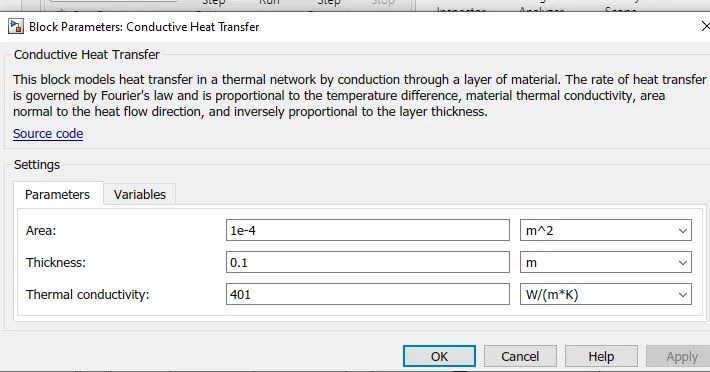
The Conductive Heat Transfer block represents a heat transfer by conduction between two layers of the same material. The transfer is governed by the Fourier law and is described with the following equation:
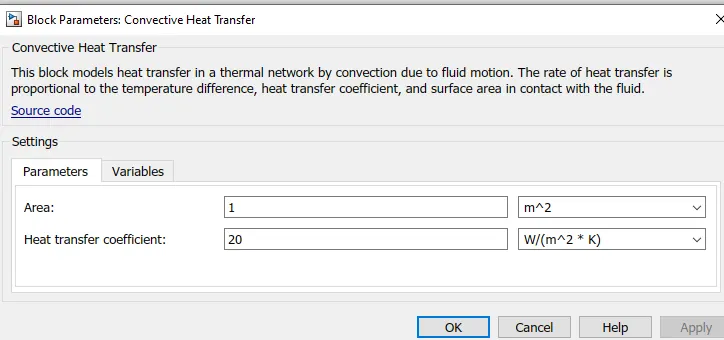
The Convective Heat Transfer block represents a heat transfer by convection between two bodies by means of fluid motion. The transfer is governed by the Newton law of cooling and is described with the following equation:
3) Temperature calculation:
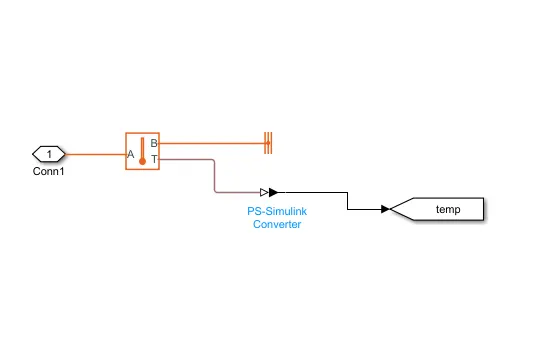
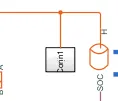 This subsystem is used to calculate the temperature of each cell then later they are all combined with help of a mux block
Simulation:(273.15K = 0°c)
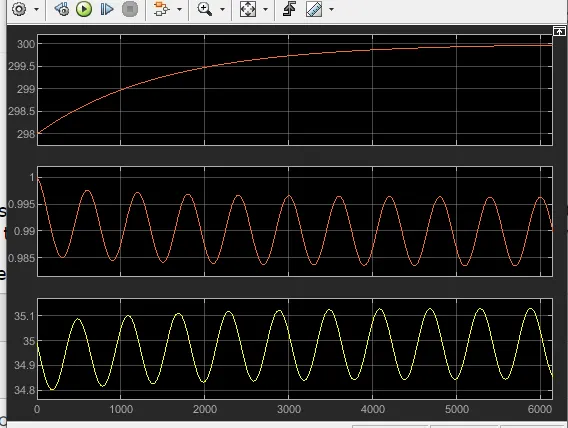
*for the this simulation the external temperature is kept at a constat of 300K then the battery tempirature will be varied and the state of charge will be observed.
*External tempirature is 300k and battery tempirature is 298K
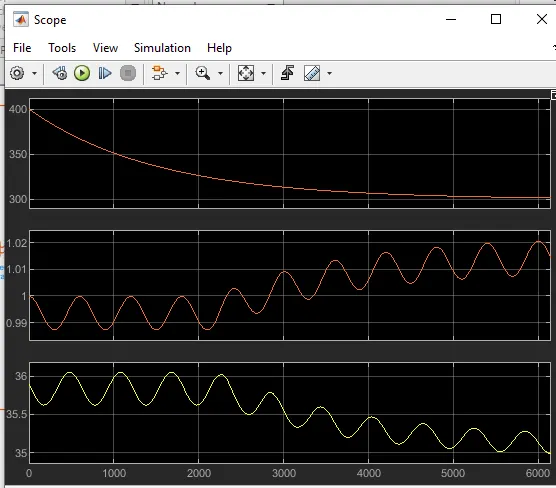
*For the next simulation external temperature is 300k and battery temperature is 400K
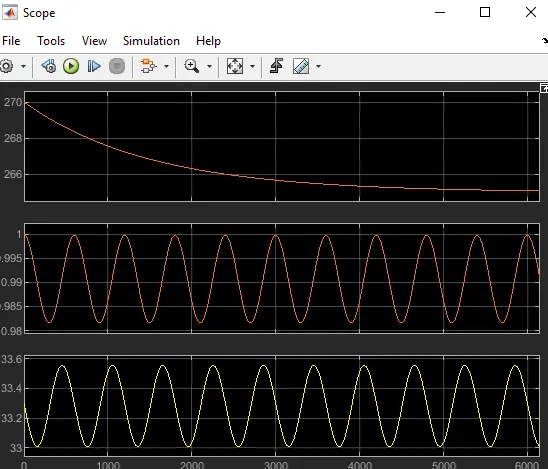
*for the third simulation both external temperature and battery temperature will be taken bolow 0°c. (273,15K = 0°c). External temperature is 265K and Battery temperature is 270K.
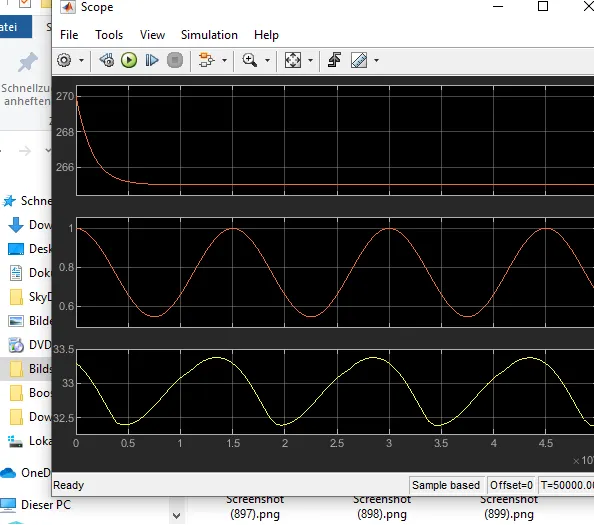
the simulation time and the charging and discharging time was prolonged to better observe how battery statre of charge drops.
Results analysis:
*In the above three simulations plots of thermal effects on charging and discharging 10 batteries cells in series and thier aswell life cycle.
*Since all cells are in series they have a total voltage of almost 35V to 36V.
-The first plot on each simulation image is the thermal change of the batteries.
-The second is the charge and discharge on the batteries
The third which is a yellow line is the voltage diffence across the battery during the charging and discharging.
*For th fir simulation a normal room temperature (24-27) was choosen, later a higher temperature was choosen and finaly a low temperature.
*For the first simulation of room temperature we notice the battery has a healthy state of charge since the voltage fluctuates between its voltage range, and the soc was aslo stady.
*At higher tempirature we notice an unstability in the SOC of battery and the voltage not charging to its original 36V of value
*At low temperature the SOC , Battery voltage capacity and its life cycle is also compromised .