Project 2 Thermal modeling of battery pack
THEMAL MODELLING OF BATTERY PACK:
According to the difference in heat transfer medium, thermal management of lithium-ionbattery can be divided into three types: phase change material cooling, air cooling and liquid cooling . Amongst these three, first one is passive thermal management and theremaining two are the active thermal management. The external air enters into the innerchannel of the battery pack at the time of air cooling. After the convective transfer of the heat on the surface of the battery and the flows out along with the air. Based on the spontaneity of the air flow, cooling can be divided in two types: free convective air coolingand forced convective air cooling. Free convective air cooling is defined as the natural convection caused by vehicle driving is. The heat transfer coefficient on the heat exchange surface is approximately 5 W/m ∗ ℃. Forced convective air cooling is driven by a fan to provide the flowing air. Its heat transfer coefficient on the heat exchange surface is about more than 10 W/m ∗ ℃. In the designing of the air duct, air cooling has higher demands, and the temperature consistency of the cell monomer is not optimal enough due to inconsistency in the flow field.
Thermal management systems on the surface of the battery are based on heat transfer,similarly, to mitigate the temperature rise in the center of battery and balk the degradation process of materials. The intrinsic thermal properties such as latent heat per volume of the battery and the ability to effectively shuttle heat away by the convection of air from the battery surface. The battery packs and its application decide to use active thermal
management or passive thermal management systems in a battery. Such as man-pack electronics and electric driven tools it uses active thermal management systems are efficient to transfer heat away from the battery surface, size occupies a large amount of space. Passive thermal management systems that are PCM based provide concise in construction which mitigates the demand for mechanical devices and doesn’t require additional power to operate them
SIMULATION OF THERMAL MODELLING OF BATTERY PACK:
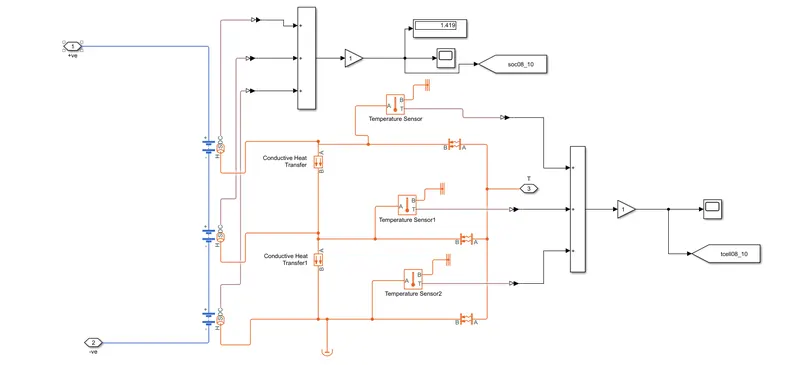
for simulation we take 10 cells in series and create subsystems and table based batteries, controlled current source,temperature sensor,thermal mass,conductive heat transfer,convective heat transfer,perfect insulator,thermal referance,controlled current source,resistor,electricalreferance,signal builder.
table based battery:
This block models a battery based on tabulated characteristics as functions of state of charge (SOC) and optional temperature (T).
controlled current source:
The block represents an ideal current source that is powerful enough to maintain the specified current through it regardless of the voltage across it. The output current is I = Is, where Is is the numerical value presented at the physical signal port.
resistor:
The voltage-current (V-I) relationship for a linear resistor is V=I*R, where R is the constant resistance in ohms.The positive and negative terminals of the resistor are denoted by the + and - signs respectively. By convention, the voltage across the resistor is given by V(+)-V(-), and the sign of the current is positive when flowing through the device from the positive to the negative terminal. This convention ensures that the power absorbed by a resistor is always positive.
temperature sensor:
This block measures temperature in a thermal network. There is no heat flow through the sensor. The physical signal port T reports the temperature difference across the sensor. The measurement is positive when the temperature at port A is greater than the temperature at port B.
conductive heat transfer:
This block models heat transfer in a thermal network by conduction through a layer of material. The rate of heat transfer is governed by Fourier's law and is proportional to the temperature difference, material thermal conductivity, area normal to the heat flow direction, and inversely proportional to the layer thickness.
convective heat transfer:
This block models heat transfer in a thermal network by convection due to fluid motion. The rate of heat transfer is proportional to the temperature difference, heat transfer coefficient, and surface area in contact with the fluid.
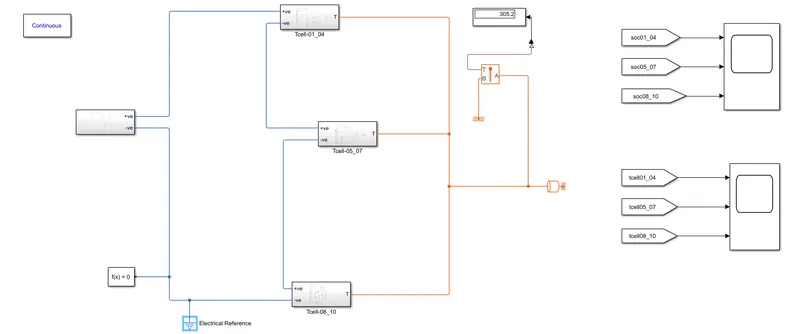
we load the values in signal builder temperature and time values from udds cycle and we use by using controlled current source give soc and temperature . we use ps -simulink converter Converts the input Physical Signal to a Simulink output signal create subsystem for signal builder and 4 batteies in one subsystem and 3,3 batteries in other subsystems and make connections we take the values of soc and temperature from blocks to scopes.
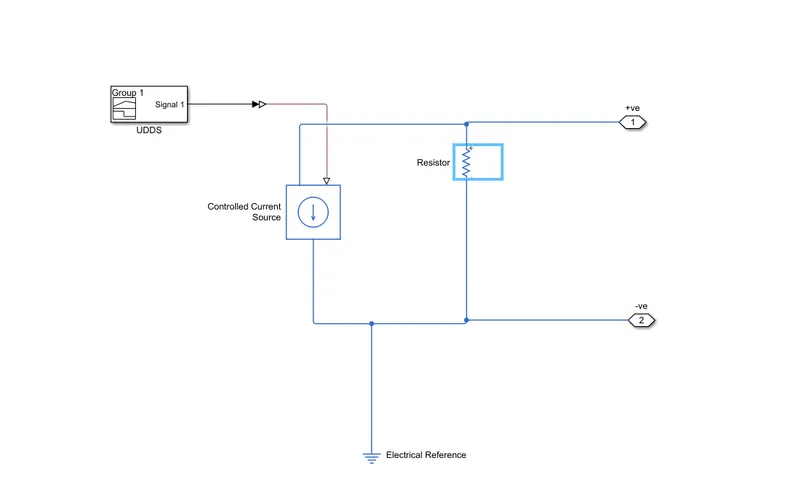
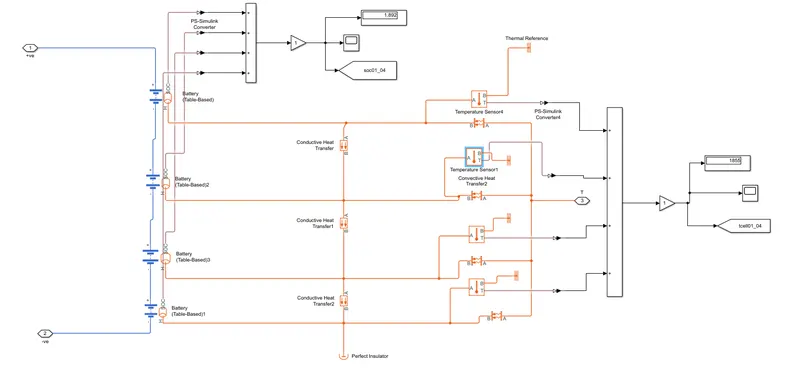
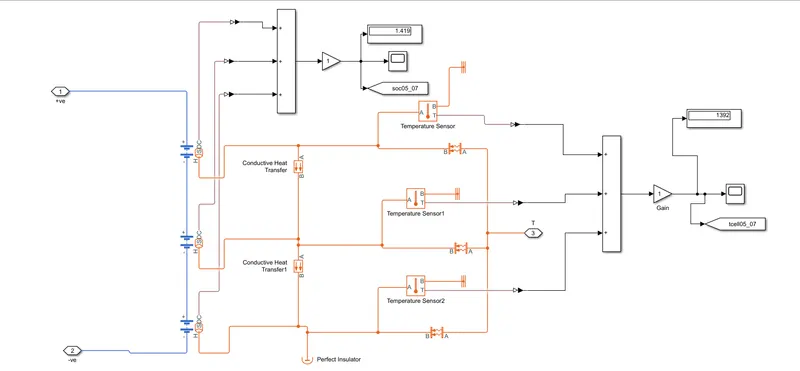
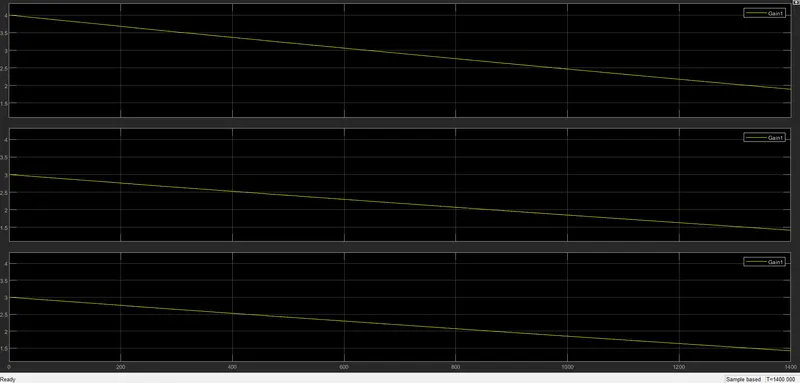
scope for state of charge:
As we see that the battery is fluctuating which depend uponthe thermal behaviour battery pack
scope for temperature:
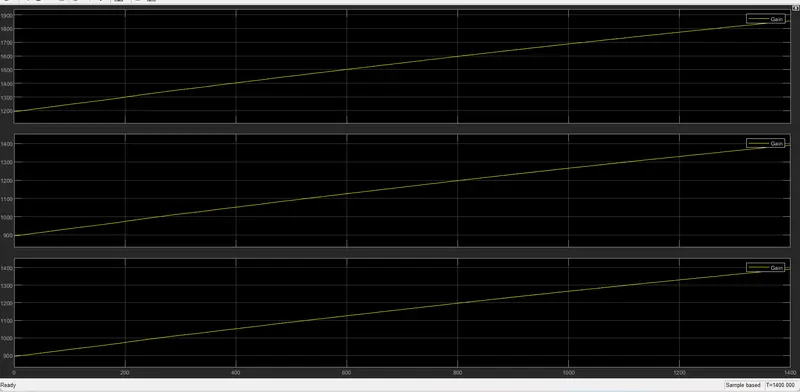
the flow of heat is decreased at constant and minimum teperature there is slightly changes in cyclic charge and discharge of cell.