Project 2 Thermal modeling of battery pack
AIM:
For a 10 cell series lithium ion battery model, simulate the thermal effects and compare life cycle performance at various temperatures, charge & discharge rates using MATLAB.
OBJECTIVE:
- Simulate the thermal effects of lithium ion battery.
- Compare life cycle performance at various temperatures, charge and discharge rates.
THEORY:
It has been very know that the temperature of the battery is important for their performance, efficiency, safety, and capacity. On the one side the temperature is influenced by the environmental temperature; on the other side the temperature of the battery is influenced by the charging and discharging process. As the ageing of the battery cell accelerates when the temperature of a cell is too high, battery management systems (BMS) take into account this effect using the battery temperature. Additionally, with the knowledge of the core temperature a BMS can adapt the current flow so that the efficiency of a battery is at its optimum. Due to the difficulty measuring the battery cell temperature, the temperature is often measured on or near the poles of the cell. We know that the temperature measured at the poles of a dynamically loaded battery varies to the relevant cell temperature. Hence, the accuracy of the measurement at the poles is limited. Therefore a thermal model of the battery is used in order to calculate the cell temperature.
SIMULINK MODEL:
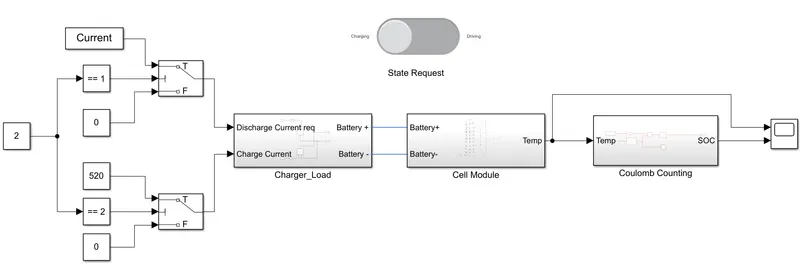
Fig: Simulink Model
This Simulink model consist of a state request system, switching circuit system, cell module system and coulomb counting system.
State request system:
Here according to the state request we use dynamic current and constant current inputs for analysis.
Switch block helps to select the input according to the state request. Switch passes input 1 when input 2 satisfies the selected criterion otherwise, pass through input 3. The inputs are numbered top to bottom. The first and third input ports are data ports, and the second input port is the control port. The criteria for control port 2 are u2 >= Threshold, u2 > Threshold or u2 ~= 0.
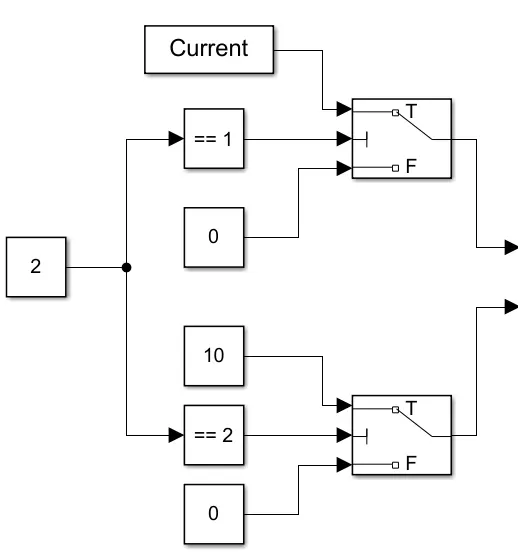
Switching circuit system:
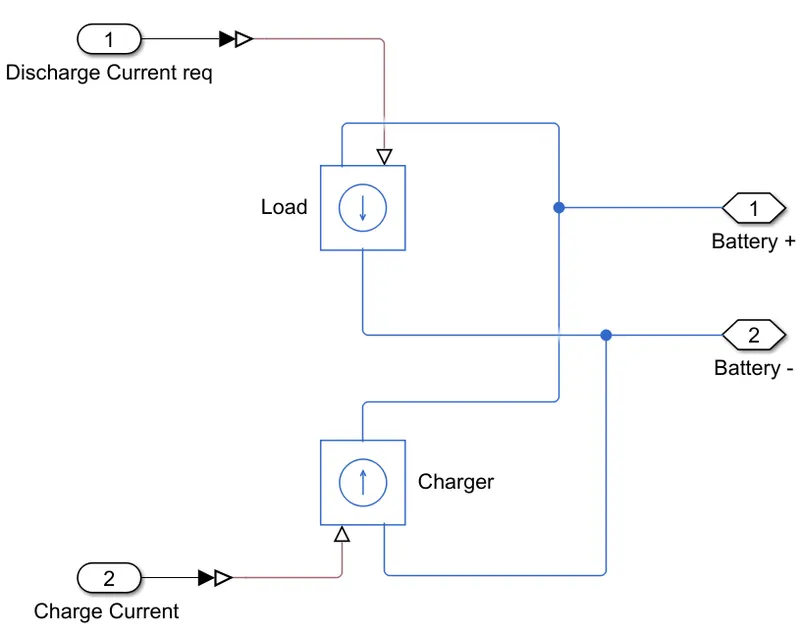
This subsystem use a controlled current source to constantly charge and also dynamic charge and discharge the battery. A physical signal is given to both blocks in order to operate.
Cell Module:
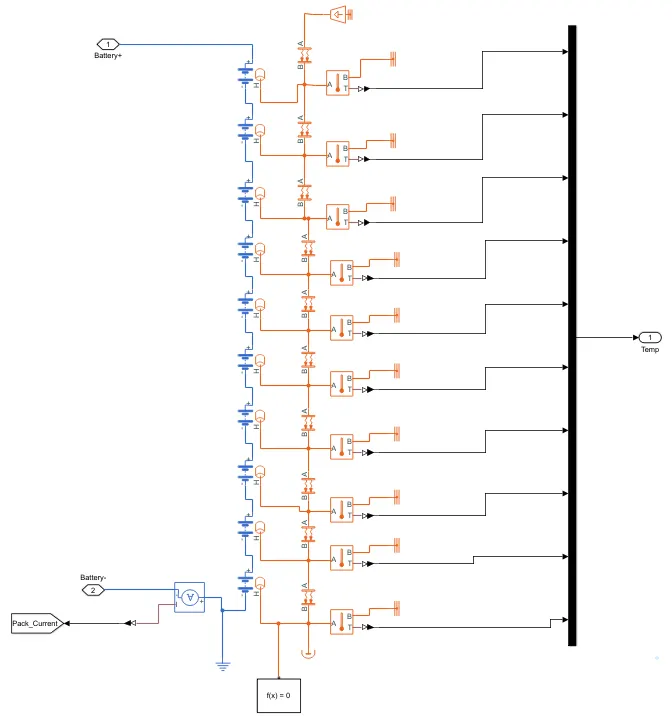
Cell module consist of 10 cells connected in series. The cell parameters are configured as below.
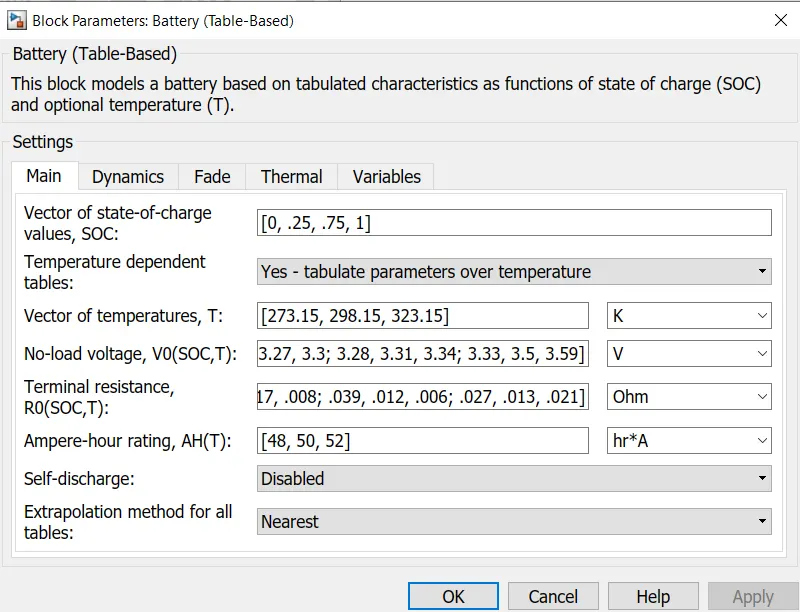
The battery model we are using has thermal port, which need a temperature source, temperature sensor and a convective heat transfer block.
Temperature source:

The Temperature Source block represents an ideal source of thermal energy that is powerful enough to maintain specified temperature at its outlet regardless of the heat flow consumed by the system. The source generates constant absolute temperature, defined by the temperature parameter value.
Convective heat transfer:
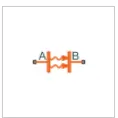
The Convective Heat Transfer block represents a heat transfer by convection between two bodies by means of fluid motion. The block is configured by giving surface area in contact, temperature difference and heat transfer coefficient.
Temperature sensor:
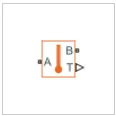
The Temperature Sensor block represents an ideal temperature sensor, that is, a device that determines the temperature differential measured between two points without drawing any heat. Connections A and B are thermal conserving ports that connect to the two points where temperature is being monitored. Port T is a physical signal port that outputs the temperature differential value.
Current sensor:
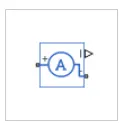
The Current Sensor block represents an ideal current sensor, that is, a device that converts current measured in any electrical branch into a physical signal proportional to the current. Connections + and – are electrical conserving ports through which the sensor is inserted into the circuit. Connection I is a physical signal port that outputs the measurement result. This block is connected series to the cell connection.
PS-Simulink convertor:
This block converts physical signal to simulink signal.
Coulomb Counting:

Coulomb counting method measures the discharging current of a battery and integrates the current over time along with temperature in consideration to estimate SOC. Coulomb counting method is done to estimate the SOC(t) , which is estimated from the discharging current, I (t), previously estimated SOC values, SOC(t-1) and charge capacity of battery, Qn. SOC is calculated by the following equation:
`SOC(t)=SOC(t-1)+(I(t))/Q_n ∆t`
But there are several factors that affect the accuracy of Coulomb counting method including temperature, battery history, discharge current, and cycle life.
Coulomb counting system consist of lookup table, gain block and integrated block.
Lookup table:
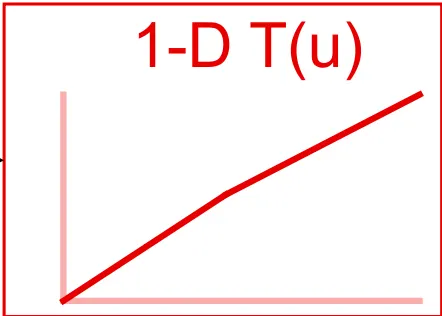
The lookup table maps inputs to an output value by looking up or interpolating a table of values defined within block parameters. Here input is temperature and output value is given by looking the table of data.
Discrete-Time integrator:
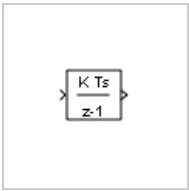
This block integrate the signal using forward Euler method for the sample time.
RESULT:
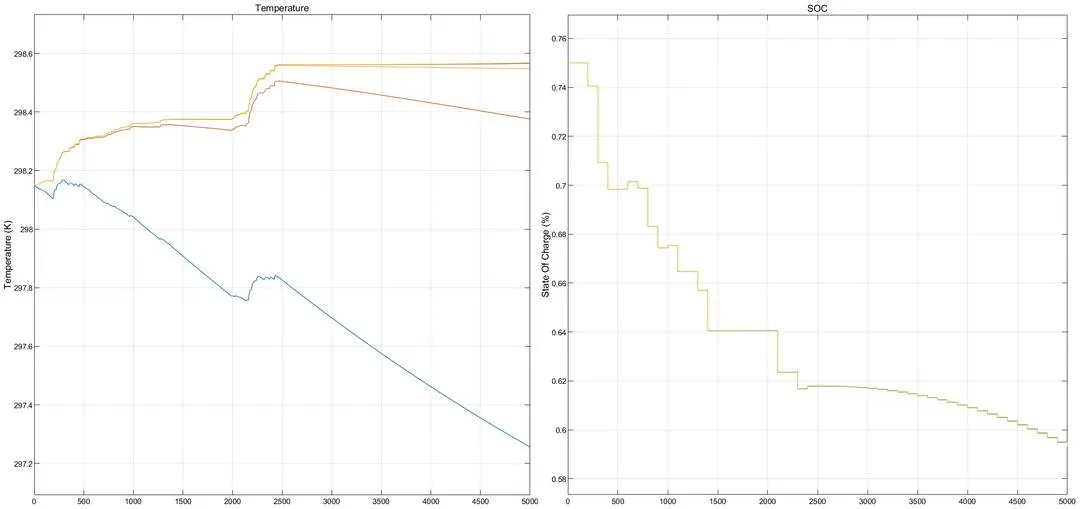
FIG: Charge and Discharge of battery at 293.15K ambient temperature
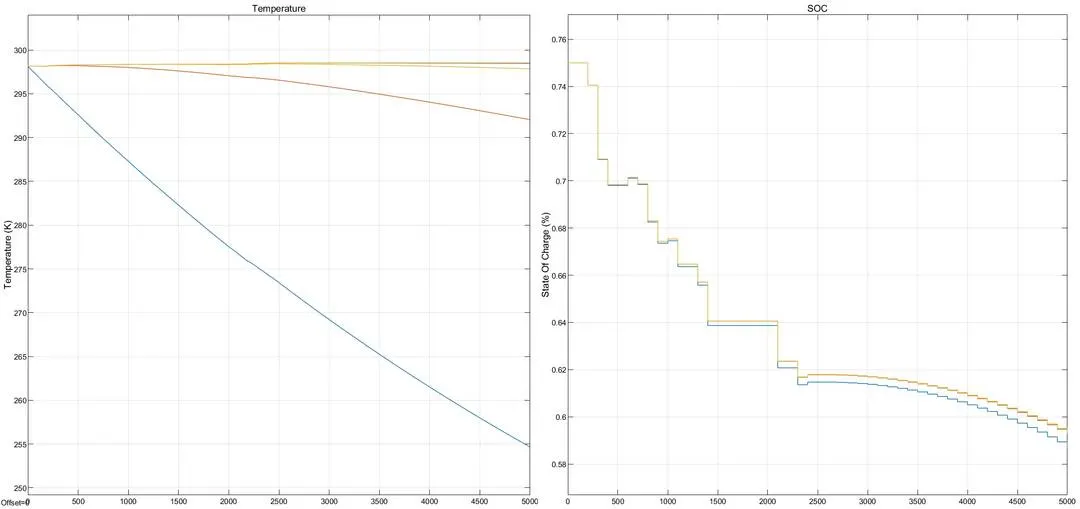
FIG: Charge and Discharge of battery at 120K ambient temperature
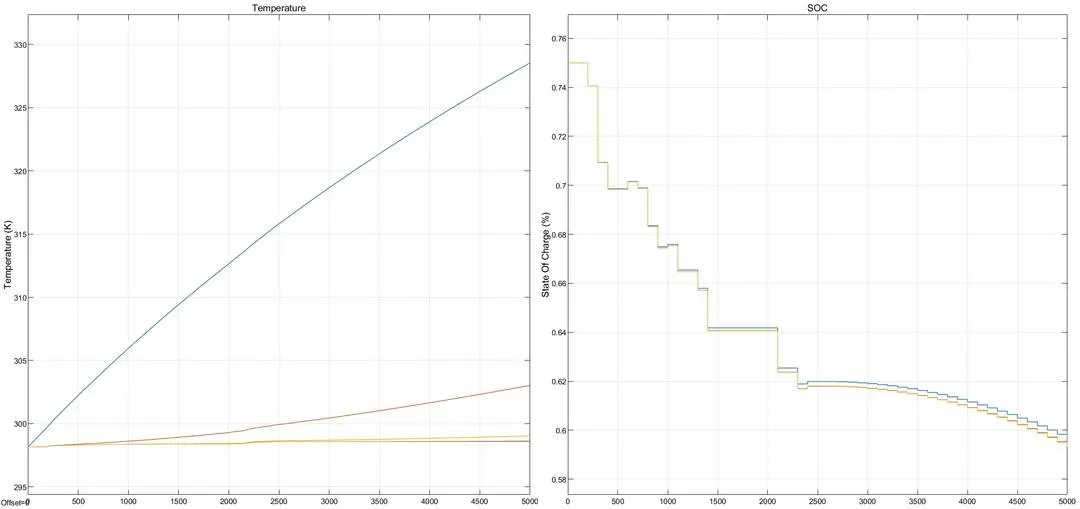
FIG: Charge and Discharge of battery at 420K ambient temperature
From this simulation we can see that when different ambient temperatures were given the cell 1 shows the most deviation from other cells and also as temperature changes there is slight difference in charge discharge cycle.
Life cycle of the battery depends on how we charge and discharge the battery along with the temperature in consideration.
We can improve the system by introducing cell balancing. The need of cell balancing is that to avoid damage of battery because of too much charge and discharge. The other reason for cell balancing include thermal runaway, especially lithium cells are very sensitive to overcharging and undercharging. This leads to thermal runaway when the rate of internal heat generation exceeds the rate at which the heat can be released. By the use of cell balancing, every non-defective cell in the battery pack should be balanced to the same relative capacity as the other non-defective cells. Other than using cell balancing, you can keep the pack cool since heat is one of the primary factors that lead to thermal runaway.