Project - 2
Project name :-Additive manufactured in Human Orthopedic Implants
intoduction:
- In biomedical engineering, orthopaedics is surgical discipline applied through various disciplines such as joint arthroplasty, ranging from trauma surgery to tumour surgery for correction of the deformity. Orthopaedic applications provide a detailed analysis of the musculoskeletal system and craniomaxillofacial surgery.
- Applications of additive manufacturing give a flexible solution with quick and cost-effective production of implants and also surgical instruments with high-quality of patient-specific. AM offers multiple benefits as compared to conventional implant production methods. By 3D CAD data, patient-specific parts are produced without using any tool along with required medically compatible materials and with a high quality of accuracy and precision.
- It makes surgeon job easier and optimise patient's treatment with minimum unpleasant side effects. AM methods can produce individual instrument and easily manufacture various medical devices. This technology is recasting in orthopaedic care that rapidly fabricates implantable devices by the use of bioactive materials and polymer.
- In orthopaedics, AM has extensive benefit for bone ingrowths capabilities. It enables to fabricate complex metal parts of the different shape, size and design. Regarding improving lives, it has a dramatic effect on the human condition. This is helpful for both clinical environment and manufacturing method. It creates implant of spinal devices, standard knee and helpful in the development of orthopaedic implant.
The additive manufacturing process is really much more complex and can be broken down into four main steps:
- As you’d expect, CAD plays a critical role in additive manufacturing. It’s used to design and test 3D models that are viable for real-world applications.
- Some of the top CAD software products for professional use include:
AutoCAD — one of the first CAD suites to be released, all the way back in 1982. AutoCAD is widely used across all industries for 3D design, and known to be extremely versatile in expert hands.
Creo — a market leader in product design that includes a wide range of design functionality and the ability to complete dimension calculations during the modeling process.
SolidWorks — widely used for industrial object design. Solidworks includes an extremely wide range of engineering tools and features.
Step 2: Pre-Processing
Pre-processing covers a range of steps that must be completed between design and manufacturing. It covers two primary activities:
1) simulation modeling
Simulation modeling is used to digitally test 3D designs before they are manufactured. These tests are used to determine the real-world structural integrity of an object — i.e., whether it is likely to fail, how it might fail, and what forces it can withstand without failing.
2) Preparing Files for 3D printing
Once a 3D design has been tested and signed off, it’s ready to be prepared for printing. To do this, a hurdle must be overcome
Interoperability is the ability of different computer systems to exchange and make use of information. In the additive manufacturing process, the problem is simple — manufacturing machines like 3D printers don’t ‘understand’ CAD files well enough to enable the manufacturing process.
To overcome this, a file must be converted into a set of instructions that can be understood by additive manufacturing hardware. These instructions are created using ‘slicer’ software which converts the 3D design into 2D layers or slices which can then be used to calculate the tool path or G-Code needed to manufacture the object.
Step 3: Printing
Depending on the additive manufacturing technology being used, the ‘printing’ phase can look very different.
In a typical 3D printing process — like those seen in commercially available 3D printers — print heads alternate a layer of powder material with a layer of binding liquid. These layers are built up on top of each other to form the final product. This process is more accurately called ‘binder jetting’.
However, other forms of additive manufacturing look quite different.
Stereolithography (SLA) uses powerful lasers in place of a liquid binder to cure layers of photopolymer resin. During the build cycle, the building platform is lowered into a pool of resin, into which the laser traces the pattern of the layer being printed. Once each layer is cured, the build platform is fractionally lowered into the resin pool.
On the other hand, in Fused Deposition Modeling (FDM), a thermoplastic material is heated and applied to the build platform layer-by-layer. Once a layer is dry, the next layer is applied on top of it.
Other common techniques include Selective Laser Sintering (SLS), Metal Laser Sintering (DMLS), and Electron Beam Melting (EBM).
Step 4: Post-processing
Post-processing is often the most expensive and time-consuming aspect of additive manufacturing.
The steps vary depending on the type of additive manufacturing process being used, but usually fall into three categories:
- Build removal — Removing excess material from the object and build platform.
- Part separation — Removing the object from the build platform, separating parts, and removing any support structures used to aid the build process.
- Debinding — Soaking objects in a solution to remove any excess binding material.
types of orthopedics implants
- The three most common types of orthopedic implants are screws, plates, and prostheses, and you can be sure that once your hardware is in place, you will feel like your orthopedist has brought you back to life!\
a) SCREWS :
- Looking nearly identical to the screws you might find at a hardware store, orthopedic screws can have either a flat or Phillips head, and are used to tighten up damaged areas, such as a torn labrum or rotator cuff. Expect your orthopedist to use screws to repair fractured bone or restore stability in a weak area, and do not expect to have them removed. Typically, your screws are there to stay.
b)Plates
Orthopedic plates were first used to fix long bone fractures in 1886 – more than 50 years after Mary Shelley wrote Frankenstein. Perhaps these doctors were inspired by this horror masterpiece? It is doubtful, because plates were then and remain a most successful treatment for fractures, reconstruction and stability. There are five primary types of plates:
- Buttress plates are used to hold together fractures at the end of long bones, in particular, at the knee and ankle, where the fracture site experiences large compressive and other distorting forces. These plates are contoured so they can move with the body, however, some may be L- or T-shaped.
- Neutralization plates are not a specific plate, but rather, a category of plates that work to span the fractured area, balancing the load so that screws or other devices can secure and stabilize the area.
- Bridging plates are used to stabilize the area while providing length and alignment. Additionally, bridging plates promote secondary bone healing because they preserve the blood supply to the fracture fragments by not disrupting the damaged area.
- Tension plates usually are wires used to secure an area as it heals.
- Compression plates are metallic plates used to repair a bone by using dynamic pressure between bone fragments to promote healing.
c)prothesis
- ORTHOPEDISTS use a variety of orthopedic prosthetic implants to replace missing joints or bones, or to provide support to a damaged bone. Most commonly, orthopedists use prostheses for knees and hips, allowing the patients to regain full range of motion, pain-free, in a relatively short amount of time. In some cases, the prosthetic material can be combined with healthy bone to replace diseased or damaged bone, or prostheses can replace certain parts of a joint bone entirely.
Internal Fixation: Plates:-
- A plate is a type of internal fixation that is attached to the bone with screws. Plates are made of surgical grade stainless steel or titanium. After treatment, plates can be removed during a surgical procedure or they can remain in place. Our doctors discuss the pros and cons about removing plates with each patient.
How are plates used:-
Plates secured with multiple screws are used to hold pieces of bone together after oseotomyor fracture. Special short two-holed plates with only two screws are used to perform guided growth in children, a method that slowly corrects crooked bones through natural growth without surgically cutting the bones.
A plate can be used when crooked bones are straightened during surgery. The crooked bone is cut , and the two bone fragments are moved until they are correctly aligned. Then a plate can be applied to keep the bone securely held in the correct position while it heals. Applying a plate can reduce the chances of nonunion (the bone cut not healing) and malunion(the bone cut healing crooked).
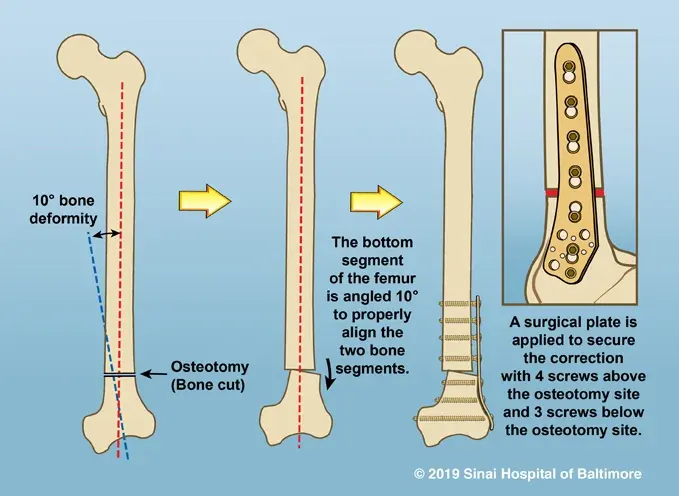
- A recently fractured bone (from trauma/injury) also may need to be stabilized and held in the correct position to heal. In simple fractures, this can be accomplished with a cast or splint. For complex fractures, a plate may be applied to the bone. During surgery, the bone fragments are aligned and then a plate is secured to the bone with screws. The plate keeps the bone fragments in the correct position while the bone heals. Eventually, when the bone is fully healed, the plate can be removed. If a plate is in a certain location in an adult, it may remain in place forever.
- Titanium (Ti) and its alloys (mainly Ti-6Al-4V) have become the metals of choice for dental implants. However, prosthetic components of the implants are still made from gold alloys, stainless steel, and cobalt-chromium and nickel-chromium alloys.
PROCESS AND METHODOLOGY of manufacturing implants:-
- The process was aimed at developing a system for the rapid manufacture of anatomically adapted implants which allows for the faithful reproduction of the fine details of any anatomical structure, and can be used simultaneously with surgery. The approach was based on the intraoperative procedure developed by Mulier et al.to obtain the geometry of the implant by direct capture during surgery of the housing structure.
- The methodology was developed to minimize the costs of acquiring the necessary technology and the time for implementing the solution.
- To perform the surgery, there is a preliminary stage that begins with an XR, and based on this information, the surgery-specific instruments that may be necessary are designed and manufactured.
- A master model is also made, which will support the material used for printing in obtaining the geometry of the implant and an implant with an oversized shape so as to decrease the time of manufacture of the implant during surgery, because the geometry and final sizing of the implant will be determined during surgery and after obtaining the contour of the housing in situ.
- During surgery, after establishing the housing structure of the implant, the doctor uses the previously manufactured master model and obtains the geometry of the implant in detail using the printing material. This geometry is then placed in a 3D laser scanning machine to generate a digital model of the contour of the implant.
- This virtual 3D model is transferred to the CAM system that will generate the control program of the CNC machine where the implant will be made. The pre-implant obtained with the oversized shape is then subjected to machining that will determine its final geometry. After sterilization, the implant is ready to be placed in the patient.depicts the process of the intraoperative manufacture of implants.
Conclusion
Additive manufacturing is a type of manufacturing process that produces a 3D object from the digital model. Based on CT and MRI, the bone 3D image can be reconstructed, and then obtains a bone prototype by layer by layer technique and play an effective role in medical as well as in orthopaedic surgery. This is helpful for surgical design, teaching and presentation of complex surgeries. By using reverse engineering technique of AM, a missing part of the bone is created. The popularity and advancement of this technology are for implant design and fabrication, tissue engineering, preoperative surgical planning and even in training of doctors and surgeon. It produces an implant of the individual patient at a fast pace which fits better as compared to standard implant manufacturing by the traditional manufacturing process. The true physical model produced by this technology allows the surgeon to have a better understanding. Production of scaffolds for bone tissue engineering is another application of this technology which is used for the fabrication of structurally sophisticated bio-scaffolds. 3-D bio-scaffolds are designed as per the need of clinical applications with significant mechanical and biological properties. 3D printed surgical guides simplify the surgery that reduces operative time and makes surgery precise. CT and MRI scan are used to capture data, and additive manufacturing technologies are used to make surgery successful.