Project 2
Using MATLAB/Simulink and the drive cycle from the attached excel sheet, find-
- The max heat generation of the battery
- The SOC of the battery at 2 *104 seconds of the battery operation.
a)
Aim:
To determine the maximum heat generated by the battery from a given drive cycle. And calculate the SOC using MATLAB/Simulink for 2 *104 seconds of battery operation.
1. The max heat generation of the battery
There are 2 heat sources for the battery heat generation
- Joules heat
- Entropy heat
Heat generated = Joules Heat + Entropy Heat
Joules Heat :
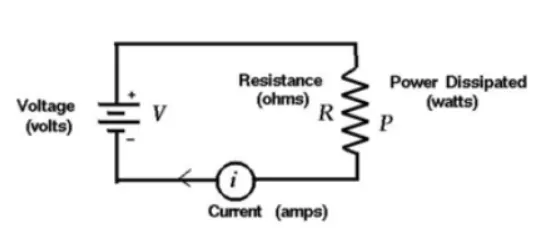
froms ohms law we know that
V = IR
when a current flowing through a resistance, there is a heat dissipated in the resistor. This heat dissipation is called Joule heating. Joule heating is also known as ohmic heating.
Power,
P = V*I = I*I*R = I^2*R
Heat,
H = ∫P.dt with the limits of time 0 to t
H = I^2*R*t
Joule heat,
H = I^2*R*t
where. p = Power
V = Voltage
I = Current
R = Resistance
H = Heat
t = Time
The heat Generated in the Reisitor is-
- Directly praportion to the square of the current flowing through it
- Directly praportion to the resistance
- Directly praportion to the time for which the current flows through it.
Entropy Heat:
The heat generation due to entropy change inside a battery occurs when electro chemical reactions are performed. The entropy heat is reversible heat resulting from change in open circuit voltage with respect to temperature at two Electrodes.
Given data
Battery resistance = 0.5 mOhm = 0.0005 Ohm
Maximun current = -0.896 A
Max current time = 1.7 sec
Entropic factor = 2
Total heat generation = Jouleheat + Entropy heat
The maximum heat generation in the battery pack
Max heat generation = Max Joule Heat + Entropy factor*Max Joule Heat
Max Joule Heat = I^2 *R*t
Max Joule Heat = (-0.8962)^2 * 0.0005 * 1.7
Max Joule Heat = 0.0006823936 Joules
Max heat generation = Max Joule Heat + Entropy factor*Max Joule Heat
Max heat generation = 0.0006823936 + 2*0.0006823936 = 2.0006823936 Jouls
The Max heat generation is 2.0469 mJouls
b) The SOC of the battery at 2 *104second of the battery operation
Controlling heat build up in EVs:
Battery thermal management is a huge challenge in electric vehicles. In addition to increasing the risk
of fire, high temperatures can have a direct influence on range. By efficiently controlling EV
temperature levels, battery range can be maximized.
Just like internal-combustion engine vehicles, when an electric power train works harder, it gets
hotter. Therefore, EVs require effective, efficient and durable cooling systems. Heat management can
have a major impact on not only the components within a vehicle, but also its overall performance.
Formula:
Heat Generation = Joule Heat + Entropic Heat
Joule Heat = i^2 X r X t
Where, t = time (sec/hr)
i = battery current (A)
r = resistance (mohm)
Joule heating, also known as ohmic heating, is used to directly heat water with electric current.
Joule heating is sometimes also referred to as ohmic heating or electrical resistance heating. It refers
to the method of heating electrolyte-filled water by exposing it directly to electrical current.
The entropic coefficient of a lithium-ion battery cell is used to calculate the reversible heat of a
battery during operation, which is a nonnegligible part of the battery thermal modeling.
SOC % (State Of Charge) of a Battery pack:
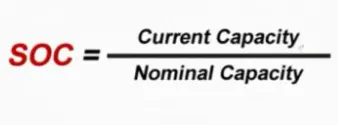
The SOC is the measurement of the amount of charge remaining on a battery. It represents the ratio
of the current capacity of the battery to its nominal capacity after a period of use or long-term
shelving, which also indicates the maximum amount of power that can be stored in the battery. The
SOC is calculated as a percentage: when it’s at 0, it means the battery is completely discharged.
When the SOC is at 100, it means the battery is completely full.
Absolute Charge State
There is also what’s called an absolute charge state, which is a reference value calculated from the
fixed capacity value when the cell is manufactured. The absolute SOC of a new fully charged battery is
100% while an aged battery, even if fully charged, cannot reach 100% in different charge and dis-
charge situations.
Influencing Factors
Most SOC estimations require precise data measurements, whether it is the chemistry of the cell (type
of electrolyte), its operating conditions, or the variables of the cell (voltage, current), etc., thus being
suitable only in the laboratory and not in real applications. The SOC of a battery is a combination of
voltage, charge/discharge current and internal resistance parameters to estimate its size. These
parameters are also affected by a variety of uncertainties such as battery aging, temperature changes
and usage status.
Accurate SOC estimations reflect important information, such as battery performance, remaining
battery life, etc., which ultimately leads to efficient management and utilization of battery power and
energy. In addition, SOC estimation can be used to regulate battery life degradation, explosions or
fires due to battery over-discharge and overcharge, as well as aging and permanent damage to the
battery cell structure. Therefore, the SOC indicator on a BMS is vital for user convenience, as well as
the efficiency, safety and life of the battery.
Simulink Model:
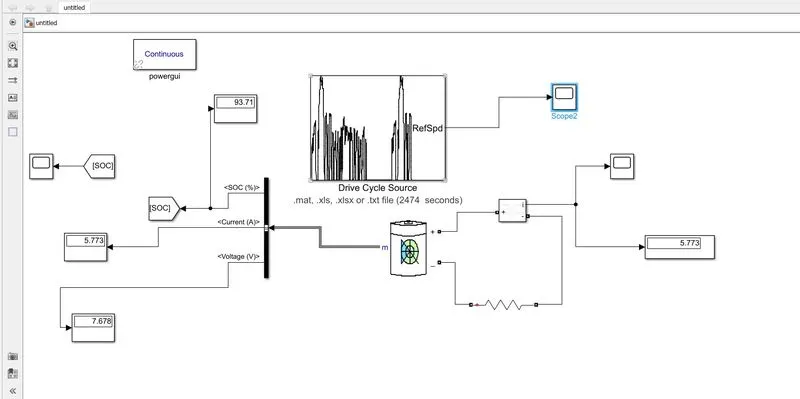
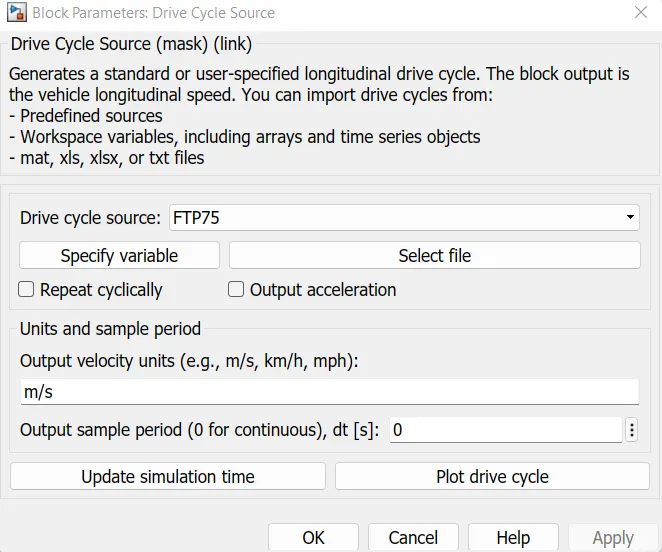
In this simulation we are using Drive cycle source FTP75(2474 Second) to estimate the SOC of a battery pack for 2*104 sec of time.
Components used:
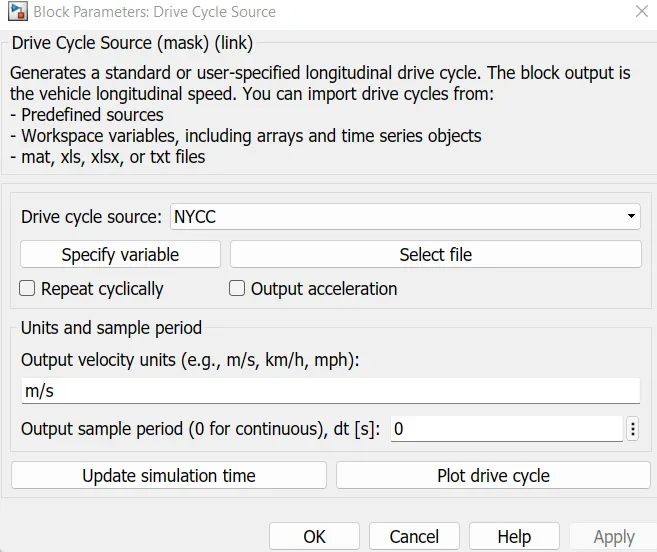
1. Drive cycle source
2. Scope block
3. Battery
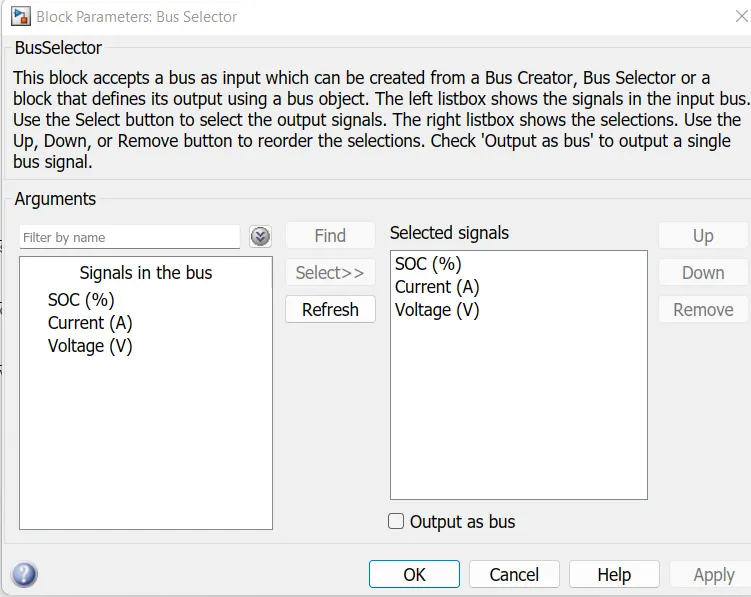
4. Bus Selector
5. powergui block
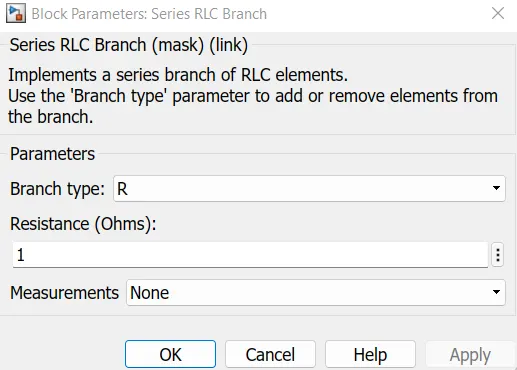
6. Series RLC branch
Results in Scope:
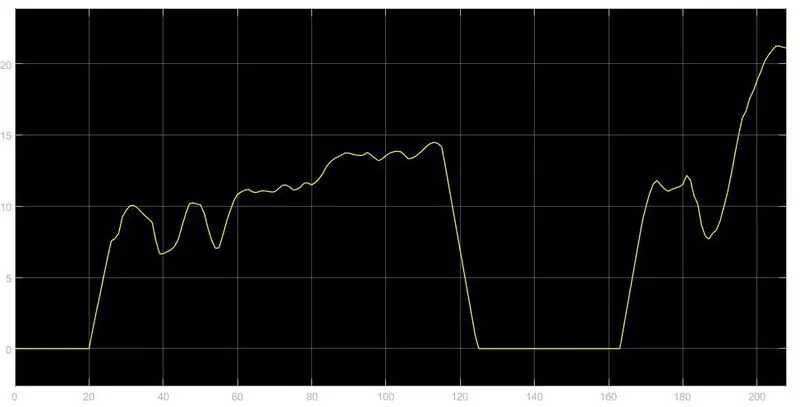
Drive cycle plot
Simulation Results:
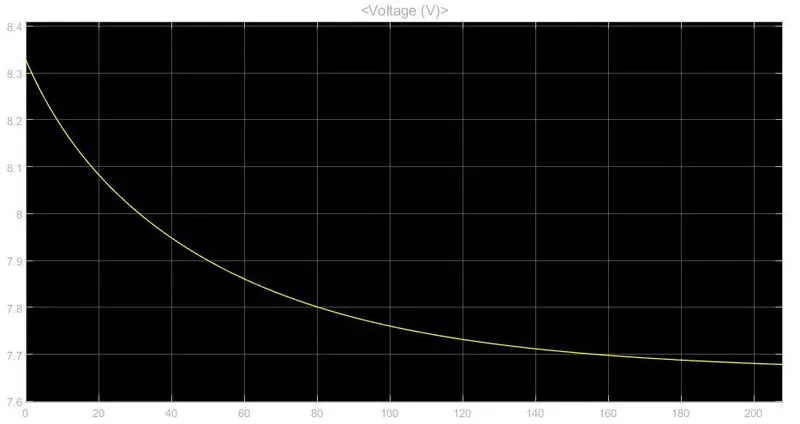
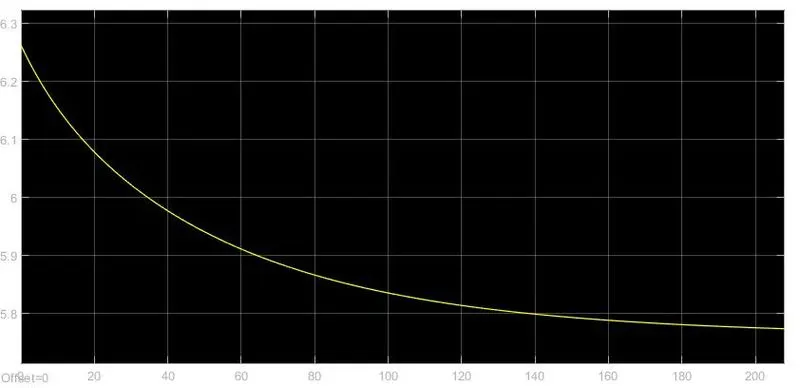
Current plot
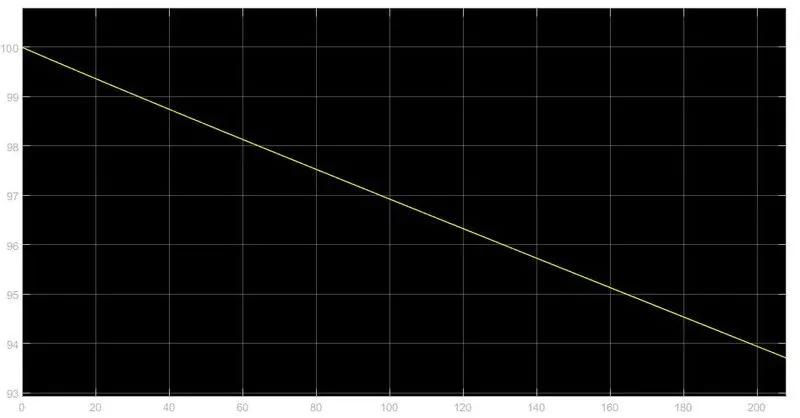
SOC plot
Battery parameters:
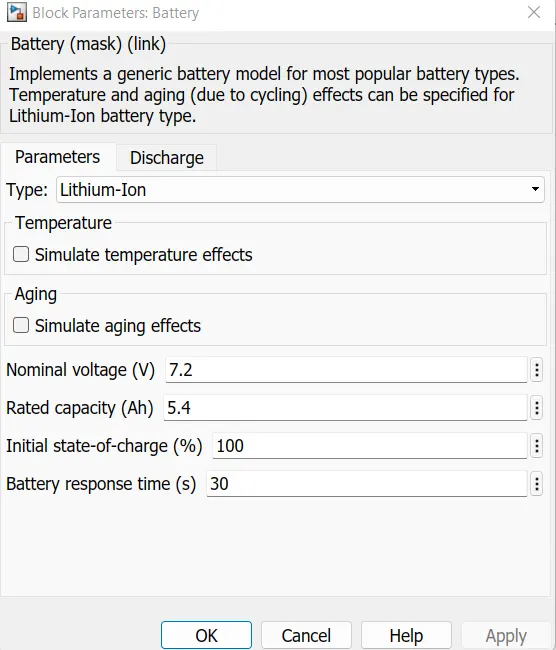
Bus selector:
Resistance:
Drive cycle source:
Conclusion:
1. Internal heat generation during the operation of a battery is a critical concern. If batteries get too hot,
they can rupture or explode. And Lithium and Lithium-ion cells/batteries can catch on fire when they
rupture, creating even more of a safety hazard.
2. Here, the Maximum heat generated in a battery pack is 2.0469 mJ.
3. Accurate SOC estimations reflect important information, such as battery performance, remaining
battery life, etc., which ultimately leads to efficient management and utilization of battery power and
energy.
4. Estimated SOC% of a battery pack is 93.7%.