Project 2
The Calculations of the water current forces, centrifugal forces, wave forces, snow loads, temperature loads, and Barge Impact load for the bridge structure are as below:
1. Water Current Load Calculation:
Maximum Velocity = SQRT(2) X Mean velocity of the river
=SQRT(2) X 2 =2.83 m/s
Water Current Force = 52 x K x V^2
Pier is of square shape, K=1.5
Water current force = 52 x 1.5 x 2.83 ^2 = 625 kg/m2 = 6.25 kN/m2
As the size of the pier is 1.2 m, the Uniformly varying load to be applied = 6.25 x1.2 =7.5 kN/m
2. Centrifugal force calculation:
For class 70R tracked vehicles,
Weight of 70R tracked vehicle (W) = 700 kN.
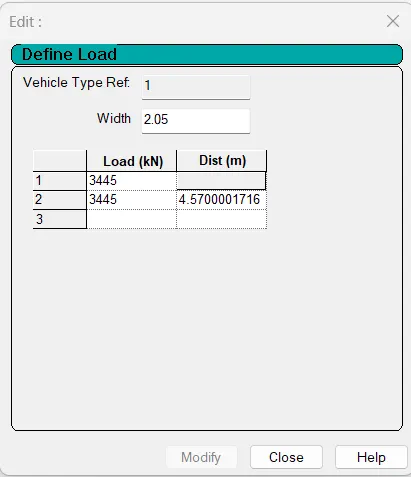
Centrifugal load (C) = WV^2/127R = 700 x (50)^2/(127*2)= 6890 kN
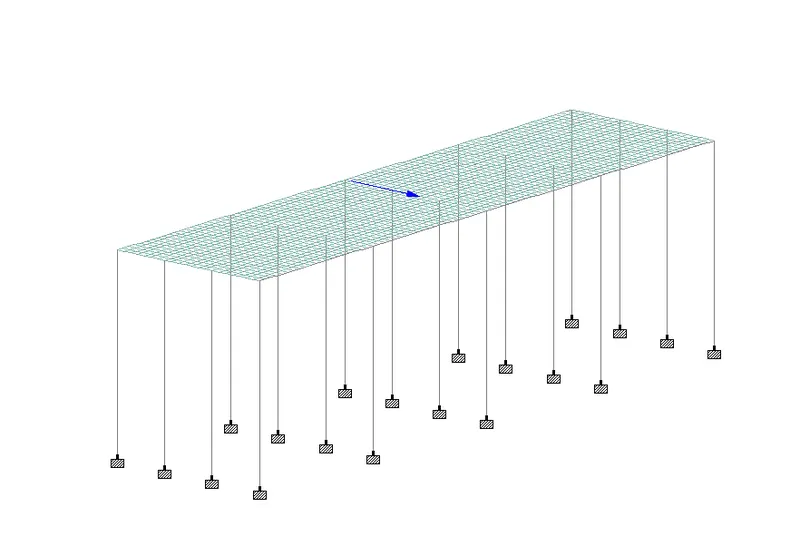
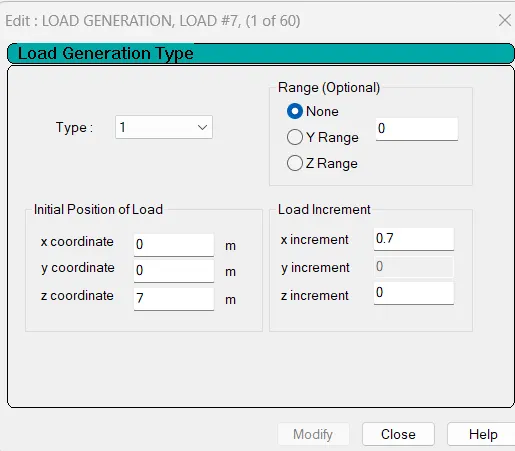
The above-calculated load will be applied as a double axle moving load with each axle load as (6890/2=3445 kN) in Stadd pro.
3. Wave force calculation:
Δz,h = η,max - Centroid of I-Girder= 3 -(1.6/2) = 2.2 m
Δz,v = η,max - depth of I-Girder= 3 -1.6 = 1.4 m
Horizontal load,Fh =γw x Δz,h x Ah = 10 x2.2 x(10x1.5)=330 kN
(Ah= Bridge span x (thickness of deck))
Vertical load,Fv = γw x Δz,v x Av = 10 x 1.4 x(9x1.6/2)=100.8 kN
(Av= Bridge deck width x (depth of I girder/2))
Maximum Horizontal load = (1+Cr(N-1))Cva x Fh=(1+0.4x(4-1))x3x330 =2178 kN
Maximum Vertical load =Cva x Fv = 3 x 100.8 = 302.4 kN
4. Snow load calculation:
Consider the density of snow as 9 kN/m3.
As the slope of the deck is less than 30 degrees, so shape coefficient is 0.8 m.
Total snow load to be considered on top of bridge deck = (depth of accumulation of snow)x(density of snow)x(shape coefficient)
=1.25 x 9 x 0.8 =9 kN/m2
5. Temperature loads calculation:
Consider the location as Delhi,
As per IRC 6, Annexure F, the Maximum and minimum temperatures at Delhi are 48.4 & -2.2 degrees Celsius.
As the difference between maximum & minimum temperature is more than 20 degrees Celsius,
Effective temperature differnece = (48.4-(-2.2))/2 + 10=25.3 + 10 =35.3 degree celcius
Thermal expansion coefficient for concrete= 11.27 x 10^(-6)
Modulus of Elasticity of Concrete = 5000 x sqrt(40)
Stress due to Temperature = α x △T x E = 11.27 x 10^(-6) x 35.3 x 5000 x sqrt(40) =12.58 kN/m2
Maximum Permissible stress = (2/3) x Modulus of rupture of concrete =(2/3)* 0.7 * sqrt(40) =2.95 kN/m2
So it will be ensured that the stress to be encountered in the bridge deck shall not exceed 2.95 kN/m2.
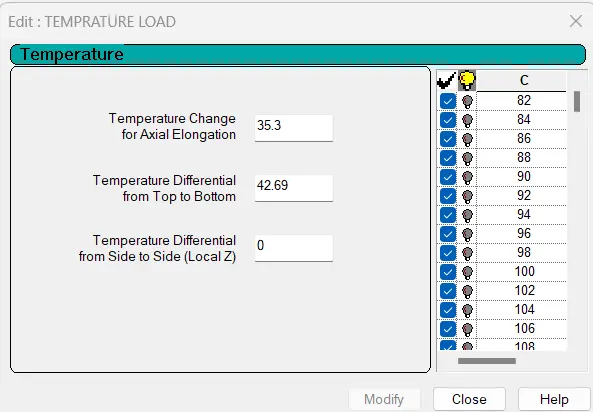
Temperature to be applied in Staad Pro as a load case:
The temperature at the Top = is 48.4 degrees
The temperature at the Bottom =(2.1/17.8)*48.4 =5.71 degrees (The ratio is taken from IRC 6, Figure 16A)
Temperature difference from top to bottom = 48.4 -5.71 =42.69 degrees.
6. Barge Impact load calculation:
Consider the barge speed as 60 km/h. (16.67 m/s)
Barge Collision Energy = KE = 500 x Ch x W x V^2
= 500 x 1.25 x 25000 x 16.67 ^2 =4342014063 N .m
Barge Impact Depth,
aB= 3100 x ( [1 + 1.3 x 10(-7) x KE]^0.5 - 1)
=70616 mm
Which is more than 100 mm,
So Barge Collision Impact Force (PB) = 6.0 x 10^6 + 1600 x (aB) = 118985600 N =118985.6 kN
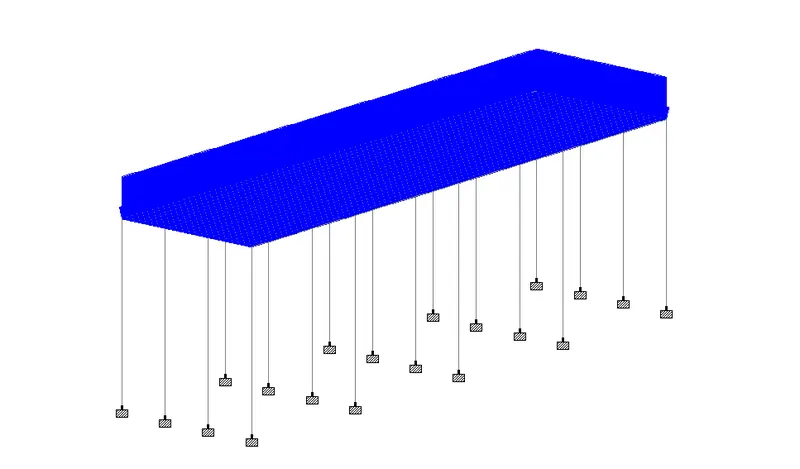
7. Modelling in Staad Pro: Following are the results of water current forces ,centrifugal forces, wave forces, snow loads, temperature loads, Barge Impact load for the bridge structure-
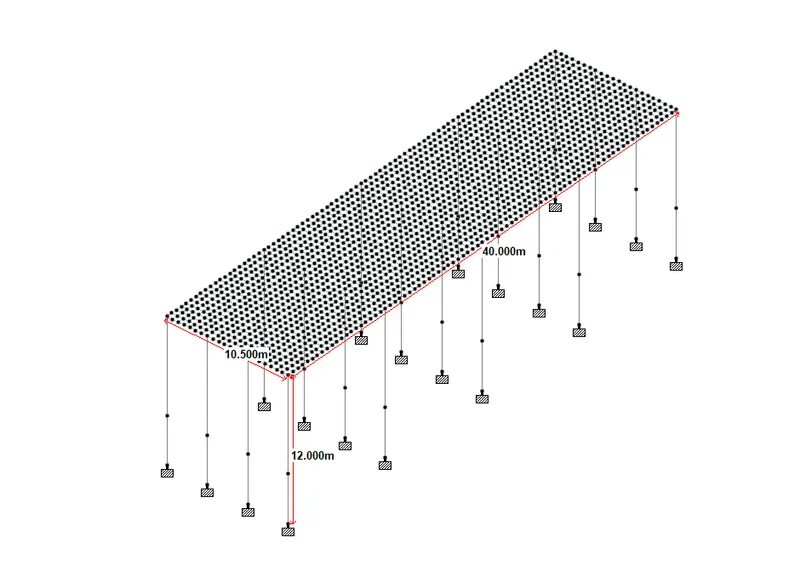
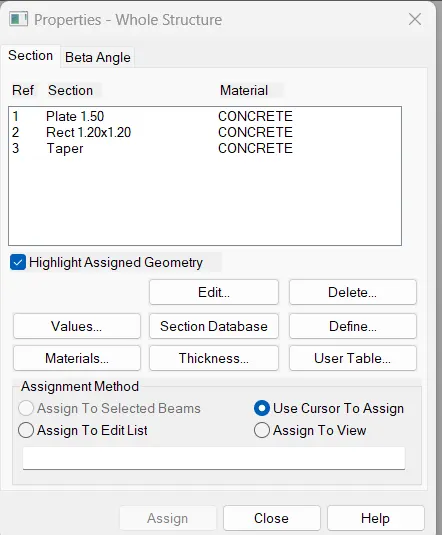
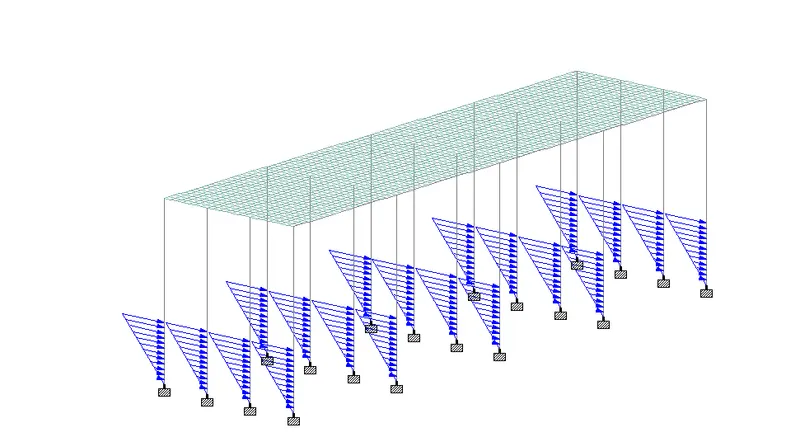
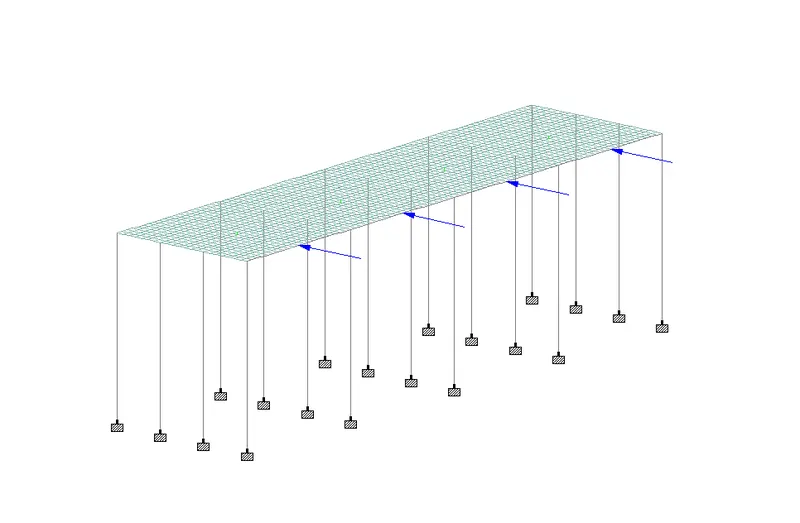
1)Water current load
The maximum bending moment observed in the pier = 35.525 kN.m
The maximum bending moment observed in the girder = 1.033 kN.m
The maximum bending moment observed in the deck slab = 6.127 kN.m/m
2)Wave load
The maximum bending moment observed in the pier = 2920 kN.m
The maximum bending moment observed in the girder = 519.297 kN.m
The maximum bending moment observed in the deck slab = 3162 kN.m
3)Snow Load
The maximum bending moment observed in the pier = 31.76 kN.m
The maximum bending moment observed in the girder = 85.487 kN.m
The maximum bending moment observed in the deck slab = 44.3 kN.m
4)Temperature Load
The maximum bending moment observed in the pier = 848.327 kN.m
The maximum bending moment observed in the girder = 848.327 kN.m
The maximum bending moment observed in the deck slab = 2400 kN.m
5)Barge Impact Load
The maximum bending moment observed in the pier = 41138.852 kN.m
The maximum bending moment observed in the girder = 6585 kN.m
The maximum bending moment observed in the deck slab = 42191 kN.m
6)Centrifugal Load
The maximum bending moment observed in the pier = 606.616 kN.m
The maximum bending moment observed in the girder = 2268.413 kN.m
The maximum bending moment observed in the deck slab = 1386 kN.m