Project
AIM:
To study and analyze the baja all terain vechicle(ATV) model using simulink.
OBJECTIVE:
To prepare a technical report of baja ATV model with and without lookup table.
THERORY:
All terain vechicle (ATV),also known as quad(Four)Light utility vechicle (LTV).A vechicle that travel with low pressure tiers,with a operated by the operator along with handlebars for steering control.It is designed to handle a wider variety of all terain compared to other vechicles.
BAJA ATV(SAE):
The baja sae series is an event for the ug engineering students organised globally by the sae,usa.baja sae tasks the students to design,fabricate and validate a single seater foue wheeled off road vechicle.
COMPONENTS USED IN THE SIMULATION:
GENERIC ENGINE:
The generic engine block is a main part of this atv.which houses a ic engine.which is a spark type ignition
(such as a petrol type)and compression ignition(such as a diesel).it as a different types of ports.they are,
Ports:
B-rotational conserving port representing the engine block.
F-rotational conserving the engine crankshaft.
T-physical signal input port.(throttle body)
P- physical signal outport port.(engine power)
FC-physical input port(fuel consumption)
SIMPLE GEAR:
simple gear is a combinatiion of a driver and driven direction.the gear ratio is defined as,
some of ports are:
B-base gear.
F-follower gear.
CVT TRANSMISSION:
Cvt stands for continuous variable transmission. it as a combination of pulleys connected to the crankshaft of the engine.The driving pully is also called as input pulley.In the input pulley where the energy from the engine enters the transmission.second pulley is called as a driven pulley.the driven pulley transfers energy to the driveshaft.
The distance between the center of pulleys to where the belt makes the contact known as pitch radius.when the pulleys are close together,the belt rides the higher and radius increases.when the pulleys are comes unter the large condition the resulting radius becomes decreases.resulting a lowering gear.when the driving pulley on large and driven pulley on small resulting the higher gear.Hence the cvt has a infinite number of gears that runs unter the continuous running engine with variable speeds.
ports used in the block:
R-variable transmission ratio.
VECHICLE BODY:
Two axle vechicle with dynamic and adjustable mass,geomentry,and drag properties.vechicle which houses a same or a different number of wheels mon each axes.the vechicle is identical in size.the vechicle can also have a center of gravity.
in the vechicle body some of the ports are used.they are:
NR-rear axel.
NF-front axel.
Beta-road incline angle.
V-velocity.
W-wind speed.
H-horizontal motion.
DOUBLE SHOE BRAKE:
the double shoe brake block represents a frictional brake with two pivoted rigit shoes that press against a rotating drum to produce a braking action.viscous and contact friction between the drum and the rigit shoe surfaces cause the rotating drum to deacelerate.
ports used in this block:
S-rotational conserving port.
F-physical signal input port.
TIRE:
the vechicle body is connected to 4 tires each per axle to move the vechicle according to the power input to the axle.
ports used in this block:
N-nornal force.
S-tire slip.
A-axle.
H-mechanical translation port.
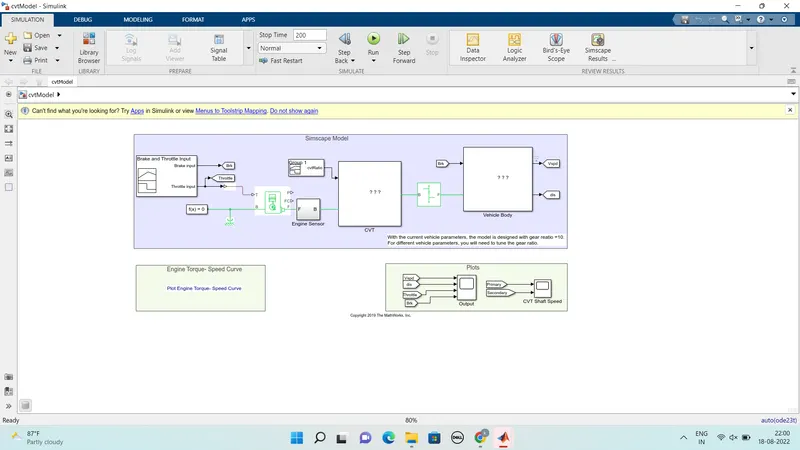
BLOCKS USED:
*signal builder-to input the break,throttle and cvt ratio.
*simulink to ps converter-to convert the simulink signal to simscape environment.
*solver configuration-to specify the solver parameters.
*mechanical reference-to make sure all the components are clamped to ground.
*generic engine-to run the engine with speed and torque value as input.
*ps to simulink converter-to convert simscape signal to simulink environment.
*scope-to view the graph.
*display-to view the engine power.
*rotational motion sensor-to sense the rotational motion of engine.
*variable gear ratio-to vary the speed .
*ps terminator-terminate the unconnected physical signals.
*double shoe brake-to apply brake to stop vechicle.
*ps constant-generate constant signals.
*tire-to transport vechicle from one place to another.
*rotational free end-for mechanical component.
*vechicle body-to represent baja atv model.
*measure gauge-to measure the break and throttle input.
*knob- to increase and decrease the throttle and break inputs.
*lookup table-to insert the cvt values.
*simple gear-to reduce the speed of engine.
*step-to increase or decrease an input value.
BAJA ATV MODEL WITHOUT DASHBOARD:
ENGINE SENSOR:
This block measures angular velocity or angle in the mechanical rotational network.the sensor is ideal since it does not friction,sdelays,energy consumption,and so on.
the physical signal ports w and a report the anguilar displacemwnt,respectively,port r relative to port c.the measurement is positive when the motion at r is greater than the motion at c.
CVT SYSTEM:
VECHICLE BODY:
the throttle signal is generated byb the signal builder block and input to generic engine.
the torque and speed vector are input from the matlab workspace.
The engine will generate the output rpm which can be taken from the crankshaft output.this speed will be given to rotational motion sensor to sense output rpm.
the output speed will be given to a simple gear mechanism.
then the output speed from the gear reducer will be given to the variable ratio transmission block.
the cvt ratio is provided to the variable ratio transmission through signal builder.
the speed is controlled by the variable cvt ratios and the controlled output.
speed is given to the vechicle axle.
the brake signal is generated by the signal builder and input to the vechicle body,for applying the brake to axle.
the velocity is taken as output from thevechicle body for further analysis.
OUTPUT:
TORQUE-SPEED PLOT:
The torque and speed are input from the matlab workspace window to the generic engine block to generate the output rpm accordingly.
ENGINE SPEED PLOT:
Here ew can see the engine rpm generated with throttle,speed and torque inputs.
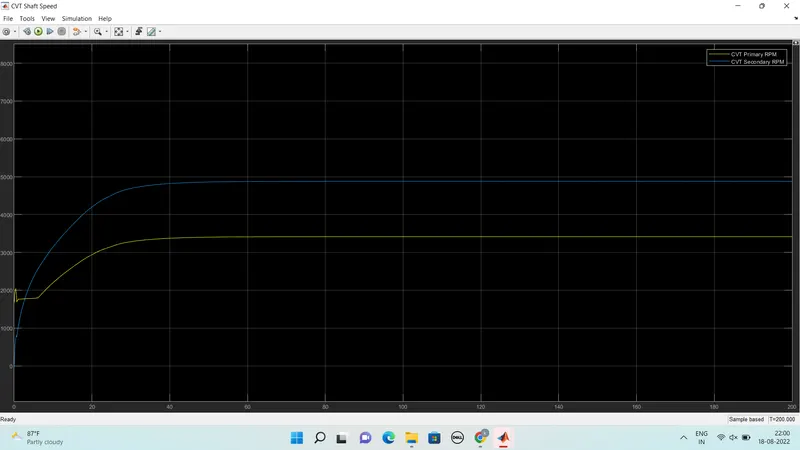
CVT SPEED REDUCTION PLOT:
The engine reduced speed is controlled by various cvt ratios.for verification the calculated marimum rpm ios plotted.
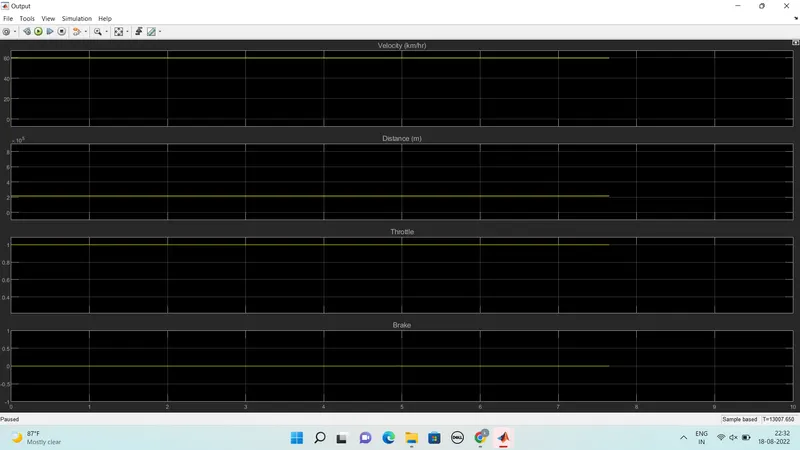
SPEED VS THROTTLE PLOT:
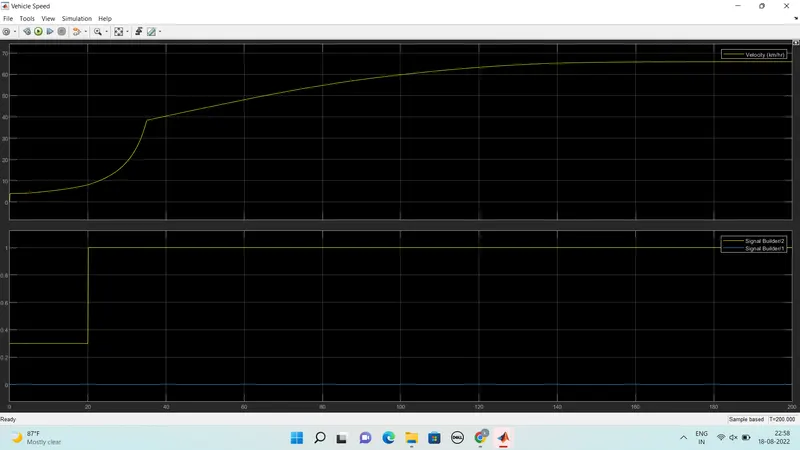
From the result that shows the break is not applied during the drive cycle and the throttle is constant till 20sec and being increased by 1 to 20 sec,where it is constant after rest of the run.
with the increase in throttle the vechicle speed also increased.
ACCELERATION PLOT:
The vechicle is accelerated from 0 to 20kmph and then gradually increases till30kmph approximately.and its accelerated toto 55 kmph where it remains constant throughout the cycle.
BAJA ATV WITH DASHBOARD:
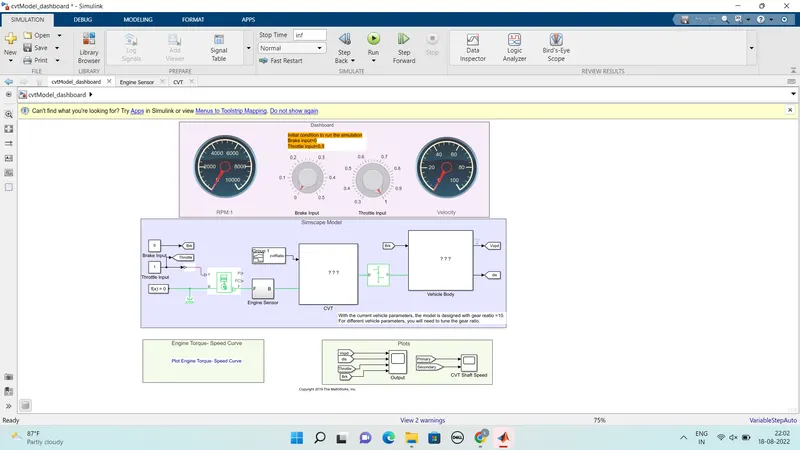
OUTPUT:
ENGINE SPEED PLOT:
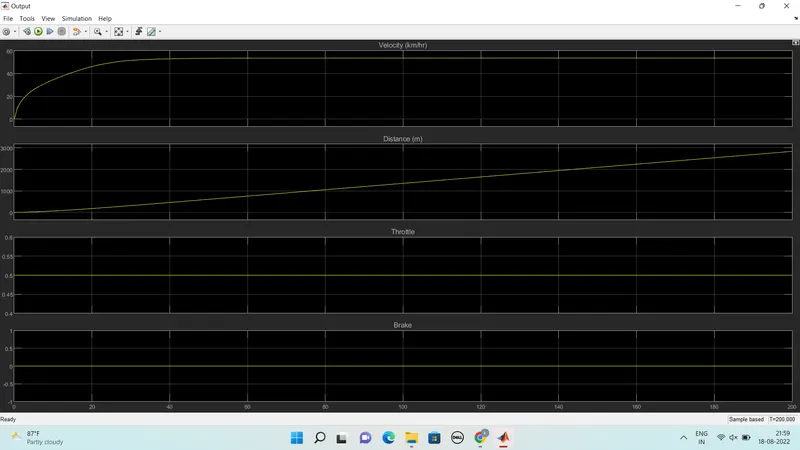
Here the engine speed is generated according to inputs like throttle,breaks,torque and speed vectors.stepup is throttle and stepdown are breake inputs.
ENGINESPEED VSGEAR READUCTION SPEED PLOT:
Here we can see that the engine speed is reduced bybthe gear ratio 4 for verification the calculated constant rpm(42000-50000sec).maximum rpm=2759
gear ratio=1:4
we know that,
driven=2759/1
driven=689rpm
CVT SPEED REDUCTION PLOT:
The engine reduced speed is controlled by various cvt ratios.for verification the calculated constant rpm(42000-50000)sec
maximum rpm=689.825rpm
cvt ratio=1:1.8
driven=689.825/1.8
driven=383.23rpm
SPEED VS THROTTLE PLOT:
Vechicle is accelerating while throttle is applied and deacelerate while break is applied.
ACCELERATION PLOT:
While the vechicle is accelerated to 46kmph initially and then the state changes when the user controls the throttle and break knobs.the step up and step down are acceleration and descceleration respectively.
BAJA ATV MODEL WITH DASHBOARD:
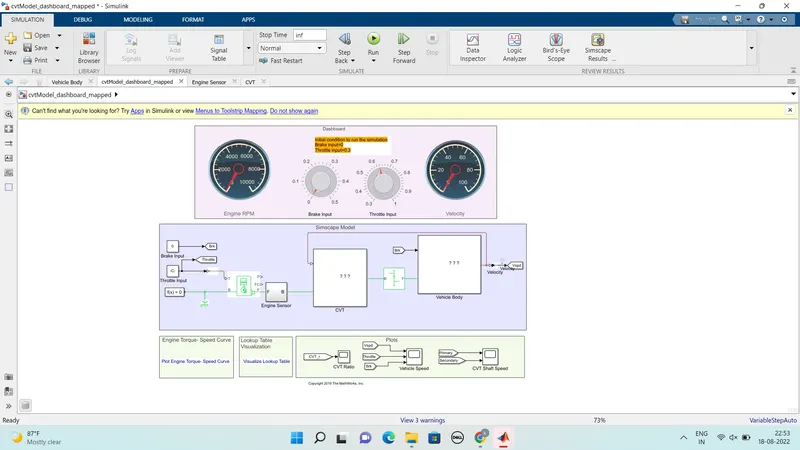
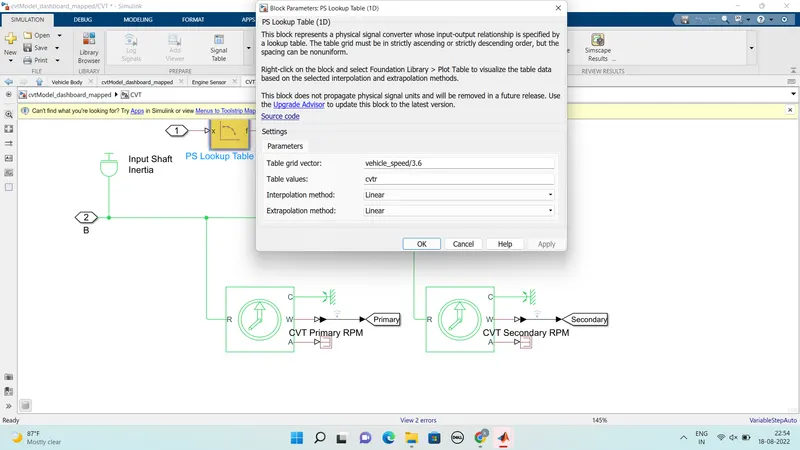
Signal builder block is used for cvt ratio,the 2-d lookup table is used.
SIMULATION ON:
SIMULATION OFF:
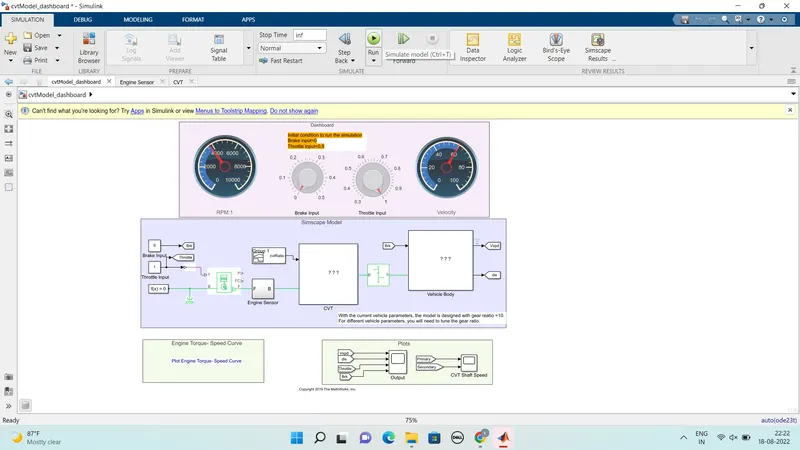
instead of a signal builder block for cvt ratio the 2d lookup table is used.the interpolation and extrapolation methods are set to linear.
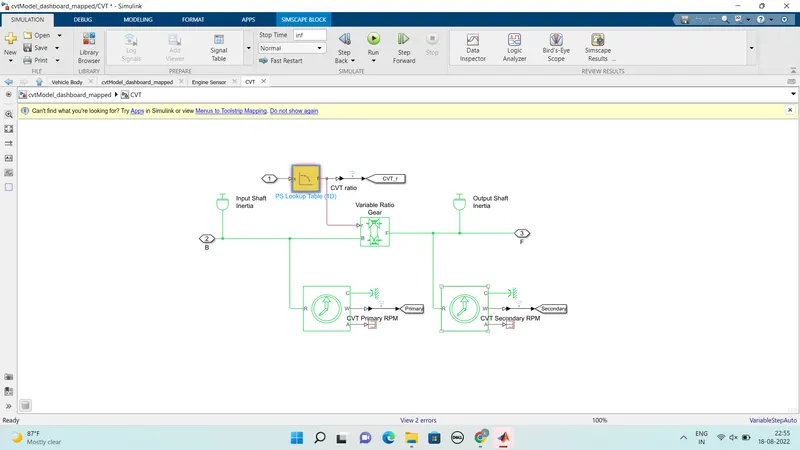
RELATION OF CVT RATIO,THROTTLE AND BREAK INPUTS:
In this baja atv model,the engine is preset to run at3300rpm with the throttle value of 0.3. and the velocity at 45m/s.the cvt ratio for minimum and maximum speed of engine was predefined as 2.3 and 1.8respectively.when the simulation is started the initial throttle value0.3 is archeived so that cvt ratio near by 1.85.
when braking is reduced the cvt ratio is moves towards 1.85 which is the basic throttle input0.
3 or if any other throttle vcalue is applied it would reach that cvt ratio.
RESULT:
Hence the baja atv was sucessfully executed by the model.