Project-1: Powertrain for aircraft in runways
QUESTION 1:
1. Search and list out the total weight of various types of aircrafts.
The aircraft gross weight (also known as the all-up weight and abbreviated AUW) is the total aircraft weight at any moment during the flight or ground operation.
An aircraft's gross weight will decrease during a flight due to fuel and oil consumption. An aircraft's gross weight may also vary during a flight due to payload dropping.
Let us look at the different weight types involved in aircrafts.
MEW:
Also called Manufacturer's Empty Weight (MEW) or Licensed Empty Weight.
It is the weight of the aircraft "as built" and includes the weight of the structure, power plant, furnishings, installations, systems and other equipment that are considered an integral part of an aircraft.
This excludes any baggage, passengers, or usable fuel.
ZFW:
Called as Zero fuel Weight (ZFW)
This is the total weight of the airplane and all its contents (including unusable fuel), but excluding the total weight of the usable fuel on board.
As a flight progresses and fuel is consumed, the total weight of the airplane reduces, but the ZFW remains constant.
Maximum zero fuel weight (MZFW) is the maximum weight allowed before usable fuel and other specified usable agents (engine injection fluid, and other consumable propulsion agents) are loaded.
OEW:
Called as Operating Empty Weight
(Roughly equivalent to basic empty weight on light aircraft)
It is the basic weight of an aircraft including the crew, all fluids necessary for operation such as engine oil, engine coolant, water, unusable fuel and all operator items and equipment required for flight but excluding usable fuel and the payload.
PAYLOAD:
It is the carrying capacity of an aircraft. It includes cargo, people, extra fuel. In the case of a commercial airliner, it may refer only to revenue-generating cargo or paying passengers.
MTOW:
Also known as Maximum Take Off Weight.
This is the maximum weight at which the pilot of the aircraft is allowed to attempt to take off.
Regulated Take Off Weight(RTOW)
Depending on different factors (e.g. flap setting, altitude, air temperature, length of runway), RTOW or maximum permissible takeoff weight varies for each takeoff. It can never be higher than MTOW.
Maximum Landing Weight (MLW)
This maximum weight at which an aircraft is permitted to land.
The graph below shows us the total fuel weight & payload involved in an aircraft.
These are the various weights involved in aircrafts.
QUESTION 2:
2. Is there any difference between ground speed and air speed?
Yes, there is a difference between ground & airspeed. The relationship between airspeed & ground speed is given by the formula,
Airspeed = Groundspeed + Windspeed.
The above formula can change with respect to the wind direction. If the wind direction is along the motion of aircraft, then the windspeed is added & subtracted if it is opposite.
Let us look in detail what groundspeed and airspeed is in layman's terms.
Groundspeed:
It is the horizontal speed of an aircraft relative to the Earth’s surface. It is vital for accurate navigation to the destination that the pilot has an estimate of the ground speed that will be achieved during a flight.
An aircraft diving vertically will have a groundspeed of zero.
Airspeed:
It is the relative motion between the aircraft and the wind direction. This speed cannot be measured directly from the ground. It depends on the formula, Airspeed = Groundspeed + Windspeed.
In the above picture, we can see the windspeed acting opposite to the motion of aircraft, and the airspeed & groundspeed of the same.
QUESTION 3:
3. Why is it not recommended to use aircraft engine power to move it on the ground at Airport?
There is a term called taxiing in aircraft terminology. Taxiing is the movement of aircrafts on the ground(runway) under its own power.
Some examples of taxiing include transporting the aircraft from the runway to the hangar. (Hangars are closed building structures where aircrafts are sent for repair & maintenance).
The term "taxiing" is not used for the accelerating run along a runway prior to takeoff, or the decelerating run immediately after landing, which are called the takeoff roll and landing rollout, respectively.
The reason why engine power(jet engine) is not used for taxiing is because of fuel wastage. The thrust provided by the engines is huge in aircrafts, leading to less fuel during flight time. Since fuel cost is the major expense for an airline company, they use huge electric motors for taxiing purposes.
Other reasons also include the jet blast while using engine power, leading to environmental damage and collateral damage.
QUESTION 4:
4. How an aircraft is pushed to runway when it is ready to take off?
When an aircraft is ready to take off, it is transported to the runways using pushback tractors & motors.
In aviation, pushback is an airport procedure during which an aircraft is pushed backwards away from an airport gate by external power. Pushbacks are carried out by special, low-profile vehicles called pushback tractors or tugs.
Although many aircrafts are capable of moving themselves backwards on the ground using reverse thrust (a procedure referred to as a powerback), the resulting jet blast might cause damage to the terminal building or equipment. Engines close to the ground may also blow sand and debris forward and then suck them into the engine, causing damage to the engine. A pushback is therefore the preferred method to move the aircraft away from the gate terminal.
QUESTION 5:
5. Learn about take off power, tyre design, rolling resistance, tyre pressure, brake forces when landing.
Take-off power:
The instant at which the aircraft leaves the ground and becomes airborne is called takeoff & the power required to achieve this is called the takeoff power.
The take-off power is dependent on three factors:
Aerodynamic drag - The drag force opposite to the direction of motion of the aircraft while airborne.
Rolling resistance - The frictional force between the wheels of the aircraft and the runway that affect the groundspeed.
Thrust force - The thrust provided by the jet propulsion system which pushes the aircraft along the runway. This provides the nencessary momentum.
Take off power is calculated by adding all the above factors.
Tyre design:
When it comes to safety, tyres are one of the most important components of aircraft. They help to absorb the shock of landing and provide cushioning. It also provides the necessary traction for braking and stopping of an aircraft.
An aircraft tyre is designed to withstand extremely heavy loads while landing, take off, taxing, and parking. The number of wheels required for aircraft increases with the weight of the aircraft, as the weight of the aeroplane needs to be distributed more evenly.
The materials used for aircraft tyres are mostly natural rubber, carbon black & silica. The major manufacturers of aircraft tyres are:
1. Michelin
2. Yokohoma.
3. Dunlop.
Today most aircrafts use tubeless tyres. The carcass plies are used to form the tire. They are sometimes called casing plies. A picture of the plies are attached below:
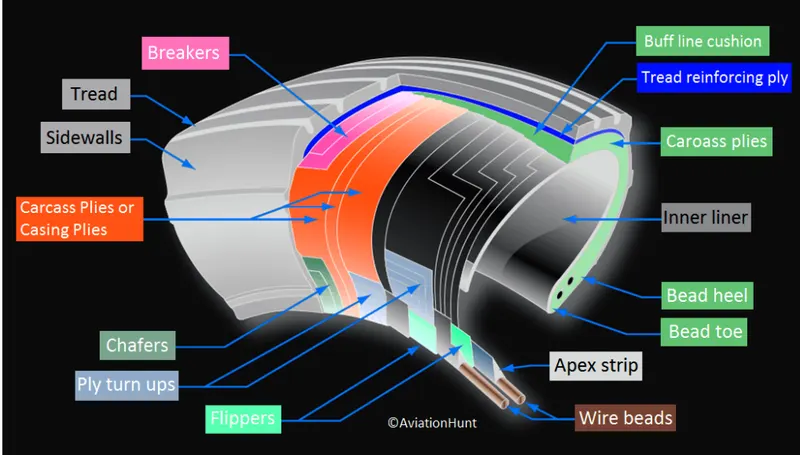
These structures are important in holding the tyre.
The operating pressure of these tyres are at 180 - 200 psi. They are higher because of the heavy structure of the aircrafts.
Rolling resistance:
The frictional force between the aircraft wheels and the runway is called the rolling resistance. The formula for the rolling resistance force is:
Fr = Cr*N
Cr - friction coefficient. N - normal force.
The normal force in an aircraft will be the difference between the weight of aircraft and the lift force. The coefficient value is approximately equal to 0.02 - 0.03 for a tarmac runway.
Brake forces:
To stop the aircraft & decelerate it in the runway, certain brake forces are applied. Let us look at those examples.
Braking using reverse thrust:
(The above image is a thrust reverser of a Turbo-Union jet engine)
Thrust reversal, also called reverse thrust, is the temporary diversion of an engine's thrust for it to act against the forward travel of the aircraft, providing deceleration. Thrust reverser systems are featured on many aircrafts to help slow down just after touch-down, reducing wear on the brakes and enabling shorter landing distances.
Operating principle:
A simple and effective method is to reverse the direction of the exhaust stream of the jet engine and use the power of the engine itself to decelerate.
Braking using wheels:
In aircrafts, we use the disc braking method in the aircraft's landing gear for deceleration. The braking is generally hydraulic or pneumatic.
Certain aircrafts use the plane's wings to increase the aerodynamic drag force, for deceleration. This is done with the help of surface panels called ground spoilers.
QUESTION 6:
6. With necessary assumptions, calculate the force and power required to push / pull an aircraft by a towing vehicle.
The pushback vehicles, already discussed above are used in pushing or pulling an aircraft to the runway. These pushbacks experience two main forces:
1. Aerodynamic drag force.
2. Rolling resistance force.
If we know the aircraft's average mass, drag coefficient, rolling resistance coefficient, velocity of a towing vehicle, we can calculate the force.
An aircraft weighs around 90,000 pounds (41000kg). We have already discussed above that the rolling resistance co-efficient is between 0.02-0.03 for a tarmac runway.
The mass of a pushback is approximately 2000kgs. The coefficient of friction is generally higher for pushbacks since it pulls the aircraft, thereby experiencing more friction. u = 0.09 - 0.1
Now the rolling resiatance formula = Fr = u*m*g.
Fr for the aircraft = 0.02*41000*9.81 = 8044.2 N.
Fr for the pushback = 0.10*2000*9.81 = 1962 N.
Total rolling resistance would be = 8044.2 + 1962 = 10006.2 N.
The aerodynamic drag force = Fd = 1/2*p*A*Cd*v^2.
But during ground operations, the aerodynamic force is non-existent in nature. The drag force is most experienced only during takeoff & flight.
Hence the aerodynamic force is zero.
Now the total towing force would be equal to 10006.2 N
Consider the velocity of the pushback to be operating at 20 kmph = 5.55m/s.
The total towing power formula = Ft*v, where v is the velocity of the pushback.
Hence the total towing power = P = 10006.2*5.55 = 55,534.41 W.
QUESTION 7:
7. Design an electric powertrain with type of motor, it’s power rating, and energy requirement to fulfill aircraft towing application. Estimate the duty cycle range to control the aircraft speed from zero to highest. Make all required assumptions. Prepare a table of assumed parameters. Draw a block diagram of powertrain.
As discussed above, aircrafts use electric drives for ground operations (taxiing & pushback), inorder to save the jet fuel consumptions.
We are asked to choose the type of motor to be used for aircraft towing applications. There are two alternatives. One is the PMDC(Permanent Magnet DC) motor & the BLDC motor(Brushless DC) motor. We will select the PMDC motor since it is used widely in EV drives.
We are asked to calculate the power rating of the DC motor chosen. We have already calculated above, the power required for towing an aircraft. The value was found to be 55.534 KW. This will be our motor rating.
Now let us calculate the energy required for towing:
Energy for towing = (Power required for towing)*(Time required for towing)
Let the time be 15 mins for towing = 900secs.
We must calculate the energy in KW-h.
E = 55.534*(900/1200) = 41.650 Kw-h.
This is the energy required for towing.
Now let us calculate the duty cycle for the towing operation. We use a standard lithium-ion battery pack for this operation. Let us assume the input voltage needed to be 200V & the current required to be 400 A.
Power input = V*I = 200*400 = 80000W. = 80KW.
We have calculated the power output(power rating) to be 55.534 KW.
Duty cycle = Power output/Power input = 55.534/80 = 0.694
Duty cycle for this towing operation is 69%
Now we will draw a simple block diagram of the powertrain of the aircraft towing EV drive.
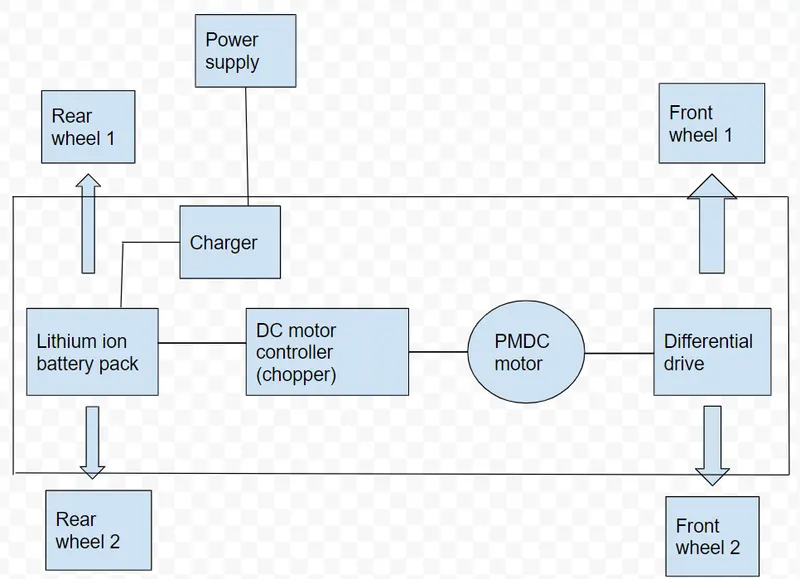
Parameters that we have assumed so far in this calculation:
| PARAMETERS | VALUE |
| AIRCRAFT WEIGHT | 41000kgs. |
| ROLLING RESISTANCE(RUNWAY) | 0.02 |
| ROLLING RESISTANCE(PUSHBACK) | 0.10 |
| PUSHBACK VEHICLE WEIGHT | 2000kgs. |
| PUSHBACK VELOCITY | 5.55m/s |
| TOWING OPERATION TIME | 15mins. |
| BATTERY VOLTAGE & CURRENT REQUIRED FOR THE PUSHBACK | 200V & 400A |
The aerodynamic drag is not considered since it is negligible for ground operations.