Project-1: Powertrain for aircraft in runways
1)Search and list out the total weight of various types of aircrafts.
ANSWER
In the below table we can see the weights of some of the biggest aircraft’s in the world,
|
Aircraft Name |
MTOW (in tonnes) |
MLW (in tonnes) |
|
Antonov An-225 |
640.00 |
591.7 |
|
Airbus A380-800 |
575.00 |
394 |
|
Boeing 747-8F |
447.70 |
346.091 |
|
Boeing 747-8 |
443.61 |
306.175 |
|
Boeing 747-400ER |
412.77 |
295.742 |
|
Antonov An-124-100M |
405.06 |
330 |
|
Boeing 747-400 |
396.90 |
295.742 |
|
Lockheed C-5 Galaxy |
381.00 |
288.417 |
|
Boeing 747-300 |
377.84 |
260.32 |
|
Boeing 747-200 |
377.84 |
285.7 |
|
Airbus A340-500 |
371.95 |
240 |
|
Airbus A340-600 |
367.40 |
256 |
|
Boeing 777-300ER |
351.80 |
251.29 |
|
Boeing 777F |
347.80 |
260.816 |
|
Boeing 777-200LR |
347.45 |
223.168 |
|
Boeing 747-100 |
340.20 |
265.3 |
|
Airbus A350-1000 |
308.00 |
233.5 |
|
Boeing 777-300 |
299.37 |
237.683 |
|
Boeing 777-200ER |
297.55 |
213 |
|
Airbus A340-300 |
276.70 |
190 |
In this table we can see two different columns showing the total weight , the first one is Maximum Take-Off Weight (MTOW) and the other one is Maximum Landing Weight (MLW).
A MTOW is defined as the the maximum weight at which the aircraft is allowed to take-off. This weight is decided after considering the structural or other limits of the aircraft. Also this is the heaviest weight at which the aircraft meets all the airworthiness requirements.
Whereas a MLW specifies the maximum aircraft gross weight at which an aircraft is permitted to land. This weight is decided by the design and operational limitations of the aircraft.
The total weight of various types of aircraft’s are shown in the below table,
|
ICAO category |
MTOW |
FAA category |
MTOW |
|
Light (L) |
MTOW ≤ 7,000 kg (15,400 lb) |
Small |
MTOW ≤ 41,000 lb (18,600 kg) |
|
Medium (M) |
7,000 kg < MTOW < 136,000 kg (300,000 lb) |
||
|
Large |
41,000 lb < MTOW < 300,000 lb (136,000 kg) |
||
|
Heavy (H) |
136,000 kg ≤ MTOW |
Heavy |
300,000 lb ≤ MTOW (136077 kg) |
|
Super (J) |
Airbus A380 |
Super |
Airbus A380, Antonov An-225 |
In this table we can see two types of category , one is ICAO which stands for
International Civil Aviation Organization and the other FAA stands for Federal Aviation Administration.
2)Is there any difference between ground speed and air speed?
ANSWER
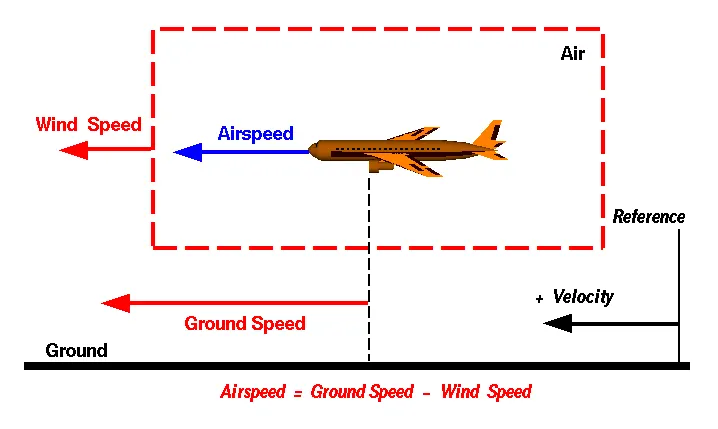
Yes, there is difference between ground speed and air speed. In simple terms , a ground speed is defined as the speed of an aircraft relative to the Earth’s surface and air speed is defined as the speed of an aircraft relative to the air.
Now let us look at the relationship between these two speeds,
Air speed = Ground speed - Wind speed
Here , both ground speed and wind speed are vector quantities and hence direction has to be taken into consideration, i.e if the wind is flowing towards the aircraft then its value is negative and if it is flowing in the same direction its value is positive.
So this air speed is what matters the most and it is the actual speed produced by the aircraft engine alone.
Ground speed is dependent on wind speed , where as air speed is not dependent on wind speed.
3)Why is it not recommended to use aircraft engine power to move it on the ground at Airport?
ANSWER
It is recommended not to use aircraft engine power to move it on the ground at airport so as to avoid any mishaps and also to save fuel consumption. An aircraft when parked will be close to the terminal building, so there will be many airport personnel near the aircraft and if we use the engine power to move , debris can get into the jet engine and also the noise levels will be very high. Another reason is to reduce fuel consumption.
4)How an aircraft is pushed to runway when its ready to take off?
ANSWER
A pushback tug is used to push an aircraft to the runway when its ready to take-off.
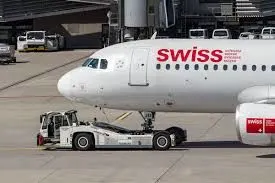
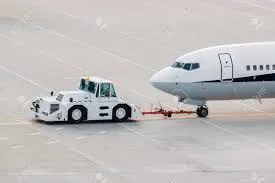
A pushback tug is a low profile vehicle. There are two types of this pushback tugs , namely conventional and towbarless. Conventional type is connected to the aircraft nose landing gear using the towbar and in the towbarless type the tug will scoop up the nose landing gear , hence lifting it off the ground.
Towbarless type,
Conventional type,
5)Learn about take off power, tyre design, rolling resistance, tyre pressure, brake forces when landing.
ANSWER
Take-off power is the power required by an aircraft to have enough lift force so that it can fly. For light aircraft full power is used for take-off where as for large aircraft reduced power is used for take-off in order to prolong engine life and reduce maintenance costs.
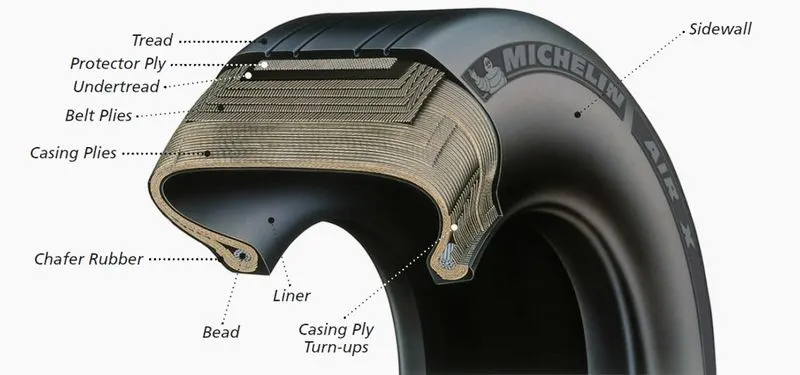
Tires are designed such that it has cool running and is made of heat resistant materials. There are two types of tires mainly used in aircraft , which are bias ply type and radial type. The first one is more durable and also retreadable , where as the latter is much lighter and also has reduced rolling resistance.
Cross-section of an aircraft tyre,
Rolling resistance is defined as the force resisting the motion when a body rolls on a surface. The rolling resistance force is found out using the following equation,
`F_(rr) = mu_(rr)*m*g` , where , ‘`mu_(rr)`’ is the Coefficient of rolling resistance , ‘`m`’ is the total mass of the vehicle including pay load , ‘`g`’ is the acceleration due to gravity.
Tyre pressure of an aircraft is always maintained at a very high pressure. This is done because higher the pressure firmer the tire will be and this will provide more strength to support the plane. Typically tyre pressure is maintained at around 200psi/14bar , but this value can change depending on the speed and the load and the time of landing. In a fighter jet this pressure value can go as high as 320psi.
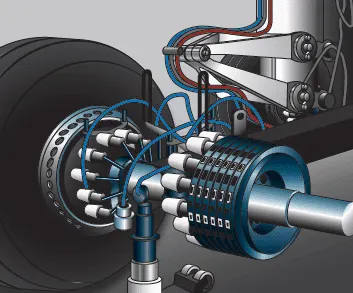
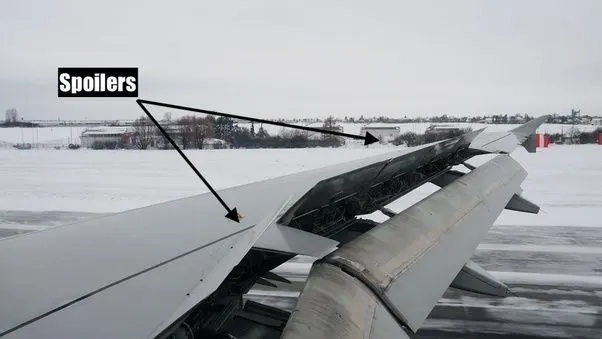
Brake forces are applied to the wheels using disc brakes which are hydraulically or electrically operated. In a hydraulic type pressures around 200 bar is applied in order to slowdown a landing aircraft. There will be rotor discs and stator discs and multiple of them will be stacked on top of each other , when we apply brakes pressure is applied on the stator discs which will push it against the rotor discs and the friction caused will slow down the aircraft. Also spoilers are used , which will increase the wind drag and hence slowing down the aircraft. Another method of applying brake force is through reverse thrust generation , in this method the jet engine will operate in the reverse direction.
Aircraft brakes,
Aircraft spoilers,
6)With necessary assumptions, calculate the force and power required to push / pull an aircraft by a towing vehicle.
ANSWER
Let us assume the aircraft to be Airbus 320 neo model.
The technical specification for this aircraft is as follows,
MTOW = 79 tonnes
MLW = 67.4 tonnes
Assume the rolling resistance coefficient , `mu_(ra) = 0.0035`
Now we can calculate the rolling resistance force of this aircraft ,
`F_(ra) = mu_(ra)*m*g` , where `g` is the acceleration due to gravity
Let us take value of m to be MTOW.
So , `F_(ra) = 0.0035*79000*9.81`
`=2712.465N`
Now to find the rolling resistance of the towing vehicle,
m = 50 tonnes
`mu_(rt) = 0.005`
`F_(rt) = 0.05*50000*9.81`
`=2452.5N`
Now to calculate the air drag force of the towing vehicle,
Air Drag Force(N), `F_(ad) = 1/2*rho*A*C_d*v^2` , where , ‘`rho`’ is the air density , ‘A’ is the frontal area in `m^2` ,’`C_d`’ is the Drag coefficient , ‘`v`’ is the velocity in m/s.
Let us assume ,`rho = 1.25` , `C_d = 0.5` , `v = 3` and `A = 4.5`
`F_(adt)=1/2*1.25*4.5*0.5*3^2`
`=12.66N`
Air drag force on aircraft,
Let us assume , `rho = 1.25` ,`C_d = 0.0265` , `v = 3` and `A =15`
`F_(ada)=1/2*1.25*15*0.0265*3^2`
`=2.25N`
So the total force ,`F=F_(ra)+F_(rt)+F_(ad)+F_(ada)`
`=2712.465+2452.5+12.66+2.25`
`=5179.88N`
Power required , `P = F*v`
`=5179.88*3`
`=15539.63W`
`=15.5KW`
So the force and power required to push/pull an aircraft using a towing vehicle is `5179.88N` and `15.5KW` respectively.
8)TO DESIGN AN AIRCRAFT TOWING VEHICLE
AIM
To design an electric powertrain with type of motor, it’s power rating, and energy requirement to fulfill aircraft towing application. Also to estimate the duty cycle range to control the aircraft speed from zero to highest and then draw a block diagram of powertrain.
CALCULATION
To calculate the energy required to tow the aircraft,
`E=P*t` , where `P` is the power in KW and `t` is the time in hours.
As we already know the power required to tow an aircraft , `P=15.5KW`
And the time time taken , `t=10min = (1/6)^(th) "of an hour"`
`E = 15.5 *1/6`
`=2.58KWH`
Now we need a motor that satisfies the power requirement. Let us take a BLDC motor with star winding , as star winding will provide high torque at low RPM.
Also the appropriate battery pack required to run this motor is also required.
The specification of the motor and battery is as follows,
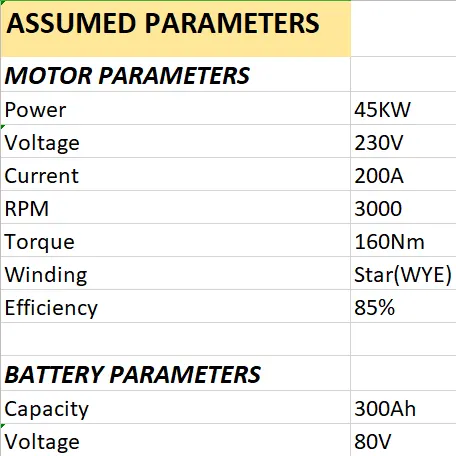
This motor can produce 38.25KW of output power and can output 6.375KWH of energy in 10 minutes.
Now we can calculate the duty cycle as follows,
`"Duty cycle" = (power_(out))/(power_("in"))*100`
`= 15.5/38.25*100`
`=40.5%`
With this battery pack , we can roughly carry out 55 cycles of push/pull of aircraft’s , where each cycle lasts for 10 minutes.
BLOCK DIAGRAM
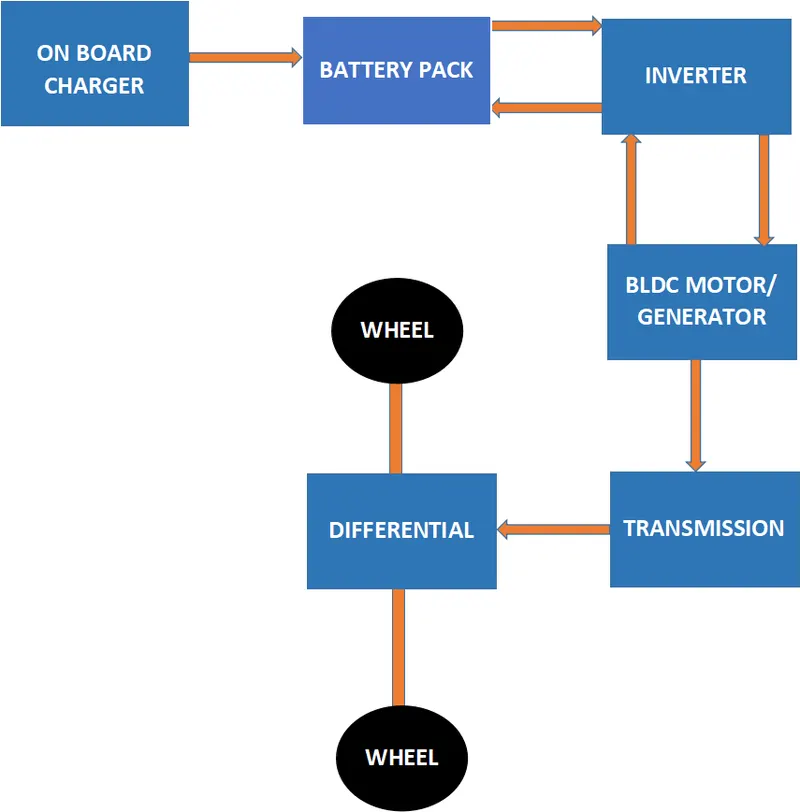
- The first block , which is the On board charger , this component is used to charge the battery externally. Here this on board charger can take either AC or DC as input. If the input is in AC then this will be converted to DC by this on board charger.
- Next block represents the battery pack. This battery back is connected to the on board charger and also to the inverter.
- The inverter block represents the DC to pulsed AC converter , which is required to run the BLDC motor. Also this inverter acts as AC to DC converter to charge the battery pack when the vehicle is in the regenerative braking mode. The speed control of the motor can also be controlled using this.
- Next comes the BLDC motor itself , which represents the Brushless DC motor. This motor runs the vehicle and is controlled by the inverter. This motor can also act as a generator in case of regenerative braking.
- This BLDC motor is connected to the axle and the wheel of the vehicle with the help of a transmission and a differential. This transmission only has a reduction gear in it which is single speed.
CONCLUSION
The design of an electric powertrain with type of motor, it’s power rating, and energy requirement to fulfill aircraft towing application and then to draw a block diagram of powertrain has been done successfully.