Project-1: Powertrain for aircraft in runways
Part-A-
01- Search and list out the total weight of various types of aircrafts. -
Weight is major factor in airplane construnction and operaion, and it demands respect from all pilots and pertiular diligence by all mainatenance personnel.Excessive weight reduces the efficiency of an aircraft and the available safety margin if an emergency condition should arise.The total weight is the maimum take-off weight.It ia the maximum mass at which the aircraft is certified for take-off due to structural or other limits. MTOW = Maximum take-off weight, MLW = Maximum landing Weight,
TOR = Take-off run,
LR = Landing run.
| Type | MTOW [kg] | MLW [tonnes] |
|---|---|---|
| Antonov An-225 | 640,000 | 591.7 |
| Airbus A380-800 | 575,000 | 394 |
| Boeing 747-8F | 447,700 | 346.091 |
| Boeing 747-8 | 443,613 | 306.175 |
| Boeing 747-400ER | 412,770 | 295.742 |
| Antonov An-124-100M | 405,060 | 330 |
| Boeing 747-400 | 396,900 | 295.742 |
| Lockheed C-5 Galaxy | 381,000 | 288.417 |
| Boeing 747-200 | 377,840 | 285.700 |
| Boeing 747-300 | 377,840 | 260.320 |
| Airbus A340-500 | 371,950 | 240 |
| Airbus A340-600 | 367,400 | 256 |
| Boeing 777F | 347,800 | 260.816 |
| Boeing 777-300ER | 351,800 | 251.29 |
| Boeing 777-200LR | 347,450 | 223.168 |
| Boeing 747-100 | 340,200 | 265.300 |
| Airbus A350-1000 | 308,000 | 233.5 |
| Boeing 777-300 | 299,370 | 237.683 |
| Boeing 777-200ER | 297,550 | 213.00 |
Maximum take-off weight-
The maximum weight limits for an aircraft to begin its take-off roll called the max. take-off weight.
Maximum landing Weight:
The Maximum landing weight is, as you might imagine, the maximum aircraft wight limit approved for an aircraft to land. Landing weight structural damage.
This is a list of aircraft sorted by maximum takeoff weight.
Contents
Airplanes
Helicopters
Convertplanes
Weight class is based are desighned by APO130 based on the TFMS observed aircraft codes.
There are 6 categories,
| A- Heavy, | D- Large Commuter, |
| B- B757, | E- Medium, |
| C- Large Jet , | F- Small. |
A-Heavy: Any aircraft weighing more than 255,000 lb such as the Boeing 747 or the Airbus A340. B-B757: Boeing 757 all series. C-Large Jet: Large jet aircraft weighing more than 41,000 and up to 255,000 lbs such as the Boeing 737 or the Airbus A320. D- Large Commuter: Large non-jet aircraft (such as the Aerospatiale/Alenia ATR-42 and the Saab SF 340), and small regional jets (such as the Bombardier Canadair Regional Jet), weighing more than 41,000 and up to 255,000 lbs. E-Medium: Small commuter aircraft including business jets weighing more than 12,500 up to 41,000 lbs such as the Embraer 120 or the Learjet 35. F- Small: Small, single, or twin engine aircraft weighing 12,500 lbs or less such as the Beech 90 or the Cessna Caravan.
MTOW[kg]: Maximum Take-off weight in kg.
02- Difference between Ground Speed and Air Speed -
| Ground speed | Airspeed |
| Ground speed is the airplane's speed relative to the surface of the earth | Air speed is the speed relative to the air it is flying in. |
| Ground speed is what determines how fast an aircraft will get to its destination | Airspeed is what determines whether there is enough airflow around an aircraft to make it fly |
| Ground speed is simply the sum of airspeed and wind speed. | It is independent of ground speed. |
Ground Speed-For a reference point picked on the ground, the aircraft moves relative to the reference point at the ground speed. Ground speed is also a vector quantity. So a comparison of the ground speed to the wind speed must be done according to rules for Vector comparision.
Wind Speed-For a reference point picked on the ground, the air moves relative to the reference point at the wind speed.The wind speed is a vector quantity and has both a magnitude and a direction. A positive velocity is defined to be in the direction of the aircraft's motion. We are neglecting cross winds, which occur perpendicular to the flight path but parallel to the ground, and updrafts and downdrafts, which occur perpendicular to the ground.
Air speed-The important quantity in the generation of lift is the relative velocity between the object and the air, which is called the airspeed. Airspeed cannot be directly measured from a ground position, but must be computed from the ground speed and the wind speed. Airspeed is the vector difference between the ground speed and the wind speed.
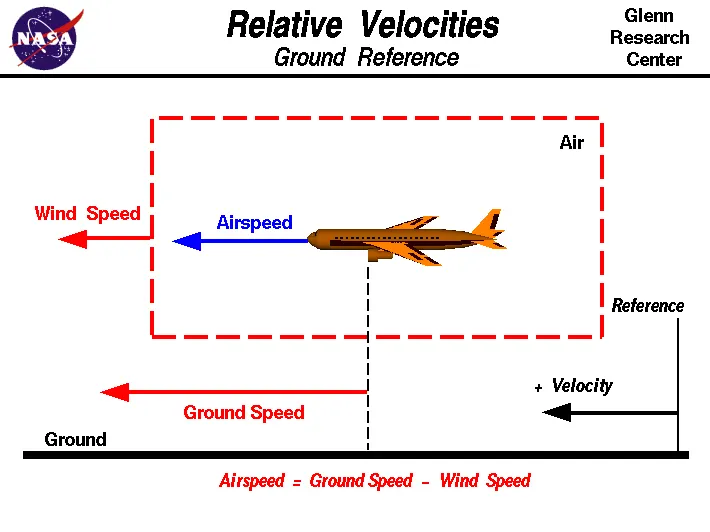
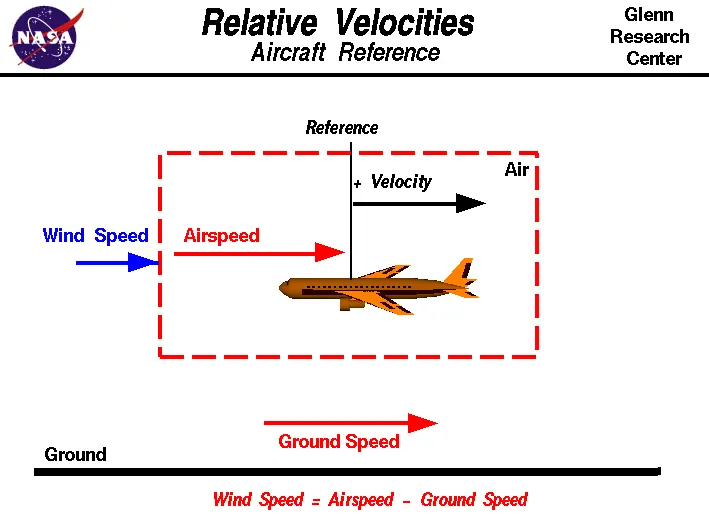
From the above two figures indicates that relative velocity with respect to the aircraft reference and ground reference.The aircraft usually operate on land as well as in air and so we need to study their speed difference in ground and in air.The ground speed and he airspeed usually chnge based on the wind component.If we consider that there is no wind component then, ground speed = airspeed SpeedIf the wind is blowing in the tail direction of the aircraft then (airspeed > ground speed) so, airspeed = Ground Speed + Wind component If the wind is blowing in the head direction of the aircraft then (airspeed < ground xss=removed>
03 -Why is it not recommended to use aircraft engine power to move it on the ground at Airport?
For movement on the ground the aircraft uses it own engine power, which is called taxing.
Althogh many aircrafts are capable of moving in backward using reverese thrust, as result the jet blast or pop wash might cause damage to the terminal building or equipment.
Engine close to ground many also blow sand and debris forward and then suck them into the engine, causing damage to the engine. Therefore there are pushback trucks in the airport.
A pushback truck lifts the front wheel of the aircraf, their role in most airports is to move the aircraft away from the parking spot on to the taxiways, which is called towing.
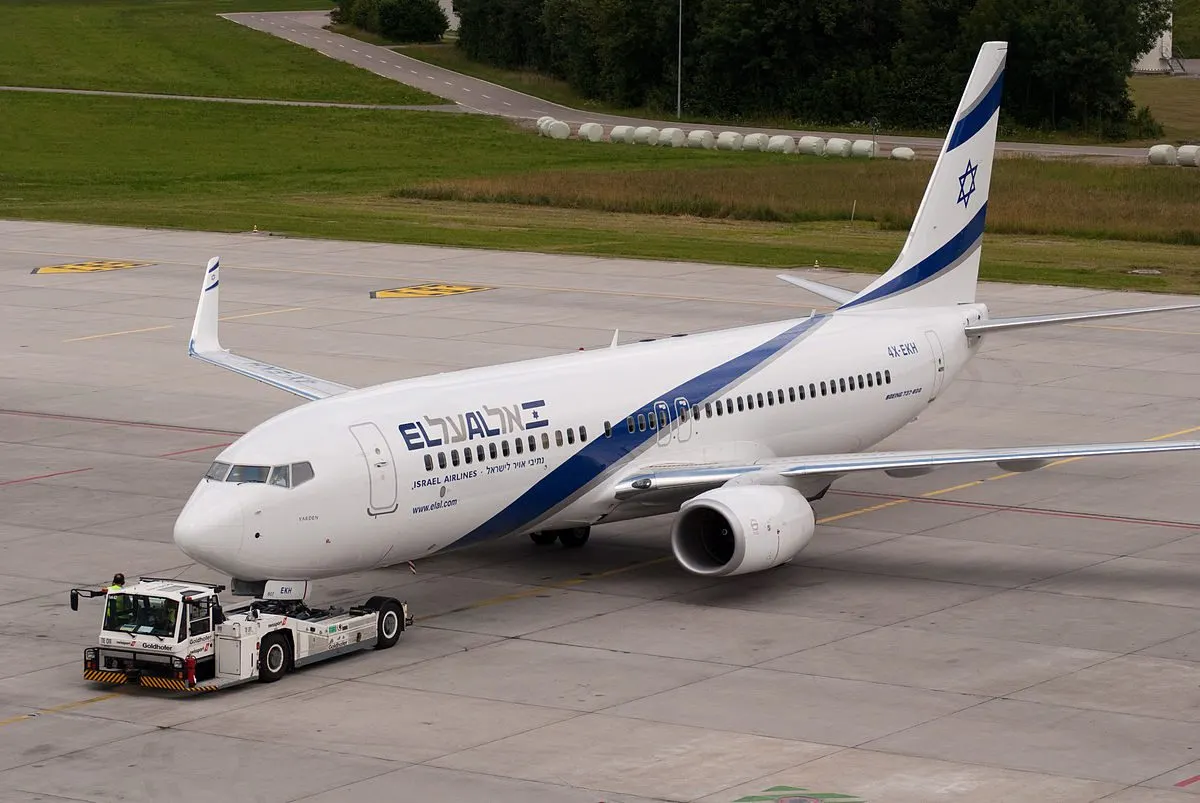
Although most aircraft are capable of moving themsleves backwards on the ground using reverese thrust, a procedure called as powerback, it is not typically done due to the following reasons:
- Effectively a loss of control can happen, especially during high power engine running. Damage can occure to the aircraft itself, other aircraft nearby or to airside structures.
- There is a risk of injury to ground support personal who may be in relatively close proximity to the aircraft.
- It is easier for truck driver to see the surroundings better than the pilot sitting in he cockpit with limited window. The pushback driver knows the airport better than the pilot.
- It also saves fuel. virgin Atlantic had proposed a new system in which pushback truck will move the aircraft all the way to runway to save fuel and reduce impack of environment.
- The plane engines are very loud. When more than one plane will add up their sound, than it will not be pleasent for passangers and others near airport.
4. How an aircraft is pushed to runway when its ready to take off?
Airplanes have engines, and they can use them to move forward along the ground. So they push themselves to the runway.It is true that most of the time, a small vehicle is needed to push the larger commercial airplanes backwards away from the terminal building, because even if a plane can reverse it’s thrust, it’s not always safe to hit the buildings with that reverse thrust. So the little trucks push the bigger planes back away from the buildings, but after that, the planes can apply a small amount of engine power to roll forward just as all airplanes can.
Aircraft push themselves to the runway.
- The pilot parks the aircraft in exactly the right place. Usually with the help of an automatic system, but occasionally guided by a marshaller waving two paddles or wands. Dozens of handling personnel are already standing by to perform a whole range of tasks simultaneously.
- As soon as the aircraft is stationary and the engines are switched off, the first priority is to disembark the passenger as quickly as possible. The apron handler places chocks in front of the wheels and connect the ground power. Meanwhile, the passenger bridge manoeuvres up to the door and a belt loader rolls up to the cargo hold. Luggage is unloaded and transferred to the terminal on baggage carts.
- Refuelling begins, usually from a hydrant at the stand. A hose is attached to this from a special vehicel called dispenser, with the other side connected to the fuel tank in the wing
- Now it is time to service the aircraft. The caterer loads new meals and takes away the food waste and use cutlery and crockery. Other activities include draining the lavatories, replacing the headrest covers, removing rubbish and distibuting fresh blankets and in-flight magazine.
- A specialist team or sometimes the crew themselves- cleans the cabin so that the new passengers boared a pristine aircraft.
- Meanwhile, specialist from thr airline conduct a technical check to make sure that the engines, wings, control surfaces, landing gear, instruments doors and others equipment are in full working order.
- The aircraft is now ready for baggage to be loaded for the next flight. This is a quick process, on average taking only 10-15 min. A little letter the passengers to start boarding. As soon as they are all in their seats, the door is closed and the pilot informsair traffic control that the fl9ight is ready for departure.
- The apron handler reoves the chocks.A so called pushback truck reverese the aircraft into taxiing position, pushing it with a towbar attached to the nose-wheel strut. Or, in most modern vesions, by actually lifiting the wheel. The speed up coupling and decoupling.
- The aircraft taxis to the runway to depart at the agreedtime.
- The pilot waits for permission to take off from air-traffic control. This is possible once to departure route is clear. As soon as the go ahead is received, the plane takes to the air at full power.
5. Learn about take off power, tyre design, rolling resistance, tyre pressure, brake forces when landing -
Take-off Power:
Take-off (T-O) is the phase of flight in which an aerospace vehicle leaves the ground and becomes airborne.For aircraft that take off horizontally, this usually involves starting with a tarnision from moving along the ground on arunway. For light aircraft, usually full power is used during take-off.
Large transport category aircraft may use a reduced power for take-off, where less than full power is applied in order to prolong engine life, reduce maintanance costs and reduce noise emissions.
The aircraft is permitted to accelerate to rotation speed. The term rotation is used to because the aircraft pivots around the axis of its main landing gear while still on the ground, usually because of gentle manipulation of the flight controls to mae or facilitate this change in aircraft attitude and once proper air displacement occurs under or over the wings, an aircraft will lift on its own.
Generally, the T-O phase is split into the segments shown in figure below.
The ground roll is the distance from brake release to the initiation of the rotation, When the pilot pills the control wheel (or stick or yoke) backword in order to raise the nose of the aircraft.
This maneuver is required to increase the area of attack of the airplane to help it become airborne.
The aircraft typically remains in this attitude for some 1-3 sec, depending on aircraft size, before the tires lose contact with the ground. This segment is called the rotation. The rotation phase concludes as the aircraft lifts of the ground and begins the transition and subsequent climb phase.
Here V is the instantaneous airspeed of the aircraft, VR is the ground run speed ,VLOF is the lift off for rotation speed, V2 is the climb speed and Vs is the stalling speed in the T-O configuration. This means that if the airplane features high-lift devices, Vs refers to the stalling speed with flaps deployed.
The importnat point is that the airplane must accelerate from standstill to a given airspeed, called the lift-off speed, before it can, well, lift off.
Generally the take of speed or the climb speed of the aircraft (V2) is calculated as,
V2 = 1.2Vs
Where the stalling speed at theTake-Off configuration is given as,
Vs = √(2W/ρSCL, max)
In the above equation,
W= Gross weight of the aircraft,
ρ = Free stream density of air,
S = Wing area of the aircraft,
CL, max = maximum lift coefficient.
the take-off speed required varies with aircraft weight and aircraft configuration, the heavier the weight, the greater the speed needed.
Typical take-off air speeds for jetliners are in the range of 240-285 km/h, light aircraft take off at around 100 km/h and ultra lights have even lower take-off speeds,
Tyre design:
When it comes to safety tyres are one of the most important components of aircraft. They help to absorb the shock of landing and provide cushioning. It also provides the necessary traction for braking and stopping of an aircraft.An aircraft tyre is designed to withstand extreamly heavy loads while landing, take off , taxing and parking. The number of wheels required for aircraft increases with the weight of the aircraft, as the weight of the aeroplane needs to be distributed more evently.A 737NG & MAX uses 6 wheels, Boeing 787 uses 10 wheels, Boeing 777 uses 14 wheels, Airbus A380 uses 22 wheels.Aircraft tyres work under extreme conditions, carrying up to 340 tons and accelerating at over 250 km/hr at takeoff, in addition to enduring varied environmental stress when in flight and taxing.
Radial Tyre: It has fibre strands of the ply fabric oriented at 90° to the direction of rotation and the tyre sidewall. This restricts flexibility bidirectional and the flexibility of the sidewall while it strengthens the tyre to carry heavy loads. Due to their unique construction most radial tyres are resistant to penetration ad cuts. Due to stiffer tread they distribute weight evenly. Thus provide greater traction. Radial tyres have an advantage in term of reducing the heat better.
Bias-ply Tyre: It has the fabric bias oriented with and across the direction of rotation and the sidewall. Since fabric can stretchon the bias, the tyre is flexible and can absorb loads. Tyre strength is obtained by adding plies. It is cut resistant is sidewall area. These tyres do not offer as much smoothness in terms of riding quality.
Design and Construction of Aircraft tyre:
Carcass plies are used to form the tire. They are sometimes called casing plies. An aircraft tyre is constructed for the purpose it serves.
They support the weight of an aircraft while it is on the ground .
It also provides the necessary traction for braking and stopping of an aeroplane.
Tyre also helps to absorb the shock of landing and provide cushioning the roughness of takeoff, roll-out and taxi opeations.
Unlike an automobile or truck tyre, it does not have to carry a load for a long period of continuous operation. However, an aircraft tyre absorbs the high impact loads of landing and also it's operating at high speeds for a short time when required.
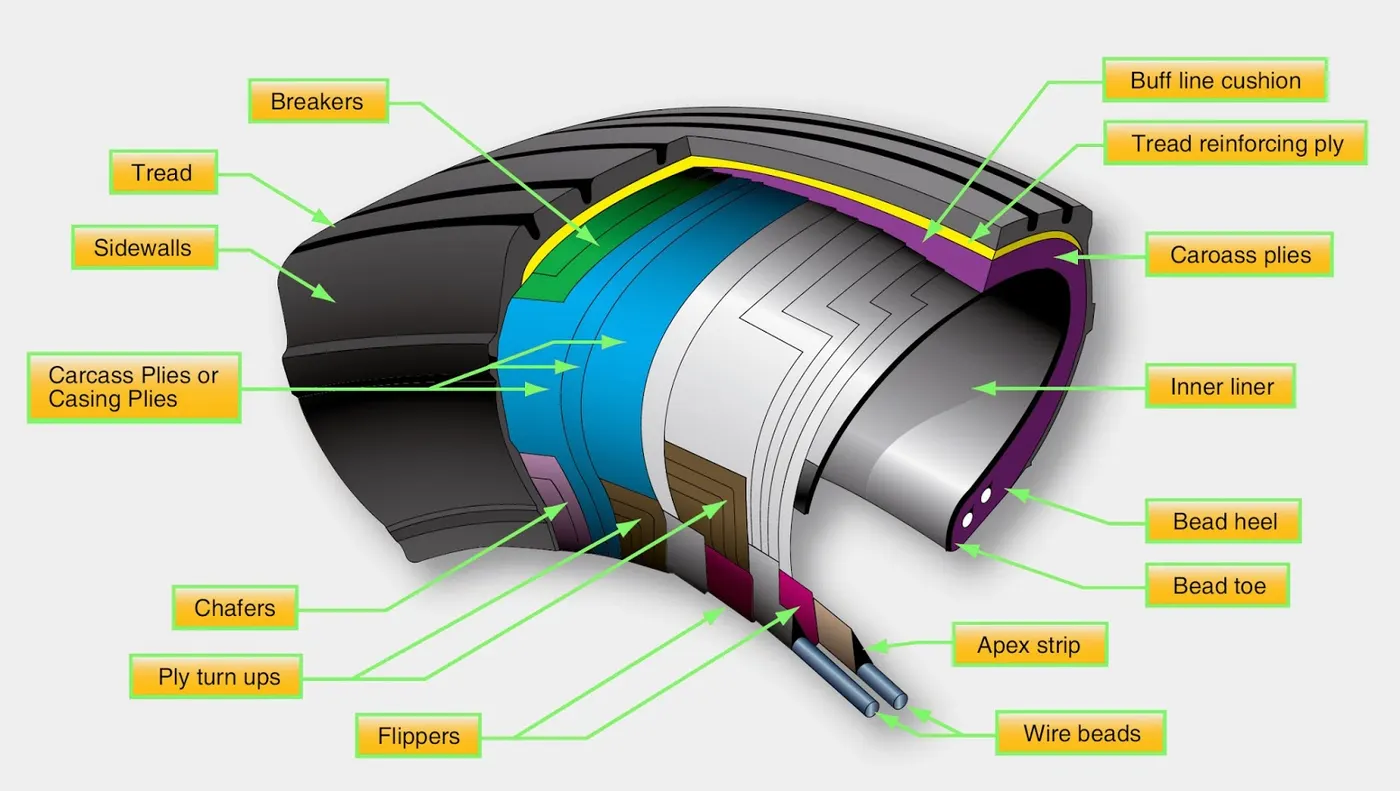
Some technical aspect of the tyre:
Retrading- It is the methodes of restoring a worn tyre by renewing the tread area or by renewing the tread area plus one or both side walls.
Repairs are included in the tyre retreading process.
Load Rating- Load Rating is the maximum permissible load at a specified inflation pressure.
Ply rating- Ply Rating is used to identify the maximum recommended load rating and inflation pressure for a specified tyre.
It is an index of tyre strength.
Speed Rating - The speed rating is the aximum takeoff speed to which the tyre has been tested.
Skid Depth- Skid Depth is the distance between the tread surface and deepest groove as measured in the mould.
today's tyre are conductive. Aircraft tyre are manufactured with tread rubber with conducting compounds to permit earthing static charges.
In early days when tyres were not sufficiently conductive,aircraft used to have aconductive strip hanging down from the axel of the landing gear.
Upon landing this strip would be the first part of the airraft to touch the earth. This discharges any static electricity accumulated on the outer susurface of the aircraft.
Rolling Resistance:
Rolling resistance is the force resisting the motion when a body (such as ball, tyre or wheel) rolls on a surface. Rolling resistance can be seen in the aircraft when the aircraft takes-off from the runway & while landing at the runway with the help of their wheels.
Rolling resistance can be expressed as Frr=μrr⋅m⋅g">Frr=μrr⋅m⋅g=(N).
Where
Frr">Frris the Rolli resistance(N)
μrr">μrr is coefficient of rolling resistance.
m is mass (kg)
g is acceleration due to gravity = 9.81m/s^2
μrr Typical Values for Aircraft-
SURFACE BRAKES OFF BRAKES ON
Dry concrete/ 0.03-0.05 0.3-0.5
asphate
Wet concrete/ 0.05 0.15-0.3
asphate
Icy concrete/ 0.02 0.06-0.10
asphate
Hard turf 0.05 0.4
Firm dirt 0.04 0.3
Soft turf 0.07 0.2
Wet grass 0.08 0.2
Tyre pressure:Aircraft tyres operate at such high extremes of pressure, load, and speed, their care and service is critically important. The most important action an operator can take to prevent tyre-related events is to maintain proper tire inflation pressure. Failure to keep aircraft tires properly inflated can lead to very serious consequences. One relatively easy way to help avoid those consequences is to check tire pressures regularly and service them as necessary. Following these three actions is a good way to make sure you get the most value out of your tires and contribute to the safe operation of your aircraft.Aircraft tires are usually inflated with nitrogen to minimize expansion and contraction from extreme changes in ambient temperature and pressure experienced during flight. Dry nitrogen expands at the same rate as other dry atmospheric gases (normal air is about 80% nitrogen). but common compressed air sources may contain moisture, which increases the expansion rate with temperature.
Also, the use of an inert gas for tire inflation eliminates the possibility of tire explosion.
Relation to Rolling Resistance and Tire Pressure:
Rolling resistance and Tire pressure are inversly proportional
Aircraft braking system included:
Aircraft Disc Brake:
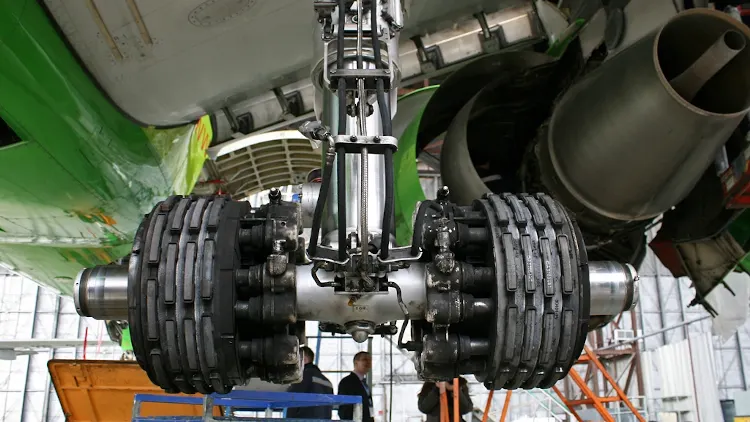
In the landing gear it is used to brake the wheels while touchinh the ground.These brakes are operated hydraulically. In most modern aircraft hey are activated by the top sction of the rudder pedals("toe brakes"). In some older aircraft the bottom section is used instead("heel brakes"). Levers are used in a few aircraft. Most aircraft are capable of differential braking.
Braking Forces During Landing:
Following braking devices are used to decelerate the aircraft -
1. Spoilers.
2. Wheel Brakes (Including Anti-Skid systems & Auto-Brake systems).
3. Reverse Thrust
Spoilers:
The mechanical deflection of parts of the wing upper surface by increasing aerodynamic drag on the moving aircraft. This can be achieved by raising upper wing surface panels called ground spoilers or by operation of a tail cone 'clamshell' type air brake and also by increasing the effective downward load on the landing gear and thereby increasing the efficiency of wheel braking
Wheel Brakes:
To be effective, braking action at any speed depends upon sufficient friction existing between the tires and the runway surface achieved through freely rotating wheels.
Anti skid system:
When landing on slippery runways, there's a chance that the wheels may start to skid as the brakes are applied. To stop this from happening and to maintain maximum effective braking, each wheel has anti-skid protection.
Using a variety of sources to determine the aircraft speed, the brake units know how fast the wheels should be spinning. If that speed drops significantly, it's because the current brake pressure on that wheel is too great and the wheel is just skidding over the surface.
In this situation, the anti-skid system automatically reduces the braking on that wheel to a point where the skid stops before reapplying the pressure.
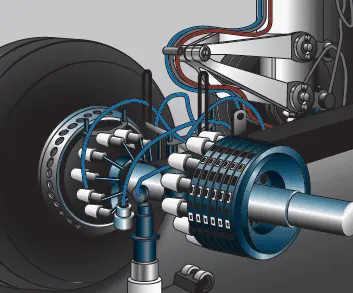
Reverse Thrust:
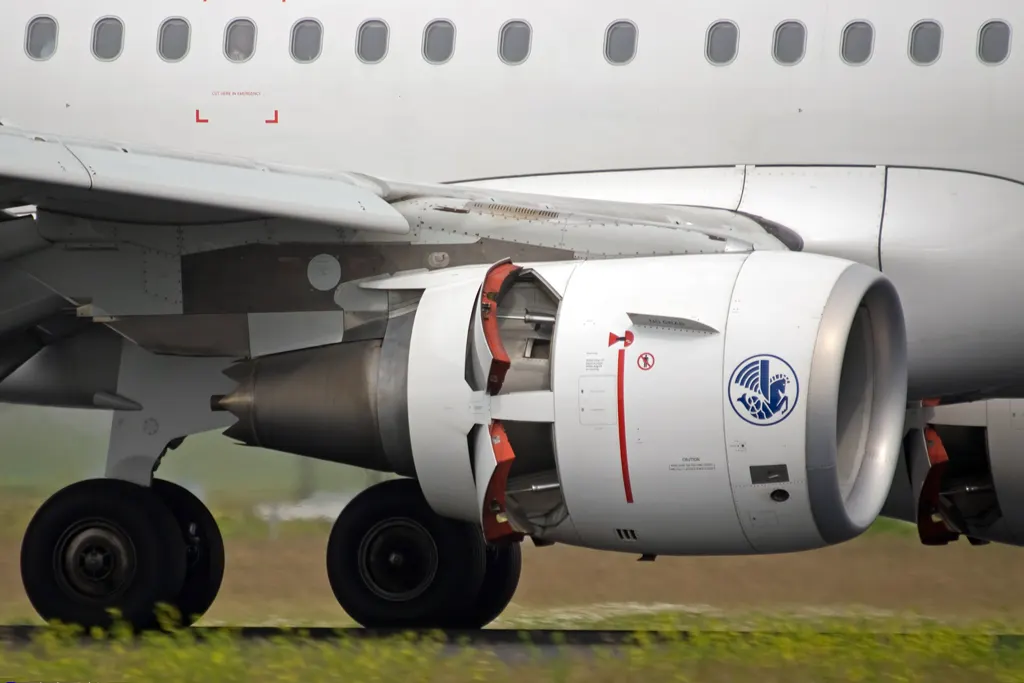
Thrust reversers provide a deceleration force that is independent of runway condition. Thrust reverser efficiency is higher at high airspeed therefore. Treversers must be selected as early as possible after touchdown.
Thrust reversers should be returned after reverse idle at low airspeed to prevent engine stall or foreign object damage.
Part B:
6. A. With necessary assumptions, calculate the force and power required to push / pull an aircraft by a towing vehicle.
Considering:
Total mass of ther aircraft (including payload) for airbus a380 = 575,000kg. Mass of the push back: 1000kg (assumed) Rolling Resistance (Frr):
Coefficient of rolling resistance (Crr) = 0.002 (on tarmac)
Rolling resistance force is given by
Frr=Crr⋅m.g
For the aircraft:
Frr=0.002*575000*9.81
⇒
Frr=11281.5N
⇒
Frr=11.2815kN
⇒
Frr=11.2815N
For the Towing Vehicle: Frrt=0.002*1000*9.81
⇒
Frrt=19.6N
As the towing vehicle resistance is so less compared to the Aircraft because this is a heavy aircraft these can be neglected
Aerodynamic resistnace (Far):
Drag coeffcient(Cd): 0.025
Air Density (ρ) = 1.125kg/m^3
Frontal Area (A): 150m^2.
Velocity (v) = 14.5kmph or 4m/s
Far=1/2*Cd*ρ*A⋅^2
Far=1/2*0.025*1.125*150*4^2
⇒
33.75N
As the vehicle and Plane is moving at very low speed Aerodynamic resistance can be neglected
Hill Climb Resistnace:
Runways are constructed flat so Gradient resistance/ hill climb force is neglected.
Total Resistance:
Ft=11.2815kN
Power Required:P=Ft*v
⇒
P=11.2815⋅4
⇒
45.26kW
The min power required by the tow vehicle is 45.26kW to taxi a heavy air craft at 4m/s..
B. Develop the model for the calculated force and power using Simulink.
Simulink Model:
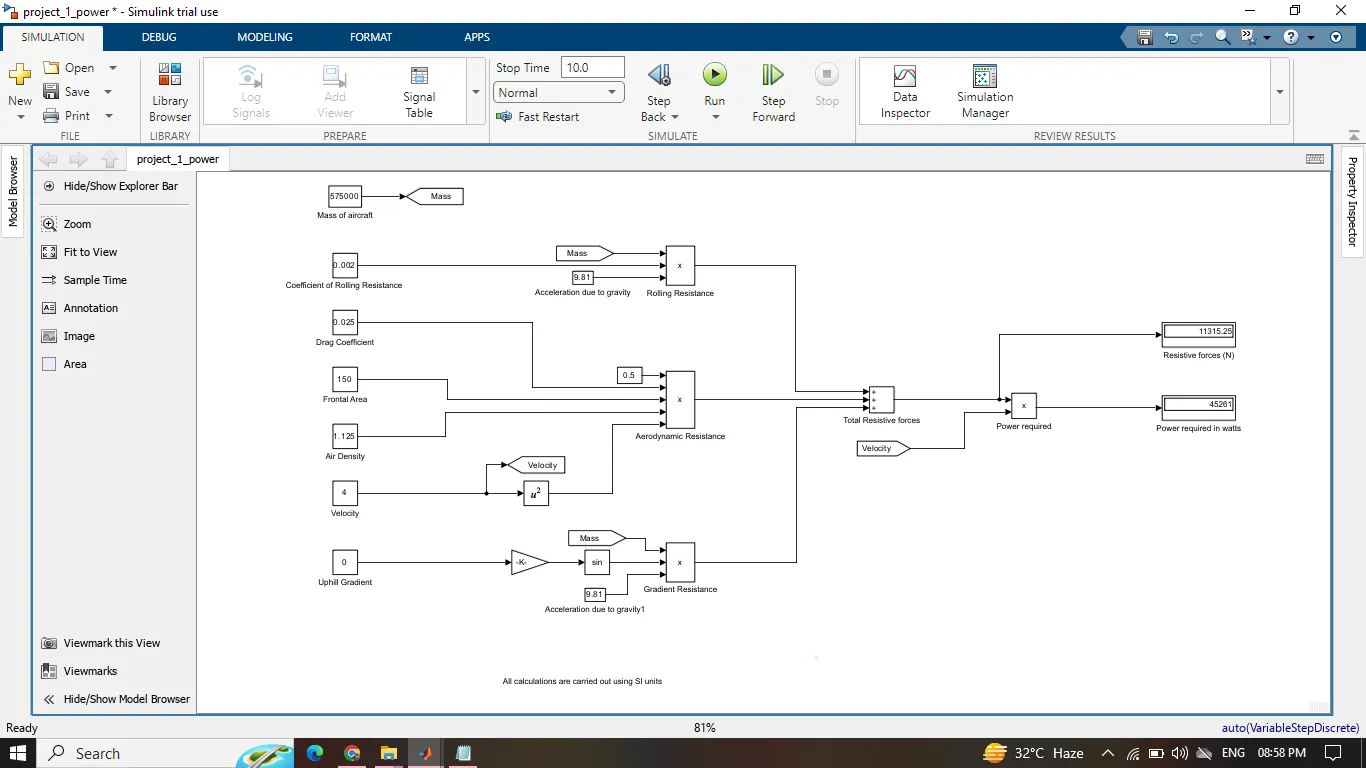
- constant blocks are used to feed the parameters such as mass, coefficients and other parameters
- using product block the resistive forces are calculated.
- using sum block, total resistive forces can be calculated.
- the outputs are visualised using display blocks.
7.A-Design an electric powertrain with type of motor, it's power rating and energy requirement to fulfill aircraft towing application
Assumption For Powertrain Design-The power required by the aircraft is 45.26kW. Consider a motor with following specifications
Voltage 400-800V Peak Power 60-70kW RPM 1500-4000 Torque 300Nm Transmission consider 60kW as peak power therefore voltage will be 400V. Assume battery power to be 550V. Now we can calculate the duty cycle d=Vo/Vs = 400/550 = 0.7272
Duty cycle is the 0.7272 Assume parameterss
Parameter value Aircraft Mass (mA) = 575,000kg Towing vehicle Mass =50,000kg(assume) Rolling Resistance Co-efficient (Crr) = 0.002 Air density ρ = 1.125kg/m^2 Towing vehicle Drag coefficient Cd = 0.5 Aircraft Drag co-efficient =0.09 Fronatal Area A = 150 m^2 Inclination angle = 0 rad Tyre Pressure = 203PSI/14 bar Towing Velocity (V) = 14.5kmph or 4m/s Towing Time(t) = 2 min Radius of the towing vehicle wheel = 0.38
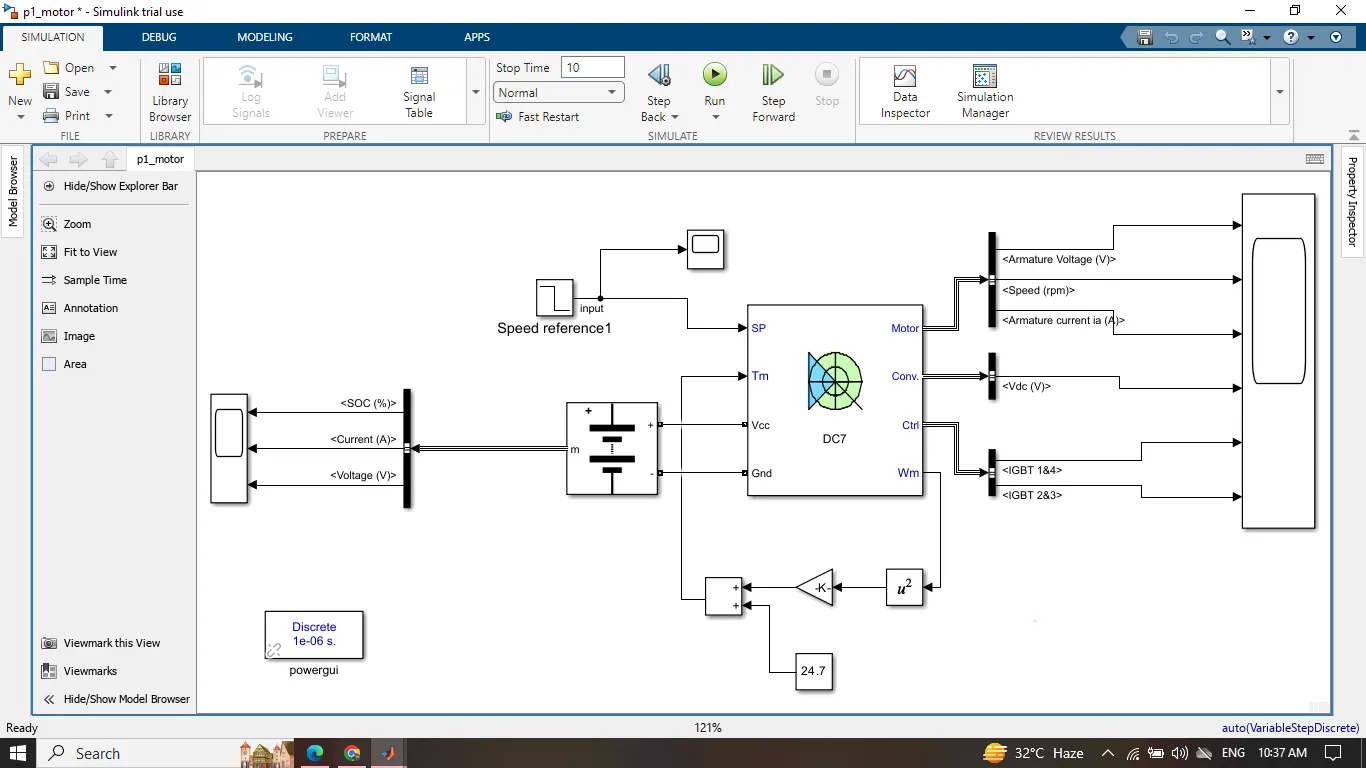
Block diagram of powertrain:
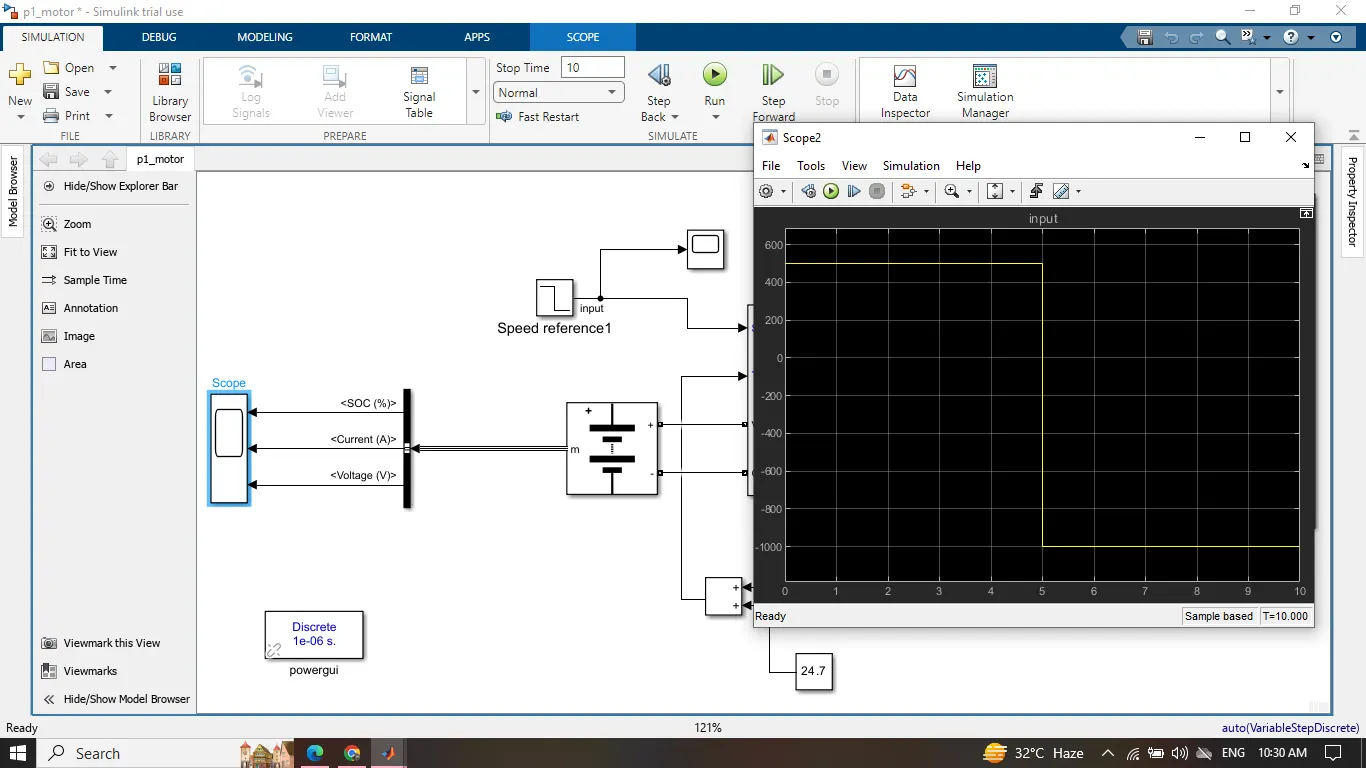
SPEED REFERENCE-
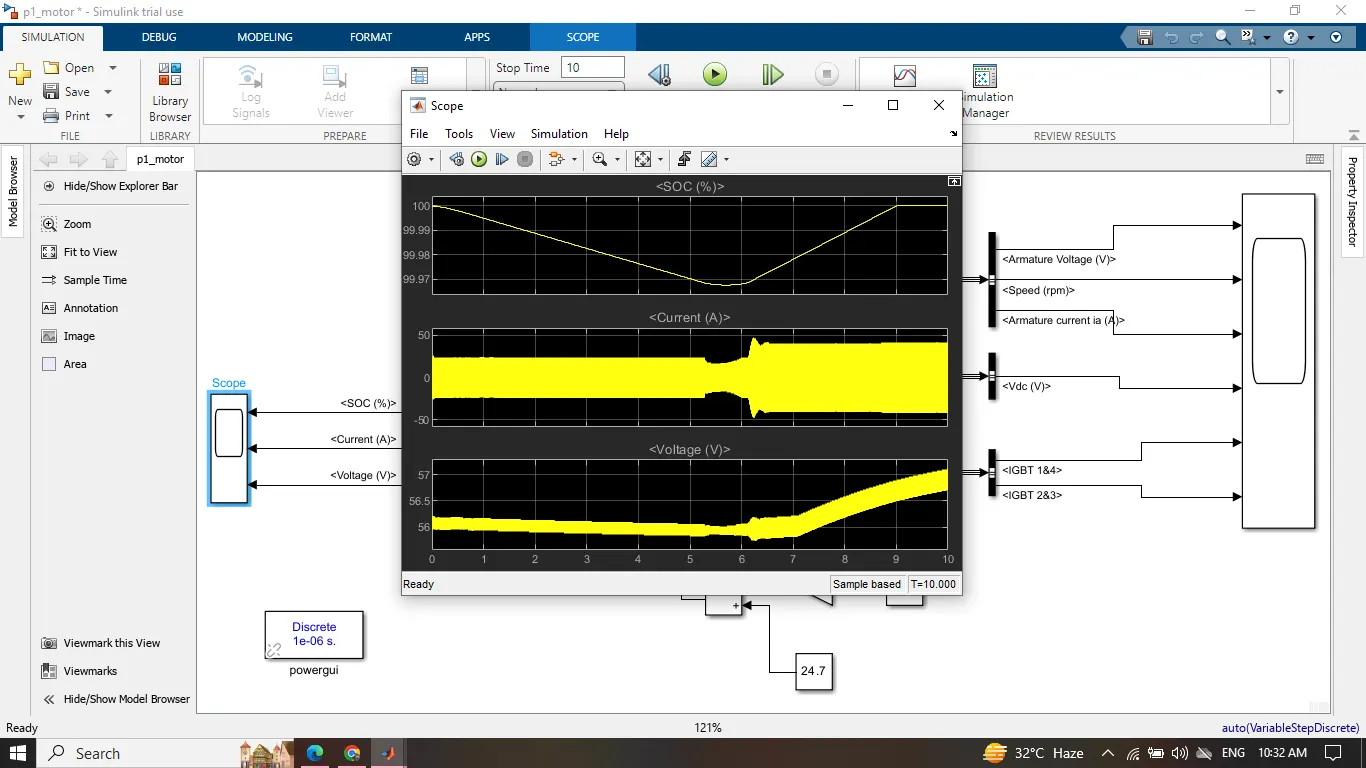
BATTTERY OUTPUT-
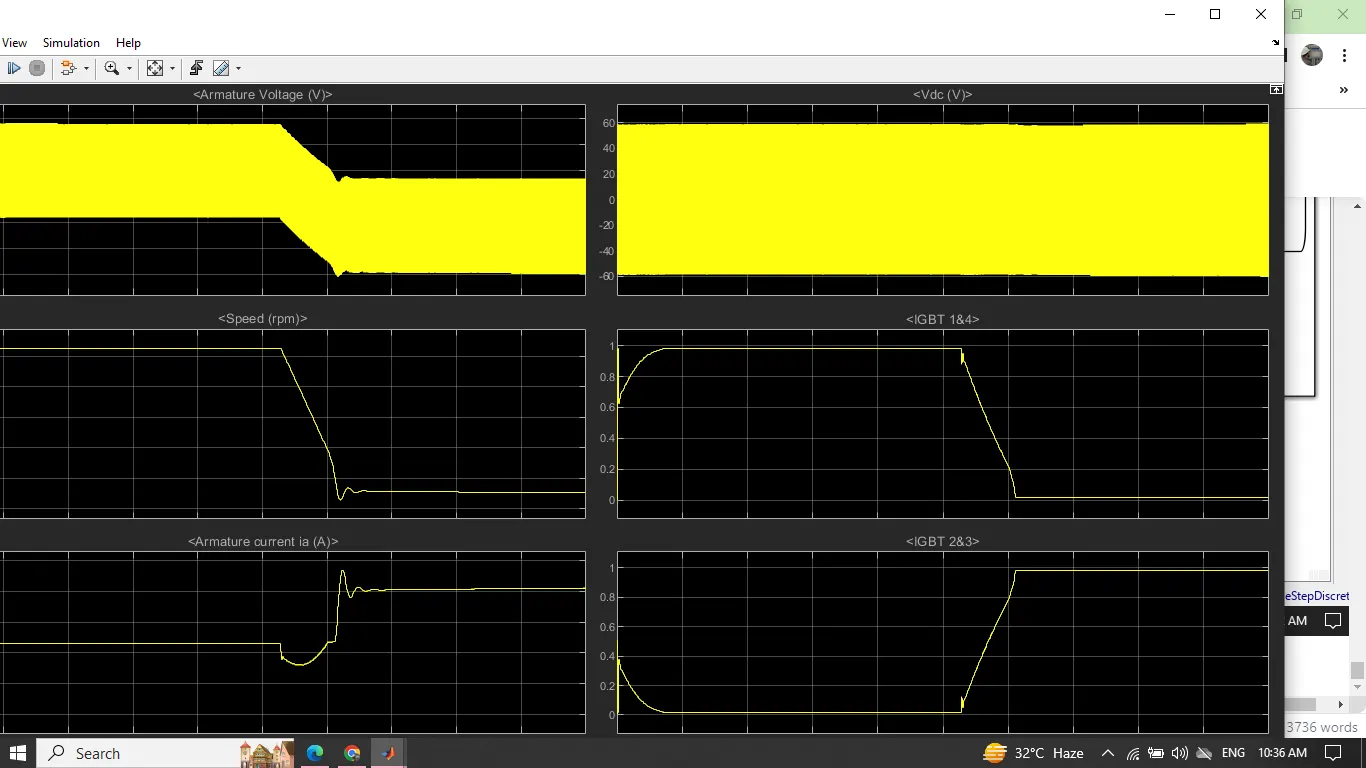
MOTOR OUTPUT-
MODEL-
other required document enclosed with the project documentation section.