Project-1: Powertrain for aircraft in runways
*PART -A*
Q.
(1).Ans:-
List of the total weight of various types of aircrafts:-
* An aircraft's gross weight is limited by several weight restrictions in order to avoid overloading its structure or to avoid unacceptable performance or handling qualities while in operation.
* Aircraft gross weight limits are established during an aircraft's design and certification period and are laid down in the aircraft's type certificate and manufacturer specification documents.
* The aircraft gross weight is the total aircraft weight at any moment during the flight or ground operation.
* An aircraft's gross weight will decrease during a flight due to fuel and oil consumption.
* An aircraft's gross weight may also vary during a flight due to payload dropping or in-flight refuelling.
Total weight of various types of aircrafts:-
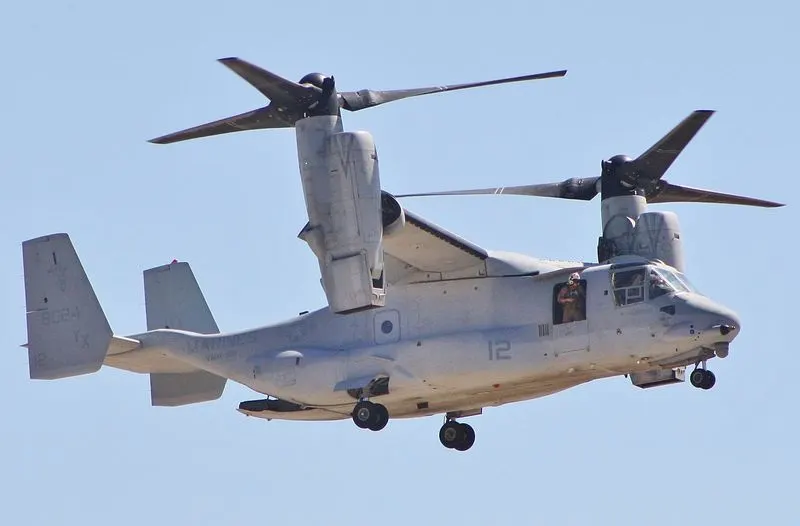
(i).Powerlift:-
* A powered lift aircraft takes off and lands vertically under engine power but uses a fixed wing for horizontal flight.
* Like helicopters, these aircraft do not need a long runway to take off and land, but they have a speed and performance similar to standard fixed-wing aircraft in combat or other situations.
* A heavier-than-air aircraft capable of vertical take-off, vertical landing, and low-speed flight.
* Which depends principally on engine-driven lift devices or engine thrust for the lift during these flight regimes and on non-rotating aerofoil(s) for lift during horizontal flight.
* Total weight = 160kgs.
(ii).Transport aircraft:-
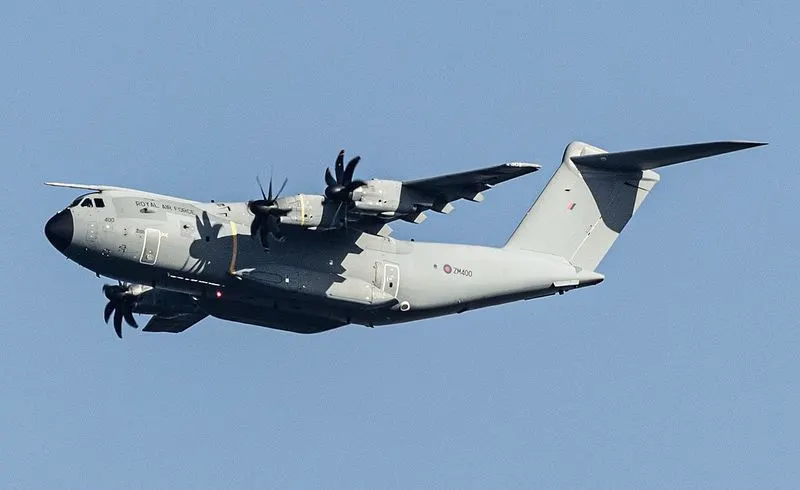
* Airliners, aircraft, usually large and most often operated by airlines, intended for carrying multiple passengers or cargo in commercial service.
* Cargo aircraft or freighters, fixed-wing aircraft designed or converted for the carriage of goods, rather than passengers, lacking in passenger amenities.
* Generally featuring one or more large doors for loading cargo also known as freight aircraft, freighters, airlifters, or cargo jets.
* Military transport aircraft or military cargo aircraft are used to airlift troops, weapons and other military equipment to support military operations.
* Transport aircraft can be used for both strategic and tactical missions, and are often diverted to civil emergency relief missions.
* Total weight = 25000kgs.
(iii).Fighter aircraft:-
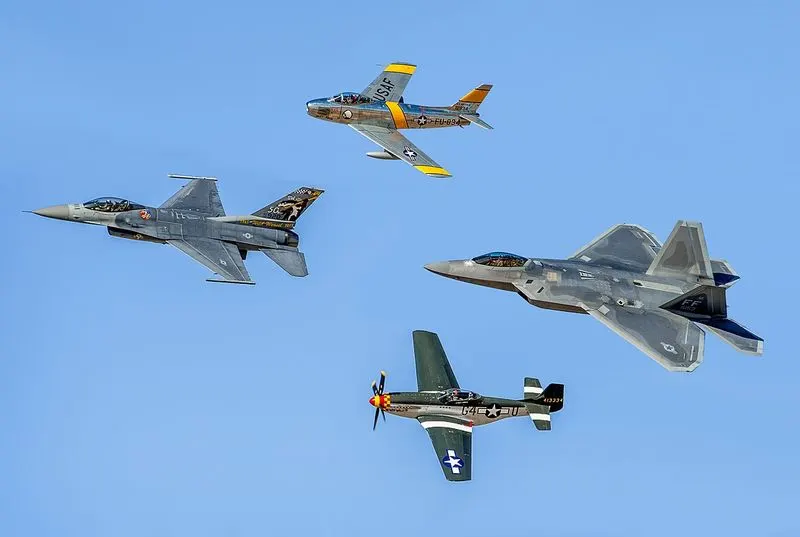
* Fighter aircraft are fixed-wing military aircraft designed primarily for air-to-air combat.
* In military conflict, the role of fighter aircraft is to establish air superiority of the battlespace.
* Domination of the airspace above a battlefield permits bombers and attack aircraft to engage in tactical and strategic bombing of enemy targets.
* Total weight = 13500kgs.
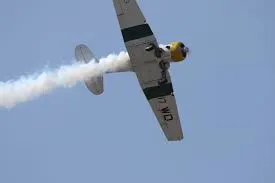
(iv).Aerobatic aircraft:-
* An aerobatic aircraft is an aerodyne (a heavier-than-air aircraft) used in aerobatics, both for flight exhibitions and aerobatic competitions.
* Most aerobatic manoeuvres involve rotation of the aircraft about its longitudinal (roll) axis or lateral (pitch) axis.
* Other maneuvers, such as a spin, displace the aircraft about its vertical (yaw) axis.
* Manoeuvres are often combined to form a complete aerobatic sequence for entertainment or competition.
* Aerobatic flying requires a broader set of piloting skills and exposes the aircraft to greater structural stress than for normal flight.
* Total weight = 770kgs.
(v).Glider aircraft:-
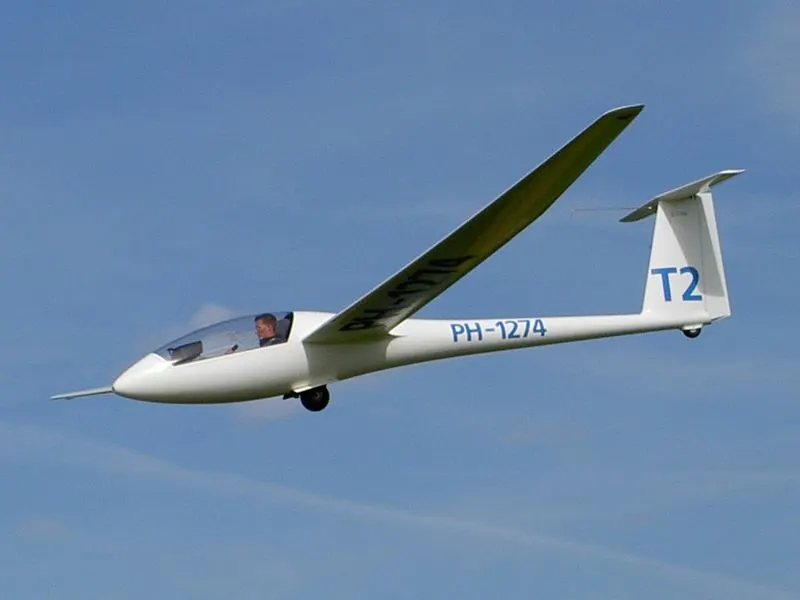
* A glider is a fixed-wing aircraft that is supported in flight by the dynamic reaction of the air against its lifting surfaces, and whose free flight does not depend on an engine.
* Most gliders do not have an engine, although motor-gliders have small engines for extending their flight when necessary by sustaining the altitude.
* Normally a sailplane relies on rising air to maintain altitude) with some being powerful enough to take off by self-launch.
* Here are a wide variety of types differing in the construction of their wings, aerodynamic efficiency, location of the pilot, controls and intended purpose.
* Most exploit meteorological phenomena to maintain or gain height.
* Gliders are principally used for the air sports of gliding, hang gliding and paragliding.
* Total weight = 400 to 600kgs.
(2).Ans:-
Difference between ground speed and air speed:-
* Generally , there are two different types of speed when talking about airplanes – ground speed and airspeed.
* Airspeed is the vector difference between the ground speed and the wind speed.
* On a perfectly still day, the airspeed is equal to the ground speed.
* But if the wind is blowing in the same direction that the aircraft is moving, the airspeed will be less than the ground speed.
Ground speed vs air speed:-
* As mentioned above, true airspeed is simply the speed at which an aircraft is moving relative to the air it is flying in. As such, it’s also the speed at which the air is flowing around the aircraft’s wings.
* Ground speed, on the other hand, is the aircraft’s speed relative to the ground.
* One thing that should be noted here is that it’s its horizontal rather than vertical speed – an aircraft climbing completely vertically would have a ground speed of zero.
* In other words, while airspeed is what determines whether there is enough airflow around an aircraft to make it fly.
* Ground speed is what determines how fast an aircraft will get to its destination.
(3).Ans:-
Why is it not recommended to use aircraft engine power to move it on the ground at Airport:-
* High engine thrust during maintenance activity can cause considerable damage to airplanes and other elements in the airport environment.
* An example of this problem occurred after an airplane arrived at its final destination with a log entry indicating the flight crew had experienced anomalous engine operation.
* The risks which may arise from engine ground running relate to the potential for loss of control of the aircraft by those persons occupying the pilot seats in the flight deck.
* Unwanted consequences from such static running are mainly related to those arising from the unintended movement of the aircraft during engine running.
* Damage can occur to the aircraft itself, other aircraft nearby or to airside structures.
* In addition, there is a risk of injury to ground support personnel who may be in relatively close proximity to the aircraft.
* Towing is coupling two or more objects together so that they may be pulled by a designated power source or sources.
* The towing source may be a motorized land vehicle, vessel, animal, or human, and the load being anything that can be pulled.
* The extensive noise arises from the engine power also dangerous for humans and other living things around the vicinity.
* Hence for the above reasons it is not recommended to use engine power to move on the ground.
(4).Ans:-
How an aircraft is pushed to runway when its ready to take off:-
* Pushback is when an aircraft is pushed backwards away from the airport gate by vehicles called tugs or tractors.
* Closer to departure, an aircraft tug will park right in front of the nose wheel.
* The tug might be directly attached to the plane's nose gear with a tow bar, or could be a “wheel-lift” tug.
* In aviation, pushback is an airport procedure during which an aircraft is pushed backwards away from its parking position, usually at an airport gate by external power.
* Pushbacks are carried out by special, low-profile vehicles called pushback tractors or tugs.
* Pushbacks at busy aerodromes are usually subject to ground control clearance to facilitate ground movement on taxiways.
* Since the pilots cannot see what is behind the aircraft, steering is done by the pushback tractor driver and not by the pilots.
* Depending on the aircraft type and airline procedure, a bypass pin may be temporarily installed into the nose gear to disconnect it from the aircraft's normal steering mechanism.
* Once the pushback is completed, the towbar is disconnected, and any bypass pin removed.
* The ground handler will show the bypass pin to the pilots to make it clear that it has been removed.
* The pushback is then complete, and the aircraft can taxi forward under its own power.
(5).Ans:-
About take off power, tyre design, rolling resistance, tyre pressure, brake forces when landing:-
Take off power:-
* On take-off, in order to position the aircraft to a safe height away from terrain and obstacles (i.e. a flight path of maximum height and minimum ground distance desired).
* The engine thrust is set to a high 'take-off power' setting (although this is not necessarily full power) and the aircraft attitude is pitched up.
* The light aircraft, usually full power is used during takeoff.
* Large transport category (airliner) aircraft may use a reduced power for takeoff.
* Where less than full power is applied in order to prolong engine life, reduce maintenance costs and reduce noise emissions.
* The aircraft is permitted to accelerate to rotation speed (often referred to as Vr). The term rotation is used because the aircraft pivots around the axis of its main landing gear.
* While still on the ground, usually because of gentle manipulation of the flight controls to make or facilitate this change in aircraft attitude.
Tyre design:-
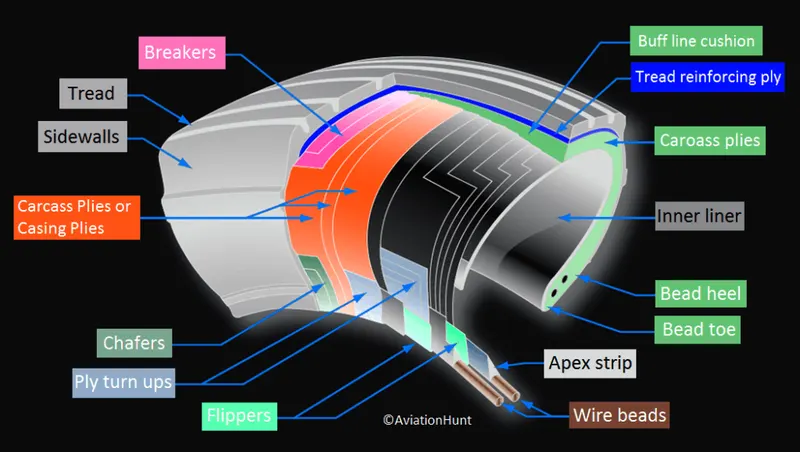
* They support the weight of an aircraft while it is on the ground.
* It also provides the necessary traction for braking and stopping of an aeroplane.
* Tyre also helps to absorb the shock of landing and provide cushioning the roughness of takeoff, roll-out, and taxi operations.
* An automobile or truck tyre, it does not have to carry a load for a long period of continuous operation.
* However, an aircraft tyre absorbs the high impact loads of landing, and also it’s operating at high speeds for a short time when required.
* Retreading – Retreading is methods of restoring a worn tyre by renewing the tread area or by renewing the tread area plus one or both sidewalls. Repairs are included in the tyre retreading process.
* Load rating - Load rating is the maximum permissible load at a specified inflation pressure.
* Ply Rating - Ply Rating is used to identify the maximum recommended load rating and inflation pressure for a specified tyre. It is an index of tyre strength.
* Speed rating - The speed rating is the maximum takeoff speed to which the tyre has been tested.
* Skid depth - Skid depth is the distance between the tread surface and the deepest groove as measured in the mould.
* Based on the method for containing the inflation gas the tyres can be:
* Tube-type tyres - these require tubes for inflation retention.
* Tubeless tyres - these do not require tubes. They are constructed with an innerliner (integral rubber lining that is engineered to prevent the diffusion of the inflation gas into the casing.).
Rolling resistance:-
* The resistance offered by the tyres against motion of vehicle/aircraft is called as rolling resistance.
* The rolling resistance is produced during take off/landing in the runway.
* It is mainly caused by non-elastic effects that is, not all the energy needed for deformation (or movement) of the wheel, roadbed, etc., is recovered when the pressure is removed.
Tyre pressure:-
* Aircraft tires are usually inflated with nitrogen to minimize expansion and contraction from extreme changes in ambient temperature and pressure experienced during flight.
* Dry nitrogen expands at the same rate as other dry atmospheric gases (normal air is about 80% nitrogen).
* But common compressed air sources may contain moisture, which increases the expansion rate with temperature.
* Car tyre pressure is a measurement of how much air is in your pneumatic tyre.
* And ensures the tyres wear evenly and maintain the correct level of grip on the road surface.
* This is commonly expressed as PSI, or pounds-per-square-inch.
* Airplane wheel/tire assemblies are inflated to high pressures (many in excess of 200 psi).
* In addition, the pressure in the bottle or tire-servicing cart can be as high as 3,000 psi
Brake forces:-
* In addition to wing spoilers, airplanes use disc brakes.
* Airplane disc brakes are similar to the braking system in automobiles.
* They consist of a pair of calipers that, when engaged, squeeze pads against the rotors of an airplane's landing gear.
* Disc brakes are designed to remain static at all times.
* In general, when the wheels touch the ground, a set of spoilers raise up quickly, which kills the lift provided by the wings.
* There are two sets seen in the image below: ground spoilers that only deploy on landing, and spoilers that are used in flight as speed brakes as well as on landing.
* Wheel brakes are usually selected to engage automatically after landing. These are called autobrakes.
* That all airliners have several levels of autobrake severity.
* The crew will decide which is the most appropriate to use for every landing depending upon factors like the length of runway.
* If it is wet or dry, or if the pilots want to exit the runway at a particular point.
*PART -B*
Q.6
(A).Ans:-
To calculate the force and power required to push / pull an aircraft by a towing vehicle:-
* The push or pull an aircraft by a towing vehicle, there are 3 type of forces will act on that vehicle.
(a).Rolling resistance
(b).Aerodynamic drag force
(c).Hill climbing force
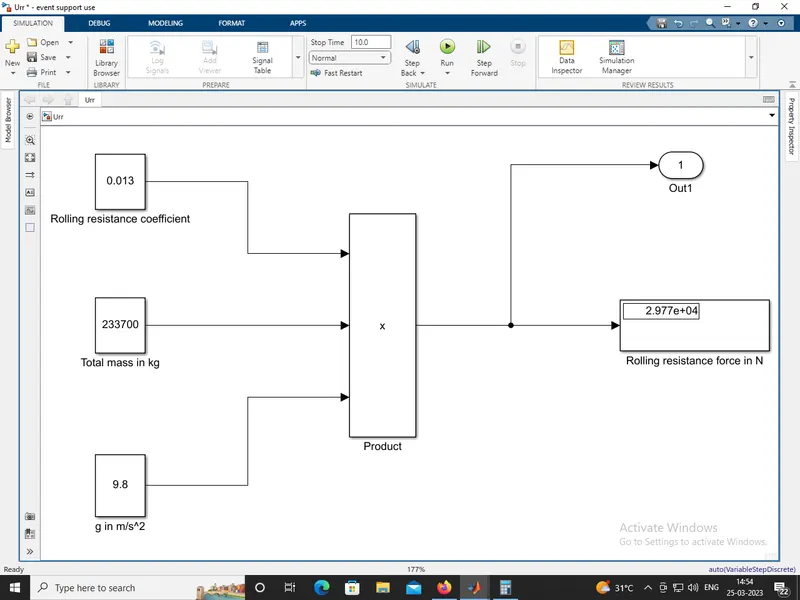
(a).Rolling resistance:-
* Rolling resistance force
Frr = urr * m * g
Where,
m = total mass of the aircraft(Actual mass+Pay load) in kg and
g = gravitational constant, that is 9.8 m/s^2 .
* The force to move an airplane on an absolute flat runway with no wind at constant low speed is equal to the rolling resistance between the plane and the tarmac.
* Rolling resistance is the force resisting the motion when a body rolls on a surface. It is the friction force that is needed to be overcome to move a vehicle.
* The kinetic energy of the wheels is partially converted into heat.
* The rolling resistance is proportional to the normal force perpendicular to the rolling wheel and is approximated by the rolling resistance coefficient urr.
(b).Aerodynamic drag force :-
* As the airplane moves through the air, there is another aerodynamic force present.
* The air resists the motion of the aircraft, this resistance force is called the drag of the airplane.
* Like lift, there are many factors that affect the magnitude of the drag force including:
(i).shape of the airplane.
(ii).stickiness of the air.
(iii).speed.
* When the vehicle moves the velocity of air near boundary is higher than the air surrounding.
* Both the tug and the aircraft will experience some aerodynamic drag
* The aerodynamic drag force caused by the aircraft and towing vehicle can be given by Equation:
Fad = (1/2) * p * V^2 * A * (Cd_t + Cd_a)
where,
p = Air density, that is normally 1.25 kg/m^3
A = Frontal area of the vehicle in m^2
Cd_t = Air drag co-efficient of towing vehicle
Cd_a = Air drag co-efficient of aircraft
v = Velocity of the vehicle in m/s
(c).Hill climbing force:-
* Hill climbing force is the force needed to move the vehicle in up gradient. To Hill Climbing force the expression of the equation is:
Fhc = m * g * sin(theta)
where,
m = Total mass of the vehicle(vehicle mass + payload) in kg
g = Gravitational constant that is 9.8 m/s^2
theta = up gradient angle or inclination angle in radian
To calculate the force and power required to push / pull an aircraft by a towing vehicle:-
* Let consider,
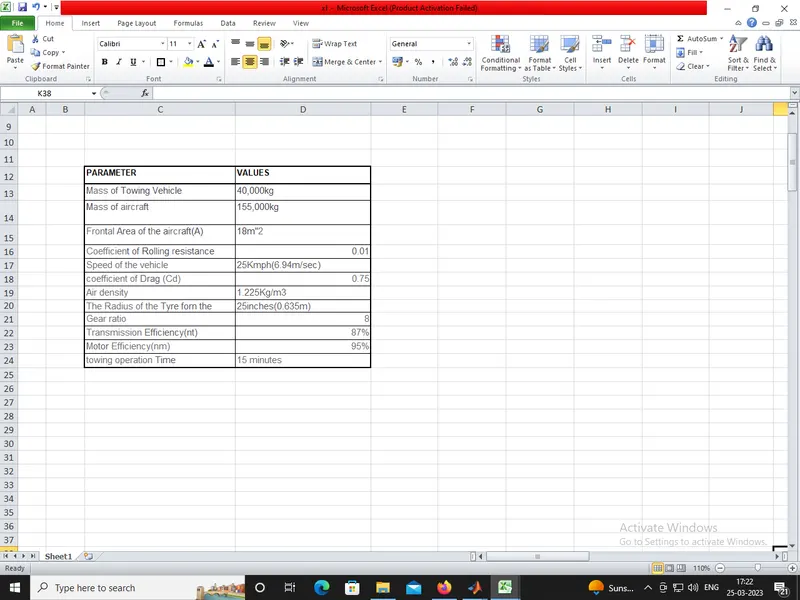
towing vehicle mass = 50000 Kg
aircraft mass or payload on towing vehicle = 183700 Kg
speed of the vehicle(V) = 30 Km/hr = 8.333 m/s
total mass of the vehicle(m) = (50000+183700) = 233700 Kg
towing vehicle fontal area(A) = 20 m^2
velocity of the vehicle = 2.778
Rolling Resistance Force(Frr) = urr * m * g
=0.013 * (50000+183700) * 9.8
=29,773.38 N
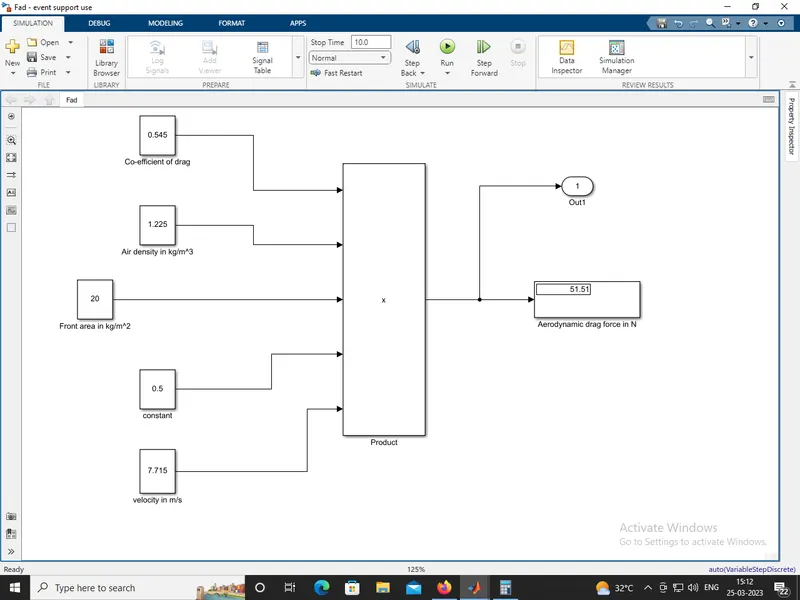
Aerodynamic Drag Force(Fad) = (1/2) * p * V^2 * A * (Cd_t + Cd_a)
= (1/2) * 1.225 * (2.778)^2 * 20 * (0.5+0.045)
= 51.514 N
Hill Climbing Force(Fhc) = m * g * sin(theta)
=(50000+183700) * 9.8 * sin(theta)
=0 N
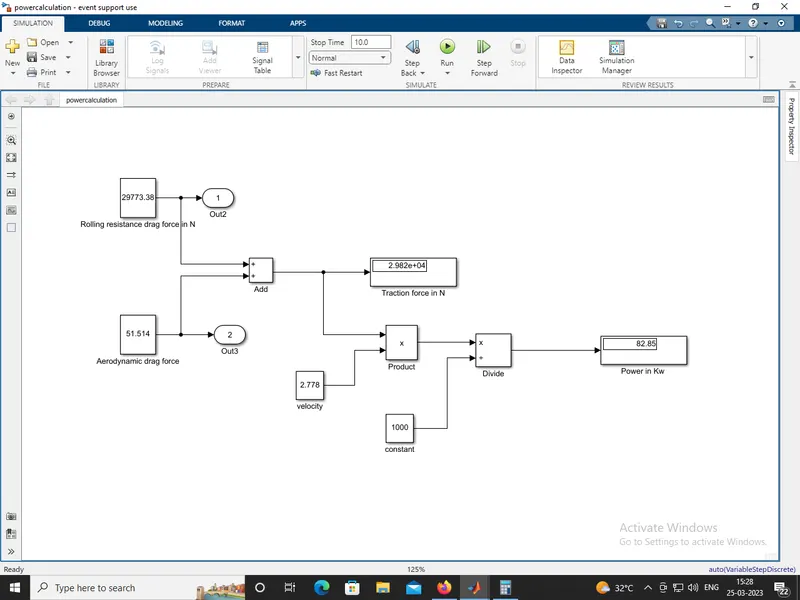
Total required traction power(Tf) = Frr + Fad + Fhc
=29773.38 + 51.514 + 0
=29824.894 N
Q.6
(B).Ans:-
To develop the model for the calculated force and power using Simulink:-
(a).Rolling Resistence Force Calculation:-
(b).Aerodynamic drag force calculation:
Power calculation:-
Q.7
(A).Ans:-
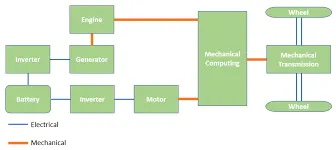
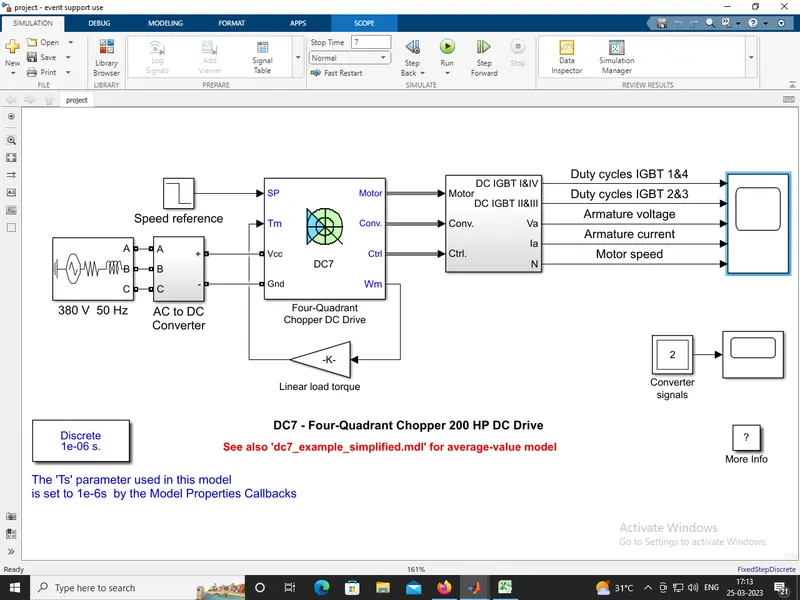
To Design an electric powertrain with type of motor, it’s power rating, and energy requirement to fulfill aircraft towing application in Simulink:-
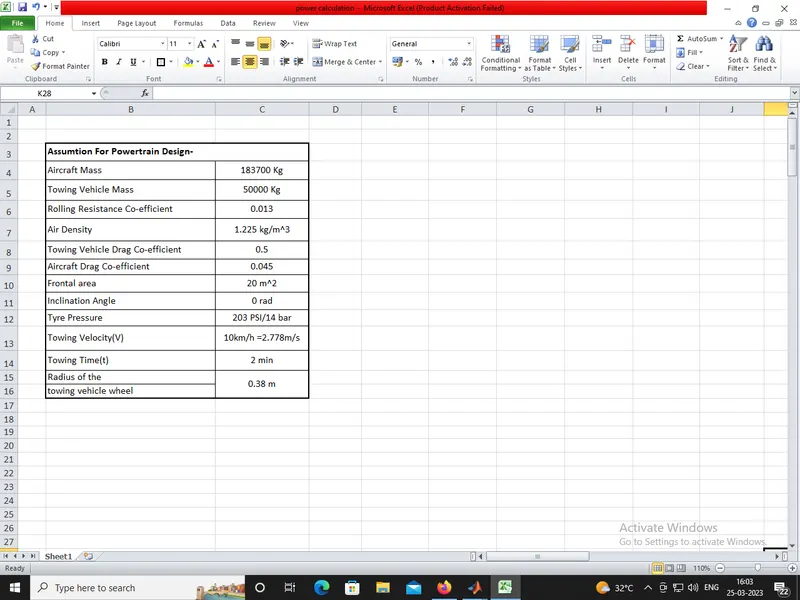
* From the excell cheet calculator we got traction force(F)= 29824.89427 N
* Power required (p) = F * v
= 29824.89427 * 2.778
= 82846.928 watt
= 82.846 kw
we know that,
torque (T) = force * wheel radius
= 29824.89427 * 0.38
= 11333.45972 N-m
* Required Energy(E) for towing application based on the assumed time, that is E = P * t
E= 82.846*(120/3600)
E= 2.761 kwh
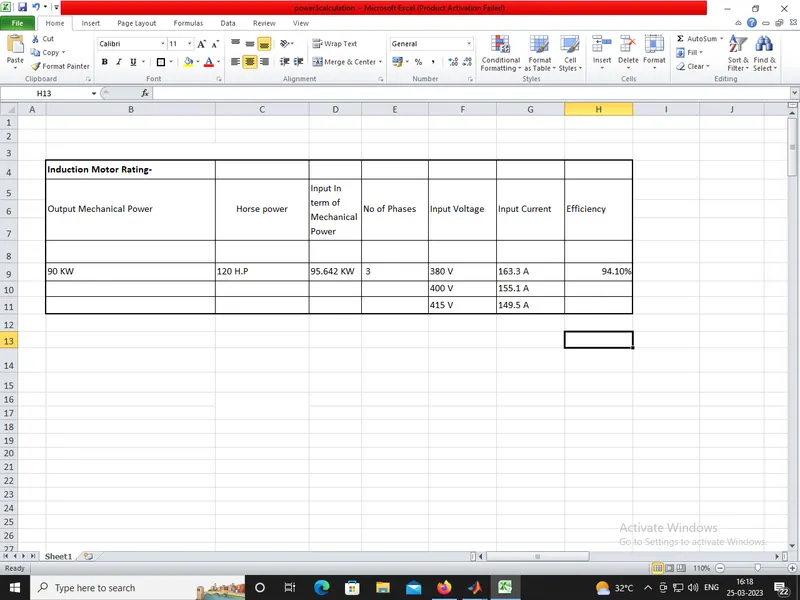
* The motor output power is the input power of the towing vehicle so to obtain maximum speed, the duty cycle needed is calculated as below- Duty Cycle = Output Power/Input Power
= (82.846/90)*100 = (0.921*100)%, so the duty cycle will be 92.1%
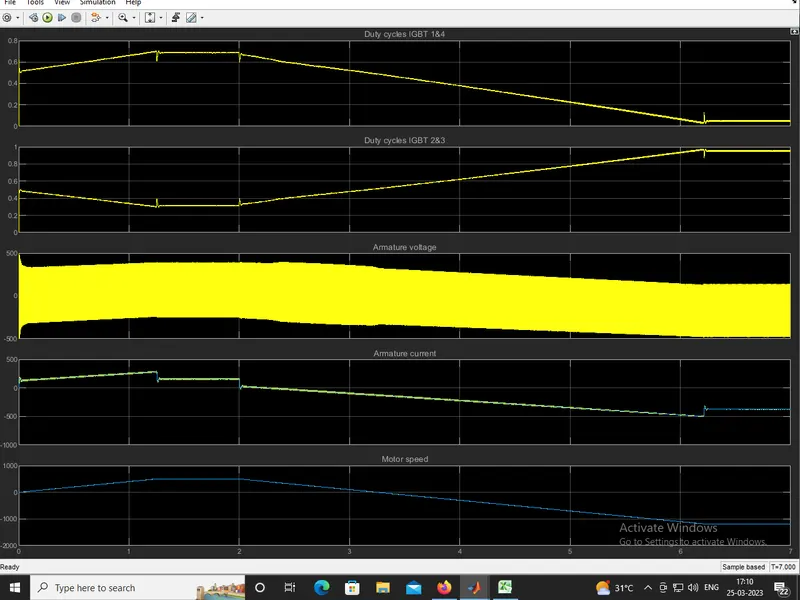
* The duty cycle range to control the aircraft speed from zero to highest is from 0 to 92.1 %
Block diagram of power train:-
Simulink model:-
Output results:-
Q.7
(B).Ans:-
To design the parameters in excel sheet:-