Project-1: Powertrain for aircraft in runways
2. Is there any difference between ground speed and airspeed?
Answer:- 1. The aircraft usually operates inland as well as in air and so we need to study their speed difference in-ground and in air
2. The ground speed and the airspeed usually change based on the wind component.
3.If we consider that there is no wind component then,
ground speed = airspeed
4, if the wind is blowing in the tail direction of the aircraft then (airspped>ground speed)
airspeed = groundspeed + wind component
5. if the wind is blowing in the head direction of the aircraft then(airpeed
airspeed = ground speed - wind component
6. also the gravity too plays a major role in increasing the aircraft's speed while it is descending
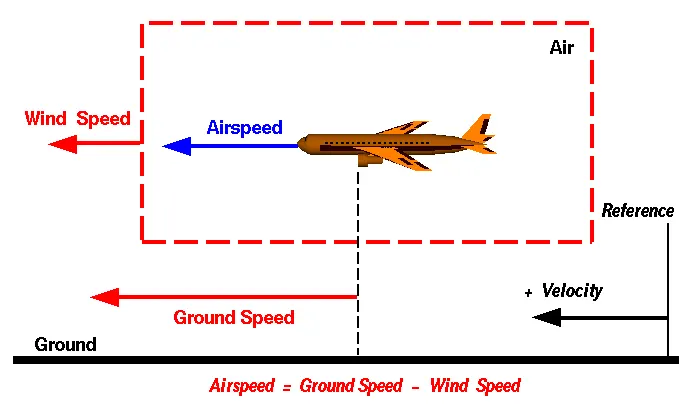
One of the most confusing concepts for young scientists is the relative velocity between objects. Aerodynamic forces are generated by an object moving through a fluid (liquid or gas). A fixed object in a static fluid does not generate aerodynamic forces. Hot air balloons "lift" because of buoyancy forces and some aircraft like the Harrier use thrust to "lift" the vehicle, but these are not examples of aerodynamic lift. To generate lift, an object must move through the air, or air must move past the object. Aerodynamic lift depends on the square of the velocity between the object and the air. Now things get confusing because not only can the object be moved through the air, but the air itself can move. To properly define the relative velocity, it is necessary to pick a fixed reference point and measure velocities relative to the fixed point. In this slide, the reference point is fixed to the ground, but it could just as easily be fixed to the aircraft itself. It is important to understand the relationships of wind speed to ground speed and airspeed.
Wind Speed
For a reference point picked on the ground, the air moves relative to the reference point at the wind speed. Notice that the wind speed is a vector quantity and has both a magnitude and a direction. Direction is important. A 20 mph wind from the west is different from a 20 mph wind from the east. The wind has components in all three primary directions (north-south, east-west, and up-down). In this figure, we are considering only velocities along the aircraft's flight path. A positive velocity is defined to be in the direction of the aircraft's motion. We are neglecting cross winds, which occur perpendicular to the flight path but parallel to the ground, and updrafts and downdrafts, which occur perpendicular to the ground.
Ground Speed
For a reference point picked on the ground, the aircraft moves relative to the reference point at the ground speed. Ground speed is also a vector quantity so a comparison of the ground speed to the wind speed must be done according to rules for vector comparisons.
Airspeed
The important quantity in the generation of lift is the relative velocity between the object and the air, which is called the airspeed. Airspeed cannot be directly measured from a ground position, but must be computed from the ground speed and the wind speed. Airspeed is the vector difference between the ground speed and the wind speed.
Airspeed = Ground Speed - Wind Speed
On a perfectly still day, the airspeed is equal to the ground speed. But if the wind is blowing in the same direction that the aircraft is moving, the airspeed will be less than the ground speed.
Examples
Suppose we had an airplane that could take off on a windless day at 100 mph (liftoff airspeed is 100 mph). We are at an airport with an east-west runway that is 1 mile long. The wind is blowing 20 mph towards the west and the airplane takes off going east. The wind is blowing towards the aircraft which we call a headwind. Since we have defined a positive velocity to be in the direction of the aircraft's motion, a headwind is a negative velocity. While the plane is sitting still on the runway, it has a ground speed of 0 and an airspeed of 20 mph:
Airspeed = Ground Speed (0) - Wind Speed (-20) = 20 mph
The airplane starts its take off roll and has a constant acceleration a. From Newton's second law of motion, the ground speed V at any time t is:
V = a * t
and the distance d down the runway at any time is:
d = 1/2 * a * t^2
For a fixed length runway, this specifies the time to be used in the velocity equation. Let's assume that at 5000 feet down the runway, the velocity is 80 mph. Then the airspeed is given by
Airspeed = Ground Speed (80) - Wind Speed (-20) = 100 mph
and the airplane begins to fly. Now another pilot, with exactly the same airplane decides to take off to the west. The wind is now in the same direction as the motion and this is called a tailwind. The sign on the wind speed is now positive, not negative as with the headwind. The acceleration along the ground is the same, so at 5000 feet down the runway, the ground speed is again 80 mph. The airspeed is then given by:
Airspeed = Ground Speed (80) - Wind Speed (20) = 60 mph
This airplane doesn't have enough airspeed to fly. It runs off the end of the runway
3. Why is it not recommended to use aircraft engine power to move it on the ground at Airport? Answer:-The aircraft usually does not use its engine powered to reach the runway from the airport terminal.
This happens because, when the aircraft engine power is used the propeller blades starts rotating and it eventually pulls the dust and other particles on the ground into the propeller and it can damage the propeller blades.
also, there are other reasons like propeller will cause a lot of wind disturbances around the aircraft which will be a problem for the nearby buildings and other aircraft settled nearby.
so to avoid all these things towing tractors are introduced for getting the job done
We are assuming passenger commuter aircraft and large airliners. Aircraft move using their own engine power all the time on the airport apron and taxiways under their own power to go towards runways and after landing taxi to their assigned gate.
The only time they use external assistance is to pushback from the gate. Large turbofan aircraft need help to reverse via a pushback tractor. The engines are turned on after the pushback is complete and the aircraft can move forward under It’s own power.
To be accurate, some aircraft can reverse using a variable pitch prop or thrust reversing on turbofans but generally reversing is done via pushback tractors. Blasting jet reversers blows debris In the crowded gate area creating foreign object damage hazard for adjacent aircraft, gate equipment or terminal waiting area glass windows.
Engine power is used all the time to move aircraft on the ground. I think you mean in the ramp area. if, so, again, engine power is used all the time in the ramp. They do get pushed back because only aircraft with engines on the tail can power-back due to FOD. Sometimes, if it’s a tight area, a tug will be used.
Unless the aircraft is in a location where it is unwise to taxi under aircraft power and necessitating a tow by a large tractor, the aircraft’s engine(s) is how the craft moves. Obviously, it is prudent to use only the amount of power to get the airplane moving and then reduce the power for taxiing to avoid high volumes of air spreading debris or damaging other aircraft or ground vehicles.
Whether jets or prop airplanes, we use the aircraft’s (engine) power to move on the airfield
4. How an aircraft is pushed to the runway when it's ready to take off?
Answer:-
when the aircraft is ready with all the passengers and languages the aviation, pushback is an airport procedure during which an aircraft is pushed backwards away from an airport gate by an external power.
1. pushbacks are carried out by special, low profile vehicles called pushback tractors or tugs.
2. these are heavy weighing low profile vehicles with enormous torque to do the job of pushing/pulling the large aircraft from the terminals to the runway.
3. The tractors are designed with extra weight purposely to offer them enough traction to push-pull heavy aircraft.
4. some of the categories of aircraft tugs is shown below as per, IATA airport handling ground support equipment specification
5. There shall be four categories of tractors that are defined in accordance with the maximum aircraft weight.
Cat:1 aircraft less than 50k kg
Cat 2:- aircraft less than 150 K Kg
cat 3:- aircraft less than 260 k Kg.
cat 4- aircraft more than 260 k kg
The minimum tractor weight for each clsass,
category 1 - 4k kg
cat 2 - 12k kg
cat 3- 18k kg
cat 4 - 40k kg
this is about the aircraft towing tractors and its weights.
Large aircraft cannot be moved by hand and must have a tractor or tug. Pushback tractors use a low profile design to fit under the aircraft nose. For sufficient traction the tractor must be heavy, and most models can have extra ballast added. A typical tractor for large aircraft weighs up to 54 tonnes (59.5 short tons; 53.1 long tons; 119,000 pounds) and has a drawbar pull of 334 kN (75,000 lbf). Often the driver's cabin can be raised for increased visibility when reversing and lowered to fit under aircraft. There are two types of pushback tractors: conventional and towbarless (TBL).
Conventional tugs use a tow bar to connect the tug to the nose landing gear of the aircraft. The tow bar is fixed laterally at the nose landing gear, but may move slightly vertically for height adjustment. At the end that attaches to the tug, the tow bar may pivot freely laterally and vertically. In this manner the tow bar acts as a large lever to rotate the nose landing gear. Each aircraft type has a unique tow fitting so the towbar also acts as an adapter between the standard-sized tow pin on the tug and the type-specific fitting on the aircraft's landing gear. The tow bar must be long enough to place the tug far away enough to avoid hitting the aircraft and to provide sufficient leverage to facilitate turns. On heavy tow bars for large aircraft the towbar rides on its own wheels when not connected to an aircraft. The wheels are attached to a hydraulic jacking mechanism which can lift the towbar to the correct height to mate to both the airplane and the tug, and once this is accomplished the same mechanism is used in reverse to raise the tow bar wheels from the ground during the pushback process. The tow bar can be connected at the front or the rear of the tractor, depending on whether the aircraft will be pushed or pulled. The towbar has a shear pin which prevents the aircraft from being mishandled by the tug; when overstressed the shear pin will snap, disconnecting the bar from the nose gear to prevent damage to the aircraft and tug.
Towbarless (TBL) tractors do not use a towbar; they scoop up the nose landing gear and lift it off the ground. This avoids the time penalty of connecting/disconnecting a towbar and entirely removes the cost/complexity of maintaining towbars on the ramp. The tug itself does not need to be particularly massive - the aircraft's nosewheel weight provides the necessary downward force. Lastly, a TBL tug is much shorter (compared to a tug+towbar system) and has one only a single pivot point instead of one at either end of the towbar, so it has much simpler and precise control of the aircraft. This is very useful in general aviation settings with a wider variety of aircraft in more confined spaces than their airline counterparts.
Manufacturers of electric TBL tugs offer models capable of moving any aircraft from the smallest single-engine type to narrow-body airliners, military cargo and airline-sized business jets. Just as specialized towbars are required for a wide range of aircraft, many TBL tugs use adapters which enable the movement of many unique aircraft. The majority of aircraft do not require adapters and can be moved without any special adjustments to the tug. This is in contrast to conventional tugs which often use so-called "universal" towbars which must be adjustable to suit many aircraft types. Electric TBL tugs are gaining popularity among general aviation operators and FBOs as an alternative to gas or diesel-powered conventional tugs. Being electric rather than internal combustion-powered, electric tugs are low-emission which is a major advantage for environmentally-conscious operators; this also enables the tug to be safely operated inside a closed hangar.
- Learn about take-off power, tyre design, rolling resistance, tyre pressure, brake forces when landing.
1. Take off power
takeoff is the phase of flight in which an aerospace vehicle leaves the ground and becomes airborne.
for aircraft that take off horizontally, this usually involves starting with a transition from moving along the ground on a runway
the takeoff speed required varies with air density, aircraft gross weight, and aircraft configuration
the power from the engine of the aircraft used to achieve the flight is called take-off power
for light aircraft, usually, full power is used during takeoff.
large transport category aircraft may use a reduced power for takeoff, where less than full power is applied in order to prolong engine life, reduce maintenance costs and reduce noise emissions
2. Tyre Design
the aircraft tyre is usually specially designed as the tyre has to withstand more load and also the higher speed at the same time.
the number of tyres required for any aircraft increases with aircrafts weight, as the weight of the aircraft weight, as the weight of the aircraft needs to be distributed more evenly;
the aircraft tread pattern is designed to facilitate stability in high crosswind conditions, to channel water away to prevent hydroplaning and for braking effect. some of the tyre design is listed below
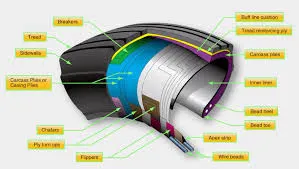
Radial tires are the most modern design of aircraft tyres. It is a design that is similar to that of car that of care tyres.
typically, the radial tyre offering more landing per tread per tread and lighter weight than a bias tyre, through some times at the expense of retread lives.
radial aircraft tyres differ to bias aircraft tyres in that the plies all run radially from bead to bead at approximately 90degree to the centre line of the tyre. ngled belt plies are laid between the trad and resulting in a flatter trad and adding strength to the tyre.
these are some of the common types of aircraft tyres and also there are three key metrics that are used regarding aircraft tyres.
plyrating:
the ply rating of an aircraft tire is used to identify the maximum static rated load capacity and corresponding inflation pressure applicable to specific operational requirement.
the ply rating is an index of aeroplane tyre strength and does not necessarily correspond to the actual number of casing plies with in that tyre.
Load rating
the load rating denotes the maximum static load capacity of the tyre in-lbs.
speed rating
this some information about the aircraft tyres.
3. Rolling resistance:
the rolling resistance force is mainly experienced by the tyre when the vehicle moves over any surface.
the rolling resistance force is given by the expression,
Frr = Urr*(m.g), where (m.g ) is the weight in newton and urr is the coefficient of rolling resistance.
the coefficient of rolling resistance depends on many factors like the tyre pressure, tyre temperature, material of the tyre, tread pattern of the tyre and also the road roughness
these factors determine the rolling resistance force
Tyre pressure:the pressure generally is very high in an aircraft tire to reduce the rolling resistance and to withstand the weight. usually,it will be around 200 and 300 psi of pressure and they change base value.
tests of airliner aircraft tyres have shown that they are able to sustain the sure of maximum 800 psi.
aircraft tyres are usually inflated with nitrogen to minimize expansion and contraction from extreme changes in ambient temperature and pressure experienced during flight.
5. Brake force while landing:
the brake force while landing is done by three different price3ss and they are,
Aircraft disc breakers:
Aircraft has disc rotors in the landing gear, used to brake the wheels while touching the ground. these breakers are operated hydraulically or pneumatically.
trust reversers:
thrust reverser allows thrust from the engines to be used to slow the aircraft. his is also very effective in bringing down the speed of the aircraft. By using a negative angle plane, we are at he propeller to flow in the opposite direction.
Airbrake:
air brake dedicated flight control surface that works by increasing the drag force, air brakes are designed to increase drag while making little change to lift, resulting in higher stall speed.
these are some of the tyres of braking methods used to bring down the aircrafts speed while landing the flight.
6. With necessary assumptions, calculate the force and power required to push / pull an aircraft by a towing vehicle.
1. The forces acting on the aircraft should be analysed :
the forces that will be involved in moving the aircraft with the towing tractor is studied and there are mainly two forces acting in this condition
1. rolling resistance force
2. air drag force
the gredibility and acceleration forces will not be there that much because the towing tracotor operates in such a working environment, so we neglect those two forces.
2. rolling resistance force
the rolling resistance force is mainly experienced by the tyre when the vechile moves over any surface.
the rolling resistance force is given by the expression,
Frr = Urr*mg where mg is the weight in newton and ur is the coefficient of rolling resistance.
the coefficient of rolling resistance urr depends on many factors like the tyre pressure, tyre temperature, material of the tyre, thread pattern of the tyre and also the road roughness.
here we are taking the heaviest flight as a reference to design our electric powered towing tractor because if we design for heavey application all the light aircraft can be push pulled too.
calculation:
weight of aircraft = 64K
wight of towing tracot = 50KG
rollin resistance coefficient of towing vechicle (urr) =0.001
rolling resitance coefficent of an aircraft =0.06 (assume)
rolling resittance force of tow tractor = Urr*mg = 0.49N
Rolling resistance force aircraft = Urr*mg = 37.67N
The total rolling resistance force = rolling resistance force of aircraft+towing tractor =0.49+37.67
the total rolling resistance force =38.16N
2. Air drag force
the air drag force is the force that occurs due to the air striking effect on the vehicle when it moves.
the vehicle moves through an air medium of particular density value with a certain speed, this causes the air to strike against the body of the vehicle and it causes a drag force on the vehicle
the aerodynamic drag is given by the expression,
Frr= ur*mg
the coefficient of rolling resistance depends on many factors like the tyre pressure tyres temperature, material of the tyre, tread pattern of the tyre and also the road roughness and liquids on the road.
here we are taking the heaviest flight as a reference to design our eclectic powered towing tractor because if we design for heavey application all the light aircraft can be push pulled too.
calculation
weight of the aircraft = 64k kg
weight of the towing tractor = 5000kg
rolling resistance coefficient towing vehicle urr = 0.001 assume
Rollin resistance coefficient of an aircraft tire = 0.006
rolling resistance force of tow tractor = urr*mg=0.49
rolling resistance force of aircraft = Urr*mg = 0.006*(640000*9.81)
Air drag force is = 0.015KN
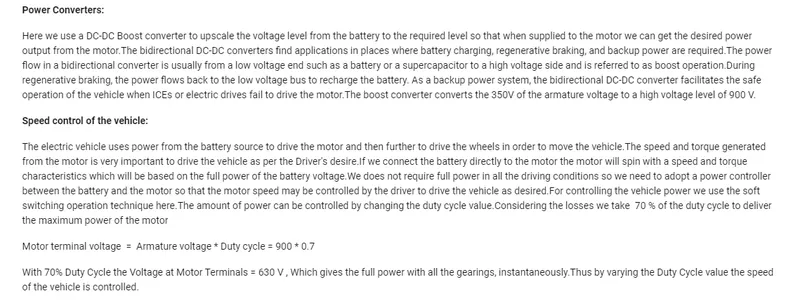
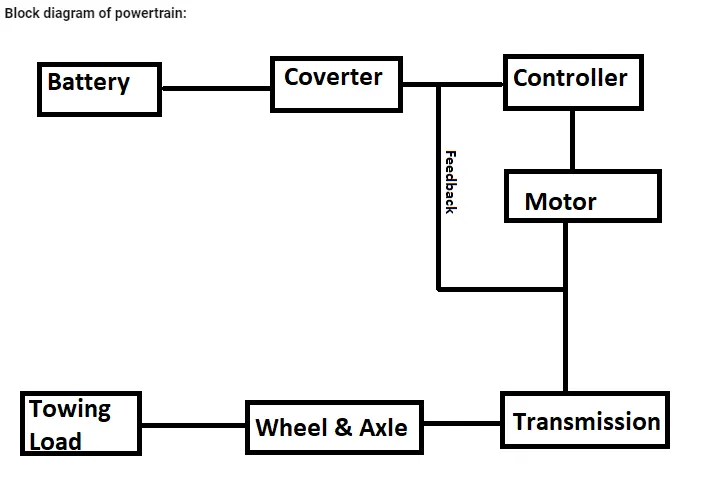
7. Design an electric powertrain with the type of motor, it’s power rating, and energy requirement to fulfil aircraft towing application. Estimate the duty cycle range to control the aircraft speed from zero to highest. Make all required assumptions. Prepare a table of assumed parameters. Draw a block diagram of the powertrain.
l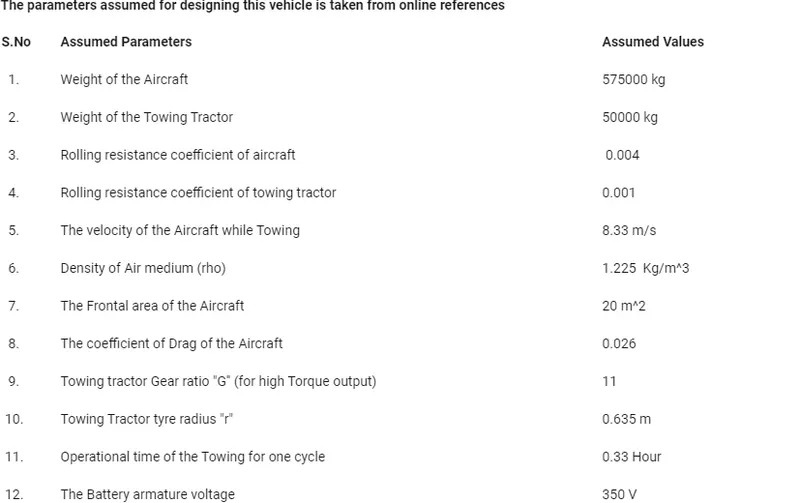
1. Search and list out the total weight of various types of aircraft.
The different terms represent different weights or masses1. For each flight, the weights are taken into account for several reasons.
A brief description about these is below:
Manufacturer's empty weight (MEW)
Also called Manufacturer's Weight Empty (MWE) or Licensed Empty Weight
It is the weight of the aircraft "as built" and includes the weight of the structure, power plant, furnishings, installations, systems and other equipment that are considered an integral part of an aircraft.
This excludes any baggage, passengers, or usable fuel2.
Zero-fuel weight (ZFW)
This is the total weight of the airplane and all its contents (including unusable fuel), but excluding the total weight of the usable fuel on board.
As a flight progresses and fuel is consumed, the total weight of the airplane reduces, but the ZFW remains constant.
Maximum zero fuel weight (MZFW) is the maximum weight allowed before usable fuel and other specified usable agents (engine injection fluid, and other consumable propulsion agents) are loaded.
Operating empty weight (OEW) (Roughly equivalent to basic empty weight on light aircraft)
It is the basic weight of an aircraft including the crew, all fluids necessary for operation such as engine oil, engine coolant, water, unusable fuel and all operator items and equipment required for flight but excluding usable fuel and the payload.
It is the carrying capacity of an aircraft. It includes cargo, people, extra fuel. In the case of a commercial airliner, it may refer only to revenue-generating cargo or paying passengers.
Maximum takeoff weight (MTOW)
This is the maximum weight at which the pilot of the aircraft is allowed to attempt to take off3.
Regulated takeoff weight (RTOW)
Depending on different factors (e.g. flap setting, altitude, air temperature, length of runway), RTOW or maximum permissible takeoff weight varies for each takeoff. It can never be higher than MTOW. More information is on this answer.
Maximum landing weight (MLW)
This maximum weight at which an aircraft is permitted to land3.
The following image depicts takeoff weight components.
Maximum ramp weight (MRW)
also called maximum taxi weight (MTW)
It is the maximum weight authorized for maneuvering (taxiing or towing) an aircraft on the ground.
It is the total aircraft weight at any moment during the flight or ground operation. This decreases during flight due to fuel and oil consumption.