Project-1: Powertrain for aircraft in runways
| 1. Search and list out the total weight of various types of aircrafts. | ||||||
| Type | MTOW [kg] | MLW [tonnes] | TOR [m] | LR [m] | ICAO category | FAA category |
| Antonov An-225 | 640,000 | 591.7 | 3,500 | Heavy | Super | |
| Scaled Composites Model 351 Stratolaunch | 589,670 | 3,660 | Heavy | Super | ||
| Airbus A380-800[1][2][3] | 575,000 | 394 | 3,100 | 1,930 | Heavy | Super |
| Boeing 747-8F | 447,700 | 346.091 | 3,100 | 1,800 | Heavy | Heavy |
| Boeing 747-8 | 443,613 | 306.175 | 3,100 | Heavy | Heavy | |
| Boeing 747-400ER | 412,770 | 295.742 | 3,090 | Heavy | Heavy | |
| Antonov An-124-100M | 405,060 | 330 | 2,520 | 900 | Heavy | Heavy |
| Boeing 747-400 | 396,900 | 295.742 | 3,018 | 2,179 | Heavy | Heavy |
| Lockheed C-5 Galaxy[4][5][6] | 381,000 | 288.417 | 2,530 | 1,494 | Heavy | Heavy |
| Boeing 747-200[7] | 377,840 | 285.7 | 3,338 | 2,109 | Heavy | Heavy |
| Boeing 747-300[7] | 377,840 | 260.32 | 3,222 | 1,905 | Heavy | Heavy |
| Airbus A340-500[8] | 371,950 | 240 | 3,050 | 2,010 | Heavy | Heavy |
| Airbus A340-600[8] | 367,400 | 256 | 3,100 | 2,100 | Heavy | Heavy |
| Boeing 777F | 347,800 | 260.816 | 2,830 | Heavy | Heavy | |
| Boeing 777-300ER | 351,800 | 251.29 | 3,100 | Heavy | Heavy | |
| Boeing 777-200LR | 347,450 | 223.168 | 3,000 | Heavy | Heavy | |
| Boeing 747-100[7] | 340,200 | 265.3 | Heavy | Heavy | ||
| Airbus A350-1000 | 308,000 | 233.5 | Heavy | Heavy | ||
| Boeing 777-300 | 299,370 | 237.683 | 3,380 | Heavy | Heavy | |
| Boeing 777-200ER | 297,550 | 213 | 3,380 | 1,550 | Heavy | Heavy |
| Airbus A340-300[8][9] | 276,700 | 190 | 3000 | 1926 | Heavy | Heavy |
| McDonnell Douglas MD-11 | 273,300 | 185 | 2,990 | 1,890 | Heavy | Heavy |
| Airbus A350-900 | 270,000 | 175 | 2,670 | 1,860 | Heavy | Heavy |
| Ilyushin Il-96M | 270,000 | 195.04 | 3,115 | 2,118 | Heavy | Heavy |
| McDonnell Douglas DC-10 | 256,280 | 183 | 2,990 | 1,890 | Heavy | Heavy |
| Boeing 787-9[10] | 254,000 | 192.777 | 2,900 | Heavy | Heavy | |
| Boeing 787-10[10] | 254,000 | 201.849 | Heavy | Heavy | ||
| Airbus A340-200[8][11] | 253,500 | 181 | 2990 | Heavy | Heavy | |
| Airbus A330-900 | 251,000 | 191 | 3,100 | Heavy | Heavy | |
| Ilyushin IL-96-300 | 250,000 | 175 | 2,600 | 1,980 | Heavy | Heavy |
| Airbus A330-300[12][13] | 242,000 | 185 | 2500 | 1750 | Heavy | Heavy |
| Airbus A330-200[12][13] | 242,000 | 180 | 2,220 | 1,750 | Heavy | Heavy |
| Lockheed L-1011-500 | 231,300 | 166.92 | 2,636 | Heavy | Heavy | |
| Boeing 787-8[10] | 228,000 | 172.365 | 3,300 | 1,695 | Heavy | Heavy |
| Lockheed L-1011-200 | 211,400 | Heavy | Heavy | |||
| Ilyushin IL-86 | 208,000 | 175 | Heavy | Heavy | ||
| Boeing 767-400ER | 204,000 | 158.758 | 3,414 | Heavy | Heavy | |
| Airbus A300-600R[14] | 192,000 | 140 | 2,385 | 1,555 | Heavy | Heavy |
| Boeing 767-300ER | 187,000 | 136.08 | 2,713 | 1,676 | Heavy | Heavy |
| Concorde | 185,000 | 111.1 | 3,440 | 2,220 | Heavy | Heavy |
| Airbus A300-600[14] | 163,000 | 138 | 2,324 | 1,536 | Heavy | Heavy |
| Boeing 767-300 | 159,000 | 136.078 | 2,713 | 1,676 | Heavy | Heavy |
| Airbus A310-300[14] | 157,000 | 124 | 2,290 | 1,490 | Heavy | Heavy |
| Vickers VC10 | 152,000 | 151.9 | Heavy | Heavy | ||
| Boeing 707-320B[15] | 151,000 | 97.5 | Heavy | Heavy | ||
| Boeing 707-320C[15] | 151,000 | 112.1 | Heavy | Heavy | ||
| Douglas DC-8-61 | 147,000 | Heavy | Heavy | |||
| Airbus A310-200[14] | 142,000 | 123 | 1,860 | 1,480 | Heavy | Heavy |
| Airbus A400M | 141,000 | 122 | 980 | 770 | Heavy | Heavy |
| Douglas DC-8-32 | 140,000 | Heavy | Heavy | |||
| Douglas DC-8-51 | 125,000 | Medium | Large | |||
| Boeing 757-300 | 124,000 | 101.6 | 2,550 | 1,750 | Medium | Large |
| Boeing 707-120B[15] | 117,000 | 86.3 | Medium | Large | ||
| Boeing 757-200 | 116,000 | 89.9 | 2,347 | 1,555 | Medium | Large |
| Boeing 720B[16] | 106,000 | 79.5 | Medium | Large | ||
| Boeing 720[16] | 104,000 | 79.5 | Medium | Large | ||
| Tupolev Tu-154M | 104,000 | 80 | Medium | Large | ||
| Tupolev Tu-204SM | 104,000 | 87.5 | 2,250 | Medium | Large | |
| Convair 880 | 87,500 | Medium | Large | |||
| Boeing 737-900 | 85,000 | 66.36 | 2,500 | 1,704 | Medium | Large |
| Boeing 737-900ER | 85,000 | 71.35 | 2,804 | 1,829 | Medium | Large |
| Boeing 727-200 Advanced[17] | 84,000 | 70.1 | Medium | Large | ||
| Airbus A321-100[18] | 83,000 | 77.8 | 2,200 | 1,540 | Medium | Large |
| Boeing 737-800 | 79,000 | 65.32 | 2,308 | 1,634 | Medium | Large |
| Boeing 727-200[17] | 78,000 | 68.1 | Medium | Large | ||
| McDonnell-Douglas MD-83 | 73,000 | 63.28 | Medium | Large | ||
| Boeing 727-100[17] | 72,500 | 62.4 | Medium | Large | ||
| Boeing 727-100C[17] | 72,500 | 62.4 | Medium | Large | ||
| McDonnell-Douglas MD-90-30 | 71,000 | 64.41 | 2,165 | 1,520 | Medium | Large |
| de Havilland Comet 4 | 70,700 | Medium | Large | |||
| Boeing 737-700 | 70,000 | 58.06 | 1,921 | 1,415 | Medium | Large |
| Airbus A320-100[18] | 68,000 | 66 | 1,955 | 1,490 | Medium | Large |
| Boeing 737-400 | 68,000 | 54.9 | 2,540 | 1,540 | Medium | Large |
| de Havilland Comet 3 | 68,000 | Medium | Large | |||
| Boeing 377 | 67,000 | Medium | Large | |||
| Boeing 737-600 | 66,000 | 54.66 | 1,796 | 1,340 | Medium | Large |
| Airbus A220-300 | 65,000 | 57.61 | 1,890 | 1,494 | Medium | Large |
| Hawker Siddeley Trident 2E | 65,000 | Medium | Large | |||
| Airbus A319[18] | 64,000 | 62.5 | 1,850 | 1,470 | Medium | Large |
| Boeing 737-300 | 63,000 | 51.7 | 1,939 | 1,396 | Medium | Large |
| Boeing 737-500 | 60,000 | 49.9 | 1,832 | 1,360 | Medium | Large |
| Airbus A220-100 | 59,000 | 50.8 | 1,463 | 1,356 | Medium | Large |
| Airbus A318[18] | 59,000 | 57.5 | 1,375 | 1,340 | Medium | Large |
| Boeing 717-200HGW | 55,000 | 47.174 | 1,950 | Medium | Large | |
| Douglas DC-7 | 55,000 | Medium | Large | |||
| de Havilland Comet 2 | 54,000 | Medium | Large | |||
| Boeing 717-200BGW | 50,000 | 46.265 | 1,950 | Medium | Large | |
| de Havilland Comet 1 | 50,000 | Medium | Large | |||
| Douglas DC-6A | 48,600 | Medium | Large | |||
| Douglas DC-6B | 48,500 | Medium | Large | |||
| Embraer 190[19] | 48,000 | 43 | 2,056 | 1,323 | Medium | Large |
| Caravelle III | 46,000 | Medium | Large | |||
| Fokker 100 | 46,000 | 39.95 | 1,621 | 1,350 | Medium | Large |
| Douglas DC-6 | 44,000 | Medium | Large | |||
| Avro RJ-85 | 42,000 | 36.74 | Medium | Large | ||
| Handley Page Hermes | 39,000 | Medium | Large | |||
| Embraer 175[20] | 37,500 | 32.8 | 2,244 | 1,304 | Medium | Large |
| Bombardier CRJ900[21] | 36,500 | 33.345 | 1,778 | 1,596 | Medium | Large |
| Embraer 170[22] | 36,000 | 32.8 | 1,644 | 1,274 | Medium | Large |
| Bombardier CRJ700 | 33,000 | 30.39 | 1,564 | 1,478 | Medium | Large |
| Douglas DC-4 | 33,000 | Medium | Large | |||
| Vickers Viscount 800 | 30,400 | Medium | Large | |||
| Bombardier Q400 | 28,000 | 28.01 | 1,219 | 1,295 | Medium | Large |
| Bombardier CRJ200 | 23,000 | 21.319 | 1,918 | 1,479 | Medium | Large |
| ATR 72-600 | 22,800 | 22.35 | 1,333 | 914 | Medium | Large |
| Saab 2000 | 22,800 | 21.5 | 1,300 | Medium | Large | |
| Embraer ERJ 145 | 22,000 | 19.3 | 2,270 | 1,380 | Medium | Large |
| ATR 42-500 | 18,600 | 18.3 | 1,165 | 1,126 | Medium | Small |
| Saab 340 | 13,150 | 12.93 | 1,300 | 1,030 | Medium | Small |
| Embraer 120 Brasilia | 11,500 | 11.25 | 1,560 | 1,380 | Medium | Small |
| BAe Jetstream 41 | 10,890 | 10.57 | 1,493 | 826 | Medium | Small |
| Learjet 75[23] | 9,752 | 8.709 | 1,353 | 811 | Medium | Small |
| Pilatus PC-24[24] | 8,300 | 7.665 | 893 | 724 | Medium | Small |
| Embraer Phenom 300[25] | 8,150 | 7.65 | 956 | 677 | Medium | Small |
| Beechcraft 1900D | 7,765 | 7.605 | 1,036 | 853 | Medium | Small |
| Cessna Citation CJ4[26] | 7,761 | 7.103 | 1039 | 896 | Medium | Small |
| de Havilland Hercules | 7,000 | Medium | Small | |||
| Embraer Phenom 100 | 4,800 | 4.43 | 975 | 741 | Light | Small |
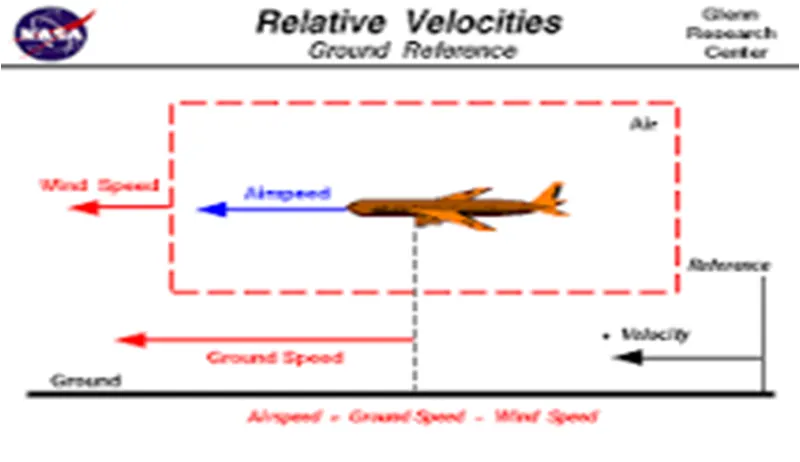
| Is there any difference between ground speed and air speed? | |||
| Airspeed is the vector difference between the ground speed and the wind speed. | |||
| On a perfectly still day, the airspeed is equal to the ground speed. | |||
| But if the wind is blowing in the same direction that the aircraft is moving, the airspeed will be less than the ground speed. | |||
| Why is it not recommended to use aircraft engine power to move it on the ground at Airport? | ||||
| Engine Thrust Hazards in the Airport Environment | ||||
| Boeing commercial airplanes are equipped with engines rated from 18,000 to nearly 100,000 lb of thrust. Such thrust levels provide for safe takeoff, flight, and landing over a wide range of temperatures, altitudes, gross weights, and payload conditions. However, the exhaust wake from these engines can pose hazards in commercial airport environments. Operators and airport authorities must carefully consider these hazards and the resulting potential for injury to people and damage to or caused by baggage carts, service vehicles, airport infrastructure, and other airplanes. | ||||
| Power Hazard Areas | ||||
| When modern jet engines are operated at rated thrust levels, the exhaust wake can exceed 375 mi/h (325 kn or 603 km/h) immediately aft of the engine exhaust nozzle. This exhaust flow field extends aft in a rapidly expanding cone, with portions of the flow field contacting and extending aft along the pavement surface (fig. 1). Exhaust velocity components are attenuated with increasing distance from the engine exhaust nozzle. However, an airflow of 300 mi/h (260 kn or 483 km/h) can still be present at the empennage, and significant people and equipment hazards will persist hundreds of feet beyond this area. At full power, the exhaust wake speed can typically be 150 mi/h (130 kn or 240 km/h) at 200 ft (61 m) beyond the airplane and 50 to 100 mi/h (43 to 88 kn or 80 to 161 km/h) well beyond this point. | ||||
| One approach to relating these values to airport operations is to consider the hurricane intensity scale used by the U.S. National Oceanic and Atmospheric Administration. A Category 1 hurricane has sustained winds of 74 to 95 mi/h (64 to 82 kn or 119 to 153 km/h). At these velocities, minimal damage to stationary building structures would be anticipated, but more damage to unanchored mobile homes and utility structures would be expected. An idling airplane can produce a compact version of a Category 3 hurricane, introducing an engine wake approaching 120 mi/h (104 kn or 192 km/h) with temperatures of 100°F (38°C). This wake velocity can increase two or three times as the throttles are advanced and the airplane begins to taxi. | ||||
| At the extreme end of the intensity scale is a Category 5 hurricane, with winds greater than 155 mi/h (135 kn or 249 km/h). Residential and industrial structures would experience roof failure, with lower strength structures experiencing complete collapse. Mobile homes, utility buildings, and utilities would be extensively damaged or destroyed, as would trees, shrubs, and landscaping. At rated thrust levels, a jet engine wake can easily exceed the sustained winds associated with a Category 5 hurricane. | ||||
| Although many aircrafts are capable of moving in backward using reverse thrust, as result the jet blast or prop wash might cause damage to the terminal building or equipment. | ||||
| Engine close to ground may also blow sand and debris forward and then suck them into the engine, causing damage to the engine. spot on to the taxiways, which is called towing. | ||||
| Therefore there are pushback trucks in the airport. A pushback truck lifts the front weel of the aircraft, their role in most airports is to move the aircraft away from the parking | ||||
| Unwanted consequences mainly arising from the unintended movement of the aircraft during engine running. | ||||
| How an aircraft is pushed to runway when its ready to take off? | |
| TOWING>> | |
| In the parking areas, where taxing the aircraft is not practical or is unsafe, | |
| such as moving aircraft in and out of mainteance hangars, or moving aircraft that are not under their own power or moving backward, | |
| then towing of aircraft is performed using the power of a specialized ground vehicle attached to or supporting the nose landing gear. | |
| The traditional method of allowing the ground vehicle to move an aircraft is to attach it to the aircraft nose landing gear by means of towbar. | |
| STUDY 5: About Take Off Power, Tyre Design, Rolling Resistance, Tyre Pressure, Brake Forces When Landing | |||
| (i)Take Off Power>> | |||
| Takeoff is the phase of flight in which an aircraft leaves the ground and becomes airborne. | |||
| For aircraft that take off horizontally, this usually involves starting with a transition and moving along the ground on a runway. | |||
| For light weight aircraft, usually full power is used during takeoff. Large transport catagory (airliner) aircraft may use a reduced power for takeoff, | |||
| Where less than full power is applied in order to prolong engine life, reduce maintenance costs and reduce noise emissions. In some cases, | |||
| The power used can then be increased to increase the performance. Before takeoff, the engines, particularly piston engines are routinely run up at high power to check for engine-related problems. | |||
| An airplane is motionless at the starting of a runway. This is denoted by location O. | |||
| The pilot releases the brakes and pushes the throttle to maximum takeoff power, and the airplane accelerates down the runway. | |||
| At some distance from its starting point, the airplane lifts into the air. The distance the airplane cover along the runway before it lifts into the air is called the ground roll (sg). | |||
| The total takeoff distance also includes the extra distance covered over the ground after the airplane is airborne but before it clears an obstacle of 50 ft for military aircraft and 35 ft for commercial aircraft. | |||
| This is denoted by sa. The sum of sg and sa is the total takeoff distance. | |||
| (ii)Tyre Design | |||
| An aircraft tire is designed to withstand extremely heavy loads for short duration of time. | |||
| The number of tires required for aircraft increases with the weight of the aircraft, as the weight of the airplane needs to be distributed more evenly. | |||
| For example -A Boeing 737NG & 737MAX uses 6 wheels, Boeing 787 uses 10 wheels, Boeing 777 uses 14 wheels and Airbus A380 uses 22 wheels. | |||
| Breakers: Breakers are reinforcing plies of rubber-coated fabric placed under the buff line cushion to protect casing plies and strengthen and stabilize the tread area. They are considered an integral part of the casing construction. | |||
| Tread: The tread is made of rubber mixed with other additives to obtain the desired level of toughness, durability, and resistance to wear. The tread pattern is designed to aircraft operational requirements, with the ribbed tread design used widely due to its good traction under varying runway conditions. | |||
| Sidewalls: The sidewall is a protective layer of rubber that covers the outer casing ply. It extends from the tread edge to the bead area. | |||
| Casing Plies: Alternate layers of rubber-coated fabric (running at opposite angles to one another) provide the strength of the tire | |||
| Chafers: A protective layer of rubber and/or fabric located between the casing plies and wheel to minimize chafing. | |||
| Ply Turnups: The casing plies are anchored by wrapping them around the wire beads, thus forming the ply turnups. | |||
| Flippers: Layers of rubberized fabric that help anchor the bead wires to the casing and improve the durability of the tire. | |||
| Wire Beads: Hoops of high tensile strength steel wire that anchor the casing plies and provide a firm mounting surface on the wheel. The outer edge of the bead that fits against the wheel flange is called the bead heel. The inner bead edge is called the bead toe. | |||
| Apex Strip: A wedge of rubber affixed to the top of the bead bundle. | |||
| Bead toe: It is the inner edge of the bead. | |||
| Bead heel: It is the outer edge of the heel. | |||
| Inner Liner: In tubeless tires, the liner is a layer of low permeability rubber that acts as a built-in tube and restricts gas from diffusing into the casing plies. In tube-type tires, a thinner liner is used to prevent tube chafing against the inside ply. | |||
| Caroass Plies: Layers of rubber-coated fabric piles which have the cords running from bead to bead. These provide the tire with strength in the sidewall area. | |||
| Tread Reinforcing Ply: One or more layers of fabric that strengthens and stabilizes the tread area for high-speed operation. It also serves as a reference for the buffing process when tires are retreaded. | |||
| Buff Line Cushion: The buff line cushion is made of rubber compound to enhance the adhesion between the tread reinforcing ply and the breakers or casing plies. It is of sufficient thickness to allow for the removal of the old tread when the tire is retreaded. | |||
| Tubeless tyres are more advantageous over tube-type. There is no longer the use of tube-type tyre in recent aviation. | |||
| Aircraft tyres must have an approved speed and load rating and have sufficient clearance when retracted through landing gear to allow for tyre growth. Tyre growth is the increase in the size of the tyre due to centrifugal forces at high speed. | |||
| Retreading – Retreading is methods of restoring a worn tyre by renewing the tread area or by renewing the tread area plus one or both sidewalls. Repairs are included in the tyre retreading process. | |||
| Load Rating – Load rating is the maximum permissible load at a specified inflation pressure. | |||
| Ply Rating – Ply Rating is used to identify the maximum recommended load rating and inflation pressure for a specified tyre. It is an index of tyre strength. | |||
| Speed Rating – The speed rating is the maximum takeoff speed to which the tyre has been tested. | |||
| Skid Depth – Skid depth is the distance between the tread surface and the deepest groove as measured in the mould. | |||
| Today’s tyres are conductive. Aircraft tyre are manufactured with tread rubber with conducting compounds to permit earthing of static charges.In early days when tyres were not sufficiently conductive, aircraft used to have a conductive strip hanging down from the axle of the landing gear. Upon landing, this strip would be the first part of the aircraft to touch the earth. This discharges any static electricity accumulated on the outer surfaces of the aircraft. | |||