Project-1: Powertrain for aircraft in runways
Wights of various types of aircrafts as follows
- Manufacturer’s Empty Weight (MEW): It is the weight of the aircraft that represents the weight of the structure, power plant (engines), furnishings, installations, systems and other equipment that are considered an integral part of an aircraft.
- Zero Fuel Weight (ZFW): This is the total weight of the airplane and all its contents including unusable fuel (to maintain structural stability of aircraft), but excluding the total weight of the usable fuel on board. Note: As a flight progresses and fuel is consumed, the total weight of the airplane reduces, but the ZFW remains constant.
- Operational Empty Weight (OEM) or Dry Operating Weight (DOW): It is the basic weight of an aircraft including the crew, all fluids necessary for operation, (such as engine oil, engine coolant, water, unusable fuel) all operator items and equipment required for flight but excluding usable fuel and the pay load.
- Maximum Zero Fuel Weight (MZFW): Maximum zero fuel weight (MZFW) is the maximum weight which is allowed before usable fuel and other specified usable agents (engine injection fluid, and other consumable propulsion agents) are loaded. OR (OEM / DOW + Payload = MZFW)
- Maximum Taxi Weight (MTW) or Maximum Ramp Weight (MRW): It is the maximum permitted weight of the aircraft at which it may be moved on the ground either with its own engine or towed by a tractor. It can also be defined as maximum weight for ground maneuvering including the weight of run-up and taxi fuel. (MZFE + Ramp Fuel = MRW)
- Maximum Take-Off Weight (MTOW): It is the maximum permitted weight at the start of the take-off. While determining this limit, the manufacturer takes into consideration the strength of the material used for the manufacturing of the aircraft and standard performance variables such as runway temperature, altitude, atmospheric pressure, wind components, flaps, etc. (MZFW + Take-Off Fuel = MTOW)
- Regulated Take-Off Weight (RTOW): As told in the above definition depending on different factors (e.g. flap setting, altitude, air temperature, length of runway), RTOW ormaximum permissible weights varies for each takeoff. It can never be higher than MTOW.
- All Up Weight (AUP): DOW + Payload + Fuel.
- Maximum Landing Weight (MLW): When aircraft touches the ground it puts force of the runway as well as on the tyres and under carriage, so to ensure structural safety of the aircraft MLW is taken into consideration. Manufactures have calculate this force to be approximately “9” times the weight of the aircraft. Thus when the aircraft has to make an emergency landing or when the weight of the aircraft before landing exceeds the MLW defined by the manufacturer the pilots dump fuel to reduce the weight of the aircraft. (MTOW – Trip Fuel = MLW)
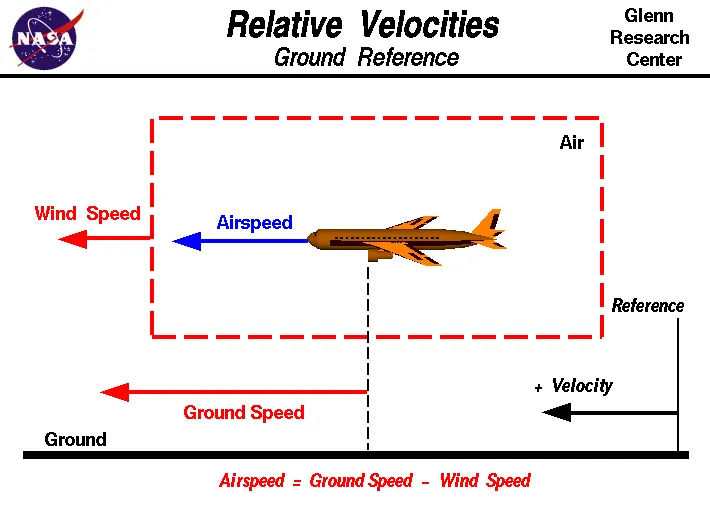
the above equation shows relationship between ground and air speed
An aircraft's true air speed tells us how fast it moves relative to the surrounding air, while the ground speed is its horizontal speed relative to the earth's surface
Ground speed defines how fast and air craft willl reach to the destination while air speed defines wheather there is the enough air flow to make it fly.
In the absense of wind air craft speed remain same as ground speed
Ans 3) Aircraft engine power during engine maintenance activity or during landing can cause considerable damage to the airplanes therefore it is not recommonded to use aircraft engine
Ans 4)
By taking into consideration the forces acting on the vehicles to propel the vehicle
The actual forces acting on the vehicle are as follows
For the regular runway the oposite forces are acting to propel the vehicle are
Rolling resistance force (Frr)
and Aerodynamic drag force.(Fad)
Hill climbing force (Fhc)is neglected.
The sum these forces is actual or total force (Fte) to overcome to propel the vehicle.
Frr=m.g.urr;
Fad=1/2*ρACdv^2;
where,
m-mass of the vehicle(kg)
g-gravitational constant.(kg/m^2)
urr-rolling resistance
ρ-air density(kg/m^3)
A-frontal area(m^2)
Cd-aerodynamic drag coefficient
v-velocity of the vehicle(m/s)
Fte=Rolling resistance force (Frr)+aerodynamic drag force.(Fad)
Fte=mgurr+1/2*ρACdv^2.
assume any vehicle(aircraft ):
some of the asumptions are :
mass of the aircraft (ma)=25000kg;
mass of the towing vehicle=10000kg;
gravitational constant(g)=9.81m/s^2;
rolling resistance(μrr)=0.07;
air density(ρ)=1.5kg/m^3;
frontal area (A)=10m^2;
aero drag coefficient(Cd)=0.4+0.2=0.6;
velocity(v)=22km/hr=6.111m/sec
Frr=mgμrr
=(25000+10000)*9.81*0.07
Frr =24034.5N
Fad=1/2*ρACdv^2
=0.5*1.5*10*0.6*6^2
Fad =162N
Fte=mgμrr+1/2*ρACdv^2
=24034.5N+162N
Fte =24196.5N
force required to pull or push the vehicle Fte=24196.5N
torque at the wheels =force *radius
=24196.5*0.2(tire radius=0.2m)
=4839.3Nm
power required to pull the vehicle;
we know;
power(p) =force *velocity
=Fte*v
=24196.5*6.11
=14780.61watts
=147.8061kw
The power required to propell the vehicle is 147.8061kw.
Parameter with assumptions as follows
| parameter | assumption |
| mass of the aircraft (ma) | 25000kg |
| mass of the towing vehicle | 10000kg |
| rolling resistance(μrr) | 0.07 |
| air density(ρ) | 1.5kg/m^3 |
| frontal area (A) | 10m^2 |
| aero drag coefficient(Cd) | 0.6 |
| velocity(v) | 22km/hr=6.11m/sec |
| gravitational constant(g) | 9.81m/s^2 |
Please find attchments of simulation and calcuations