Project-1: Powertrain for aircraft in runways
Question 1:
The aircraft gross weight is the total weight of an aircraft at any moment during the flight or ground operation. It will decrease during flight due to fuel and oil consumption. It may vary due to payload dropping or refuelling operations. At the moment of releasing it's brakes, the gross weight of an aircraft is equal to it's takeoff weight.
The various components of the gross weight of an aircraft are:
- Maximum taxi weight: It is the maximum weight certificated for aircraft manoeuvring on the ground as limited by aircraft strength and airworthiness requirements.
- Maximum takeoff weight: It is the maximum certificated design weight when the brakes are released for takeoff and is the greatest weight for which compliance with the relevant structural and engineering requirements has been demonstrated by the manufacturer.
- Maximum landing weight: It is the weight at which the aircraft meets the appropriate landing certification requirements.
- Maximum zero fuel weight: It is the weight of the aircraft less all usable fuel and other specified usable agents. It is the maximum weight permitted before usable fuel and other specified usable fluids are loaded in specified sections of the airplane.
- Maximum flight weight: It is the minimum certificated weight for flight as limited by aircraft strength and airworthiness requirements.
The different aircrafts are classified based on maximum takeoff weight (MTOW) and maximum landing weight (MLW):
- Super category:
1) Antonov An-225: MTOW- 640 tons ; MLW- 591.7 tons
2) Model 351 Stratolaunch: MTOW- 589.67 tons
3) Airbus 380-800: MTOW- 575 tons ; MLW- 394 tons
- Heavy category:
1) Boeing 747-8F: MTOW- 447.7 tons ; MLW- 346 tons
2) Boeing 747-8: MTOW- 443.613 tons ; MLW- 306.175 tons
3) Lockheed C-5 Galaxy: MTOW- 381 tons ; MLW- 288.417 tons
4) Airbus A340-500: MTOW- 371.95 tons ; MLW- 240 tons
5) McDonnell Douglas MD-11: MTOW- 273.3 tons ; MLW- 185 tons
6) Ilyushin II-96M: MTOW- 270 tons ; MLW- 195.04 tons
7) Concorde: MTOW- 185 tons ; MLW- 111.1 tons
- Large category:
1) Douglas DC-8-51: MTOW- 125 tons
2) Boeing 757-200: MTOW- 116 tons ; MLW- 89.9 tons
3) Convair 880: MTOW- 87.5 tons
4) Airbus A321-100: MTOW- 83 tons ; MLW- 77.8 tons
5) de Havilland Comet-3: MTOW- 68 tons
6) Fokker 100: MTOW- 46 tons ; MLW- 39.95 tons
- Small category:
1) ATR 42-500: MTOW- 18.6 tons ; MLW- 18.3 tons
2) Saab 340: MTOW- 13.15 tons ; MLW- 12.93 tons
3) Embraer 120 Brasilia: MTOW- 11.5 tons ; MLW- 11.25 tons
4) Learjet 75: MTOW- 9.75 tons ; MLW- 8.71 tons
5) Beechcraft 1900D: MTOW- 7.765 tons ; MLW- 7.6 tons
*all aircrafts have been categorised under the FAA (Federal Aviation Administration)
Question 2:
The concept of relative velocity is critical in estimating the aerodynamic forces on an aircraft which in turn determine the design of the aircraft structure. Aerodynamic forces are generated by an object moving through a fluid. A fixed object in a static fluid does not generate aerodynamic forces. Hot air balloons lift because of buoyancy forces and some aircraft like Harrier use thrust to lift the vehicle. To generate lift an object must move through the air, or air must move past the object. Aerodynamic lift depends on the square of the velocity between the object and the air. However the air itself can move. To properly define the relative velocity, it is necessary to pick a fixed reference point and measure velocities relative to the fixed point.
Ground speed can be defined as speed of the aircraft relative to a fixed reference point on the ground. It is a vector quantity.
In order to estimate the airspeed of an aircraft, we need to understand the term 'windspeed'. It can be defined as the speed at which air moves relative to a fixed reference point on the ground. It is also a vector quantity.
Airspeed is the vector difference between the ground speed and wind speed. It cannot be directly measured from a ground position. On a perfectly still day, the airspeed is equal to the ground speed. But if the wind is blowing in the same direction that the aircraft is moving, the airspeed will be less tahn the ground speed.
Airspeed = Ground speed - Wind speed
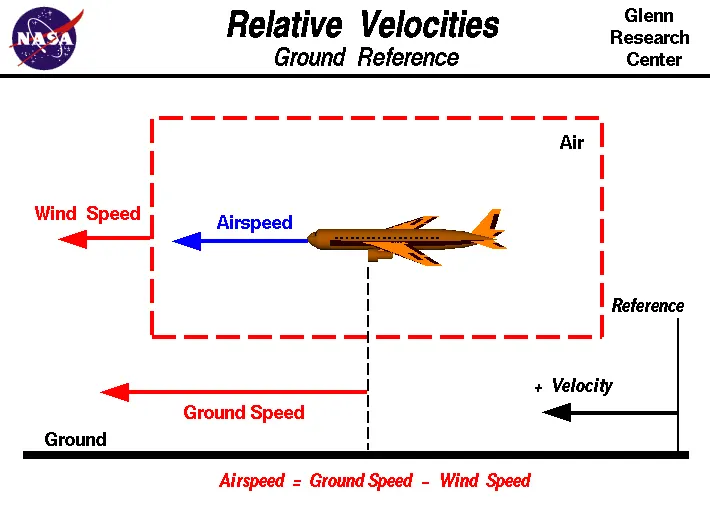
The importance of the relative velocity explains why airplanes take off and land on different runways on different days. Airplanes always try to take off and land into the wind. This requires a lower ground speed to become airborne, which means the plane can take off or land in the shortest distance traveled along the ground. Since runways have a fixed length, the aircraft must be airborne as fast as possible on takeoff and stopped as soon as possible on landing.
Question 3:
The movement of an aircraft on the ground under it's own power is called taxiing. An airplane uses taxiways to taxi from one place on an airport to another. Taxiing is not used for the accelerating run along a runway prior to takeoff or the decelerating run immidiately after landing which are called the takeoff roll and landing rollout respectively.
Consider the case of Boeing commercial airplanes. The aircraft engines are rated from 18000-100000 lb of thrust. Such thrust levels provide for safe takeoff, flight, and landing over a wide range of temperatures, altitudes, gross weights, and payload conditions. However, the exhaust wake from these engines can pose hazards in commercial airport environments. Operators and airport authorities must carefully consider these hazards and the resulting potential for injury to people and damage to or caused by baggage carts, service vehicles, airport infrastructure, and other airplanes.
When modern jet engines are operated at rated thrust levels, the exhaust wake can exceed 603 km/hr at the engine exhaust nozzle. Such high velocities can harm people and cause significant equipment hazards. Utility buildings and utilities will be extensively damaged or destroyed. If the runway facility is surrounded by trees, shrubs or landscapping it can cause serious damage to them.
High engine thrust during maintainance activity can cause considerable damage to airplanes and other elements in the airport environment. It can cause damage to the wingtips, aft fuselage and the horizontal tail. While taking off, it can chip pieces off from the runway ramp which in turn damage the aircraft wheels.
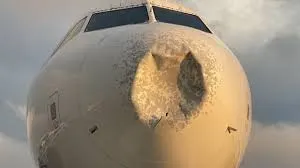
At high speeds, Foreign Object Damage (FOD) becomes significant. It can damage the aircraft structure and creates imbalance in aircraft controls. FOD also has the potential to affect the many aspects of ramp operations. These operations subject people, baggage carts, service vehicles, and airport infrastructure to injury and damage.
Other side-effects include:
- increased fuel consumption
- wear and tear of the engine
- unnecessary jet blast and noise
Thus, it is not recommended to use aircraft engine power at ground level
Question 4:
As mentioned before, 'Taxiing' is the movement of an aircraft on the ground under it's own power in contrast to towing or push-back where the aircraft is moved by a tug. An aircraft uses taxiways to taxi from one place on an airport to another like from a hangar to the runway. The term 'taxiing' is not used for the accelerating run along a runway prior to takeoff or the decelerating run immidiately after landing.
A taxiway is a path for an aircraft at an airport connecting runways with aprons, hangars, terminals and other facilities. They mostly have a hard surface such as asphalt or concrete, although smaller general aviation airports sometimes use gravel or grass. Most airports do not have a specific speed limit for taxiing. There is a general rule of safe speed based on obstacles. Operators and aircraft manufactures might have limits. Typical speeds are 37-56 kmph. The taxiways are generally fixed with markings, signs and lights in order to safely guide the aircraft.
The thrust to propel the aircraft forward comes from its propellers or jet engines. Reverse thrust for backing up can be generated by thrust reversers or reversible pitch propellers. This process is called as powerback. Most aircraft, however, are not designed to back up on their own and must be pushed back either by hand or by using an aircraft tug. During taxiing the combustion aircraft engines operate at lower efficiency than at cruise power settings.
Steering is achieved by turning a nose wheel or tail wheel/rudder; the pilot controls the direction travelled with their feet. Larger jet aircraft have a tiller wheel on the left side of the cockpit that acts as a steering wheel allowing the nosewheel to be turned hydraulically. Braking is controlled by differential toe or heel brakes. Not all aircraft have steerable wheels, and in some cases steering is solely by means of differential braking or solely by means of the rudder.
When taxiing, aircraft travel slowly. This ensures that they can be stopped quickly and do not risk wheel damage on larger aircraft if they accidentally turn off the paved surface. Taxi speeds are typically 30 to 35 km/h.
Question 5:
Aircraft take-off power:
Take-off is the phase of flight in which an aircraft leaves the ground and becomes airborne. For aircraft that take-off horizontally this usually involves starting with transition from moving along the ground on a runway.
For light aircraft usually full power is used during take-off. While large transport aircrafts a reduced power for take-off. The aircraft is permitted to accelerate to rotation speed. It means the aircraft pivots around the axis of it's main landing gear while still on the ground. Fixed wing aircraft designed for high speed operation have difficulty generating enough lift at the low speeds encountered during takeoff. These are therefore fitted with high-lift devices. The speeds needed for takeoff are relative to the motion of the air. The takeoff speed required varies with aircraft weight and aircraft configuration. They also depend on length and slope of runway and persisting conditions.
Assisted take-off is any system for helping aircraft into the air. They are used in case the aircraft's weight exceeds the normal maximum take-off weight, insufficient power or the available runway length maybe insufficient.
Aircraft tyre design:
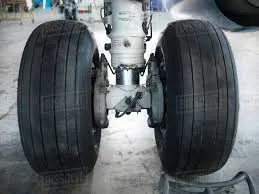
An aircraft tyre is designed to withstand extremely heavy loads for short durations. The number of tyres required for aircraft increases with weight of aircraft as weight of aircraft needs to be distributed uniformly. The tread patterns are designed to facilitate stability in high crosswind conditions for braking effect. They also include fusible plugs designed to melt at a certain temperature due to them often overheating if maximum braking is applied during an aborted take-off or emergency landing.
An aircraft tyre is a combined structure of these basic materials:
- Rubber
- Nylon
- Cord
- Steel
These tyres are combined together by a vulcanization process. It is a process of treating crude or synthetic rubber or similar plastic material chemically to give it useful properties. There are mainly two types of tyres:- Radial and Bias, each type has unique components reflecting different technologies applied to design, compounds and materials. The bias ply tyre consists of layers of rubber running diagonally at approximately right angles to one another. The bias tyre are currently in maximum usage because of their strength. In radial ply tyres, tyres have layers of the tyre running radially at an approximate perpendicular to the center line of the tyre. Radial ply tyres are low in weight as compared to the bias ply tyre but have less strength.
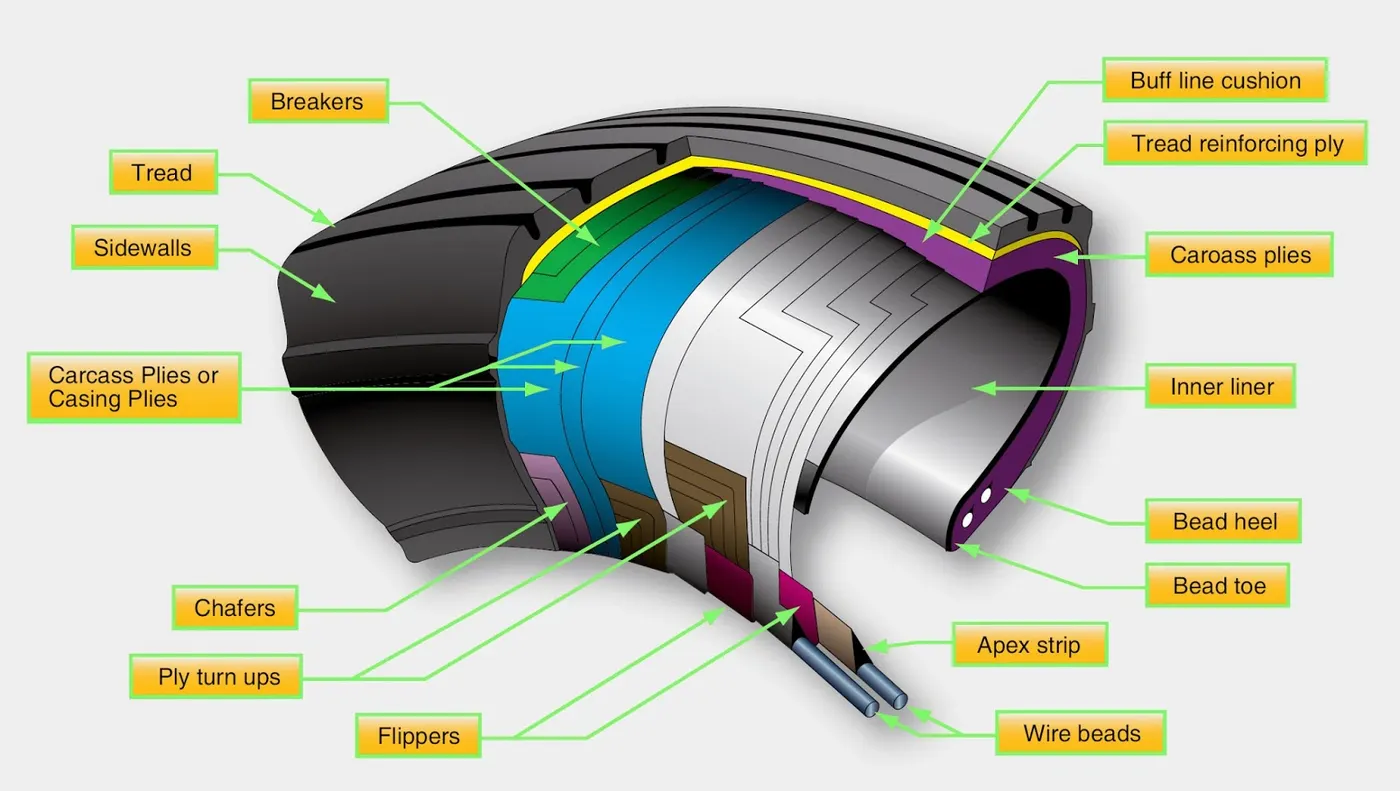
The different components of tyres are:
- Tread: It is a special composite rubber formulated to resist wear and tear, cutting, chunking, and heat build-up.
- Shoulder: Tire shoulder is the portion of the tread between the tread center and the tire sidewall. The tire shoulder offers support and protection to both the sidewall and the tread.
- Casing: The foundation strength of the tire is provided by the casing plies. Casing plies are layers of fabric coated with the high modulus of elasticity rubber on both sides to improve its elastic strength.
- Beads: The bead wire attaches the tire to the rim and ensures an airtight seal.
- Chafers: They are made of tough nylon material and are fitted around the bead clinch area to resist damage caused to the skin of tire due to repetitive rubbing.
- Sidewall: The sidewall is the area of the tire between the shoulder and the bead.
- Inner tread: Tubeless tires have a layer of rubber bonded to the inside of the first casing ply from bead to bead to resist the permeation of nitrogen and moisture into the casing.
- Under tread: The under tread is a layer of rubber that is designed to improve the adhesion between the tread and the casing plies.
The four major manufacturers in aircraft tyre manufacturing are as follows:
- Goodyear
- Michelin
- Dunlop Aircraft Tyres
- Bridgestone
These firms control approximately 85% of the manufacturing market and account for most of the retreads.
Rolling Resistance:
The friction between aircraft and runway will be proportional to the normal force exerted by the aircraft on the runway.
F = μ(W−L)
The normal force will be the difference between Weight of aircraft and Lift, whereas μ is the coefficient of friction between the aircraft wheels and the runway.
Aircraft tyre pressure:
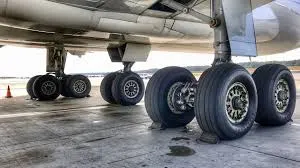
Aircraft tyres generally operate at high pressures upto 220 psi i.e 1400 kPa for airliners and even higher in business jets. In case of Boeing 777-300ER main tyres are inflated at 220 psi i.e 1500 kPa and weigh around 120 kg. It has a diameter of 134 cm and is changed every 300 cycles while brakes are changed every 2000 cycles.
The main landing gear on the Concorde was typically inflated at 16 bar whilst it's tail bumper gear tyres were as high as 20.3 bar. Tests of airliner aircraft tires have shown that they are able to sustain pressures of maximum 800 psi i.e 55 bar before bursting. During the tests the tyres have to be filled with water, to prevent the test room being blown apart by the energy that would be released by a gas when the tyre bursts.
Aircraft tyres are usually inflated with nitrogen to minimize expansion and contraction from extreme changes in ambient temperature and pressure experienced during flight. Dry nitrogen expands at the same rate as other dry atmospheric gases, but common compressed air sources may contain moisture, which increases the expansion rate with temperature. The requirement that an inert gas, such as nitrogen, be used instead of air for inflation of tyres on certain transport category airplanes was prompted by at least three cases in which the oxygen in air-filled tyres had combined with volatile gases given off by a severely overheated tyre and exploded upon reaching auto-ignition temperature. The use of an inert gas for tyre inflation eliminates the possibility of tyre explosion.
Aircraft brake forces:
Aircraft braking systems include:
- Disc brakes in the landing gear used to brake the wheels while touching the ground. These are operated hydraulically or pneumatically. In most modern aircrafts they are activated by the top section of the rudder pedals.
- Thrust reversers allow thrust from the engines to be used to slow the aircraft.
- Air brakes work by increasing air drag on the flight surface.
- Large drough parachutes used by military and civilian aircraft.
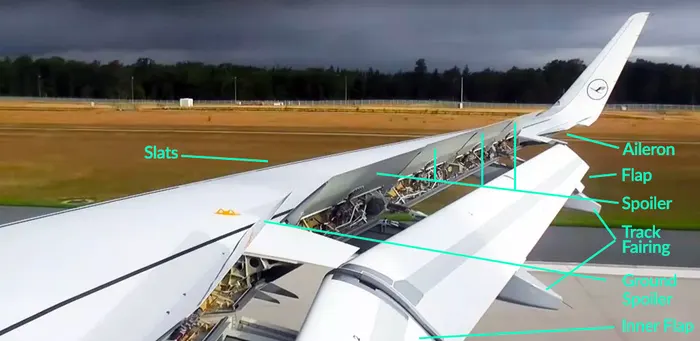
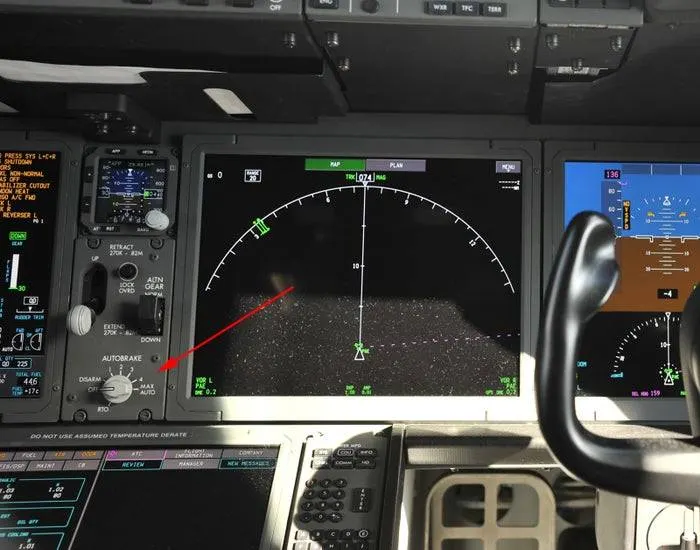
A commercial aircraft approaching towards landing flies around 145 mph. The pilot flying pulls back gently on the control column to slow the sink rate and flare for landing. The wheels touch down and the landing gear and wheels absorb the impact of the aircraft. When the wheels touch the ground a set of spoilers raise up quickly which kills the lift provided by wings. Aircrafts have multi-disc brakes made of carbon-steel material which rotate the wheel and seperate discs that are fixed. When pressure is applied the entire assembly compresses to create the braking action. Sometimes 'autobrakes' engage automatically after landing. Depending upon the runway conditions, the crew takes decision whether or not to engage the autobrakes.
The final element of braking action is thrust reversers. In modern high bypass turbofan engine almost 90% of air passing through the engine is sucked in, sped up and pushed out the engine without mixing with fuel. In these engines, ducts on the side of the engine open up and direct that air out and nearly forward, opposite the direction of travel.
Question 6:
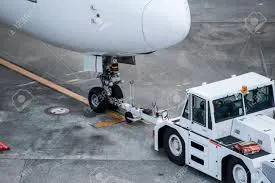
Consider the airplane is being towed along a flat runway at a very low speed.
The force required to move an airplane on an absolutely flat runway at constant low speed is equal to the rolling resistance between the plane and runway turmac and the air drag.
The rolling resistance for the airplane can be calculated as,
Fr = Cr*m*g
where, Fr = rolling resistance ; Cr = coefficient of rolling resistance ; m = MTOW of airplane ; Cd = drag coefficient ; A = frontal area ; ρ = air density
Let,
Cr = 0.02
m = 450000 kg
Cd = 0.04
ρ = 1.225 kg/m^3
A = 20 m^2
v = 10 kmph = 2.78 m/s
∴ Fr = 0.02 * 450000 * 9.81 = 88.3 kN
The air drag is calculated as,
∴ Fad = 0.5*ρ*Cd*A*v^2 = 0.5*1.225*20*0.04*2.78^2 = 3.8 N
∴ Total resistive force = Fr + Fad = 88.3 kN
Thus, the force required by a towing vehicle to pull the aircraft is 88.3 kN.
Consider, the airplane is being pulled at 10 kmph i.e 2.78 m/s
∴ Power required by towing vehicle = Fr * v = 88.3 * 2.78 = 245.5 kW
Question 7:
The different types of towing of aircrafts include:
- Pushback: Moving a fully loaded aircraft from the parking position to the taxiway. Typical speeds upto 10 kmph.
- Maintainance towing: Movement of an aircraft for maintenance/remote parking purposes. Typical speeds upto 32 kmph.
- Gate relocation towing: Movement of an aircraft from one parking position to an adjacent one or one in the same general area.
-
Dispatch or operational towing: Towing an aircraft from the terminal gate/remote parking area, to a location near the active runway. Typical speeds upto 32 kmph.
From above observations considering the maximum working speed of the towing vehicle to be 35 kmph.
Consider the same values as the previous question.
| Properties |
Value |
| Maximum Take-off Weight |
450000 kg |
| Coefficient of rolling resistance |
0.02 |
| Coefficient of drag |
0.04 |
| Maximum Vehicle speed |
35 kmph |
| Gravitational acceleration |
9.81 m/s^2 |
| Airplane frontal area |
20 m^2 |
| Air density |
1.225 kg/m^3 |
| Gear ratio |
11 |
| Wheel diameter |
50 in |
Maximum vehicle speed = 35 kmph = 9.72 m/s
Air drag = 0.5*1.225*20*0.04*9.72^2 = 46.3 N
Total resisitive force, F = Fr + Fad = 88.35 kN
Designing for maximum engine power,
Maximum engine power = 88.35 * 9.72 = 858.76 kW
Considering the towing vehicle requires 30 minutes to pull the aircraft from the parking space to runway
∴ Energy required to tow the airplane = 858.76 * 1800 = 1545.77 MJ or 429.4 kWh
We know,
Gear ratio G = 11
Diameter of wheel, D = 50 in = 1270 mm = 1.27 m
∴ Radius, r = D/2 = 0.635 m
Torque required at airplane wheels, T = F*r/G = (88.35*10^3)*0.635/11 = 5100 Nm
Selecting TMK0761-150 motor. The specifications of the motor are as given below,
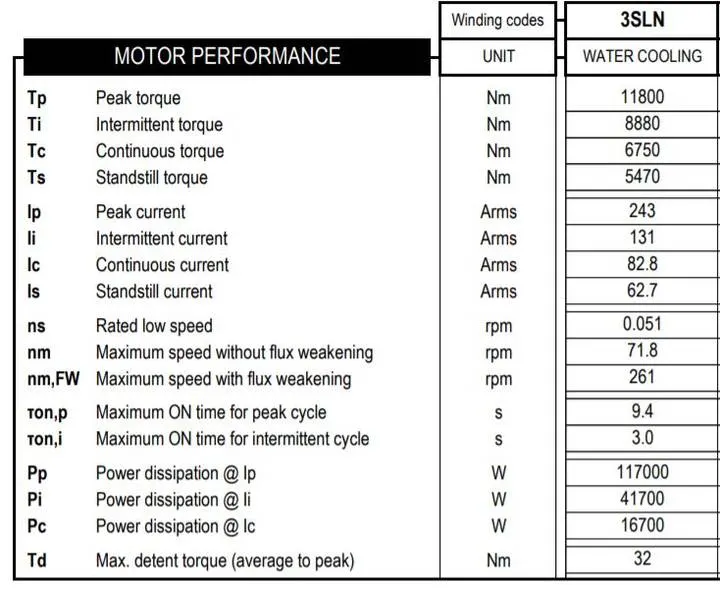
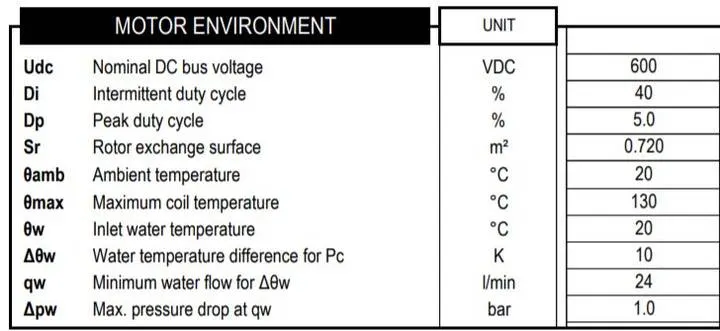
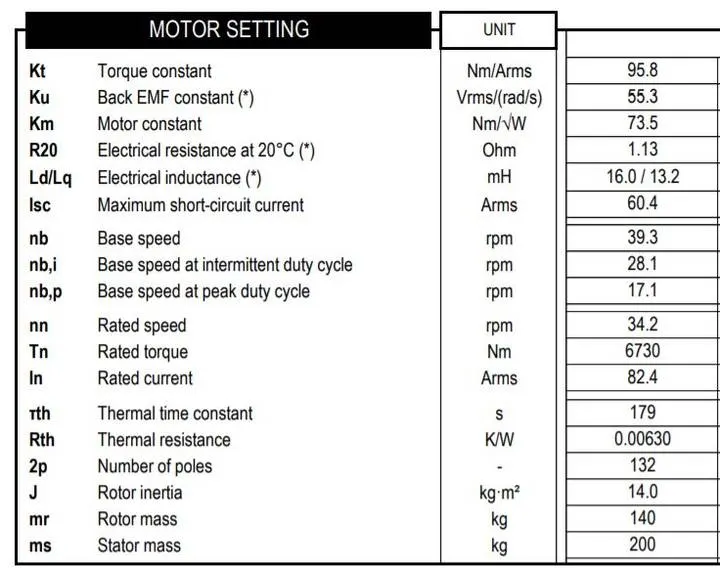
Thus, from the above specifications a duty cycle range of 5-40% is suitable for performing the airplane towing application.
The powertrain blockset for the airplane towing vehicle is illustrated as below,