Project-1: Powertrain for aircraft in runways
PART A :
1. Search and list out the total weight of various types of aircraft.
2. Is there any difference between ground speed and airspeed?
3. Why is it recommended to use aircraft engine power to move it on the ground at the airport?
4. How an aircraft is pushed to the runway when it's ready to take off.
5. Learn about take-off power, tire design, rolling resistance, tire pressure, and brake forces when loading.
1. Search and list out the total weight of various types of aircraft.
INTRODUCTION TO AIRCRAFT:
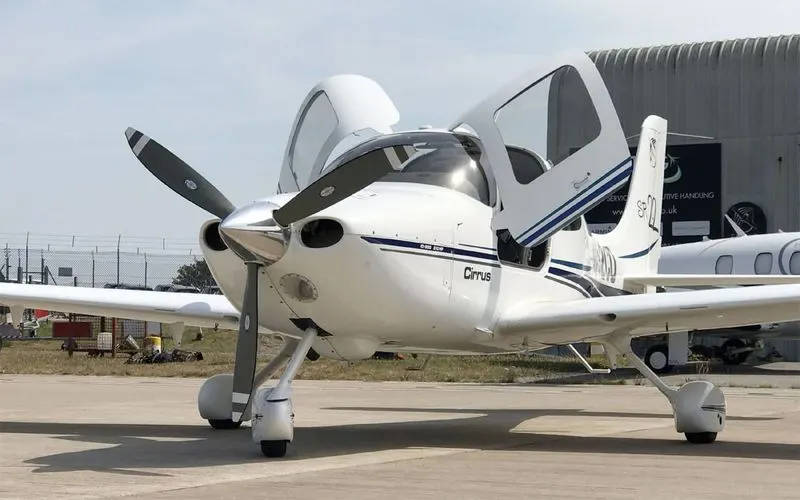
An aircraft is a vehicle or machine that can fly by gaining support from the air. It counters the force of gravity by using either static lift or by using the dynamic lift of an airfoil, or in a few cases the download thrust from jet engines. Common examples of aircraft include airplanes, helicopters, airships (Including blimps), gliders, paramotors, and hot air balloons. The human activity that surrounds aircraft is called aviation. The science of aviation, including designing and building aircraft, is called aeronautics. Crewed aircraft are flown by an onboard pilot, but unmanned aerial vehicles may be remotely controlled or self-controlled by onboard computers. Aircraft may be classified by different criteria, such as lift type, aircraft propulsion, usage, and others.
Methods of aircraft:
- Lighter than air-aerostats
- Heavier than -air -aerodynes
Lighter than air - aerostats:
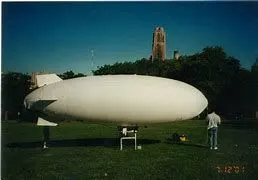
Aerostats use buoyancy to float the air in much the same way that ships float on the road water. They are characterized by one or more large cells or canopies, filled with relatively low-density gas such as Helium, Hydrogen, or Hot gas, which is less dense than the surrounding air. When the weight of this is added to the weight of the aircraft structure, it adds up to the same weight as the air that the craft displaces. Small hot air balloons, called sky lanterns, were first invented in ancient china before the 3rd century BC and used primarily in cultural celebrations, and were only the second type of aircraft to fly, the first being kites, which were invented in ancient china over two thousand years ago. A balloon was originally any aerostat, while the term airship was used for large, powered aircraft designs - usually fixed wings. In 1919, Frederick's handles page was reported as referring to ships of the air, with smaller passenger types as Air yachts.

In the 1930s, large intercontinental flying boats were also sometimes referred to as ships of the air or flying ships. The advent of powered balloons called dirigible balloons, and later rigid hulls allowing a great increase in size began to change the way these words were used. Huge powered aerostats, characterized by a rigid outer framework and separate aerodynamic skin surrounding the gas bags, were produced, the Zeppelins being the largest and most famous. There were still no Fixed-wing aircraft or non-rigid balloons large enough to be called airships, So "airship" came to be synonymous with these aircraft. Then several accidents, such as the Hindenburg disaster in 1937, led to the demise of these airships. Nowadays a "balloon" is an unpowered aerostat and an "airship" is a powered one.
Heavier - Than - Air - aerodynes:
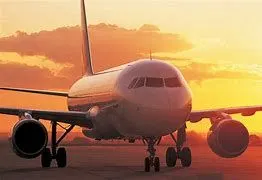
Heavier-than-air aircraft, such as airplanes, must find a way to push air or gas downwards so that a reaction occurs(by Newton's laws of motion) to push the aircraft upwards. This dynamic movement through the air is the origin of the term. There are two ways to produce dynamic upthrust- Aerodynamic lift, and powered lift in the form of engine thrust. Aerodynamic lift involving wings is the most common, with fixed-wing aircraft being kept in the air by the forward movement of wings, and rotorcraft by spinning wing-shaped rotors sometimes called rotary wings.
A wing is a flat, horizontal surface, usually shaped in a cross-section as an aerofoil. To fly, air must flow over the wings and generate lift. A flexible wing is a wing made of fabric or thin sheet material, often stretched over a rigid frame. A kite is tethered to the ground and relies on the speed of the wind over its wings, Which may be flexible or rigid, fixed, or rotary. With powered lift, the aircraft directs its engine thrust vertically downward. V/STOL aircraft, such as the harrier jump set and Lockheed martin F-35B take off and land vertically using the powered lift and transfer to aerodynamic lift in a steady state. A pure rocket is not usually regarded as an aerodynamic because it does not depend on the air for its lift(and can even fly into space); however, many aerodynamic lift vehicles have been powered or assisted by rocket motors. Rocket-powered missiles that obtain aerodynamic lift at very high speed due to airflow over their bodies are a marginal case
Types of aircraft weight:
- Manufactures empty weight
- Zero-fuel weight
- Operating empty weight
- Payload
- Maximum takeoff weight
- Regulated takeoff weight
- maximum landing weight
Manufactures empty weight:
It is the weight of the aircraft "as built" and includes the weight of the structure, power plant, furnishings, installations, systems, and other equipment that are considered as an integral path of an aircraft.
Zero-fuel weight:
This is the total weight of the airplane and all its contents(Including unusable fuel), but excluding the total weight of the usable fuel on board. As a flight progresses and fuel is consumed, the total weight of the airplane reduces, but the ZFW remains constant.
Operating empty weight:
It is the basic weight of an aircraft including the crew, all fluids necessary for operation such as engine oil, engine coolant, water, unusable fuel, and all operator items and equipment required for flight but excluding usable fuel and the payload.
Payload:
It is the carrying capacity of an aircraft. It includes cargo, people, and extra fuel. In the case of a commercial airliner, it may refer only to revenue-generating cargo or paying passengers.
Regulated takeoff weight:
Depending on different factors(e.g. flap setting, altitude, air temperature, length of runway), RTOW or maximum permissible takeoff weight varies for each takeoff. It can never be higher than MTOW.
Maximum takeoff weight:
This is the maximum weight at which the pilot of the aircraft is allowed to attempt to take off.
Listing of the total weight of various types of aircraft:
| Aircraft Type | Empty weight | Maximum weight |
| Cassna 172 | 1450lbs | 2450lbs |
| Citation jet M2 | 6990lbs | 10,700lbs |
| Boeing | 195,000lbs | 400,000lbs |
| Boeing767-300 | 264,500lbs | 502,500lbs |
| Boeing777-300 | 354,000lbs | 666,000lbs |
| Boeing 747-400 | 407,000lbs | 910,000lbs |
| Airbus A320 | 82,000lbs | 170,000lbs |
| Airbus A330 | 274,500lbs | 507,000lbs |
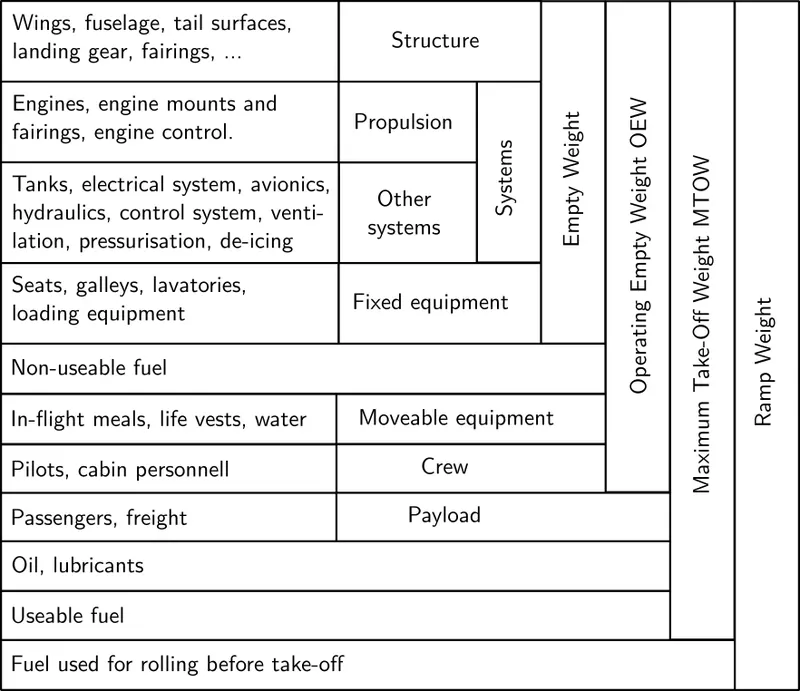
Dry operating weight = Bew + weight of crew (pilot + cabin including their bags)+Pantry
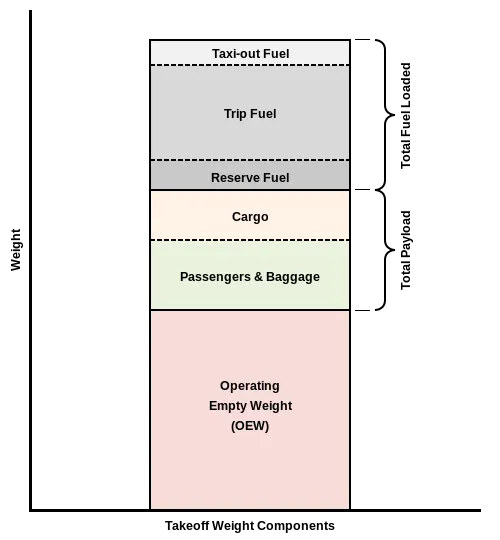
Operating Weight (OW) = DOW + Takeoff fuel (i.e. Ramp fuel - taxi fuel)
Maximum Zero fuel weight (MZFW) = DOW + payload (anything put on their aircraft that generates revenue to the company, e.g: passenger, baggage, cargo)
Maximum takeoff weight (MTW)= MZFW + Ramp fuel
Maximum takeoff weight (MTOW) = MFZW + Takeoff fuel, or MTW
Maximum landing weight (MLW) MTOW - Trip fuel.
| Aircraft type | MTOW | MLW | TOR | LR |
| Lockheed c-5 Galaxy | 381000 | 288.417 | 2530 | 1494 |
| Illyushin II-96M | 270,000 | 195.04 | 3115 | 2118 |
| Illyushin IL - 96 -300 | 250,000 | 175 | 2600 | 1980 |
| Concorde | 185,000 | 111.1 | 3440 | 2220 |
| Embraer 190 | 48,000 | 43 | 2056 | 1323 |
| Embraer | 37,500 | 32.8 | 2244 | 1304 |
| Bombardier CRJ900 | 36,500 | 33.345 | 1778 | 1596 |
2. Difference Between Ground speed & Airspeed:
While talking about aircraft two types of Speed take place. Ground speed & Airspeed takes place.
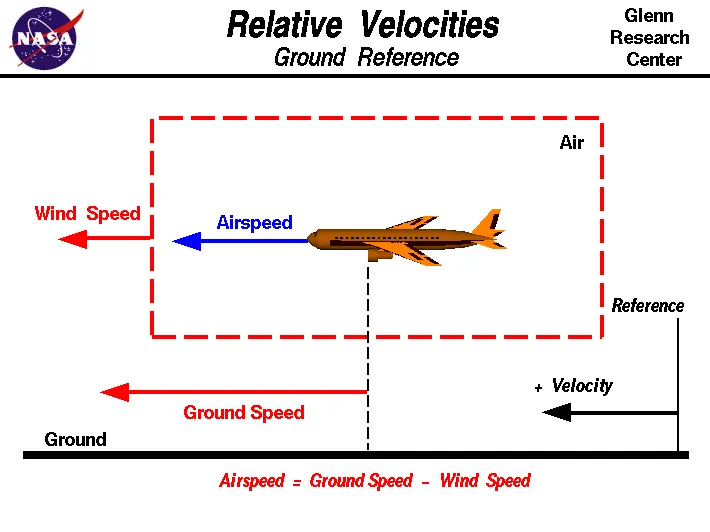
This Image was taken for reference fromhttps://www.grc.nasa.gov/www/k-12/airplane/Images/move.gif
Wind speed:
For a reference point picked from the ground. The air moves relative to the reference point at the wind speed. Wind speed is a vector quantity and has both a magnitude and a direction. A 20mph wind from the west is different from a 20 mph wind from the east. The wind has components in all three primary directions (north-south, East-west, and up-down). In this image, we are considering only velocities along the aircraft's flight path. A positive velocity is defined to be in the direction of the aircraft's motion. We are neglecting crosswinds. Which occur perpendicular to the flight path but parallel to the ground, and updrafts and downdrafts, which occur perpendicular to the ground.
Ground speed:
The aircraft moves relative to the reference point at ground speed. Ground speed is also a vector speed so a comparison of the ground speed to the wind speed must be done according to rules for vector comparisons.
Airspeed:
The important quality in the generation of lift is the relative velocity between the object and the air, which is called the airspeed. Airspeed cannot be directly measured from a ground position but must be computed from the ground speed and the wind speed. Airspeed is the vector difference between the ground speed and the wind speed.
Airspeed=Ground Speed + Wind Speed
Types of Airspeed:
Indicated Airspeed
Calibrated Airspeed
Indicated Airspeed:
It is an airspeed that is calculated directly off an aircraft's pitot-static system. It the calculated off the air drafts dynamic pressure- the difference between its total pressure and static pressure. The dynamic pressure depends not only on the aircraft's speed but also on the density of the air it is flying in. As such, the higher the aircraft flies and the lower the air density as the result-the bigger the difference between indicated and calibrated speed.
Calibrated Airspeed:
It is the speed that is adjusted for a variety of errors. One of the things that are adjusted for is the flap position. The reason for that is that at different flap positions, air flows differently around the pitot-static system and affects the indicated airspeed readings
3. why is it not recommended to use aircraft engine power to move it on the ground at Airport:
It is not recommended to use aircraft engine power to move it on the ground at the airport. Because It has some reasons,
1. Aircraft's engine makes a huge noise. It makes not good for the Airport environment.
2. If an aircraft engine will run, it will make severe damage to the surrounding crew members in the airport
3. More amount of fuel (white petrol) is needed to run the aircraft's engine on the ground.
4. while running the aircraft with an aircraft engine on the runway, it will cause damage to the engine. Then it leads to losses of economic costs.
4. How an aircraft is pushed to the runway when it's ready to take off:
"Taxiing" is the method the aircraft is pushed to the runway when it's ready to take off. Taxiing is the controlled movement of the airplane under its power while on the surface. Since an airplane is moved under its power between a parking area and the runway, the pilot must thoroughly understand and be proficient in taxi procedures. An essential requirement in conducting safe taxi operations is that the pilot maintains situational awareness of the ramp, parking areas, taxiways, runway environment, and the persons, equipment, and aircraft at all times. Without such awareness, safety may be compromised. Depending on the airport, Parking, ramp, and taxiways may or may not be controlled. As such, it is important that the pilot completely understand the environment in which they are operating. At small, rural airports these areas may be desolate with few aircraft which limits the potential hazards; however, as the complexity of the airport increases so does the potential for hazards. Regardless of the complexity, some generally accepted are appropriate. the pilot should make themselves familiar with the parking, ramp, and taxi environment.
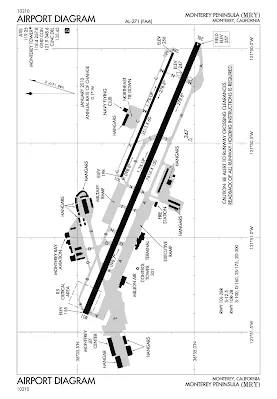
The pilot must be vigilant of the entire area around the airplane to ensure that the airplane clears all obstructions. If at any time, there is doubt about a safe clearance from an object, the pilot should stop the airplane and check the clearance. It may be necessary to have the airplane towed or physically moved by a ground crew. When taxiing, the pilot's eyes should be looking outside the airplane scanning from side to side while looking both near and far to assess routing and potential conflicts.
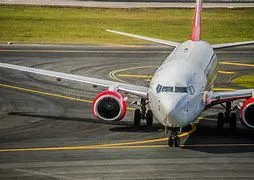
A safe taxiing speed must be maintained. The primary requirements for safe taxiing are positive control, the ability to recognize any potential hazards in time to avoid them, and the ability to stop or turn where and when desired, without undue reliance on the brakes. Pilots should proceed at a cautious speed on congested or busy ramps. Normally, the speed should be a rate where the movement of the airplane is dependent on the throttle. That is, slow enough so that when the throttle is closed, the airplane can be stopped promptly.
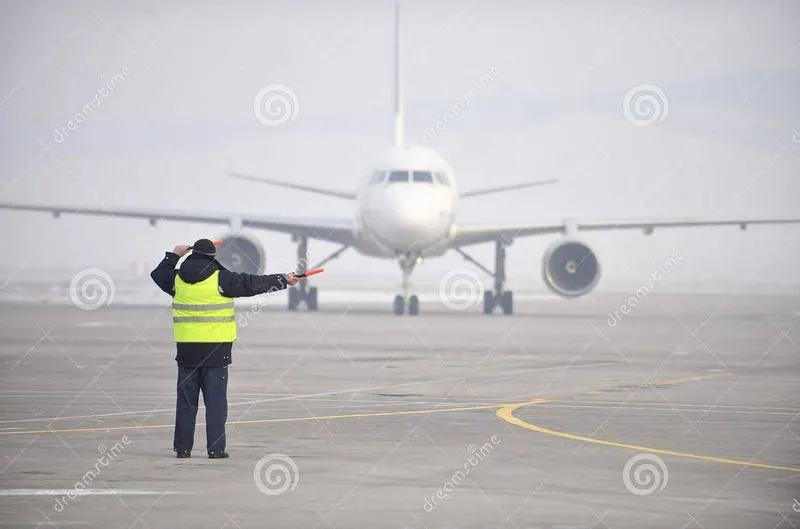
The pilot should accurately place the aircraft centered on the taxiway at all times. Some taxiways have above-ground taxi lights and signage that could impact the airplane or propellers if the pilot does not exercise accurate control. When yellow taxiway centerline strips are marked, this is more easily accomplished by the pilot visually placing the centerline stripe so it is under the center of the airline fuselage. When taxiing, the pilot slows down before attempting a turn. Sharp High-speed turns place undesirable side loads on the landing gear and may result in tire damage or an uncontrollable swerve or a ground loop. Swerves are most likely to occur when turning from a downwind heading toward an upwind heading. In moderate to high-wind conditions, the airplane may weathervane increasing the swerving tendency.
5. Learn about takeoff power, tire design, rolling resistance, tire pressure, and brake forces when landing.
Takeoff force:
Takeoff is the phase of flight in which an aerospace vehicle leaves the ground and becomes airborne. For aircraft traveling vertically, that is known as liftoff. For aircraft that take off horizontally, this usually involves starting with a transition from moving along the ground on a runway. For balloons, helicopters, and some specialized fixed-wing aircraft (VTOL aircraft such as the harrier and the bell Boeing v22 osprey), no runway is needed.
Power Settings:
For light aircraft, usually, full power is used during takeoff. Large transport category (airliner) aircraft may use a reduced power for takeoff, where less than full power is applied to prolong engine life, reduce maintenance costs and reduce noise emissions. In some emergency cases, the power used can then be increased to increase the aircraft's performance. Before take-off, the engines, particularly piston engines, are routinely run up at high power to check for engine-related problems.
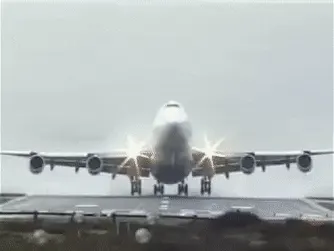
Fixed-wing aircraft designed for high-speed operation (such as commercial jets) have difficulty generating enough lift at the low speeds encountered during takeoff. These are therefore fitted with high-lift devices, often including slats and usually, flaps, which increase the camber and often area of the wing, making it more effective at low speed, thus creating more lift. These are deployed from the wing before takeoff and retracted during the climb. They can also be deployed at other times, such as before landing. Typical Takeoff speeds for jetliners are in the range of 240-285km/h. Light aircraft, such as a cessna150, takeoff at around 100km/h. Ultralights have even lower takeoff speeds. For a given aircraft, the takeoff speed is usually dependent on the weight of the aircraft.
Tire design:
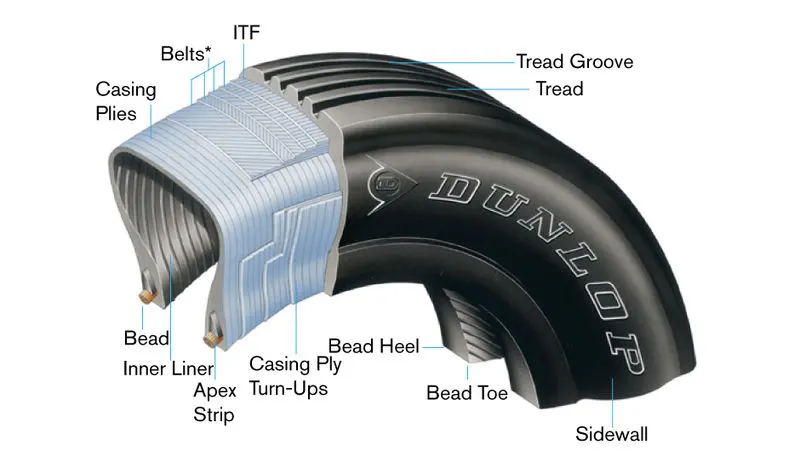
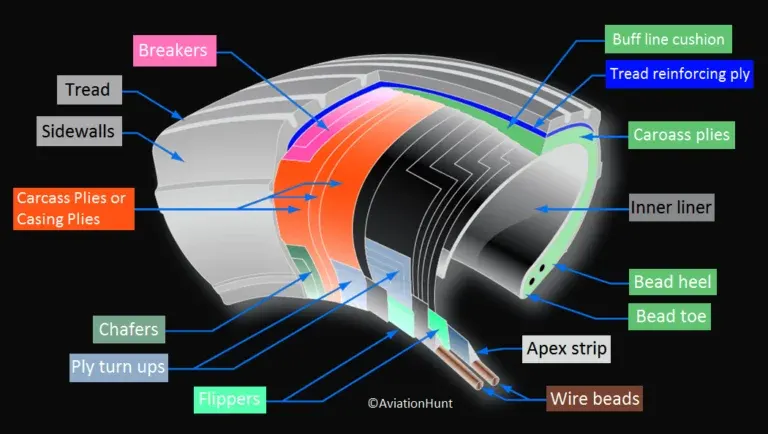
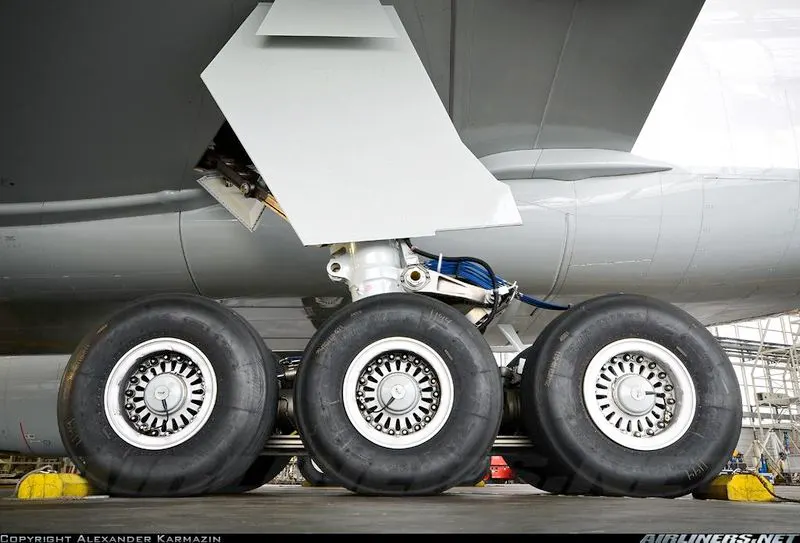
When it comes to safety, tires are one of the most important components of aircraft. They help to absorb the shock of landing and provide cushioning. It also provides the necessary traction for braking and stopping an aircraft. An aircraft tire is designed to withstand extremely heavy loads while landing, takeoff, taxing, and parking. The number of wheels required for aircraft increases with the weight of the aircraft, as the weight of the airplane needs to be distributed more evenly. A Boeing 737NG & 737MAX uses 6wheels, Boeing 787 uses 10 wheels, Boeing 777 uses 14 wheels and an airbus A380 uses 22 wheels. Aircraft tires work under extreme conditions, carrying up to 340tons and accelerating at over 250km/hr at takeoff, in addition to enduring varied environmental stress when in flight and taxiing.
Design And Construction of Aircraft tire:
Carcass plies are used to form the tire. They are sometimes called casing plies. An aircraft tire is constructed for the purpose it serves.
They support the weight of an aircraft while it is on the ground.
It also provides the necessary traction for braking and stopping an airplane.
Tyre also helps to absorb the shock of landing and provides cushioning for the roughness of takeoff, roll-out, and taxi operations.
Unlike an automobile or truck tire, it does not have to carry a load for a long period of continuous operation. However, an aircraft tire absorbs the high impact loads of landing, and also it's operating at high speeds for a short time when required
Ply Rating:
Ply rating is used to identify the maximum recommended load rating and inflation pressure for a specified tire. It is an index of tire strength.
Speed Rating:
The speed rating is the maximum takeoff speed to which the tire has been tested.
Skid Depth :
Skid depth is the distance between the tread surface and the deepest groove as measured in the mold.
Rolling Resistance:
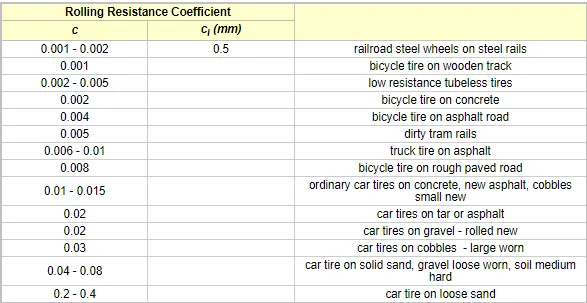
Rolling resistance is the opposing force a rolling body in motion experiences when it comes in contact with a surface. The energy required for the motion is not fully recoverable and some of it is lost when the pressure is removed. The rolling friction opposes the motion of the car, increasing the energy consumption of the EV. A rubber tire will thereby experience higher rolling resistance on an unpaved road than on a smoother road. Also, sand provides more resistance than a concrete floor. The rolling resistance of vehicles has a significant impact on their motion and thereby their energy consumption.
The coefficient of rolling friction can be expressed as,
F = crr N ------------ 1,
F = Rolling Resistance
Crr = Rolling Resistance coefficient
m = mass of the vehicle
Different Types of Rolling Resistance for Different Vehicles:
Tire Pressure:
An aircraft tire or tire is designed to withstand extremely heavy loads for short durations. The number of tires required for aircraft increases with the weight of the aircraft, as the weight of the airplane needs to be distributed more evenly. Aircraft tire tread patterns are designed to facilitate stability in high crosswind conditions, to channel water away to prevent hydroplaning, and for braking effect. Each of the twelve Boeing 777-300ER main tires is inflated to 220psi (15bar, 1,500kPa), weights120 kg (260lbs), has a diameter of 134 cm(53 in) and is changed every 300cycles while the brakes are changed every 2000 cycles.
Brake forces when landing:
Airplanes on a braking system to safely land on runways. At cruising altitude, most commercial airplanes fly at a speed of roughly 500 to 600mph. When landing, however, they must reduce their speed. A typical 747, for instace, has a landing speed of about 160 to 170mph. And upon touching the runway, airplanes must quickly brake until they come to a complete stop.
Wing Spoilers
Disc Brakes
Reverse Thrust
Wing Spoilers:
Many airplanes use wing spoilers to assist with braking when landing. Not to be confused with ailerons, spoilers are extenable flaps on the ends of an airplane's wings. Pilots can raise the spoilers to decelerate the airplane as it approaches the runway. And even while on the runway, pilots will leave the wing spoilers raised. Raised wing spoilers create drag, which essentailly slows down the airplane. so that it's able to brake more quickly.
Disc brakes:
In addition to wing spoilers, airplanes use dics brakes. Airplane disc brakes are similar to the braking system in automobiles. They consists of a pair of calipers that, when engaged, squeeze pads against the rotors of an airplane's landing gear.
Reverse Thrust:
Finally, many jet airplanes use reverse thrust to assist with braking during landings. Reverse thrust is a feature in jet engine airplanes that, as the name suggests, involves the reversal of the engine's thrust. When flying, the thrust is projected out the rear of an airplane's engines. When landing, however, pilots may use the reverse thrust feature. Reverse thrust changes the direction of the engine's thrust. Rather than projecting out the rear, the thrust will be projected out the front. This reversal of thrust provides deceleration that allows airplanes to slow down more quickly when loading.
Part-B
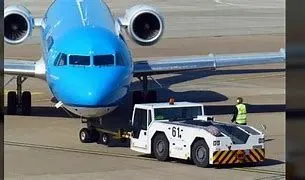
6.A. With necessary assumptions, calculate the force and power required to push/pull an aircraft by a towing vehicle.
The force and power required to push/pull an aircraft by a towing vehicle are Rolling Resistance force,& Aerodynamic force.
Rolling Resistance Force:
As we discussed above in 5. Rolling resistance, Rolling Resistance is the opposing force a rolling body motion experiences when it comes in contact with a surface. The energy required for the motion is not fully recoverable and of it. when the pressure is removed. The rolling resistance friction opposes the motion of the car, increasing the energy consumption of the EV. A rubber tire will thereby experience higher rolling resistance on an unpaved road than on a smoother road.
The Coefficient of rolling resistance is expressed as ,
F = crr N-------------1
F = Rolling Resistance
Crr = Rolling Resistance coefficient
m = mass of the vehicle
Aerodynamic Force:
Drag is one of the critical forces, as it will determine the amount of thrust required to keep the craft in dynamic equilibrium. As an aircraft is in motion, it will be moving through a fluid, which will be responsible for exerting lift and drag on the craft. Lift and drag will determine the net aerodynamic force acting on the aircraft. The drag force will be some function of velocity, depending on the flow regime. It is often desired that fluid flow across the body of an aircraft be laminar, as this will produce the smallest drag force during flight. The drag force, also called skin friction, will depend on the magnitude of the wind speed projected along the attack angle and flow regime. Several models have been used to determine the total drag force acting on an aircraft in general.
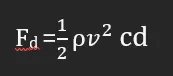
Fd = drag force
ρ = mass density of the air
ν
= flow velocity relative to the object
cd = drag coefficient
A = refernece area
Solution:
Considered as,
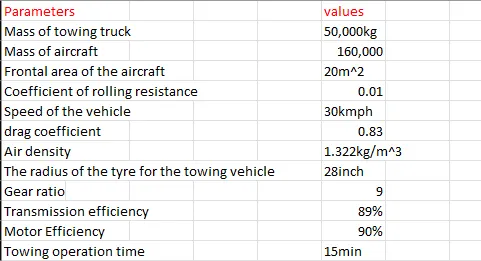
Mass of Towing Truck = 50,000kg
Mass of Aircraft = 160,000kg
Total mass(m) = 210,000
Frontal Area of the aircraft (A) = 20m2
speed of the vehicle (v) = 30kmph
Coefficient of rolling resistance = 0.01
converting kmph to m/sec
ν = 30*(1000/3600)= 8.3333m/sec
Drag coefficient ( cd) = 0.83
Air density (ρ) = 1.322kg/m3
Calculating rolling resistance Force (Frr) = crr *m*g
Frr = 0.1 *210,000*9.8
= 20,580N
Calculating Aerodynamic Dragforce (Fd) = 1/2*p*cd*A*v^2
= 0.5*1.322*20*0.83*(8.333)^2
=761.986N
Therefore the total force required to push/pull the aircraft by the towing vehicle (F) = Frr + Fd
F = 20,580 + 761.924
=21314.986
Calculating the power(p) = force * velocity
= 21,156.399 * 7.9445
= 170.618Kw
6.B. Developing the model for the calculated force and power using Simulink:
Simulink Model for Force :
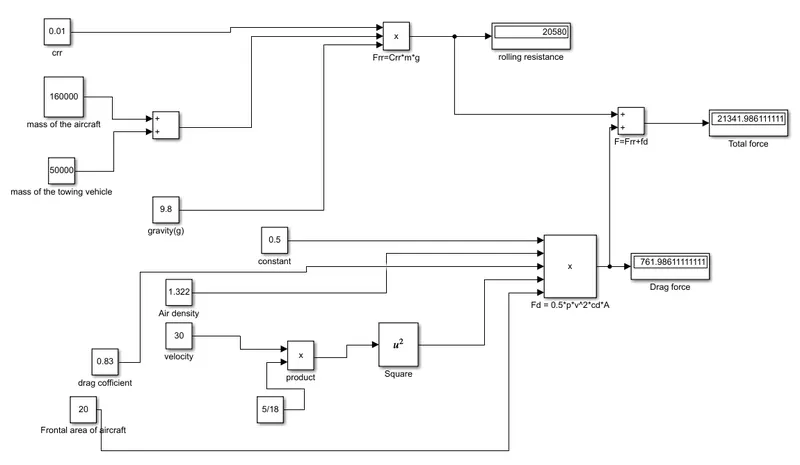
Blocks used:
- Constant
- Product
- Square
- Display
- Add
Explanation For the model:
For calculating rolling resistance, the constant block is used as crr * mass of the aircraft + mass of the towing vehicle * gravity
Frr = Crr * m*g
For calculating aerodynamic force constant(0.5)*air density*velocity*drag coefficient*frontal area of aircraft*v^2 which gives drag force
Fd = 0.5*p*v^2*cd*A
Finally F=Frr+Fcd
F = 21,341.986
Calculating the power(p) = force * velocity
= 21,341.986*6.9445
= 148.209 KW
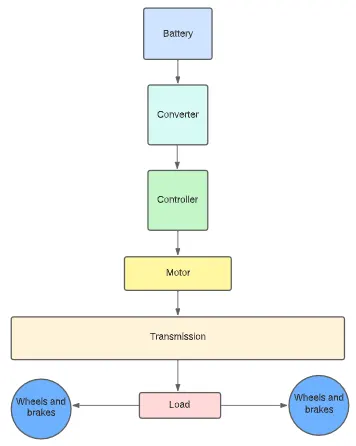
7.A Design an electric powertrain with type of motor, it's power rating, and energy requirement to full aircraft towing application in simulink. Estimate the duty cycle range to control the aircraft speed from zero to highest. Make all required assumptions. Prepare a table assumed parameters. Draw a block diagram of powertrain.
Required parameters are taken from the above solution,
Force required to push/pull the aircraft = 21.314KN
Power required = 148.209Kw
let us assume ,
The radius of the tyre for the towing truck = 28inch=0.7112m
Gear ratio = 9
Transmission efficiency (ηt) = 89%
Motor efficiency (ηm) = 90%
Torque required for wheels(TW)= Total force * radius in meters
=21.314*0.7112
=16.437 KNm
Motor Torque = Wheel torque / (gear ratio * ηt)
= 16.437 /(9*0.89)
= 16.437/8.01
= 2.052KNm
motor torque = 2.052 / 0.90 = 2.288KNm
total power required by the motor with all efficiencies = 148.209/(0.89*0.90)=185.029Kw
work done for 0.30 hrs duration,
total energy required = 185.029 * 0.30 = 55.508 Kwh
Ie we considered the battery capacity is 240kw is used by the towing truck then, The duty cycle range to control 0 to max speed (4m/s) as
Duty cycle (d) = (Required Power)/(Rated power) = 185.029/240 = 0.77
The duty cycle ranging from 0 to 77% in order to control the towing speed.
Simulink Model :
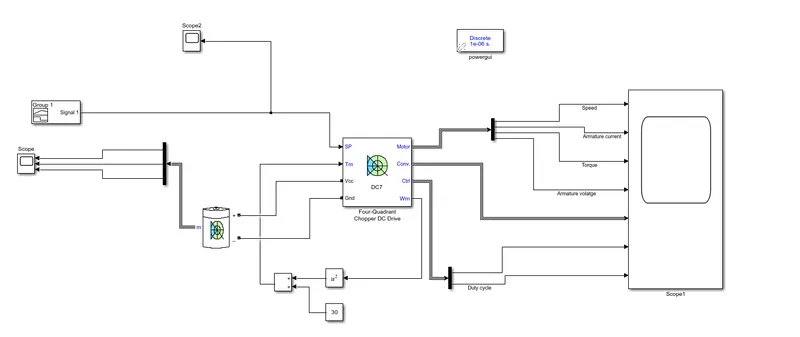
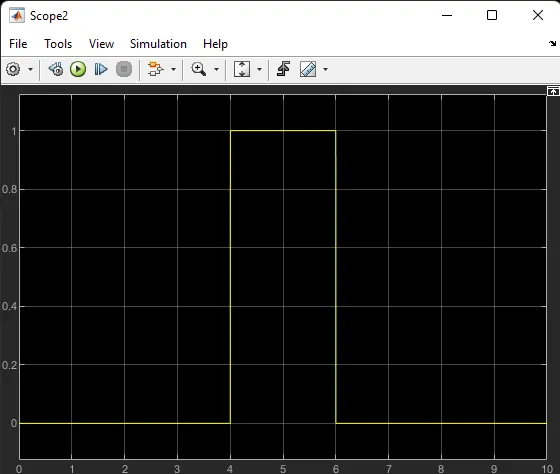
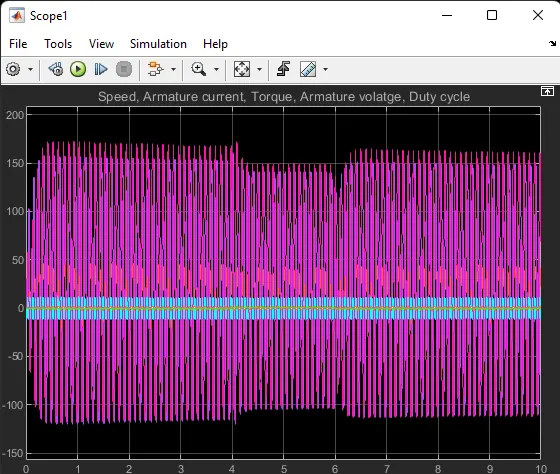
Scopes:
#Signal Builder Scope:
#Four Quadrant chopper DC drive:
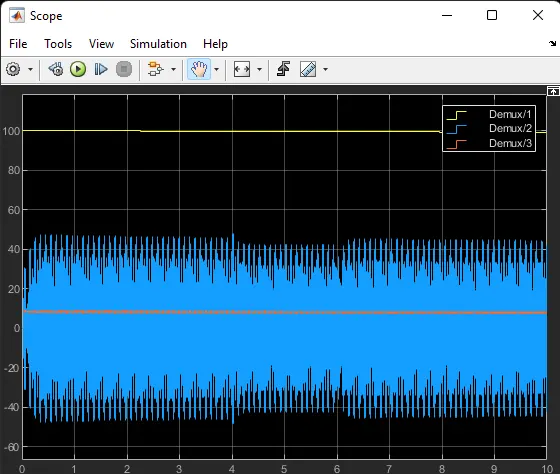
#Battery:
Block Diagram for Powertrain:
7.B. Also Design a paramaters in excel sheet: