Project-1: Powertrain for aircraft in runways
PART-A
1. Search and list out the total weight of various types of aircrafts.
Ans:-1
i) Weight of glider planes- 110 kgto 200 kg
ii) Power lift- 160 kg
iii) Fighter aircraft- 13500 Kg
iv) Military cargo planes- 250000 Kg
v) Aerobatic planes- 771 Kg
2. Is there any difference between ground speed and air speed?
Ans:-2
i) Ground speed is the airplanes speed relative to the surface of earth while air speed is the speed relative to the air flying in.
ii) Ground speed determines how fast an aircraft can reach its destination while air speed determines whether there is enough airflow around an aircraft to make it fly
iii) Ground speed is the sum of wind speed and air speed while air speed is independent of the ground speed.
3. Why is it not recommended to use aircraft engine power to move it on the ground at Airport?
Ans:-3 It is not recommenede due to following reason
i) The jet blast from the engine can damage the building and nearby equipment.
ii) It is easier for the truck driver to see the surronding better than the pilot from the cockpit.
iii) The plan engine are very loud and it can add up when multiple planes are moving around.
iv) It saves fuel as by turning on planes engines before the takeoff can increase fuel consumption.
4. How an aircraft is pushed to runway when its ready to take off?
Ans:-4 Taxing is the movement of the aircraft on the ground under its own power where aircraft is moved by tug. The power for taxing comes from the engine itself. If its a propeller powered aircraft, the propeller provide thrust and pulls the aircraft. If its a jet engine, the exhaust air that comes out of the aircraft provide forward force. Air lines have nose wheel steering, controlled by a cockpit control called a tiller. The tiller allows nose wheel to rotate at quite extreme making tighter angle possible. it also reduces fuel consumption as it doesnt need much engine power during taxing.
Once on takeoff roll and airplane gets sufficient speed, pilot go back to using rudder pedals to maintain the centr line. Some general aviation aircraft uses rudder for turns during taxi. They do not have a seperate control for nose wheel.
5. Learn about take off power, tyre design, rolling resistance, tyre pressure, brake forces when landing.
Ans:-5
a) Take off power- It can be predicted using smple measure of acceleration of the aircraft of the along the runway based on equilibrium.
dv/dt= T-D-F/m
The procedure for takeoff will be that the vehicle will accelerate until it reaches a safe flying speed. The pilot then rotate the vehicle to an attitude to produce climb lift and it will ascend from the ground
Vr=1.1 * Vstall
b) Tyre Design- When it comes to safety, tires play important component of aircraft. They help to absorb the shock and provide cushioning. It also provides neccesary traction for braking abd stopping of an aircraft. An aircraft tyre is designed to withstand extremely heavy load while landing, take off, taxing and parking. The number of wheels required for aircraft increases with the weight of aircraft, as the weight needs to be distributed evenly. Aircraft tyres must have an approved speed and load rating and have sufficient clearance when retracted through the landing gear to allow for tire growth.
c) Rolling resistance- it is the force resisting the motion when a body rolls on a surface. there are two form of losses such as hystersis losses and permanent plastic deformation of the object. Another cause of rolling resistance lies in the slippage between the wheel and the surface, which dissipates the energy
It can be expressed as
Fr= cw
d) Tyre Pressure- It is a measurement of much pneumatic air is present in tire and ensure the tires wear evenly and maintain correct level of grip on road surface.
Part B
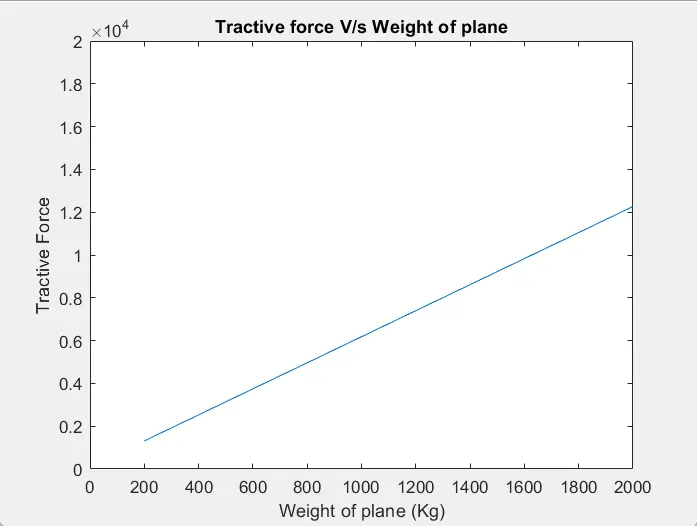
6. A. With necessary assumptions, calculate the force and power required to push / pull an aircraft by a towing vehicle.
Ans:-6
clear all
close all
clc

c = 0.02
m = linspace(200,25000,2000)
g = 9.81
u = 0.6
A = linspace(50,100,2000)
v = 2
Cd = 0.8

F1= c*m*g
F2= u*g*m
F3= 0.5*A*1.2*Cd*(v)^2
Ft= F1+F2+F3

plot(m,Ft)
title('Tractive force V/s Weight of plane')
xlabel('Weight of plane (Kg)')
ylabel('Tractive Force')
axis([0 2000 0 20000])
Output
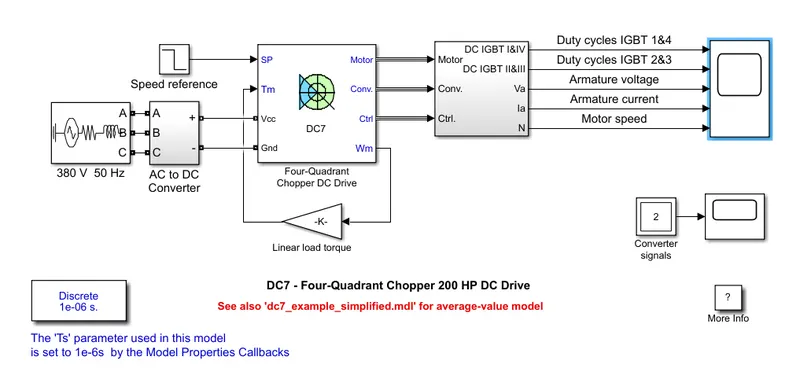
7) A. Design an electric powertrain with type of motor, it’s power rating, and energy requirement to fulfill aircraft towing application in Simulink. Estimate the duty cycle range to control the aircraft speed from zero to highest. Make all required assumptions. Prepare a table of assumed parameters. Draw a block diagram of powertrain.
Ans:-7 Force required to push/pull aircraft= 19.508 KN
Power required= 135.478 KW
r= 25 inches= 0.635 m
gear ratio= 8
transmission efficiency= 87%
motor efficiency= 95%
torque required for wheels= total force * radius
19.508*0.635= 12.387 Knm
Motor torque- Wheel torque/(gear ratio*nt)
12.387/(8.087)
1.778 Knm
Total power= 135.478/(0.85*0.950)=163.91 Kw
total energy consume= 163.91 * 0.25 = 40.98 KWh
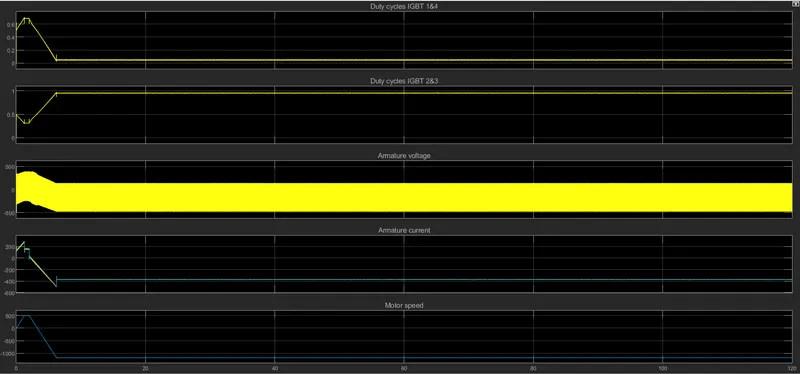
Duty cycle= required power/rated power
163.91/220= 0.75
Model:
Output: