Project-1: Powertrain for aircraft in runways
PART A:
Aim 1:- Search and list out the total weight of various types of aircrafts.
Theory:
Aircraft- An aircraft is a vehicle or machine that is able to fly by gaining support
from the air. It counters the force of gravity by using either static lift or by using
the dynamic lift of an airfoil, or in a few cases downward thrust from jet engines.
Common examples of aircraft include airplanes, helicopter, airships ( including
blimps), gliders, paramotors and hot air balloons.
The human activity that surrounds aircraft is called aviation. The science aviation,
including designing and building aircraft, is called aeronautics. Crewed aircraft are
flown by an onboard pilot, but unmanned aerial vehicles may be remotely controlled
or self controlled by onboard computers. Aircrafts may be classified by different
criteria such as lift type, aircraft propulsion, usage and others.
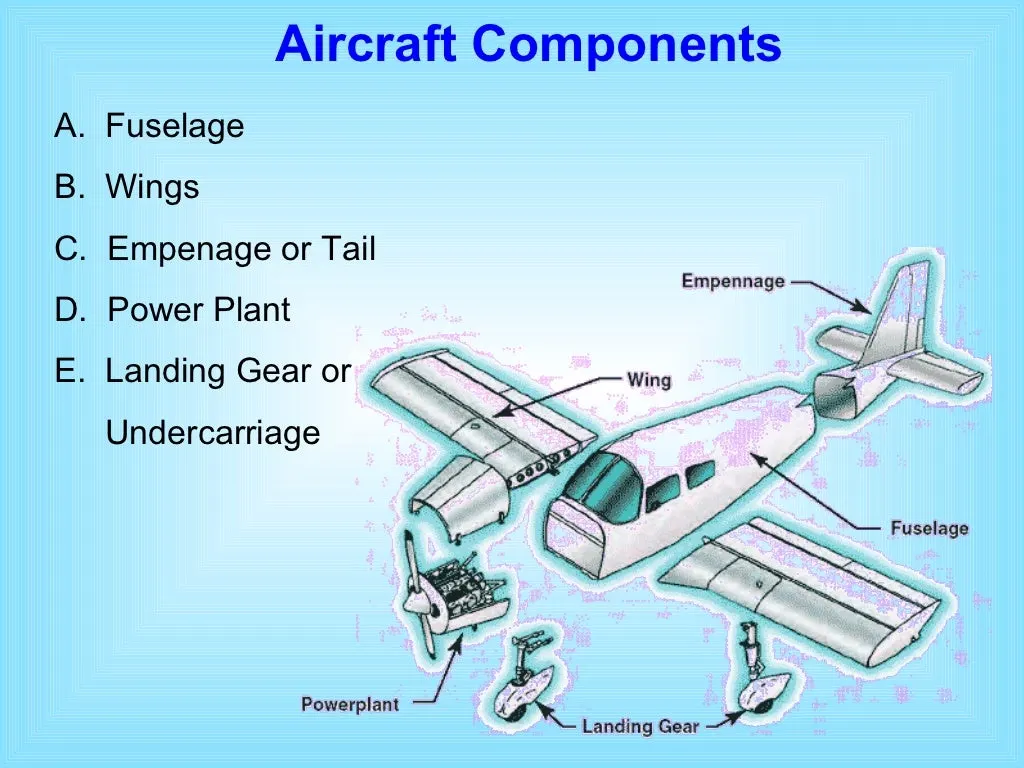
How much does an airplane weigh?
An average airplane weighs around 90,000 pounds (41,000 kilos) empty weight,
which means the weight of the airplane when its fuel tanks are empty and there
are no people or luggage on board. This example is for a B-737-800 aircraft which
is considered a medium-sized commercial jet airliner.
We can expect to add 84,000 pounds (38,000 kilos) of fuel, passengers, and
baggage to that number to get a maximum takeoff weight of 174,000lbs
(79,000 kilos).
These numbers depend dramatically on the type of aircraft we are referring to.
List of common aircrafts and their weight as shown below:
1] Cessna 172 - Used by many as initial training aircraft (27 feet long) - 145lbs
empty weight, 2450lbs max weight.
2] Citation Jet M2 - (42 feet long) - 6990lbs empty weight, 10,700lbs max weight.
3] Boeing 767-300 - (185 feet long) - 195,000lbs empty weight, 400,000 max
weight.
4] Boeing 787-800 - (186 feet long) - 264,500lbs empty weight, 502,500lbs
max weight.
5] Boeing 777-300 - (242 feet long) - 354,000lbs empty weight, 660,000lbs
max weight.
6] Boeing 747-400 - (232 feet long) - 407,000lbs empty weight, 910,000lbs
max weight.
7] Airbus A320 - (123 feet long) - 82,000lbs empty weight , 170,000lbs
max weight.
8] Airbus A330 - (210 feet long) - 274,500lbs empty weight, 507,000lbs
max weight.
What is the world's largest plane?
The world's largest passenger airliner is the Airbus A380. Its maximum takeoff
weight is over a million pounds!
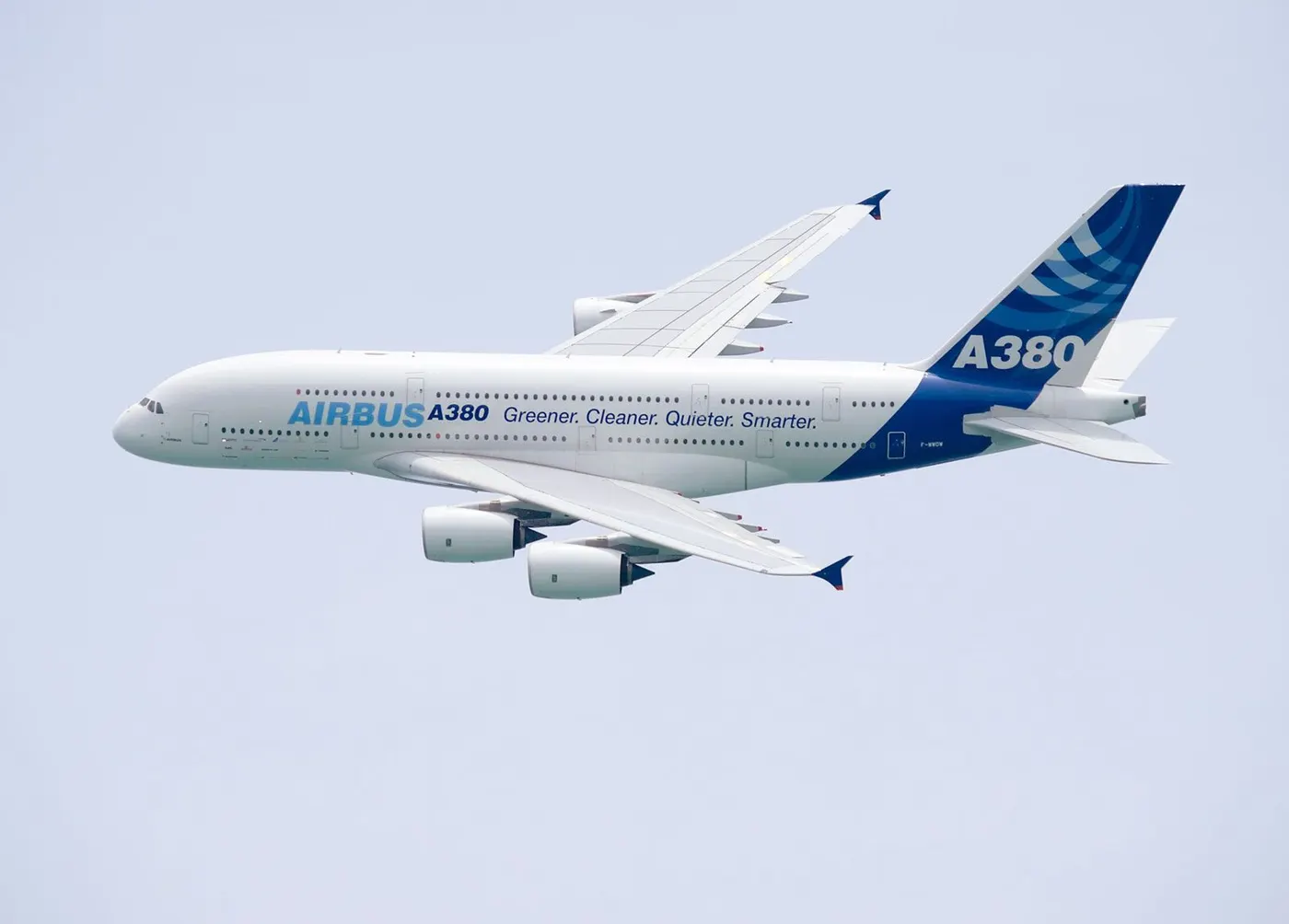
Airbus A380 - (240 feet long) - 610,700lbs empty weight, 1,234,600lbs max weight.
What is the heaviest plane?
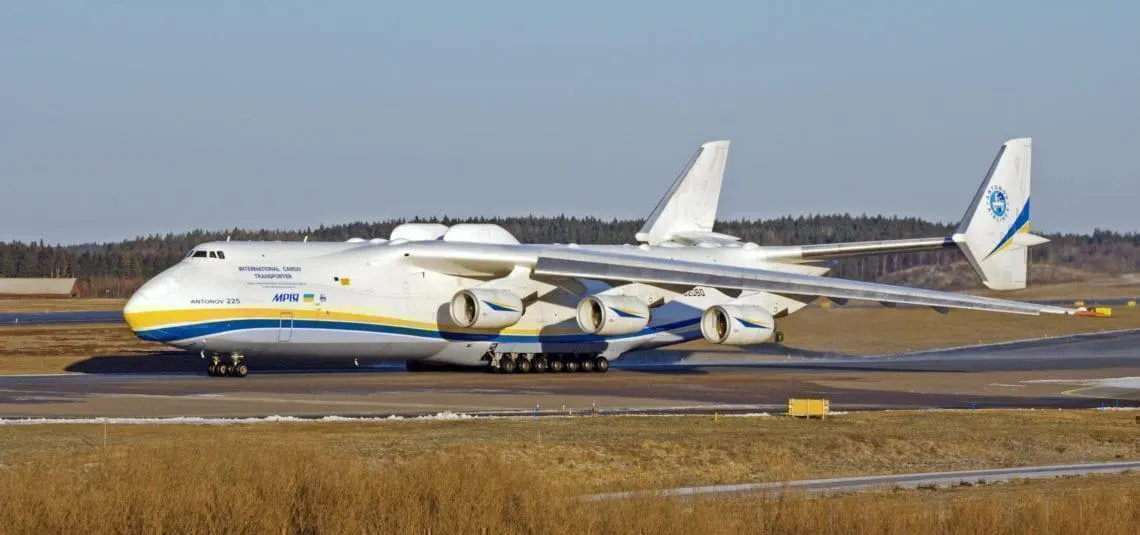
The Antonov An-225 Mriya is the largest aircraft. It is longest plane, and with six
engines is both the heaviest aircraft ever built and the largest wingspan of an
aircraft.
Fuel and Passenger Weights:-
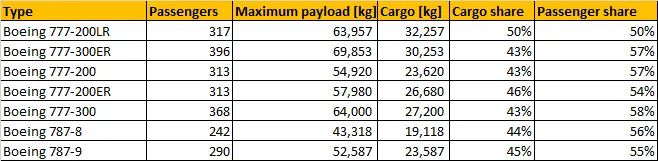
Feul and passenger weight plays a crucial role in determining the maximum weight of the
aircraft. Every aircraft has a maximum weight that is provided by the manufacturer. This
number is not to be exceeded for any aircraft used privately or commercially.
In order to determine the actual weight of the aircraft ,we must add the empty weight of
the plane + fuel weight + passenger weight + baggage weight. This number cannot be
above the maximum allowable weight limit of the aircraft.
Aircraft fuel can be divided into 2 groups i.e. Avgas and Jet fuel. They both have different
weights. Avgas is what the smaller non-jet engine aircraft will use. It weighs around 6lbs
per U.S gallon. Jet fuel weighs slightly more at just under 7lbs per U.S gallon.
Passenger weights are determined by the actual weight of people on board. In the example
of commercial airliners, there is no way to know the actual person weight of each person on
board, so they use an average weight which is based on gender, age, time of year and also
allows for carry on baggage they may be bringing.
How to calculate actual aircraft weight:
A] OEW or Operating Empty Weight or Basic Empty Weight
OEW is the weight of the aircraft as it sits empty without fuel, passengers or luggage.
But it does include all necessary fluids for operation. (oil, coolant, water, hydraulic
fluids,etc)
B] MTOW or Maximum Takeoff Weight
MTOW is the maximum weight of the aircraft to safely takeoff considering
structural or other limits.
As mentioned, the maximum weight that any aircraft can be at the time of
takeoff is MTOW.
This is calculated by taking OEW + Fuel + Passengers + Luggage - Fuel for
taxi to runway = MTOW.
Using our initial example of the B737-800 aircraft, the MTOW is 174,000lbs.
To calculate the actual weight of the plane on the day of flight, using above
formula,
= 90,000lbs + 60,000lbs fuel + 25,000 lbs passengers + 1200 lbs
luggage - 100lbs fuel
= 176,100 MTOW.
With so many variables involved, each aircraft is different and therefore will have
different weights. Each aircrfat will have its own OEW and depanding on the payload
will have a different MTOW.
What does an average aircraft weigh?
The average medium-sized airliner weighs around 90,000lbs.
What is ' minimum flight weight?'
Minimum flight weight refers to the minimum weight of a plane in its
ready-to-fly status. It has enough fuel tank to make a realistic flight,
other fluids like hydraulic and engine oils, and other miscellaneous
items. Minimum flight weight doesn't include flight crew or any cargo.
How much does a small plane weigh?
A small plane or aircraft as defined by 14 CFR part 1 is 12,500 lbs or
less maximum certified take-off weight.
Aim 2: Is there any difference between ground speed and air speed?
Answer:-
Ground speed is the airplane's speed relative to the surface of the earth , air
speed is its speed relative to the air it is flying in.
Airspeed vs Ground Speed-
True airspeed is simply the speed at which an aircraft is moving relative
to the air it is flying in. As such it's also the speed at which the air is flowing
around the aircraft's wings.
Ground speed, on other hand, is the aircraft's speed relative to the ground.
One thing that should be noted here that it's horizontal rather than vertical
speed - an aircraft climbing completely vertically would have ground speed
of zero.
In other words, while airspeed is what determines whether there is enough
airflow around an aircraft to make it fly, ground speed is what determines
how fast an aircraft will get to its destination.
Wind's effect on Ground Speed:
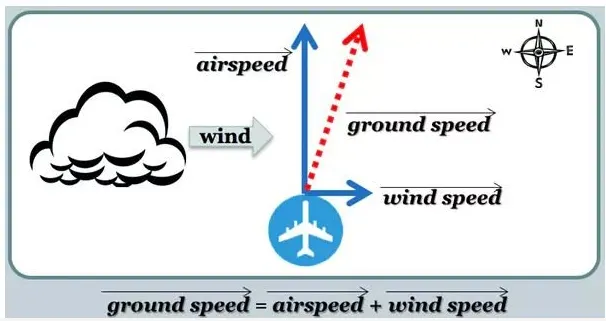
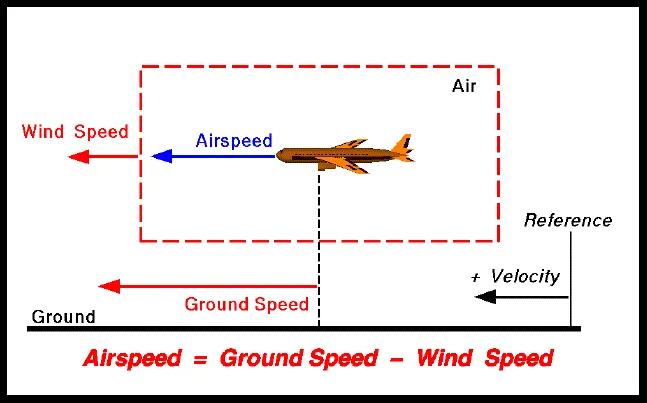
The relationship between airspeed and ground speed is fairly simple. Ground
speed is simply the sum of the airspeed and wind speed.
If the aircraft is flying in the same direction as the wind is blowing, the aircraft
experiences tailwind, and its ground speed is higher than its airspeed. On the
other hand, if the wind is blowing against the direction the aircraft is travelling
in, the aircraft experiences headwind, and its ground speed is lower than its
airspeed.
Consider an example, if an aircraft that cruises at an airspeed of 500 miles per
hour that has to cover a ground distance of 2,000 miles.
If there is no wind at all, then both the aircraft's airspeed and ground speed would
be the same 500 miles per hour, and the aircraft would reach its destination in four
hours.
If there was a 100 miles per hour headwind- wind is blowing against the aircraft's
direction of travel - the aircrfat would still be travelling at an airspeed of 500 miles
per hour. However, its ground speed would be just 400 miles per hour (100 miles
per hour slower than its airspeed) . And as such, it would take the aircraft five hours
to reach its destination.
Finally, if there was a 100 miles per hour tailwind - wind is blowing in the same
direction as the aircraft's travel- the aircraft would still be travelling at an airspeed
of 500 miles per hour, but its ground speed would be 100 miles faster. And, at 600
miles an hour, the aircrfat would reach its destination in just three hours and twenty
minutes.
The above is the reason why some flights go "out of their way'' to avoid headwinds
or catch tailwinds. And, why some flights might appear to be travelling at "Supersonic
speeds, " even though their airspeed - the speed that would actually matter in determining
whether or not the flight truly is supersonic - is subsonic.
The Moving Walkway Analogy -
Consider an example for better understanding of difference between airspeed
and ground speed. Assume a moving walkway going from point A to point B
moving at 3 miles per hour.
If we are walking on the walkway at a speed of 3 miles per hour relative to the
walkway then in other words we are moving from point A to point B at a speed
of 6 miles per hour. The sum of the speed of the walkway and the speed at which
we are walking relative to the walkway.
What if, though, we tried to walk on the walkway from point B to point A?
If we walked at 3 miles per hour relative to the walkway, we would be
standing still. To move, we would have to walk faster than 3 miles per hour
relative to the walkway, we would be moving from point B to point A at a
speed of 2 miles per hour.
Finally, if the walkway was broken and wasn't moving, your speed relative
to it would be the same as the speed we would be moving at from point A to
point B.
We have probably figured out from the anology above, the speed of the walk
way takes the place of wind speed, the speed at which we are moving from
point A to point B ( or viceversa) is the ground speed, and the speed at which
we are moving relative to the walkway is the airspeed.
Types of Airspeed:-
Pilots commonly used three different types of airspeed:
1] Indicated airspeed
2] Calibrated airspeed
3] True airspeed
1] Indicated airspeed
Indicated airspeed is an airspeed that is calculated directly off an aircraft's pitot-
static system. It's the calculated off the aircraft's dynamic pressure - the difference
between its total pressure and static pressure.
The dynamic pressure depends not only on the aircraft's speed, but also on the
density of the air it is flying in. As such, the higher the aircraft flies - and the
lower the air density as a result - the bigger the difference between indicated
and true airspeed is.
2] Calibrated airspeed
Calibrated airspeed is indicated airspeed adjusted for a variety of errors. consider
an example one of the things it's adjusted for is the flap position. The reason for
that is that at different flap positions, air flows differently around the pitot-static
system and affects the indicated airspeed readings.
3] True airspeed
True airspeed is, as has been mentioned numerous times , the actual
speed at which an aircraft is moving relative to the air it is traveling in. It's calibrated
airspeed adjusted for the exact conditions (altitude, air temperature,etc.) that the
aircraft is flying in.
This all are the differences between airspeed and ground speed.
Aim 3: Why is it not recommended to use aircraft engine power to move it on
the ground at Airport?
The Aircraft Ground Running is usually used to describe the operation of some or all of
the engines of an aircraft, whilst on the ground, for the purpose of functionally checking
the operation of either engines or aircraft systems. This usually takes place prior to the
Release of Service of an aircraft from maintainance. Ground running may be carried out
either prior to , during or after the rectification of a defect or scheduled work on an
engine or an aircraft systems, when this requires engines to be operating in order to
assess its function. Although the aircraft may need to be taxied or towed to an approved
ground running position under a clearence from ATC, most operators and maintainances
organisations do not require pilots to be on board because aircrafts technicians can be
trained and approved for these duties.
The Risk to Operational Safety
The risk which may arise from engine ground running relate to the potential for loss of
control of the aircraft by those persons occupying the pilot seats in the flight deck. In
most cases, such persons will be maintainance personnel holding specific company -
issued approval for the required tasks. The consequences of loss of control during taxi
or towing are the same as apply to these operations generally and this is concerned
only with the risks arising from the static running of one or more aircraft engines. Un-
wanted consequences from such static running are mainly related to those arising from
the unintended movement of the aircraft during engine running- effectively a loss of
control-especially during high power engine running. Damage can occur to the aircraft
itself, other aircraft nearby or to airside structures. In addition, there is a risk of injury
to ground support personnel who may be in relatively close proximity to the aircraft.
Overall Risk Mitigation
The best form of overall mitigation is to ensure that all persons authorised to
supervise or directly participate in engine ground running from the flight deck
who are not pilots or flight engineers currently rated on the specific aircraft
type, are in receipt of suitable initial trainings and that there is a proper system
for both initial and recurrent qualification for engine ground running duties. Both
initial and recurrent qualification must include practical training and assessments
of task competence using either a full flight simulator or an aircraft. Between formal
competency assessment, a maximum interval between performance task should be
specified. If that interval is exceeded, the qualification would become viod until
remedial action has been competed. In this respect, the task of engine ground
running should be seen as part of a broader group of aircraft ground movement
tasks which can be carried out under the control of flight deck occupants other
than type rated flight crew.
Key Risk Control
1] Thrust levels above ground idle should be applied symmetrically.
2] Tasks checklists must be constructed so that there is never a cause to temporarily
defer items and continue.
3] Once a task has been initially briefed by the person authorised to supervise it
modifications to the briefed task should only be permitted within a clearly defined
limit without a complete task re-briefing.
4] Where two persons, both holding the necessary authorisation to be able to supervise
a task, are teamed together to conduct it, one of them must be designated by the Aircraft
Operator or MRO as the supervisor for a particular task and should lead the pre-task
briefing. No change of designated supervisor should occur during a briefed task.
5] Any plan for engine ground running which is authorised for power above Ground idle
must be carried out with the aircraft in a position in which unexpected and unintended
forward movement will not result in damage or injury should the appropriate response
from the designated supervisor be delayed.
6] Knowledge of the brake and hydraulic systems on any aircraft type for which a person
is permitted to occupy a flight deck seat, for the purposes of engine ground running must
be comprehensive and formally certified as such.
7] All equipment and personnel must be completely clear of an aircraft befor engine
running above ground idle occurs.
8] AMM's require that a fire extinguishers be within the vicinity of the engine, parti-
cularly if the engine cowlings are open and we are giong to leak check. This is because
in the case of a fire due to an oil/fuel leak in the fan section, the engine fire extinguishers
may not be effective and we have to fight the fire with an external fire extinguishers.
Aim 4: How an aircraft is pushed to runway when its ready to take off?
Answer:- A so called pushback truck reverses the aircfarft into taxiing position, pushing
it with a towbar attached to nose-wheel strut. Or, in the modern versions, by actually
lifting the wheel. That speeds up coupling and decoupling. The aircraft taxis to the
runway to depart at a agreed speed.
An aircraft is pushed to runway when its ready to take off can be described as follows,
1] The pilot parks the aircraft in exactly the right place. Usually with the help of an
automatic system, but occasionally guided by marshaller waving two paddles or wands.
Dozens of handling personnel are already standing by to perform a whole range of tasks
simultaneously.
2] As soon as the aircraft is stationary and the engines are switched off, the first priority
is to disembark the passenger as quickly as possible. The apron handler places chocks
in front of the wheels and connects to the ground power. Meanwhile, the passenger
bridge manoeuvres up to the door and a belt loader rolls up to the cargo hold. Luggage
is unloaded and transfered to the terminal on baggage carts.
3] Refuelling begins, usually from a hydrant at the stand. A hose is attached to this
from a special vehicle called a dispenser, with the other side connected to the fuel tank
in the wing.
4] Now it is time to service the aircraft. The caster loads new meals and takes away the
food waste and used cutlery and crockery. Other activities include draining the lavatories,
replacing and headrest covers, removing rubbish and distributing fresh blankets and in-
flight magazine.
5] A specialist team - or sometimes the crew themselves - cleans the cabin so that the
new passengers boards a pristine aircraft.
6] Meanwhile, specialist from the airline conduct a techical check to make sure that the
engines, wings, control surfaces, landing gear, instruments, doors and other equipment
are in full working order.
7] The aircraft is now ready for baggage to be loaded for the next flight. This is a quick
process, on average taking only 10-15 minutes. A little later the passengers start
boarding. As soon as they are all in their seats, the door is closed and the pilot informs
air-traffic control that the flight is ready for departure.
8] The apron handler removes the chocks. A so-called pushback truck reverses the
aircraft into taxiing position, pushing it with a towbar attached to the nose-wheel strut.
Or, in the most modern versions, by actually lifting the wheel. the speeds up coupling
and decoupling.
9] The aircraft taxis to the runway to depart the agreed time.
10] The pilot waits for permissions to take off from air-traffic control. This is possible
once the departure route is clear. As soon as the go-ahead is received, the plane takes
to the air at full power.
Aim 5: Learn about take off power, tyre design, rolling resistance, tyre pressure,
brake forces when landing.
Answer:-
1] Take off power
The amount of power that an engine is allowed to produce for a limited perod of time
for takeoff. The use of take off power is usually limited to 5 min for reciprocating engines
and up to two and half minute for gas turnine engines. This may not always be the case.
specifically, with respect to reciprocating engines, it is the brake horsepower developed
under standard, sea-level conditions and under the maximum conditions of the crankshaft
rotational speed and the engine manifold pressure approved for normal take off. It is
limited in continuous use the period of time shown in the approved engine specification.
With respect to gas turbine engines, it is the thrust developed under static conditions
at a specified altitude and atmospheric conditions of the rotor shaft rotational speed
and gas temperature approved for the normal takeoff. It is limited in continuous use
to the period of time shown in the approved engine specifications.
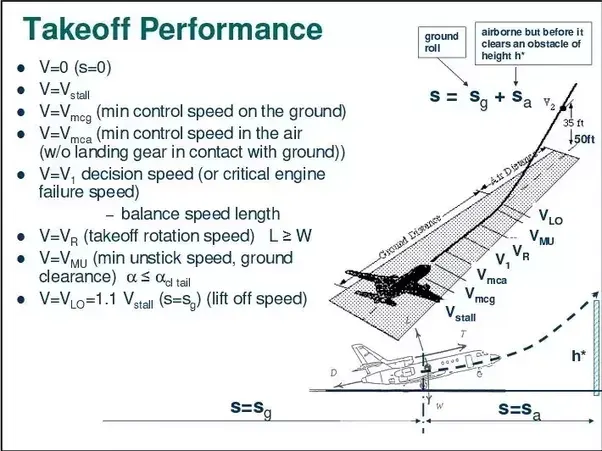
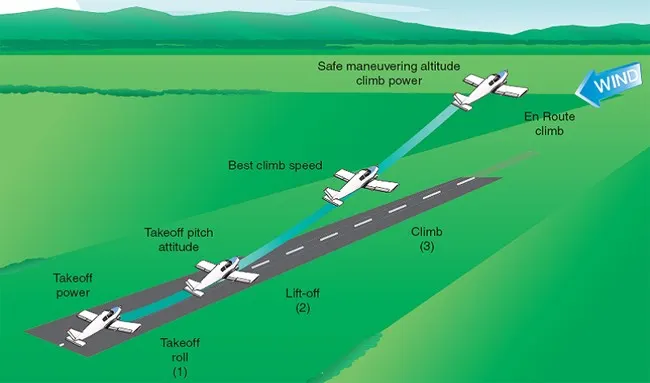
Fig. Take off activities of an aircraft
2] Tyre design
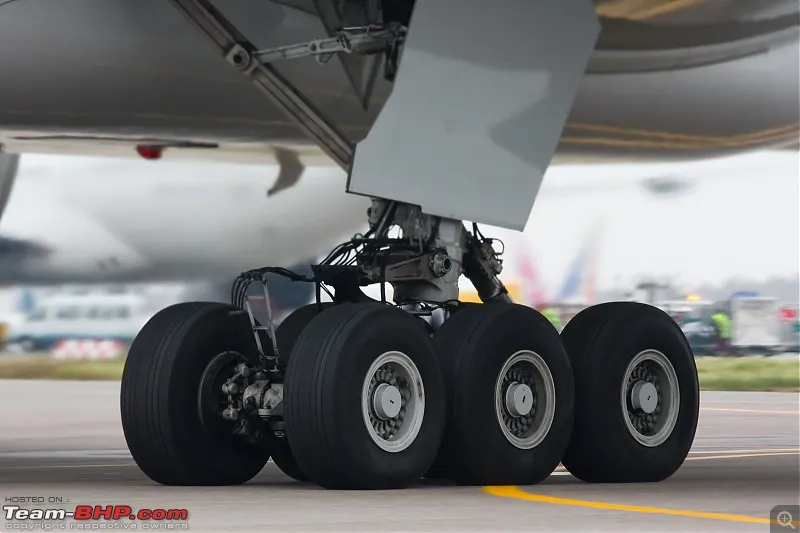
Why are tyres are important in Aircraft?
When it comes to safety, tyres are one of the most important component of aircraft.
They help to absorb the shock of landing and provide cushioning. It also provides
the necessary traction for braking and stopping of an aircraft.
An aircraft tyre is designed to withstand extremely heavy loads while landing, take
off, taxing, and parking. The number of wheels required for aircraft increases with
the weight of the aircraft, as the weight of the aeroplane needs to be distributed
more evenly.
A Boeing 737NG & 737MAX uses 6 wheels, Boeing 787 uses 10 wheels, Boeing 777
uses 14 wheels and Airbus A380 uses 22 wheels. Aircraft tyres work under extreme
conditions, carrying up to 340 tons and accelerating at over 250km/hour at takeoff,
in addition to enduring varied environmental stress when in flight and taxiing.
Design and Construction of Aircraft tyre
Carcass plies are used to form the tyre. They are sometimes called casing plies.
An aircraft tyre is constructed for the purpose it serves.
1] They support the weight of an aircraft while it is on theground.
2] It also provides the necessary traction for braking and stopping of an aeroplane.
3] Tyre also helps to absorb the shock of the landing and provide cushioning the
roughness of takeoff, roll-out, and taxi operations.
Unlike an automobile or truck tyre, it does not have to carry a load for a long
period of continuous operation. However, an aircraft tyre absorbs the high impact
loads of landing and also it's operating at high speed for a short time when required.
Some technical aspects of the tyre are,
A] Retreading
Retreading is methods of restoring a worn tyre by renewing the tread area
or by renewing the tread area plus one or both sidewalls. Repairs are
included in the tyre retreading process.
B] Load Rating
Load rating is the maximum permissible load at a specified inflation pressure.
C] Ply Rating
Ply Rating is used to identify the maximum recommended load rating and
inflation pressure for a specified tyre. It is an index of tyre strenght.
D] Speed Rating
The speed rating is the maximum takeoff speed to which the tyre has been
tested.
E] Skid Depth
Skid depth is the distance between the tread surface and the deepest groove
as measured in the mould.
Aircraft tyres must have an approved speed and load rating and have sufficient
clearence when retracted through landing gear to allow for tyre growth. Tyre
growth is the increase in the size of the tyre due to centrifugal forces at high
speed.
Aircraft tyres may be Tube-type or Tubeless
Tubeless tyres are more advantageous over tube-type. There is no longer
the use of tube-type tyre in recent aviation. Nowadays, all airliners are
using tubeless tyres. Tubeless that are meant to be used without a tube
has the word TUBELESS on the sidewall of the tyre.
Aircraft tyres may be Radial or Bias
Almost all the airliners are using Radial tyre. Bias is an older design, and
it's mainly used for road vehicles. Radial tyres have the word RADIAL on
the sidewall. Radial tyres are more expensive than bias-ply tyres. Radial
tyres are in demand because of their lower life cycle cost and long term
value.
Are aviation tyres are conductive?
Yes, Today's tyre are conductive. Aircraft tyres are manufactured with tread
rubber with conducting compounds to permit earthing of static charges.
In early days when tyre were not sufficiently conductive, aircraft used to have
a conductive strip hanging down from the axle of the landing gear. Upon
landing, this strip would be the first part of the aircraft to touch the earth.
This discharges any static electricity accumulated on the outer surfaces of
the aircraft.
What is the purpose of Chines in aviation tyre
Chines are also called deflectors. Chine tyre used on the nose wheel of aircraft,
specially fuselage-mounted jet engines. It diverts runway water from the engines
inlets.
Chines are circumferential protrusions that are moulded into the sidewall
of nose tyre that deflect water sideways to help reduce excess water ingestion
into the engines. Tyres may have chines on one or both sides, depending
on the number of nose tyres on the aircraft.
Aircraft Tyre Standards
Each manufacturer produces their own designs of the tyre with different
tread patterns, wear patterns, wear limits etc, and in some cases, different
names for the same part of the tyre. But all tyres must meet the approved
standards before being accepted by the FAA or CAA.
All commercial aircraft tyres approved under FAA Requirements Technical
Standard Order (TSO) C62. A TSO is a minimum performances standards
for specified materials, parts, and appliances used on civil aircraft.
3] Rolling Resistance
Rolling resistance, sometimes called rolling friction or rolling drag, is the force
resisting the motion when a body ( such as a ball, tire, or wheel ) rolls on a
surface. It is mainly caused by non-elastic effects; that is , not at all energy
needed for deformation (or movement) of the wheel, roadbed,etc., is recovered
when the pressure is removed. Two forms of this are hysteresis losses and the
permanent (plastic) deformation of the object or the surface (e.g.soil). All the
slippage between the wheel and the surface also results in energy dissipation.
Although sometimes it is suggested that dissipation term should be treated
separately from the rolling resistance because it is due to the applied torque
to the wheel and the resultant slip between the wheel and ground, which is
called slip loss or slip resistance. In addition only the so-called slip resistance involves
the friction, therefore, the name "rolling friction" is to an extent a misnomer.
Analogous with sliding friction, rolling resistance is often expressed as a coefficient
times the normal force. This coefficient of rolling resistance is generally much
smaller than the coefficient of sliding friction.
Factors that contribute to rolling resistance are the deformation of the wheel, the
deformation of the road surfaces and movement below the surface. Additional
contributing factors include Wheel diameter, load on wheel, surface adhesion,
sliding and relative micro-sliding between the surface of the contacts. The losses
due to hysteresis also depends strongly on material properties of the wheel or tire
and the surfaces.
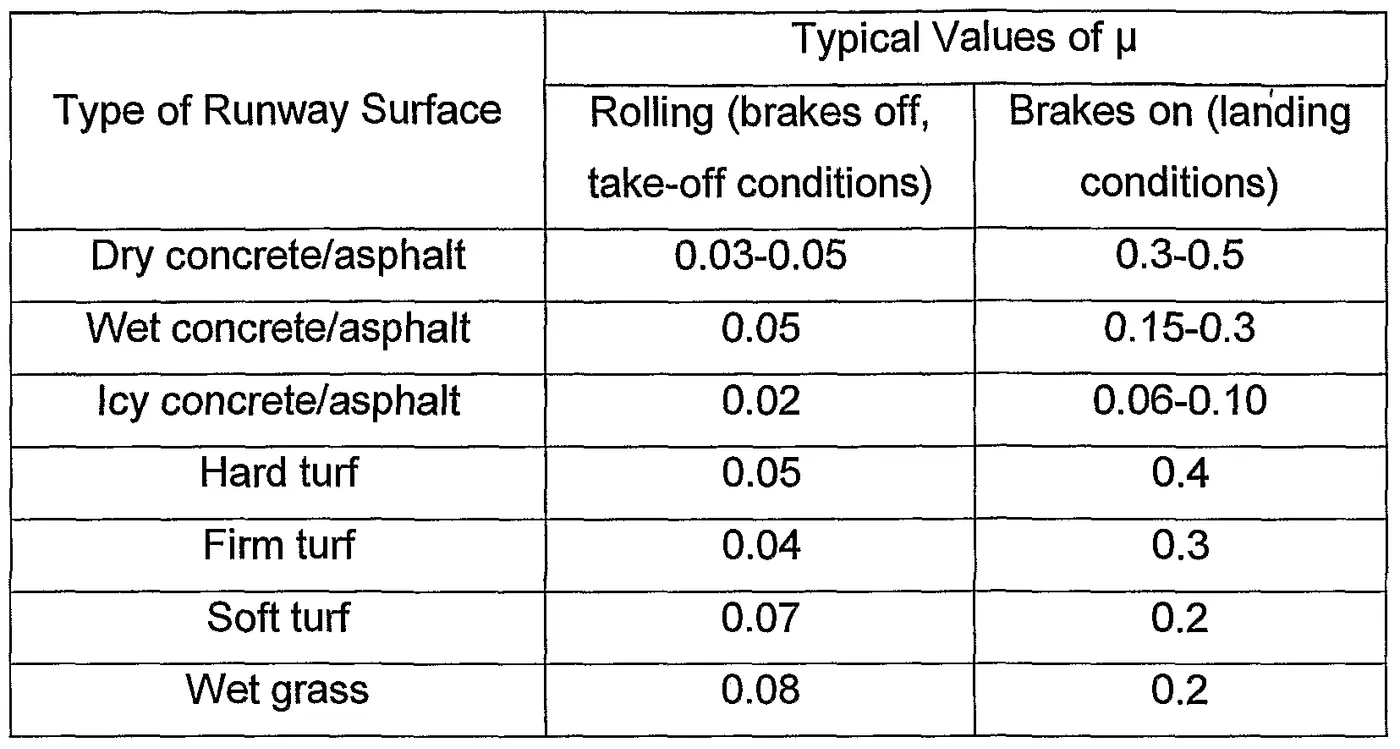
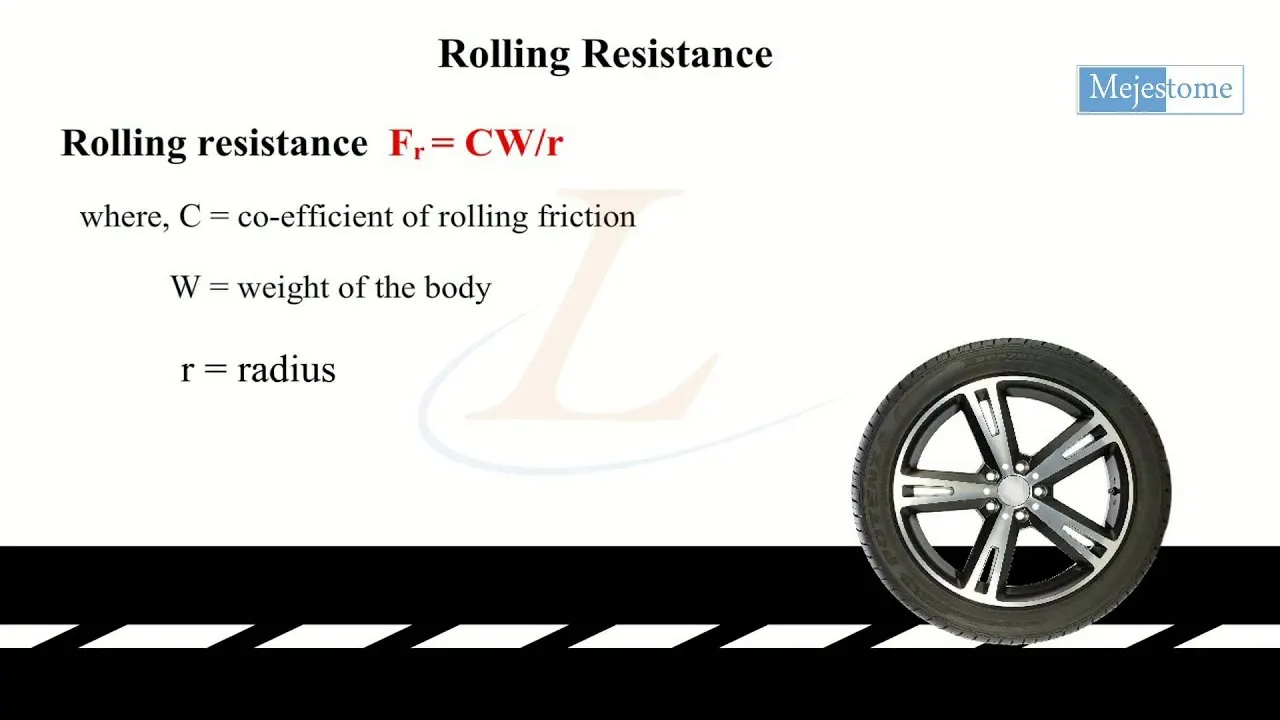
The force to move an airplane on an absolute flat runway with no wind at constant
low speed is equal to the rolling resistance between the plane and the tarmac. The
rolling resistance for the air plane can be calculated as,
Fr = c mr ag ..........(1)
where, Fr = Rolling resistance (N,lbf)
c = Rolling resistance coefficient
4] Tyre Pressure
What is tyre pressure and how it is measured?
Tyre inflation pressure depends on the amount of air that has been pumped
into the tyres. It is measured in pounds per square inch (psi), bar or kPa.
Vehicle manufacturer recommends the suitable pressure for the tyres. PSI is
the most common means of measuring tyre pressure in countries that use the
imperial system.
In order to ensure that the aircraft's tires are properly inflated, michelin
recommends ckecking the inflation pressure, with a calibrated gauge, before
the first flight of the day or before each flight if not flown daily.
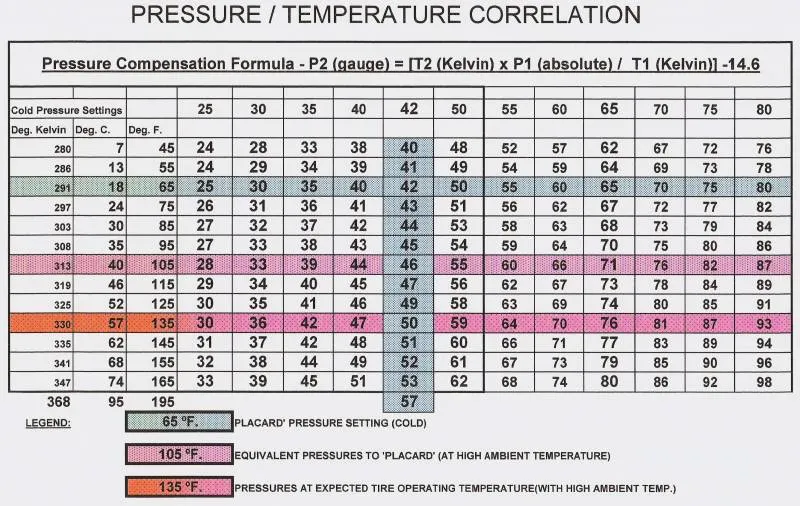
As aircraft tires operate at such high extremes of pressure, load, and speed
their care and service is critically important. The most important action an
operator can take to prevent tire-related events is to maintain proper tire
inflation pressure. Failures to keep aircraft tires properly inflated can lead
to very serious consequences. The most serius of these is the structural failure
of tire. If the tire operates underinflated or overdeflected/overloaded, the
nylon cords which form the structure of the tire go in and out of compression
as the tire rotates. This weakens the cords-much like paperclip which is bent
back and forth-until eventually the cords breaks. If enough cords break, the
entire structure will eventually fail.
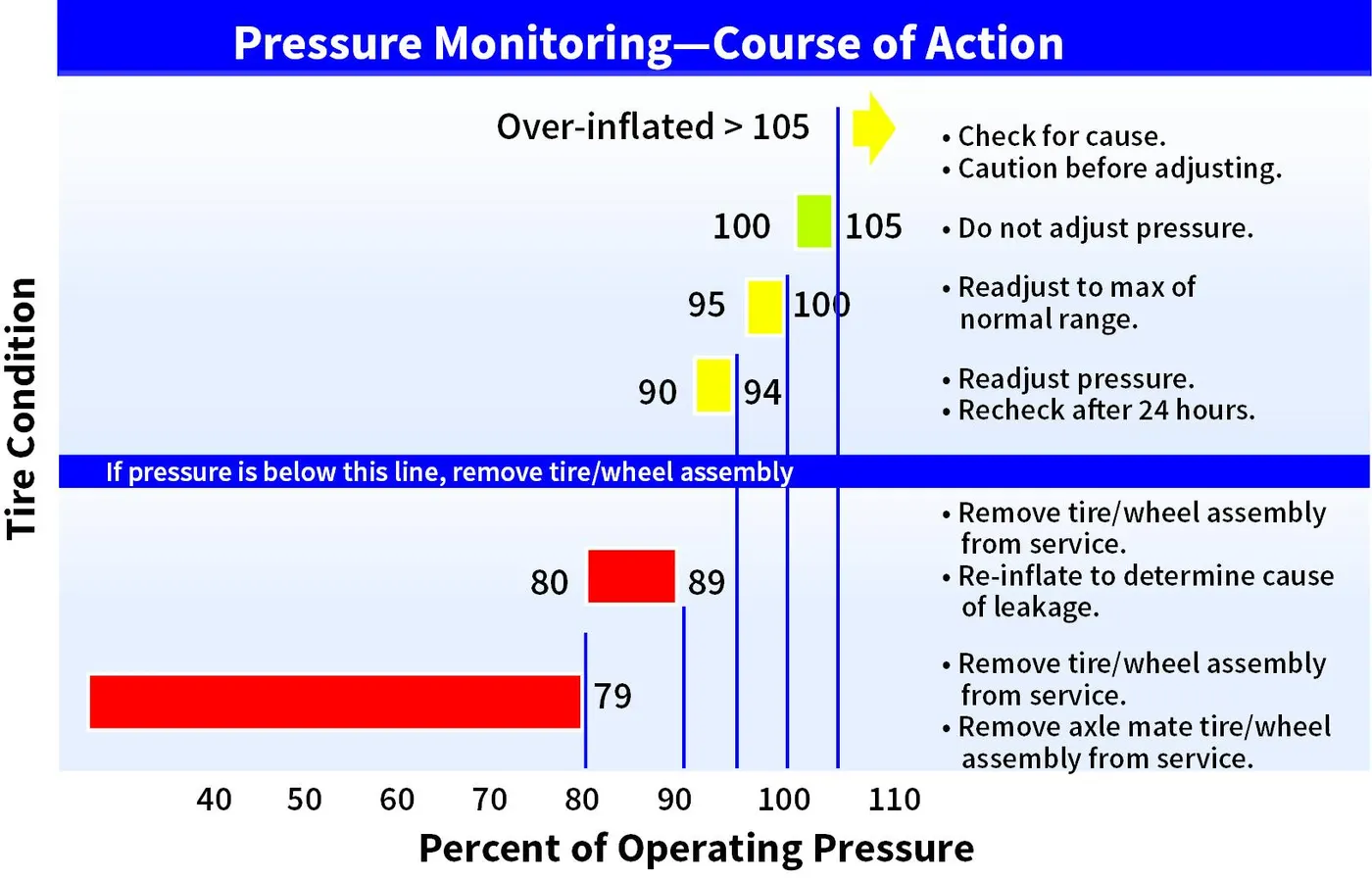
How can an operator know what the proper pressure is for their tires?
Aircraft tires are designed and tested to "rated" conditions. These rated
conditions are specified by industry standard's bodies like the Tire and Rim
Association (T&RA) and the European Tyre and Rim Technical Organisation
(ETRTO). However, most aircraft are not operated at the rated limits. This
means that an operator must consult the Aircraft's Maintainance Manual
(AMM) or Pilot Operating Handbook (POH) to find out the recommended
operating pressure range.
5] Brake forces when landing
Airplanes rely on a breaking system to safely land on runways. At cruising
altitude, most commercial airplanes fly at a speed of roughly 500 to 600
mph. When landing,however, they must reduce their speed. A typical 747,
for instance, has a landing speed of about 160 to 170 mph. And upon
touching the runway, airplanes must quickly brake until they come to a
complete stop. How do airplanes brake when landing exactly?
Wing Spoilers
Many airplanes use wing spoilers to assist with braking when landing. Not
to be confused with ailerons, spoilers are extendable flaps on the ends of an
airplane's wings. Pilots can raise the spoilers to decelerate the airplane as it
approaches the runway. And even while on the runway, pilots will typically
leave the wing spoilers raised. Raised wing spoilercreate a drag, which
essentially slows down the airplane so that it's able to break more quickly.
Disc Brakes
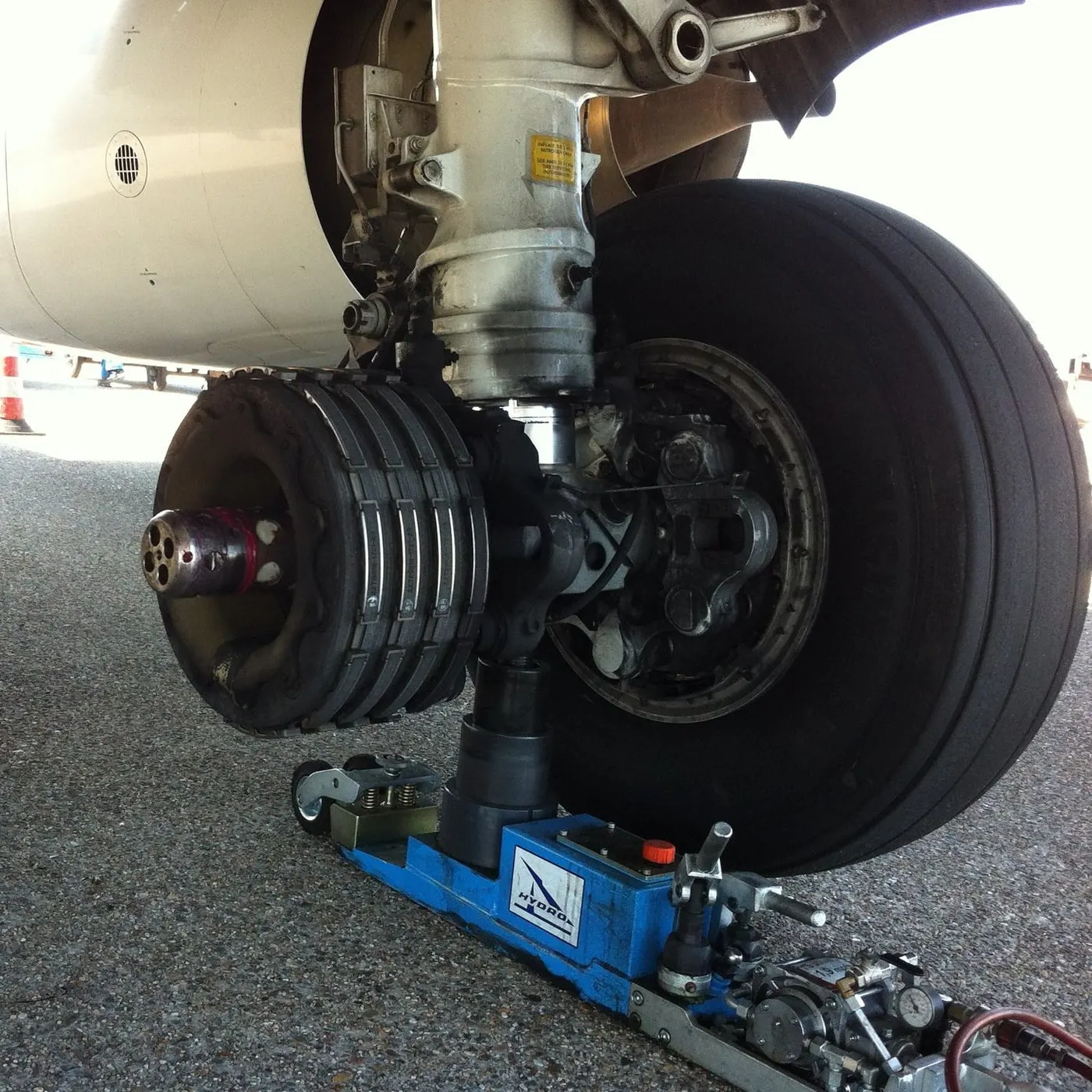
In addition to wing spoilers, airplanes use disc brakes. Airplane disc brakes are
similar to the braking system in automobiles. They consists of a pair of calipers
that, when engaged, squeeze pads against the rotors of the airplane's landing
gear.
Disc brakes are designed to remain static at all times. In other words, they
don't rotate with the wheels of an airplane's landing gear. As the wheels turn,
the disc brakes will remain static and stationary. They are a vital component
of an airplane's braking system because they are designed to apply pressure
to the airplane's wheels. Disc brakes will squeeze the wheels, thereby slowing
down the speed at which they spin. In turn, this reduces the speed of the
airplane so that it can come to a complete stop on the runway.
Reverse Thrust
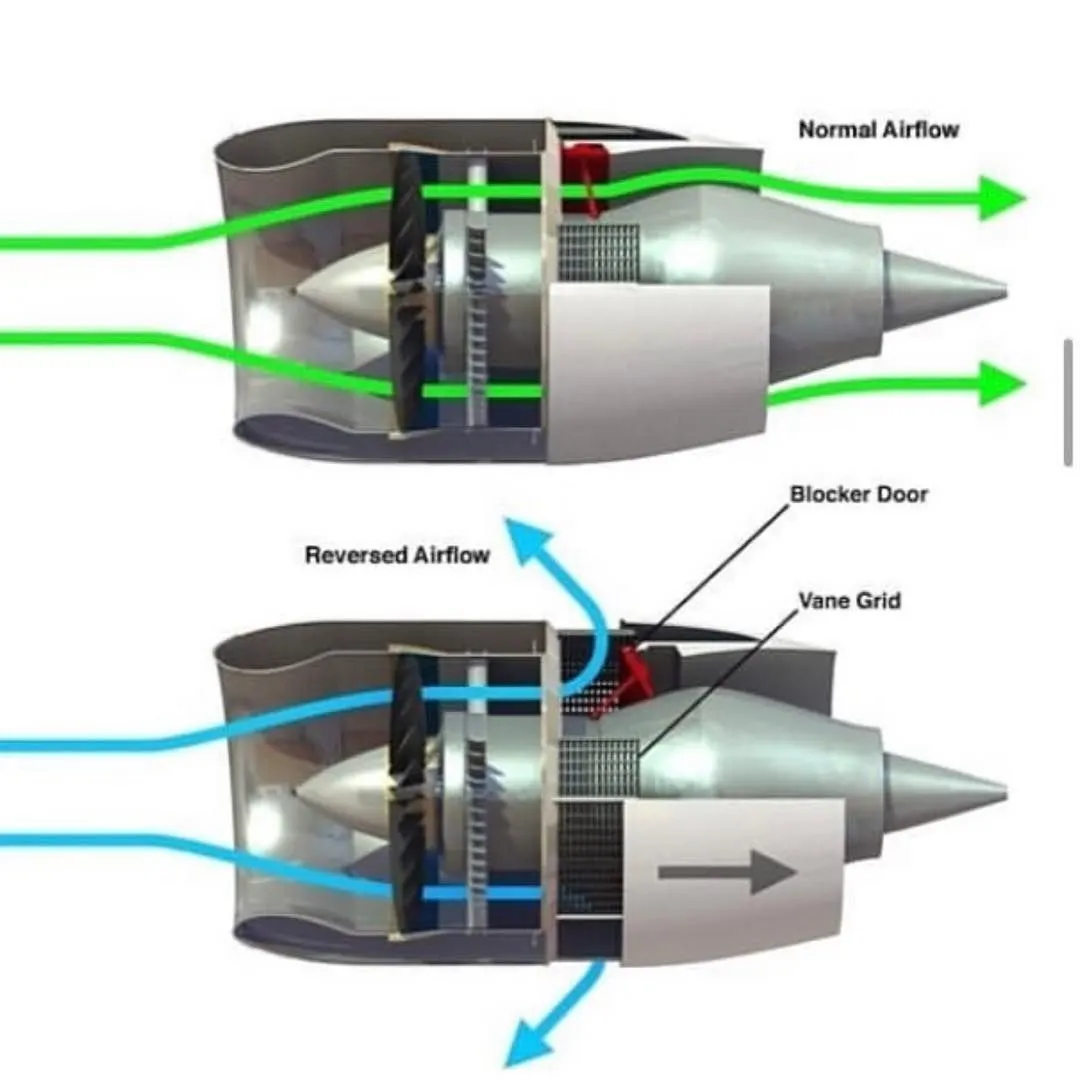
Finally, many jet airplanes use reverse thrust to assist with braking during
landings. Reverse Thrust is a feature in jet engine airplanes that, as the
name suggests, involves the reversal of the engines'thrust. When flying
the thrust is projected out the rear of an airplane's engines. When landing
however, pilots may use the reverse thrust features. Reverse thrust changes
the direction of the engine's thrust. Rather than projecting out the rear, the
thrust will be projected out the front. This reversal of thrust provides decele-
rations that allows airplanes to slow down more quickly when landing.
Part B:
6. A. With necessary assumptions, calculate the force and power required to
push / pull an aircraft by a towing vehicle.
Solutions:
For an assumption take an example of Airbus A380-800.
Here hill climbing force is not considered because it is not travelling on a slope
and gradient value is 0.
Rolling resistance force = Frr = μrr.mg
Air drag force = Fad = 1/2(ρ.Av^2.Cd)
Total tractive force = Fte = Frr + Fad
Total tractive power = Pte = Fte * v
m = total mass of the vehicle
μrr = Coefficient of rolling resistance
A = Frontal area
Cd = Drag coefficient
ρ = Air density
v = Velocity of the vehicle
The mass of the Airbus A380-800 is 575000kg
mass of truck is 1000kg
total mass = 575000+1000
= 576000kg
Coefficient of rolling resistance is 0.005
Drag coefficient is 0.6
Frontal area is 20m^2
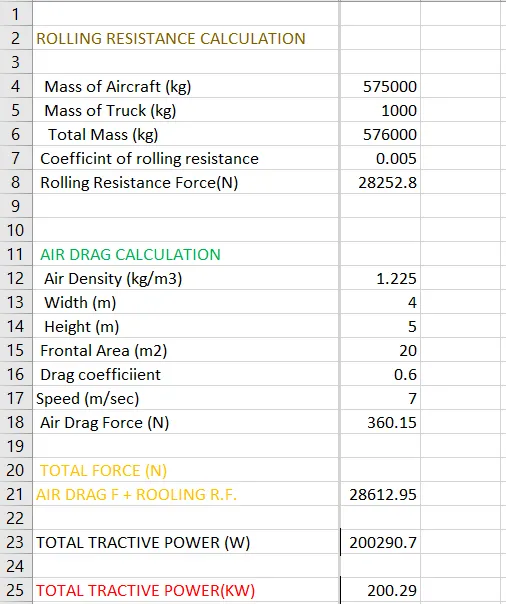
Rolling Resistance Force = Frr = μrr . mg
= 0.005 * 576000 * 9.81
Frr = 28252.8N
Air Drag Force = Fad = 1/2 (ρ * Av^2 * Cd)
Fad = (1/2)*1.225*20*(7^2)*0.6
Fad = 360.15N
Total Tractive Force = Fte = Frr + Fad
Fte = 28252.8 + 360.15
Fte = 28612.95N
Total Tractive Power = Pte = Fte * v
Pte = 28612.95 * 7
Pte = 200290.65 W
Total Tractive Power = Pte = 200.29KW
B] Develop the model for the calculated force and power using Simulink.
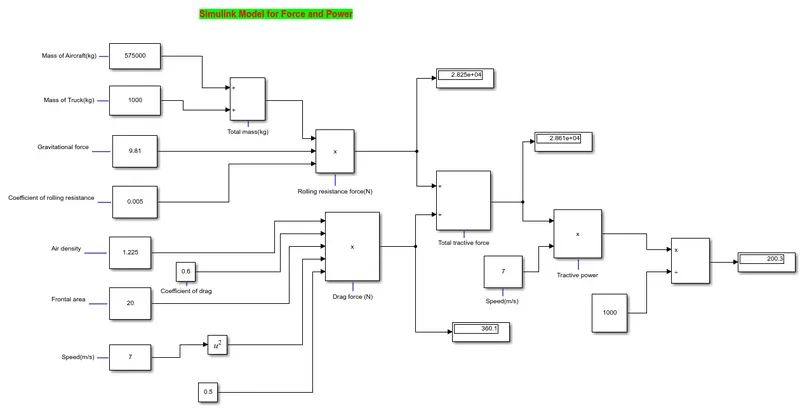
Simulink model for calculated force and power is shown below:
https://drive.google.com/file/d/1YrZEZMaxo7OLGjWj7iwuCP6zvwQRYGOk/view?usp=sharing
Blocks used:
1] Constant blocks - 11
2] Product blocks - 3
3] Divide block - 1
4] Square block - 1
5] Display blocks - 4
6] Add block - 2
Constant block - Values of Mass of aircraft, mass of truck, speed, coefficient of rolling
resistance, air density, gravitational force, Frontal area, etc are assigned in the constant
block.
Display block - Result of Frr, Fad , Fte and Pte is obtained in the display block.
Total mass is found using add block. Power is found using product block and divide
block.
7.A. Design an electric powertrain with type of motor, it’s power rating, and energy
requirement to fulfill aircraft towing application in Simulink. Estimate the duty cycle
range to control the aircraft speed from zero to highest. Make all required assumptions.
Prepare a table of assumed parameters. Draw a block diagram of powertrain.
(Hint :DC7 Block)
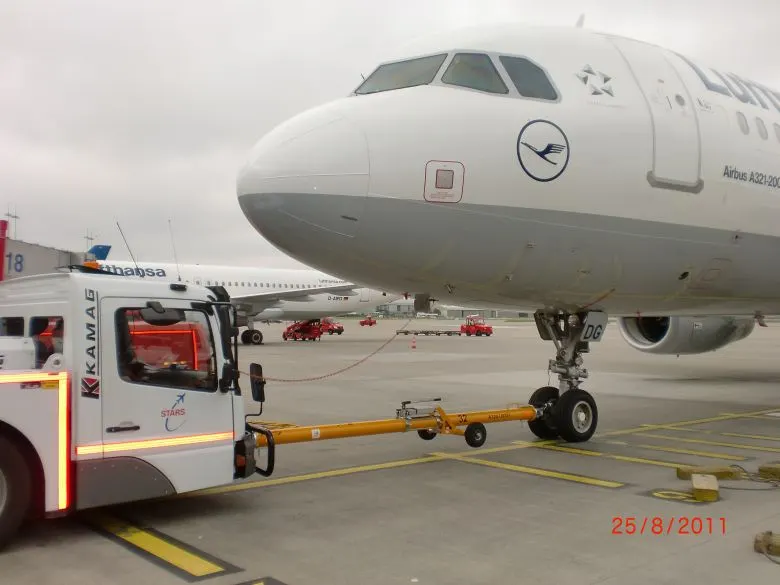
Answer:- What is an aircraft towing?
The forward movement of an aircraft, usually with engines off, using the power of
a specialised ground vehicle attached to a or supporting the nose landing gear.
It may occur for the movement of both in service aircraft.
In this simulink model for towing operation of an aircraft a Truck is used.
DC7 Block-
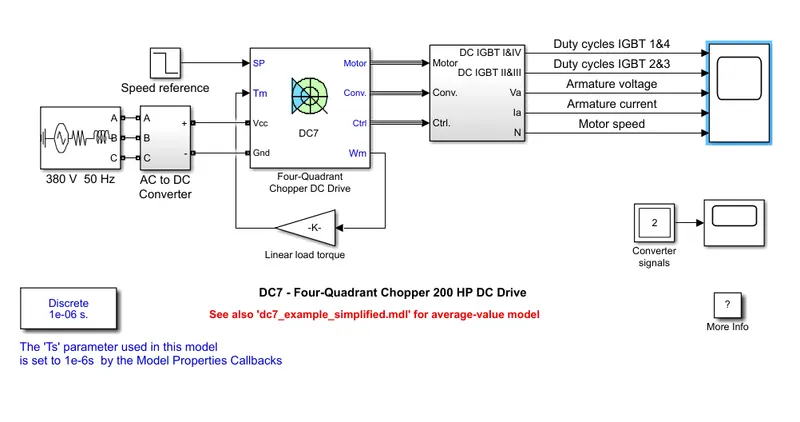
Design of an electric Powertrain for towing of an Aircraft in simulink:
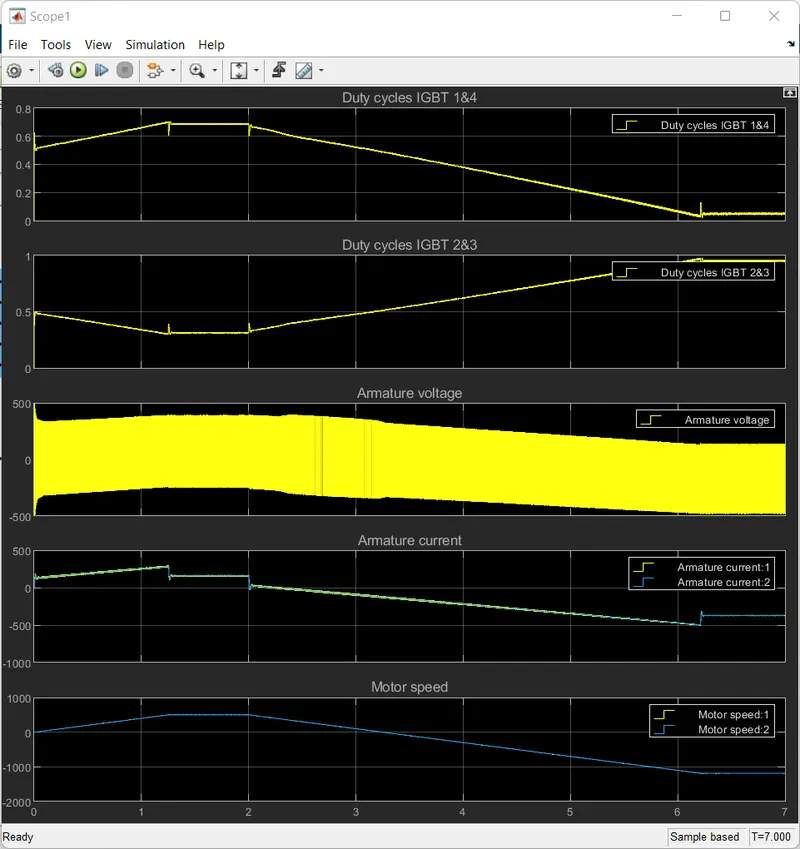
Output in Scope :
In the above simulink model of the powertrain, 200 HP DC motor is separately excited with a
constant 150 V DC field voltage source. The armature voltage is provided by an IGBT converter
controlled by two PI regulators. The converters is fed by a 515 V DC bus obtained by rectification
of a 380 V AC 50 Hz voltage source.
The 1st regulator is a speed regulators, followed by a current regulator. The speed regulator
outputs the armature current references (in p.u.) used by current controller in order to obtain
the electromagnetic torque needed to reach the desired speed. The current regulators controls
the armature current by computing the appropriate duty ratios of the 5Khz pulses of the four
IGBT devices (Pulse Width Modulation). For proper system behaviour, the instantaneous pulse
values of IGBT devices 1 and 4 are opposite to those of IGBT devices 2 and 3.
First of all before starting the simulation, set the initial bus voltage to 515 V via the GUI block .
on starting the simulation we can observe the motor armature voltage and current, the four
IGBT pulses and the motor speed in scope.
Output scope results;
1. As motor is coupled to linear load, it means that mechanical torque of the load is proportional
to speed.
2. The armature current follows the current reference very well, with fast response time and small
ripples.
3. At t=2sec, speed reference drops to -1184 rpm.
The current reference decrease to reduce the electromagnetic torque and cause the motor to
decelerate with the help of load torque.
4. At t=2.2sec, the current reverses in order to produce a braking elecromagnetic torque
(dynamic braking mode).
This causes the DC bus voltage to increase.
5. At t=3.25sec, the motor reaches 0 rpm and the load torque reverses and becomes '-ve'.
The -ve current now produces an accelerating electromagnetic torque to allow the motor
to follow the negative speed ramp (-400rpm/s).
6. At t=6.3sec, the speed reaches -1184rpm and stablilizes around its references.
Duty cycle calculations:
The required power is 200KW.
Let us assume, motor with input power of 230KW.
Duty cycle = Output power/Input power
= 200/230
Duty cycle (%) = 0.87
Table for a assumed parameters are shown below:
Mass of aircraft(kg) 575000
Mass of truck(kg) 1000
Coefficient of rolling resistance 0.005
Air Density (kg/m3) 1.225
Width(m) 4
Height(m) 5
Frontal area (m2) 20
Drag coefficient 0.6
Speed (m/s) 7
Block Diagram of a powertrain:-
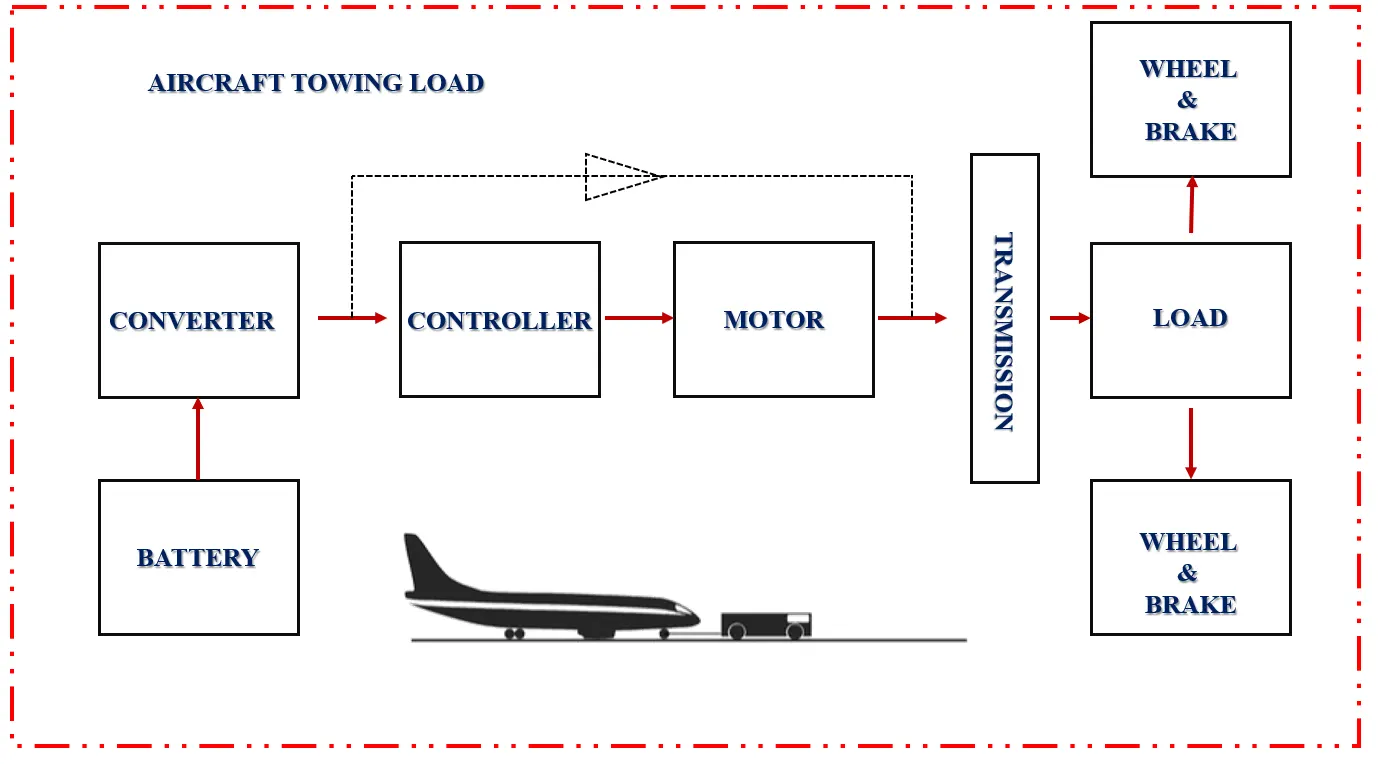
Main components of powertrain are Engine, Transmission and Driveshaft. Power
is generated by the engine and transmitted to the driveshaft . Other internal
parts and components of the engine, differential axles, emissions, control, exhaust,
engine cooling system, etc are also included in the powertrain.
B. Also, Design the parameters in excel sheet.