Project-1: Powertrain for aircraft in runways
EV-21 PROJECT - 1
1. Search and list out the total weight of various types of aircrafts.
Any vehicle that is built and made to fly in the air is called an aircraft. While the airplane is the most well-known, familiar, and popular type of aircraft that we know of, other aircraft that fly in the air also fall into this category.
They all have propellers and wings or machinery to move them through the air; however, they can vary according to size, type, usage, and more.
Before we get to know and study the different types of aircraft, let us understand how these aircraft are classified. In most general terms, there are two types of classifications for aircraft. One is lighter than the aircraft, known as aerostats, and the other is heavier than the aircraft, known as aerodynes. Aerostats (lighter than air): Aerostats are much lighter in weight than or airplanes.
These types of light aircraft typically use buoyancy, like ships, to help them float through the air. Low-density gas such as hydrogen, heliums, or hot air balloons is used to fill the aircraft. This low-density gas is lighter than air, & hence the name.
The most common types of aerostats known to us are hot air balloons & sky lanterns. Aerodyne (Heavier than Air): Alternatively, other aircraft, which are heavier than air or Aerodyne, as we understand it, is much greater in weight & size.
They push the gas or air downwards; Which reactions help in making the aircraft upwards? Since these move through motion in the air, they are called aerodyne. This dynamic lift through the air can happen mostly through mechanisms, as you may already know.
- There is a fixed-wing classification, just like aircraft. In this class of fixed-wing aircraft, the entire mechanism is relied upon to create airflow over all wings at forwarding speed.
- Another mechanism is the rotorcraft, which uses rotating rotors like wings. Helicopters are the most commonly known aircraft under this classification.
What is the maximum weight a plane can take off
-
As mentioned, the maximum weight that any aircraft can be at the time of takeoff is MTOW. This is calculated by taking OEW + Fuel + Passengers + Luggage – Fuel for taxi to runway = MTOW.
Airplanes
MTOW = Maximum take-off weight, MLW = Maximum landing weight, TOR = Take-off run (SL, ISA+15°, MTOW), LR = Landing run (SL, ISA+15°, MLW)
| Type | MTOW [kg] | MLW [tonnes] | TOR [m] | LR [m] | ICAO category | FAA category |
|---|---|---|---|---|---|---|
| Antonov An-225 | 640,000 | 591.7 | 3500 | Heavy | Super | |
| Scaled Composites Model 351 Stratolaunch | 589,670 | 3660 | Heavy | Super | ||
| Airbus A380-800[1][2][3] | 575,000 | 394 | 3100 | 1930 | Heavy | Super |
| Boeing 747-8F | 447,700 | 346.091 | 3100 | 1800 | Heavy | Heavy |
| Boeing 747-8 | 443,613 | 306.175 | 3100 | Heavy | Heavy | |
| Boeing 747-400ER | 412,770 | 295.742 | 3090 | Heavy | Heavy | |
| Antonov An-124-100M | 405,060 | 330 | 2520 | 900 | Heavy | Heavy |
| Boeing 747-400 | 396,900 | 295.742 | 3018 | 2179 | Heavy | Heavy |
| Lockheed C-5 Galaxy[4][5][6] | 381,000 | 288.417 | 2530 | 1494 | Heavy | Heavy |
| Boeing 747-200[7] | 377,840 | 285.700 | 3338 | 2109 | Heavy | Heavy |
| Boeing 747-300[7] | 377,840 | 260.320 | 3222 | 1905 | Heavy | Heavy |
| Airbus A340-500[8] | 371,950 | 240 | 3050 | 2010 | Heavy | Heavy |
| Airbus A340-600[8] | 367,400 | 256 | 3100 | 2100 | Heavy | Heavy |
| Boeing 777F | 347,800 | 260.816 | 2830 | Heavy | Heavy | |
| Boeing 777-300ER | 351,800 | 251.29 | 3100 | Heavy | Heavy | |
| Boeing 777-200LR | 347,450 | 223.168 | 3000 | Heavy | Heavy | |
| Boeing 747-100[7] | 340,200 | 265.300 | Heavy | Heavy | ||
| Airbus A350-1000 | 308,000 | 233.5 | Heavy | Heavy | ||
| Boeing 777-300 | 299,370 | 237.683 | 3380 | Heavy | Heavy | |
| Boeing 777-200ER | 297,550 | 213.00 | 3380 | 1550 | Heavy | Heavy |
| Airbus A340-300[8][9] | 276,700 | 190 | 3000 | 1926 | Heavy | Heavy |
| McDonnell Douglas MD-11 | 273,300 | 185 | 2990 | 1890 | Heavy | Heavy |
| Airbus A350-900 | 270,000 | 175 | 2670 | 1860 | Heavy | Heavy |
| Ilyushin Il-96M | 270,000 | 195.04 | 3115 | 2118 | Heavy | Heavy |
| McDonnell Douglas DC-10 | 256,280 | 183 | 2990 | 1890 | Heavy | Heavy |
| Boeing 787-9[10] | 254,000 | 192.777 | 2900 | Heavy | Heavy | |
| Boeing 787-10[10] | 254,000 | 201.849 | Heavy | Heavy | ||
| Airbus A340-200[8][11] | 253,500 | 181 | 2990 | Heavy | Heavy | |
| Airbus A330-900 | 251,000 | 191 | 3100 | Heavy | Heavy | |
| Ilyushin IL-96-300 | 250,000 | 175 | 2600 | 1980 | Heavy | Heavy |
| Airbus A330-300[12][13] | 242,000 | 185 | 2500 | 1750 | Heavy | Heavy |
| Airbus A330-200[12][13] | 242,000 | 180 | 2220 | 1750 | Heavy | Heavy |
| Lockheed L-1011-500 | 231,300 | 166.92 | 2636 | Heavy | Heavy | |
| Boeing 787-8[10] | 228,000 | 172.365 | 3300 | 1695 | Heavy | Heavy |
| Lockheed L-1011-200 | 211,400 | Heavy | Heavy | |||
| Ilyushin IL-86 | 208,000 | 175 | Heavy | Heavy | ||
| Boeing 767-400ER | 204,000 | 158.758 | 3414 | Heavy | Heavy | |
| Airbus A300-600R[14] | 192,000 | 140 | 2385 | 1555 | Heavy | Heavy |
| Boeing 767-300ER | 187,000 | 136.08 | 2713 | 1676 | Heavy | Heavy |
| Concorde | 185,000 | 111.1 | 3440 | 2220 | Heavy | Heavy |
| Airbus A300-600[14] | 163,000 | 138 | 2324 | 1536 | Heavy | Heavy |
| Boeing 767-300 | 159,000 | 136.078 | 2713 | 1676 | Heavy | Heavy |
| Airbus A310-300[14] | 157,000 | 124 | 2290 | 1490 | Heavy | Heavy |
| Vickers VC10 | 152,000 | 151.9 | Heavy | Heavy | ||
| Boeing 707-320B[15] | 151,000 | 97.5 | Heavy | Heavy | ||
| Boeing 707-320C[15] | 151,000 | 112.1 | Heavy | Heavy | ||
| Douglas DC-8-61 | 147,000 | Heavy | Heavy | |||
| Airbus A310-200[14] | 142,000 | 123 | 1860 | 1480 | Heavy | Heavy |
| Airbus A400M | 141,000 | 122 | 980 | 770 | Heavy | Heavy |
| Douglas DC-8-32 | 140,000 | Heavy | Heavy | |||
| Douglas DC-8-51 | 125,000 | Medium | Large | |||
| Boeing 757-300 | 124,000 | 101.6 | 2550 | 1750 | Medium | Large |
| Boeing 707-120B[15] | 117,000 | 86.3 | Medium | Large | ||
| Boeing 757-200 | 116,000 | 89.9 | 2347 | 1555 | Medium | Large |
| Boeing 720B[16] | 106,000 | 79.5 | Medium | Large | ||
| Boeing 720[16] | 104,000 | 79.5 | Medium | Large | ||
| Tupolev Tu-154M | 104,000 | 80 | Medium | Large | ||
| Tupolev Tu-204SM | 104,000 | 87.5 | 2250 | Medium | Large | |
| Convair 880 | 87,500 | Medium | Large | |||
| Boeing 737-900 | 85,000 | 66.36 | 2500 | 1704 | Medium | Large |
| Boeing 737-900ER | 85,000 | 71.35 | 2804 | 1829 | Medium | Large |
| Boeing 727-200 Advanced[17] | 84,000 | 70.1 | Medium | Large | ||
| Airbus A321-100[18] | 83,000 | 77.8 | 2200 | 1540 | Medium | Large |
| Boeing 737-800 | 79,000 | 65.32 | 2308 | 1634 | Medium | Large |
| Boeing 727-200[17] | 78,000 | 68.1 | Medium | Large | ||
| McDonnell-Douglas MD-83 | 73,000 | 63.28 | Medium | Large | ||
| Boeing 727-100[17] | 72,500 | 62.4 | Medium | Large | ||
| Boeing 727-100C[17] | 72,500 | 62.4 | Medium | Large | ||
| McDonnell-Douglas MD-90-30 | 71,000 | 64.41 | 2165 | 1520 | Medium | Large |
| de Havilland Comet 4 | 70,700 | Medium | Large | |||
| Boeing 737-700 | 70,000 | 58.06 | 1921 | 1415 | Medium | Large |
| Airbus A320-100[18] | 68,000 | 66 | 1955 | 1490 | Medium | Large |
| Boeing 737-400 | 68,000 | 54.9 | 2540 | 1540 | Medium | Large |
| de Havilland Comet 3 | 68,000 | Medium | Large | |||
| Boeing 377 | 67,000 | Medium | Large | |||
| Boeing 737-600 | 66,000 | 54.66 | 1796 | 1340 | Medium | Large |
| Airbus A220-300 | 65,000 | 57.61 | 1890 | 1494 | Medium | Large |
| Hawker Siddeley Trident 2E | 65,000 | Medium | Large | |||
| Airbus A319[18] | 64,000 | 62.5 | 1850 | 1470 | Medium | Large |
| Boeing 737-300 | 63,000 | 51.7 | 1939 | 1396 | Medium | Large |
| Boeing 737-500 | 60,000 | 49.9 | 1832 | 1360 | Medium | Large |
| Airbus A220-100 | 59,000 | 50.80 | 1463 | 1356 | Medium | Large |
| Airbus A318[18] | 59,000 | 57.5 | 1375 | 1340 | Medium | Large |
| Boeing 717-200HGW | 55,000 | 47.174 | 1950 | Medium | Large | |
| Douglas DC-7 | 55,000 | Medium | Large | |||
| de Havilland Comet 2 | 54,000 | Medium | Large | |||
| Boeing 717-200BGW | 50,000 | 46.265 | 1950 | Medium | Large | |
| de Havilland Comet 1 | 50,000 | Medium | Large | |||
| Douglas DC-6A | 48,600 | Medium | Large | |||
| Douglas DC-6B | 48,500 | Medium | Large | |||
| Embraer 190[19] | 48,000 | 43 | 2056 | 1323 | Medium | Large |
| Caravelle III | 46,000 | Medium | Large | |||
| Fokker 100 | 46,000 | 39.95 | 1621 | 1350 | Medium | Large |
| Douglas DC-6 | 44,000 | Medium | Large | |||
| Avro RJ-85 | 42,000 | 36.74 | Medium | Large | ||
| Handley Page Hermes | 39,000 | Medium | Large | |||
| Embraer 175[20] | 37,500 | 32.8 | 2244 | 1304 | Medium | Large |
| Bombardier CRJ900[21] | 36,500 | 33.345 | 1778 | 1596 | Medium | Large |
| Embraer 170[22] | 36,000 | 32.8 | 1644 | 1274 | Medium | Large |
| Bombardier CRJ700 | 33,000 | 30.39 | 1564 | 1478 | Medium | Large |
| Douglas DC-4 | 33,000 | Medium | Large | |||
| Vickers Viscount 800 | 30,400 | Medium | Large | |||
| Bombardier Q400 | 28,000 | 28.01 | 1219 | 1295 | Medium | Large |
| Bombardier CRJ200 | 23,000 | 21.319 | 1918 | 1479 | Medium | Large |
| ATR 72-600 | 22,800 | 22.35 | 1333 | 914 | Medium | Large |
| Saab 2000 | 22,800 | 21.5 | 1300 | Medium | Large | |
| Embraer ERJ 145 | 22,000 | 19.3 | 2270 | 1380 | Medium | Large |
| ATR 42-500 | 18,600 | 18.3 | 1165 | 1126 | Medium | Small |
| Saab 340 | 13,150 | 12.930 | 1300 | 1030 | Medium | Small |
| Embraer 120 Brasilia | 11,500 | 11.25 | 1560 | 1380 | Medium | Small |
| BAe Jetstream 41 | 10,890 | 10.570 | 1493 | 826 | Medium | Small |
| Learjet 75[23] | 9,752 | 8.709 | 1353 | 811 | Medium | Small |
| Pilatus PC-24[24] | 8,300 | 7.665 | 893 | 724 | Medium | Small |
| Embraer Phenom 300[25] | 8,150 | 7.65 | 956 | 677 | Medium | Small |
| Beechcraft 1900D | 7,765 | 7.605 | 1036 | 853 | Medium | Small |
| Cessna Citation CJ4[26] | 7,761 | 7.103 | 1039 | 896 | Medium | Small |
| de Havilland Hercules | 7,000 | Medium | Small | |||
| Embraer Phenom 100 | 4,800 | 4.43 | 975 | 741 | Light | Small |
Also called Manufacturer's Weight Empty (MWE) or Licensed Empty Weight
It is the weight of the aircraft "as built" and includes the weight of the structure, power plant, furnishings, installations, systems and other equipment that are considered an integral part of an aircraft.
This excludes any baggage, passengers, or usable fuel
ZERO FUEL WEIGHT :-
This is the total weight of the airplane and all its contents (including unusable fuel), but excluding the total weight of the usable fuel on board.
OPERATING EMPTY WEIGHT :-(Roughly equivalent to basic empty weight on light aircraft)
It is the basic weight of an aircraft including the crew, all fluids necessary for operation such as engine oil, engine coolant, water, unusable fuel and all operator items and equipment required for flight but excluding usable fuel and the payload
PAYLOAD :
It is the carrying capacity of an aircraft. It includes cargo, people, extra fuel. In the case of a commercial airliner, it may refer only to revenue-generating cargo or paying passengers.
As a flight progresses and fuel is consumed, the total weight of the airplane reduces, but the ZFW remains constant.
Maximum zero fuel weight (MZFW) is the maximum weight allowed before usable fuel and other specified usable agents (engine injection fluid, and other consumable propulsion agents) are loaded.
The different terms represent different weights or masses1. For each flight, the weights are taken into account for several reasons
A brief description about these is below:
MANUFACTURERS EMPTY WEIGHT : -
Also called Manufacturer's Weight Empty (MWE) or Licensed Empty Weight
It is the weight of the aircraft "as built" and includes the weight of the structure, power plant, furnishings, installations, systems and other equipment that are considered an integral part of an aircraft.
This excludes any baggage, passengers, or usable fuel
ZERO - FUEL WEIGHT : -
This is the total weight of the airplane and all its contents (including unusable fuel), but excluding the total weight of the usable fuel on board.
As a flight progresses and fuel is consumed, the total weight of the airplane reduces, but the ZFW remains constant.
Maximum zero fuel weight (MZFW) is the maximum weight allowed before usable fuel and other specified usable agents (engine injection fluid, and other consumable propulsion agents) are loaded
OPERATING EMPTY WEIGHT : -
(Roughly equivalent to basic empty weight on light aircraft)
It is the basic weight of an aircraft including the crew, all fluids necessary for operation such as engine oil, engine coolant, water, unusable fuel and all operator items and equipment required for flight but excluding usable fuel and the payload
PAYLOAD : -
It is the carrying capacity of an aircraft. It includes cargo, people, extra fuel. In the case of a commercial airliner, it may refer only to revenue-generating cargo or paying passengers
MAXIMUM TAKEOFF WEIGHT : -
This is the maximum weight at which the pilot of the aircraft is allowed to attempt to take off
REGULATED TAKEOFF WEIGHT : -
Depending on different factors (e.g. flap setting, altitude, air temperature, length of runway), RTOW or maximum permissible takeoff weight varies for each takeoff. It can never be higher than MTOW. More information
MAXIMUM LANDING WEIGHT : -
This maximum weight at which an aircraft is permitted to land3.
The following image depicts takeoff weight components.
MAXIMUM RAMP WEIGHT
also called maximum taxi weight (MTW)
It is the maximum weight authorized for maneuvering (taxiing or towing) an aircraft on the ground
AIR-CRAFT GROSS WEIGHT:-
It is the total aircraft weight at any moment during the flight or ground operation. This decreases during flight due to fuel and oil consumption.
Usable fuel is the fuel on board an aircraft that can actually be used by its engines. The small amount of fuel that cannot be drained from the tanks is the unusable fuel. For calculation of range, usable fuel is used. For weight and balance total fuel (usable + unusable) is used.
This restriction is due to structural, design or operational limitations.
2. Is there any difference between ground speed and air speed
AIR SPEED :-
It’s somewhat simpler than true airspeed. Indicated airspeed is measured via a pitot tube outside the aircraft, and shows up directly on an instrument in a cockpit. It takes into account static pressure as well as total pressure to determine dynamic pressure. When indicated airspeed is discussed in terms of knots, it is called KIAS
ilots become familiar with KAIS because it can help them to prevent a stall. If an airplane is flying too slowly for its performance limitations and atmospheric conditions, airflow over the wings will cease, and the pilot must recover.
Since pilots who are flying below supersonic speeds or transonic speeds use KIAS as a reference point most often, the majority of sport, commercial, and private aircraft are concerned with it. Pilots of non-military jets (and even military aircraft when flying below Mach 1) need to keep a close eye on their airspeed, so this applies to… all pilots.
GROUND SPEED :-
Ground speed, on the other hand, is the aircraft’s speed relative to the ground. One thing that should be noted here is that it’s its horizontal rather than vertical speed – an aircraft climbing completely vertically would have a ground speed of zero.
In other words, while airspeed is what determines whether there is enough airflow around an aircraft to make it fly, ground speed is what determines how fast an aircraft will get to its destination
-
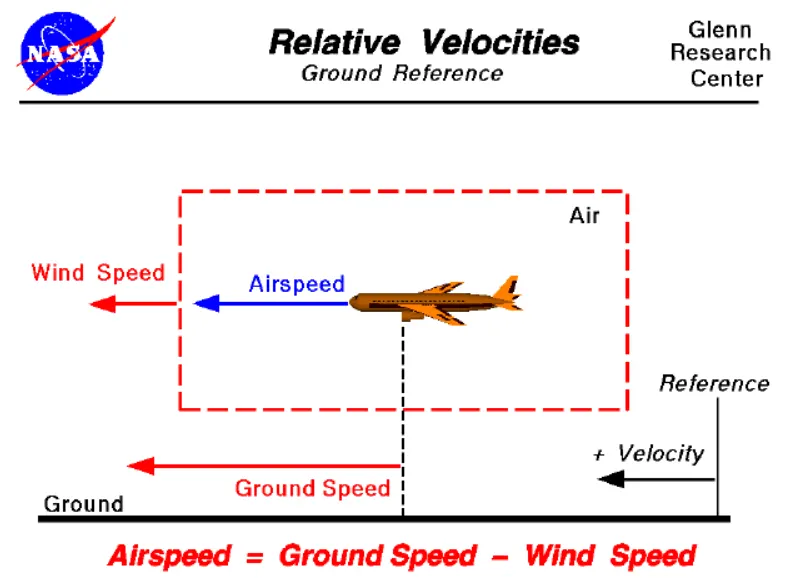
NASA explains: On a perfectly still day, the Air speed is equal to the ground speed . But if the wind is blowing in the same direction that the aircraft is moving, the air speed will be less than the ground speed air speed doesn't just affect airplanes.
-
Indicated airspeed is an airspeed that is calculated directly off an aircraft’s pitot-static system. It’s the calculated off the aircraft’s dynamic pressure – the difference between its total pressure and static pressure.
The dynamic pressure depends not only on the aircraft’s speed, but also on the density of the air it is flying in. As such, the higher the aircraft flies – and the lower the air density as a result – the bigger the difference between indicated and true airspeed is
-
Calibrated airspeed is indicated airspeed adjusted for a variety of errors.
Just as an example, one of the things it’s adjusted for is the flap position. The reason for that is that at different flap positions, air flows differently around the pitot-static system and affects the indicated airspeed readings.
True airspeed is, as has been mentioned numerous times in this article, the actual speed at which an aircraft is moving relative to the air it is traveling in. It’s calibrated airspeed adjusted for the the exact conditions (altitude, air temperature, etc.) that the aircraft is flying in
Yes there is difference between ground and air speed ground speed is how fast as an airplane shadow would move across the land if theres a strong wind pushing a aircraft that reflected in grund speed. Air speed , in contrast is how fast as an airplane is really flying strictly under its own power which is calculating the subtract the air speed from the ground speed on a perfectly still day the air speed is equal to the ground speed but if wind is blowing in the same direction that theaircraft is moving the air speed will be lessthan the ground speed
3. Why is it not recommended to use aircraft engine power to move it on the ground at Airport?
TOWING :-
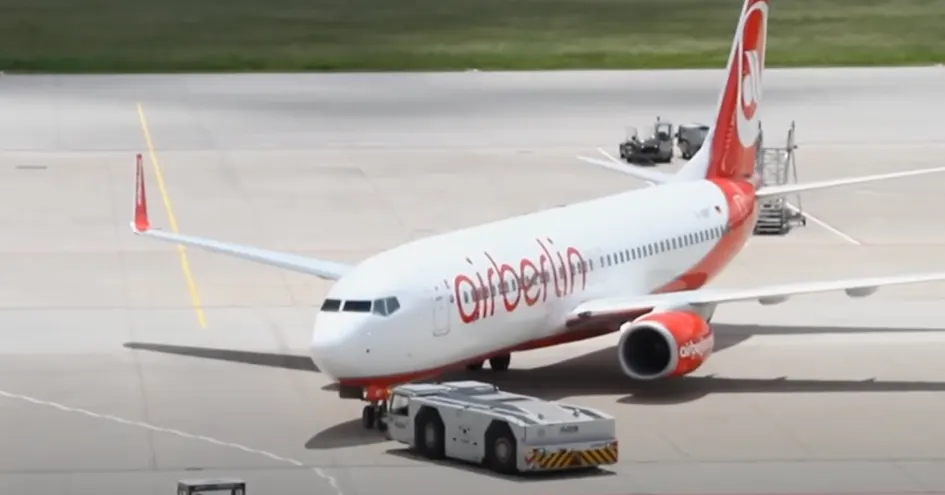
The forward movement of an aircraft usually with engines off, using the power of a specialised ground vehicle attached to or supporting the nose landing gear. It may occur for the movement of both in service and out of service aircraft
Tugs are used because aircraft don't back up very easily. Granted some planes have thrust reversers, but it's a lot of noise and exhaust near the terminal to use them. In many instances, such as a slow taxi, it's more efficient than using the aircrafts engines, which consume thousands of pounds of fuel per hour
Cars are expected to break down and are designed to be towed aircraft are maintained so that they don't need this and the airframes are not designed to be towed in the air, there is no towing point with enough strength other than that designed into the landing-gear for gentle low-speed towing on the ground.
Airplane tugs are used to put the plane into the hangar and to bring it out of the hangar when preparing for a flight. Whether you are operating a light plane or heavy, having the proper ground support equipment will make your life a lot easier.
The risks which may arise from the engine ground running relate to the potential for loss of control of the aircraft by those persons occupyingthe pilot seats in flight deck
Unwanted consequences from such static running are mainly related to those arising from the unintended movement of the aircraft during engine running - effectively a loss of control - especially during high power engine running. Damage can occur to the aircraft itself, other aircraft nearby or to airside structures
air craft move using their own engine power all the time on the airport apron and taxiways under their own power to go towards runways and after landing taxi to their assigned gate the only time they use external assistance is to pushback from the gate. Large turbofan air craft need help to reverse via a pushback tractor
-
When an aircraft is parked at the gate, it draws its power from the ground power units. It also takes at least 3 - 5 minutes to power up the engines. That is a lot of time in an over crowded airport like Mumbai — which has only one functional ru An aircraft engine has multiple functions.
TAXING : -
Taxiing, also sometimes written "taxying", is the movement of an aircraft on the ground, under its own power, in contrast to towing or push-back where the aircraft is moved by a tug. The aircraft usually moves on wheels, but the term also includes aircraft with skis or floats
Light aeroplanes may need to taxi right of the centreline to allow opposing direction aeroplanes to pass – aircraft should pass port to port (left to left). While taxiing, the aeroplane’s flight instruments (turn coordination, direction indication, compass, and artificial horizon) should be checked for serviceability
Taxiing is an important process for nearly all airplanes. From small and medium-sized airliners to large wide-body airliners, most airplanes require taxiing while on the runway. Before taking off and after landing, for example, airplanes must taxied. What is airplane taxiing exactly, and how does it work
Taxiing refers to the movement of an airplane while on the runway. At any given moment, there are 5,000 to 10,000 commercial airplanes in the skies over the United States. As these airplanes transport passengers to their intended destination, they must land at an airport. Airports, of course, only have a limited amount of runway space. Therefore, airplanes must be taxied off the runway after landing so that they won’t block or otherwise prevent other airplanes from using the same airport.
Taxiing is simply the process of moving an airplane while it’s on the runway. It occurs after an airplane has landed, and it occurs before an airplane takes off. Airplanes don’t actually fly while on the ground. As a result, the process by which they move on the runway isn’t known as flying; it’s known as taxiing.
There are different ways that airplanes can be taxied. Taxiing is most commonly performed using an airplane’s own propulsion system. For propulsion, most airplanes have either jet engines or propellers. Engaging the propulsion system allows airplanes to move while on the runway.
Some airplanes also have thrust reversers. Thrust reversers live up to their namesake by changing the direction of an airplane’s thrust. In jet-engine airplanes, thrust reversers can assist with taxiing. It essentially allows airplanes to back up while on the runway.
Pilots must still steer airplanes when taxiing them on. Steering is performed using the same control systems as flying an airplane. Pilots can turn the nose wheel or rudder to change the direction in which their airplanes travel while on the runway.
1. usage of high power mounted engines have high risk of blasting
2. usage of low power mounted engines have a risk of impurities on the ground may enter inside the engine
3. high fuel cost since aeroplanes usage large amount of power
4. How an aircraft is pushed to runway when its ready to take off?
Airplanes have engines, and they can use them to move forward along the ground. So they push themselves to the runway.
It is true that most of the time, a small vehicle is needed to push the larger commercial airplanes backwards away from the terminal building, because even if a plane can reverse it’s thrust, it’s not always safe to hit the buildings with that reverse thrust. So the little trucks push the bigger planes back away from the buildings, but after that, the planes can apply a small amount of engine power to roll forward just as all airplanes can.
- The pilot parks the aircraft in exactly the right place. Usually with the help of an automatic system, but occasionally guided by a marshaller waving two paddles or wands. Dozens of handling personnel are already standing by to perform a whole range of tasks simultaneously.
- As soon as the aircraft is stationary and the engines are switched off, the first priority is to disembark the passengers as quickly as possible. The apron handler places chocks in front of the wheels and connects the ground power. Meanwhile, the passenger bridge manoeuvres up to the door and a belt loader rolls up to the cargo hold. Luggage is unloaded and transferred to the terminal on baggage carts.
- Refuelling begins, usually from a hydrant at the stand. A hose is attached to this from a special vehicle called a dispenser, with the other side connected to the fuel tank in the wing. Read more about refuelling here.
- Now it is time to service the aircraft. The caterer loads new meals and takes away the food waste and used cutlery and crockery. Other activities include draining the lavatories, replacing the headrest covers, removing rubbish and distributing fresh blankets and in-flight magazine.
- A specialist team – or sometimes the crew themselves – cleans the cabin so that the new passengers board a pristine aircraft.
- Meanwhile, specialists from the airline conduct a technical check to make sure that the engines, wings, control surfaces, landing gear, instruments, doors and other equipment are in full working order.
- The aircraft is now ready for baggage to be loaded for the next flight. This is a quick process, on average taking only 10-15 minutes. A little later the passengers start boarding. As soon as they are all in their seats, the door is closed and the pilot informs air-traffic control that the flight is ready for departure.
- The apron handler removes the chocks. A so-called pushback truck reverses the aircraft into taxiing position, pushing it with a towbar attached to the nose-wheel strut. Or, in the most modern versions, by actually lifting the wheel. That speeds up coupling and decoupling.
- The aircraft taxis to the runway to depart at the agreed time.
- The pilot waits for permission to take off from air-traffic control. This is possible once the departure route is clear. As soon as the go-ahead is received, the plane takes to the air at full power
5. Learn about take off power, tyre design, rolling resistance, tyre pressure, brake forces when landing
Takeoff is the phase of flight in which an aircraft goes through transition from moving along ground to flying in the air For balloons, helicopters and some specialized fixed-wing aircraft (VTOL aircraft such as the Harrier), no runway is needed. Takeoff is the opposite of landing.
Even before a plane makes it to those basic stages of engaging lift and thrust to beat the forces of gravity, however, it must first go through numerous preparatory pre-takeoff procedures. Among the things that happen to a plane before it is boarded and ready for takeoff include:
Landing is the last part of a flight , where a flying air craft or spacecraft returns to the ground. When the flying object returns to water, the process is called alighting, although it is commonly called "landing" and "touchdown" as well. A normal aircraft flight would include several parts of flight including taxi , takeoff , climb , cruise , descent and landing.
While the processes regarding lift and how planes stay in the air in the first place via lift is a well-worn subject, it’s worth reexamining briefly.
Planes fly by generating enough force to resist the forces of gravity, and they are able to do that by redirecting air in such a way as to ensure that the air is directed in such a way as to have enough pushing the plane up and forward.
Planes are able to do that in a variety of different ways, with the most important tools in their flight toolbox being shape of the wings and the capability of the engines
Wings must be shaped in such a way to allow air to pass over it and strike the underside of the wings just right at takeoff. In addition, the engines need to provide enough thrust so that, when paired with the upward push of lift, they lift off the ground
TYRE DESIGN : -
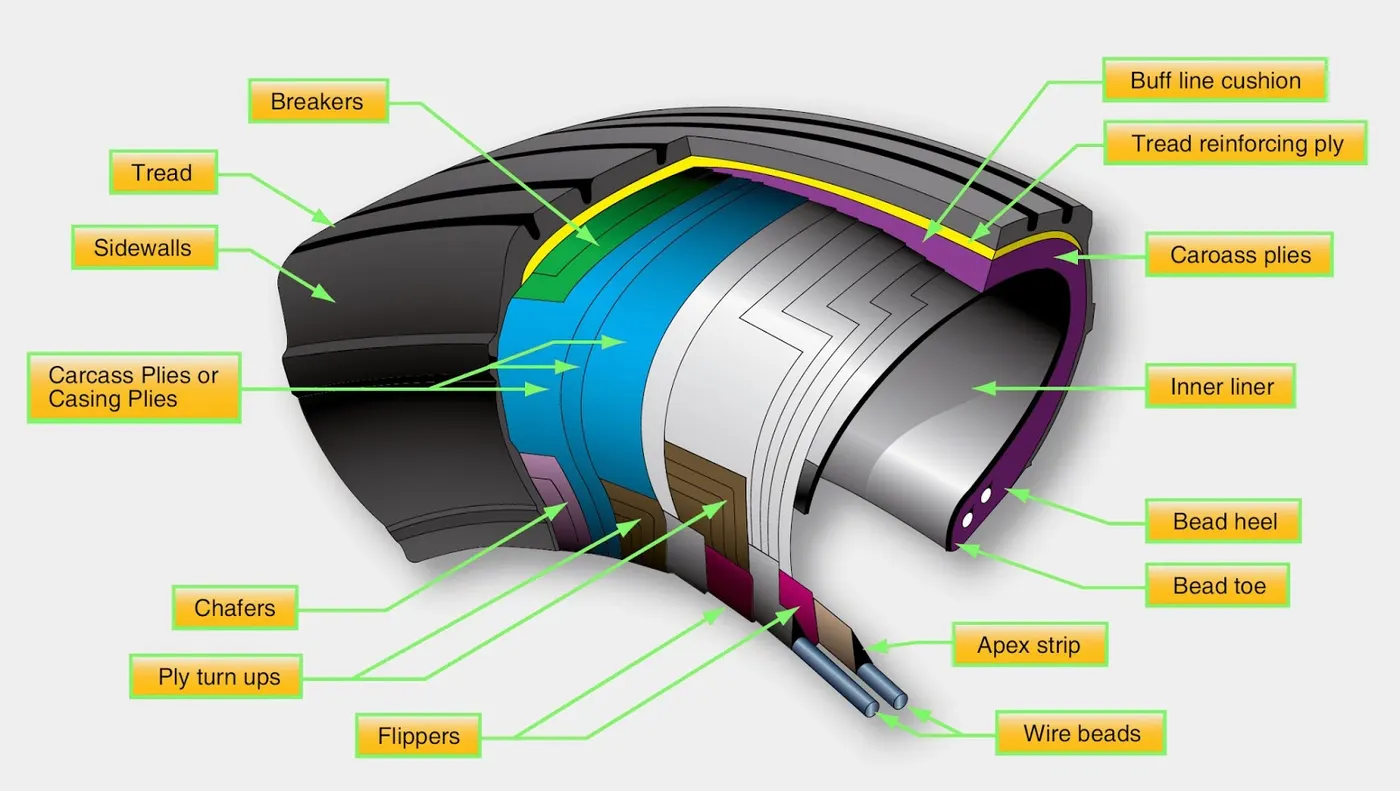
An essential part of aircraft tire design finet element method technology is utilized to predict tire component stress-strain and heat generation characteristics. The tire structure to be analyzed is divided into finite elements, normally triangular or quadrangular
An aircraft tyre is designed to withstand extremely heavy loads for short durations The number of tires required for aircraft increases with the weight of the aircraft, as the weight of the airplane needs to be distributed more evenly. Aircraft tire tread patterns are designed to facilitate stability in high crosswind conditions, to channel water away to prevent hydroplanig, and for braking effect.
Aircraft tires also include fusible plugs (which are assembled on the inside of the wheels), designed to melt at a certain temperature. Tires often overheat if maximum braking is applied during an aborted takeoff or an emergency landing . The fuses provide a safer failure mode that prevents tire explosions by deflating in a controlled manner, thus minimizing damage to aircraft and objects in the surrounding environment
Aircraft tires can easily be taken for granted. Their simplistic appearance may lead some to a false feeling of complacency. Many technicians are not aware of the critical design factors that go into every aircraft tire in use today. Seemingly minor flaws can lead to disastrous results, and inadequate maintenance practices can cause shortened tire life and even cause unsafe operating conditions.
When one considers the forces that aircraft tires endure, it seems amazing that engineers were ever able to develop these special products. Some tires are subjected to speeds as fast as a race car while at the same time supporting more weight than the largest land moving machines. They go through cyclic exposure to varying temperatures and pressures. These factors make aircraft tire design a critical process and tire maintenance an ever important step in safe aircraft operation.
Tire Design
Designing aircraft tires is a very intense undertaking. Once an aircraft manufacturer goes to the tire manufacturer with the size and weight requirements, the tire manufacturer begins the process of designing a tire that meets the needs of the aircraft manufacturer as well as all regulatory requirements — including foreign regulations in many cases.
Engineers are challenged with designing tires with cool running, heat-resistant materials while simultaneously exceeding tire service requirements. Tire prototypes are put through rigorous tests that simulate cycles of landings, take-offs, and taxi operations. It is only after the tires pass all mandatory tests and meet the requirements of the aircraft manufacturer and airworthiness authorities that the tires are put into production.
Two types of tires are used in aircraft applications — bias-ply tires and radial tires. Although both types of tires share some similarities in design, there are differences that need to be noted
ROLLING RESISTANCE : -
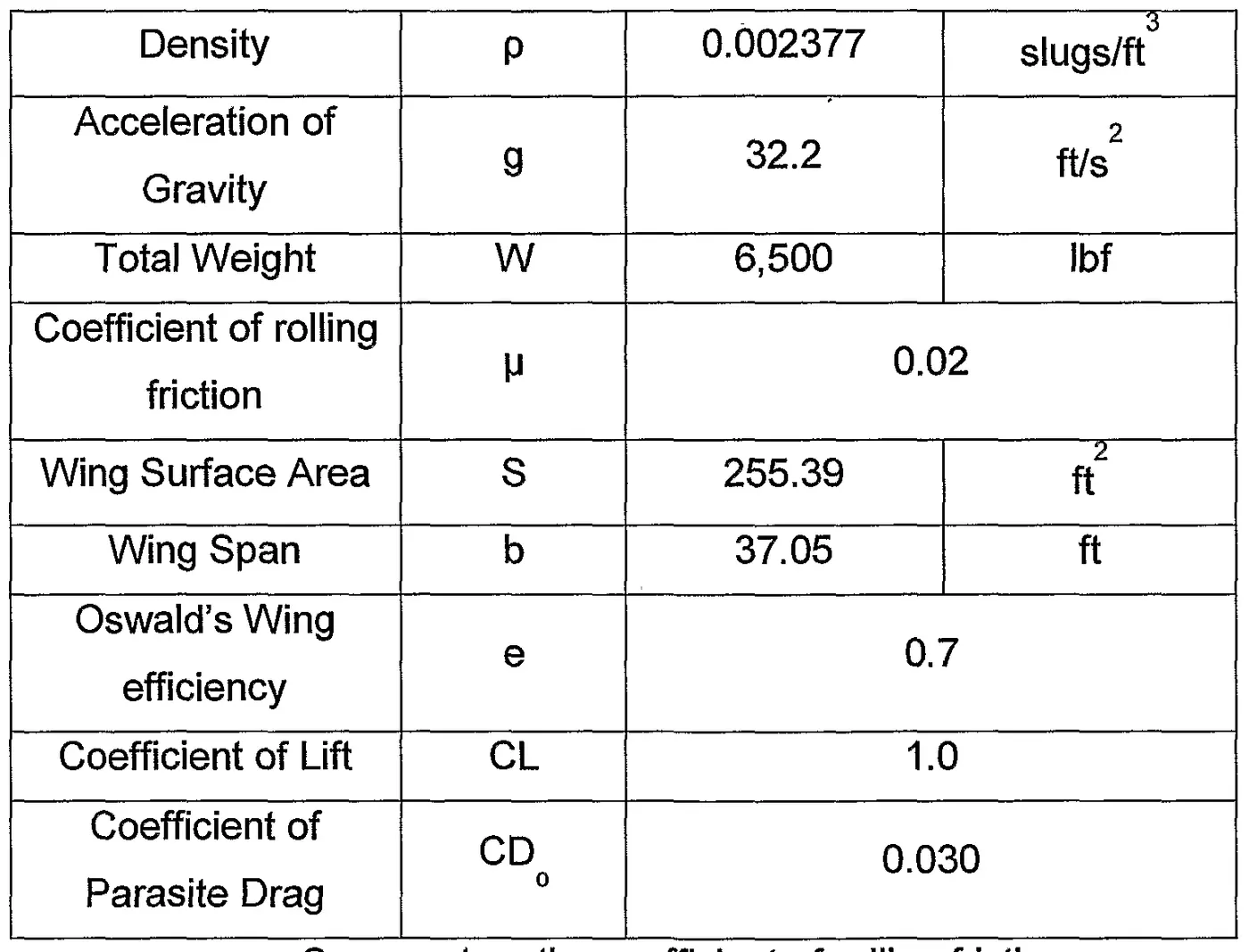
- The rolling resistance for the air plane can be calculated as Fr = c mr ag (1) where Fr = rolling resistance (N, lbf) c = rolling resistance coefficient
- Rolling resistance , sometimes called rolling friction or rolling drag, is the force resisting the motion when a body (such as a tire or wheel ) rolls on a surface. It is mainly caused by non elastic effects; that is, not all the energy needed for deformation (or movement) of the wheel, roadbed, etc., is recovered when the pressure is removed. Two forms of this are hysterisis losses , and permanent plastic deformation of the object or the surface (e.g. soil). Note that the slippage between the wheel and the surface also results in energy dissipation. Although some researchers have included this term in rolling resistance, some suggest that this dissipation term should be treated separately from rolling resistance because it is due to the applied torque to the wheel and the resultant slip between the wheel and ground, which is called slip loss or slip frequency ] In addition, only the so-called slip resistance involves friction , therefore the name "rolling friction" is to an extent a misnomer
TYRE PRESSURE :-
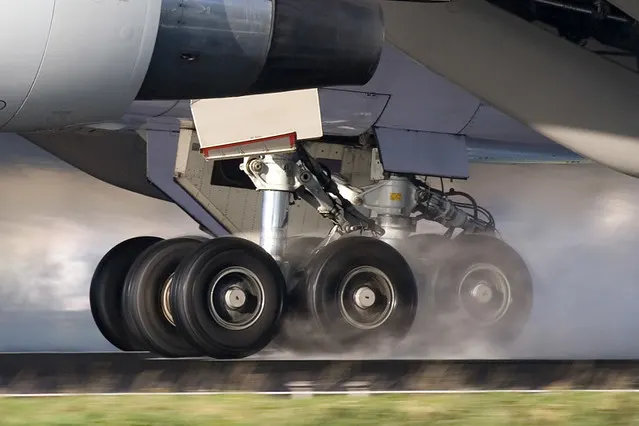
Airplane tires are pressurized to around 200 PSI with nitrogen which can handle heavier weights. 9. What is the size of a tire on a small private airplane? Smaller aircraft, like a single-engine Cessna 172, would have a much smaller tire size than a commercial airliner. A typical tire size for a small airplane would be 5 x 6 x 8
Tests of airliner aircraft tires have shown that they are able to sustain pressures of maximum 800 psi (55 bar; 5,500 kPa) before bursting. During the tests the tires have to be filled with water, to prevent the test room being blown apart by the energy that would be released by a gas when the tire burst
BRAKE FORCES :-
- Finally, many jet airplanes use reverse thrust to assist with braking during landings. Reverse thrust is a feature in jet engine airplanes that, as the name suggests, involves the reversal of the engines’ thrust. When flying, the thrust is projected out the rear of an airplane’s engines.
- Airplanes rely on a braking system to safely land on runways. At cruising altitude, most commercial airplanes fly at a speed of roughly 500 to 600 mph. When landing, however, they must reduce their speed. A typical 747, for instance, has a landing speed of about 160 to 170 mph. And upon touching the runway, airplanes must quickly brake until they come to a complete stop. How do airplanes brake when landing exactly
-
Wing Spoilers
Many airplanes use wing spoilers to assist with braking when landing. Not to be confused with ailerons, spoilers are extendable flaps on the ends of an airplane’s wings. Pilots can raise the spoilers to decelerate the airplane as it approaches the runway. And even while on the runway, pilots will typically leave the wing spoilers raised. Raised wing spoilers create drag, which essentially slows down the airplane so that it’s able to brake more quickly.
Disc Brakes
In addition to wing spoilers, airplanes use disc brakes. Airplane disc brakes are similar to the braking system in automobiles. They consist of a pair of calipers that, when engaged, squeeze pads against the rotors of an airplane’s landing gear.
Disc brakes are designed to remain static at all times. In other words, they don’t rotate with the wheels of an airplane’s landing gear. As the wheels turn, the disc brakes will remain static and stationary. They are a vital component of an airplane’s braking system because they are designed to apply pressure to the airplane’s wheels. Disc brakes will squeeze the wheels, thereby slowing down the speed at which they spin. In turn, this reduces the speed of the airplane so that it can come to a complete stop on the runway.
Reverse Thrust
Finally, many jet airplanes use reverse thrust to assist with braking during landings. Reverse thrust is a feature in jet engine airplanes that, as the name suggests, involves the reversal of the engines’ thrust. When flying, the thrust is projected out the rear of an airplane’s engines. When landing, however, pilots may use the reverse thrust feature. Reverse thrust changes the direction of the engines’ thrust. Rather than projecting out the rear, the thrust will be projected out the front. This reversal of thrust provides deceleration that allows airplanes to slow down more quickly when landing.
7. A. Design an electric powertrain with type of motor, it’s power rating, and energy requirement to fulfill aircraft towing application in Simulink. Estimate the duty cycle range to control the aircraft speed from zero to highest. Make all required assumptions. Prepare a table of assumed parameters. Draw a block diagram of powertrain.
(Hint :DC7 Block)
block diagram of powertrain
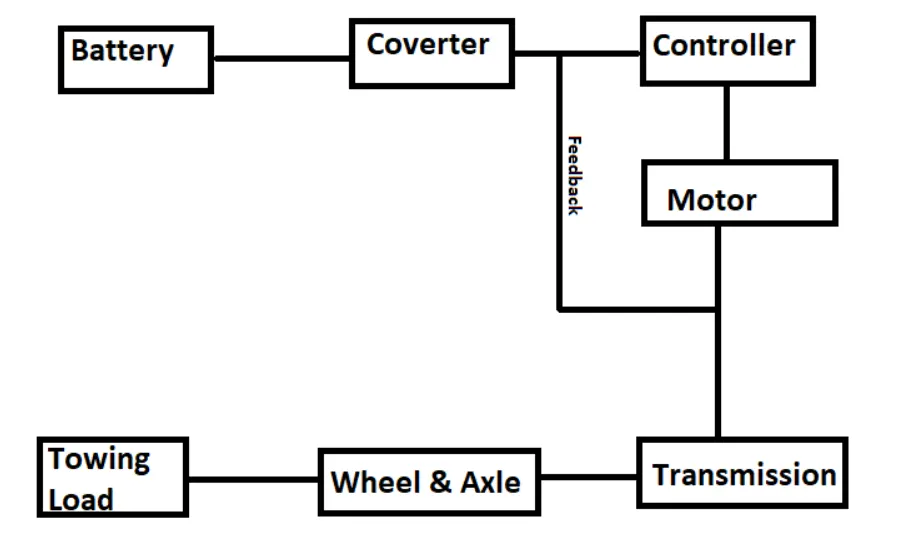
power rating and energy requirement to fullfill the aircraft towing application : -
From the forces acting on the vehicle we calculated the power required the vehicle
the power required to propell the vehicle is 23.30kw
this power is the output power of the motor in order to select the power rating of the machine we need to consider the efficiency accept
because the machine consists the different types of losses
we know that
input power = output power + losses in machine
efficiency(n) = output power / input power
let us assume the machine efficiency is 77% then the input power calculated as
= 23.305 / 0.77
= 30.266kw
Duty cycle range to control the aircraft speed from zero to highest block diagram of powertrain
To operate the machine at high speed it needs max power and the duty cycle will be
duty cycle = output / input power
= 30.266 / 23.305
= 0.77%
Here i assumed the air craft parameters
Rolling resistance calculation
weight of the aircraft
24500kg
mass of towing vehicle
7700kg
total mass
32200kg
co-efficient of rolling resistance
0.013
acceleration due to gravity (G)
9.8 m/s^2
Rolling Resistance force (N) = m.g.u
4102.28 N
aero drag force calculation
air density (kg/m^3)
1.25
velocity of the vehicle (m/sec)
5.54 m/sec
frontal area (A)
10
drag coefficient Cd
0.545
aero drag force = 1/2 p A Cd v^2
104.5433
total force (N) = Rolling resistance + aero drag force
4206.823
power required P = F*V
23.3058 KW
Motor power = 23.30 kw
input power = 30kw
duty cycle = output/input *100
23.305/30 * 100
= 77.68%
Powertrain model desined in simulink
the below model represents the simple powertrain model for aircraft on the runway in general the powertrain consists of battery source ,motor ,motor controller
this model consists of battery ,four quadrant chopper dc drive the main purpose of the dc drive is it consists the controller also
the dc7 model is reference for the powertrain for aircraft on runway
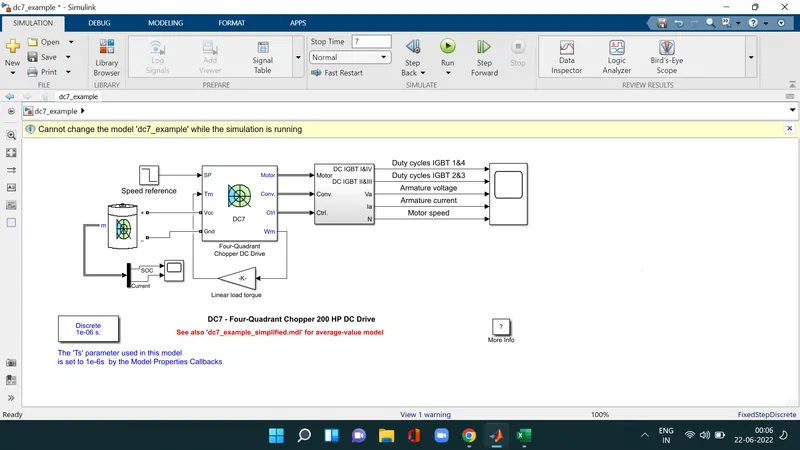
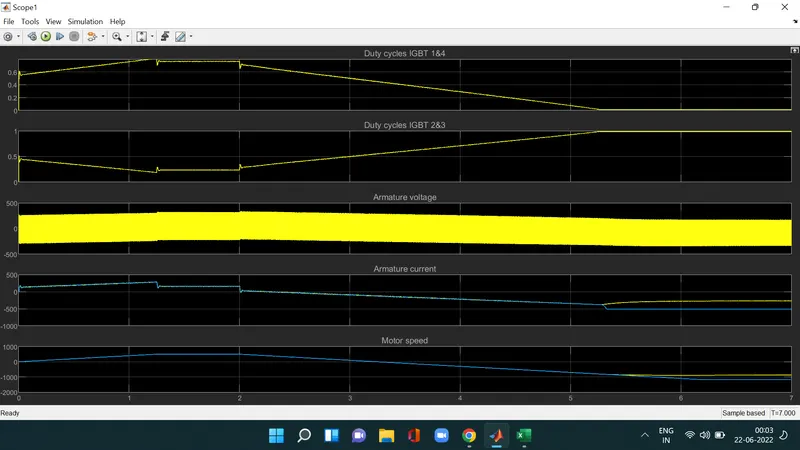
the plots consists of duty cycle of igbt switches
armature voltage of the motor ,armature current , motor speed and torque