Project-1: Powertrain for aircraft in runways
Student of EV LIVE BATCH 16
PART A:
Solution for Question 1:
List of the total weight of various types of aircrafts
MTOW = Maximum take off weight
MLW = Maximum landing weight
| Type | MTOW [Kg] | MLW [tonnes] |
| Antonov An-225 | 640,000 | 591.7 |
| Airbus A350-1000 | 308,000 | 233.5 |
| Airbus A380-800 | 575,500 | 394 |
| Boeing 747-8F | 447,700 | 346.091 |
| Boeing 747-8 | 443,613 | 306.175 |
| Boeing 747-400ER | 412,770 | 295.742 |
| Antonov An-124-100M | 405,060 | 330 |
| Boeing 747-100M | 396,900 | 295.742 |
| Lockheed C-5 Galaxy | 381,000 | 288.417 |
Solution for Question 2:
Difference between ground speed and air speed
- Airspeed is the vector differnce between the ground and the wind speed.
- Air speed = Ground speed - Wind speed
- On a perfectly still day, the airspeed is equal to the ground speed.
- But if the wind is blowing in the same direction that the aircraft is moving, the airspeed will be less than the ground speed.
Solution for Question 3:
Why is it not recommended to use aircraft engine power to move it on the ground at Airport
- Effectively a loss of control can happen,especially during high power engine running.Damage can occur to the aircraft itself,other aircraft nearby may get damaged.
- There is a risk of injury to the ground support personnel who may be in relatively stand close to the aircraft.
- it is easier for truck driver to see the surroundings better than the pilot sitting in the cockpit with a small window.
- The plane engines are very loud.When more than one aircraft will add up their sound , then it will not be pleasant for passengers and others near airport.
- Pushback truck will move the aircraft all the way to runway to save fuel and reduce the impact on environment.
Solution for Question 4:
How an aircraft is pushed to runway when its ready to take off.
TAXING:
- Taxing is the movement of an aircraft on the ground, under it's own power, in contrast to towing or pushback where the aircraft is moved ny a tug.
- The aircraft usually moves on it's wheels,but the term also indicates aircraft with skis or floats.
- An aircraft uses taxiways to taxi from one place on an airport to another,for example , when moving from a hanger to the runway.
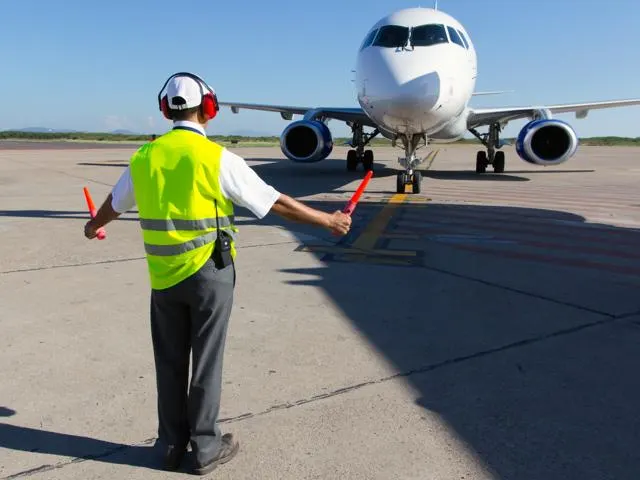
Towing:
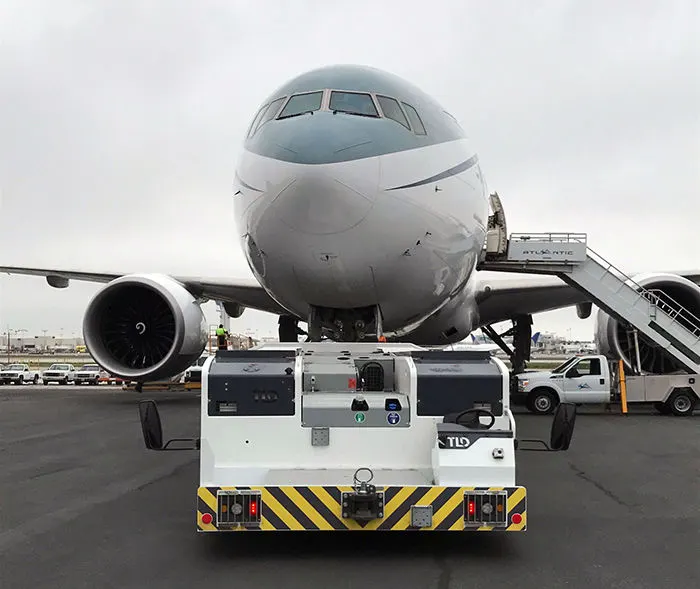
- Aircraft towing is a frequent and vital operation around an airport.Towing may be needed for the movement of active or disabled aircraft on airport ramps or in moving aircraft in and out of hangers for maintaince procedures or for storage.
- Movement of the aircraft around the airport and hangers is usually accomplished by towing with a towing vehicle or tug.
- The aircraft is attached to the tow vehicle by the use of a towbar or other specialized methods that connect to or landing gear off the ground.
Solution for Question 5:
TakeOff Power
- The amount of power that an engine is allowed to produce for a limited period of time for takeoff.
- The use of takeoff power is usually limited to 5 min for reciprocating engines and upto 2.5 min for gas turbine engines.
- Specifically,with respect to reciprocating engines, it is the brake horsepower developed under standard sea level conditions and under the maximum conditions of the crankshaft rotational speed and the engine manifold pressure approved for the normal take-off.
- With respect to gas turbine engines, it is the thrust developed under static conditions at a specified altitude and atmospheric conditions of the rotor shaft rotational speed and the gas temperature approved for the normal takeoff.
Tyre design
- Carcass Plies are used to form the tire. they are sometimes called casing plies.
- Unlike an automobile or truck tyre, it does not have to carry a load for long period of continous operation.
- However, an aircraft tyre absorbs the high impact loads on landing, and also it's operating at high speeds for a short time when required.
- TECHNICAL ASPECTS OF THE TYRE:
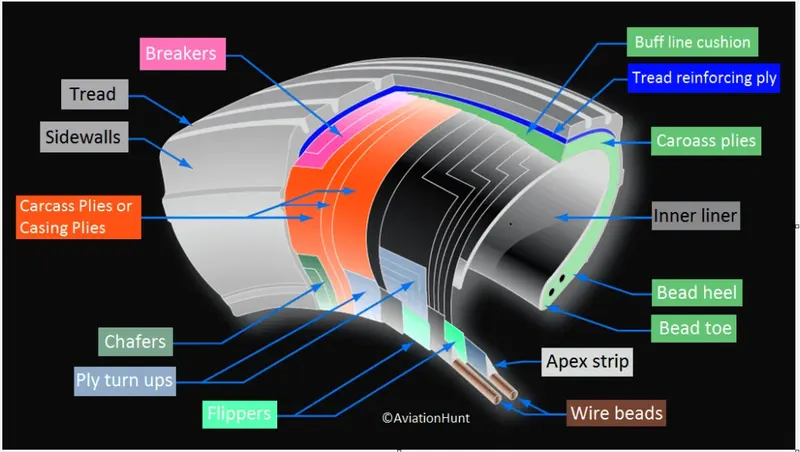
- Retreading - Retreading is methods of restoring a worn tyre by renewing the tread area or by renewing the tread area plus one or both sidewalls.Repairs are included in the tyre retreading process.
- Load Rating - Load rating is the maximum permissible load at a specified inflation process.
- Ply Rating - Ply rating is used to identify the maximum recomended load rating and inflation pressure for a specified tyre. It is an index of tyre stregth.
- Speed rating - The speed rating is the maximum takeoff speed to which the tyre has been tested.
- Skid depth - Skid depth is the distance between the tread surface and the deepest groove as measured in the mould.
Rolling resistance:
- Rolling resistance,sometimes called rolling friction or rolling drag, is the force resisting the motion when a body rolls on a surface.
- It is mainly caused by non-elastic effects, that is not all the energy needed for deformation of the wheel,roadbed etc., is recovered when the pressure is removed.
- Rolling resistance coefficient is defined by
F = Crr N
where,
F is the Rolling resistance force
Crr is the dimensions rolling resistance coefficient or coefficient of rolling friction
N is the normal force, the force perpendicular to the surface on which the wheel is rolling.
Tyre pressure:
- Aircraft tyres operate at such high extremes of pressure,load and speed, their care and service is critically important.
- The most important action of an operator can take to prevent tyre related events to maintain proper tire inflation pressure.
- Failure to keep aircraft tires properly inflated can lead to very serious consequences.
- One relatively easy way to help avoid those consequences is to check tire pressures regularly and service them as necessary.
- Aircraft tires are usually infllated with nitrogen to minimize expansion and contraction from extreme changes in ambient temperature and pressure experienced during flight.
Brake forces when loading:
- Aircraft Disc Brakes - It is used to brake the wheels while touching the ground. these barke are operated hydraulically or pneumatically.Levers are used in few aircraft. most aircraft are capable of differential barking.
- Thrust reversers - It is used on a jet aircraft to provide a significant way of increasing the rate of deacceleration during the intial stages of both a landing roll or a rejected takeoff from a high speed.use of reverse thrust on low wing aircraft with mounted engines should be limited to the time when the aircraft is on an active runway.
- Air brakes - used to cause the aircraft to slowdown rapidly when they were deployed. they produce a drag which required a high power setting , these settings are muvh more responsive and rapid thus making power and glide slope corrections on approach more rapidly with speed brakes deployed.L
- Large drogue parachutes - it is a parachute designed for deployment from a rapidly moving object.it is used for various purposes such as to decrease the speed, to provide control and stability or as a pilot parachute to deploy a larger parachute.
PART B:
Solution for Question 6.A
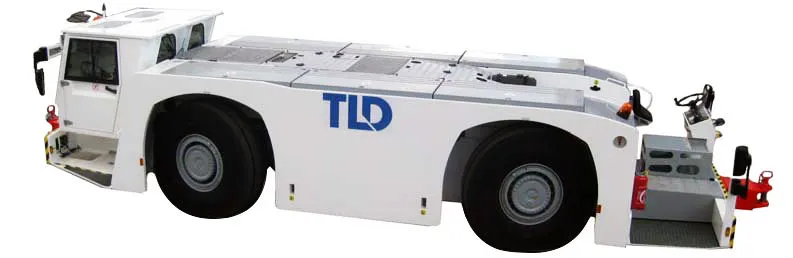
Towing trcuk:
Aircraft Airbus:
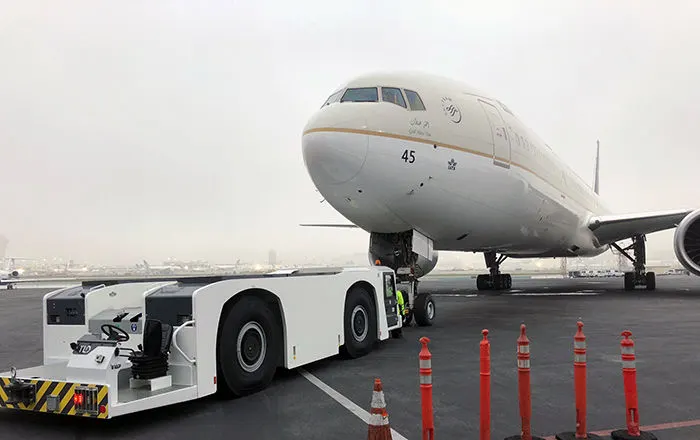
Let's Take the required data from trcuk TMX-150-9 and Aircrft Airbus A319
DATA:
- Mass of the truck = 8300 Kg
- Mass of the Aircraft = 75500 Kg
- Length of the Aircraft = 33.84 m
- Velocity of the truck = 25kmph
- Height of the Aircraft = 11.76
- Air density (ρ)= 1.225 Kg/m^3
- Drag coefficient (Cd) = 0.75
- Rolling resistance coefficient (μrr)= 0.013
- Gravitational Constant (g)= 9.8 Nm
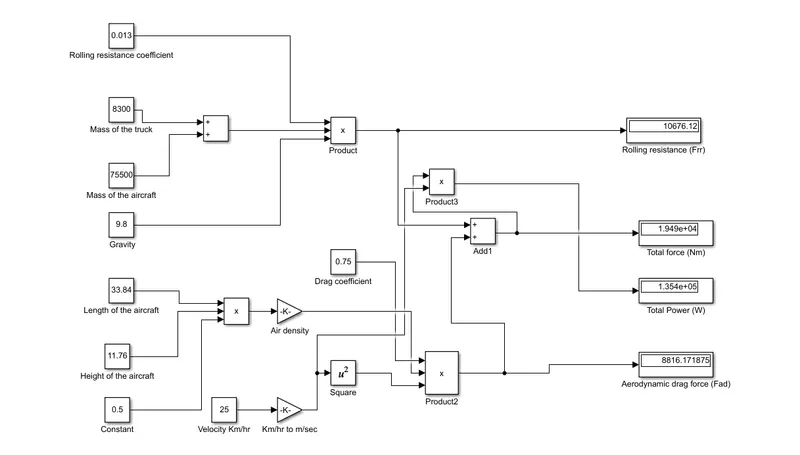
Calculation of Rolling resistance (Frr):
- Frr = μrr*m*g
m = mass of truck + mass of the aircraft = 8300+75500
= 83800 Kg
Frr = 0.013*83800*9.8
=10676.12 Nm
Calculation of Aerodynamoic drag (Fad):
- Fad = 0.5*ρ*Cd*A*V^2
Velocity of the truck in m/sec (V) = 25/3.6 = 6.95 m/sec
Area = Length of the aircraft* height of the aircraft = 33.84*11.76
=392.54 m^2
Fad = 8816 Nm
Total Force and Power required to Push/Pull an aircraft by a towing vehicle is
In Newton
F total = Frr+fad = 10676.12+8816
=19492.12 N
In Power
Total power = F total * Velocity = 19492.12 * 6.95
=135470.234 W
=135.47 KW
Solution for Question 6.B:
Simulink model:
Solution for Question 7.A:
Designing an Electric Power train for Aircraft towing
Tyre specifications: 315/70 R15
DATA:
Force required to tow the Aircraft = 19492.12 N
Power required for towing aircraft = 135.47 Kw
Tyre radius of the towing truck = 0.411 m
Gera ratio = 7
Transmission efficiency (nt) = 80%
Motor Efficiency =92 %A
Calculation:
- Torque required at the wheels (Tw)
Tw = Total force * Tyre radius = 19492.12 * 0.411
= 8011.212 Nm
- Actual Power required (Pac)
Pac = ( Power required )/ (nt* motor efficiency )
= 135.47 / ( 0.8*0.92)
= 183.917 Kw
Therefore , Motor power rating should be 190 KW
- Motor Torque (Tm)
Tm =(Tw)/(gear ratio*nt)
= 8011.212/(7*0.8)
=1.43 kNm
- Actual motor torque (Tmac)
Tmac = Tm/motor efficiency
= 1.43/0.92
= 1.55 kNm
- Calculating battery capacity
Towing tractor takes 15 minutes for taxing
15 mintues = 0.25 hours
Battery capacity = Pac * hours = 183.917 * 0.25 = 45.97 kWh
The battery should deliver the power output of 45.97 kWh
210Kw battery can run the towing tractor easily.
- Duty cycle calculation
Duty cycle = Pac / Power rated ( battery capacity ) = 183.917 / 210 = 0.875
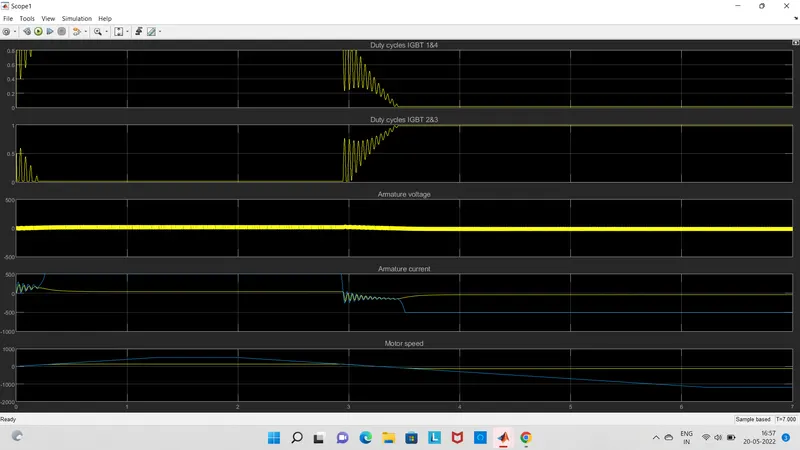
To run the towing tractor for 15 minutes with speed of 7 m/sec the duty cycle should be in range 0 to 0.875
At 0.875 the towing tractor reaches it's maximum speed of 7 m/sec.
- Parameter and values
Mass of the truck = 8300kg
Mass of the aircraft = 75500 kg
Area of the aircraft = 392.544 m^2
Coefficient of rolling resistance = 0.013
Speed of the truck = 25kmph
Drag coefficient = 0.75
Air density = 1.225 kg/m^3
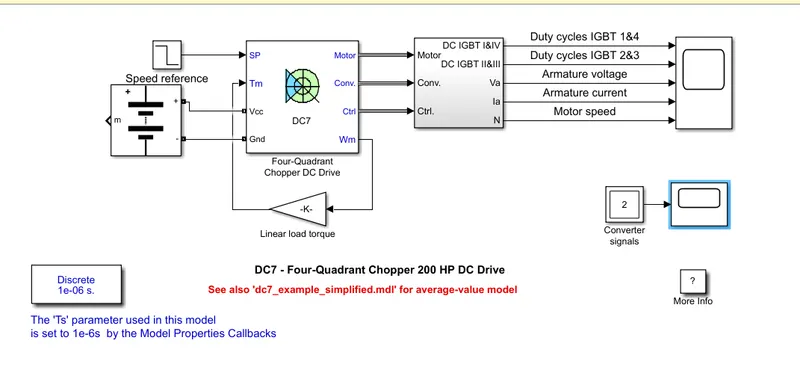
Simulink Model (DC_7 block ):
Replacing AC source with DC source and plotting the results
PLOT:
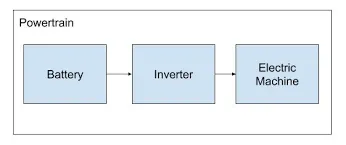
Block diagram of Power train:
Solution for Question 7.B:
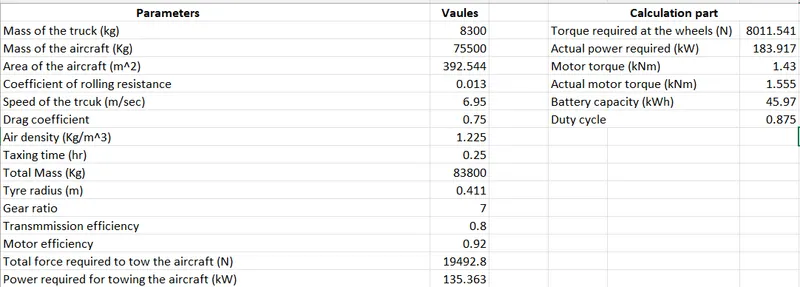
Excel sheet has been attached.