Project-1: Powertrain for aircraft in runways
Part A:
1. Search and list out the total weight of various types of aircrafts.
ANSWER:The different terms represents different weights or masses for each flight the weights are taken into account for several reasons.
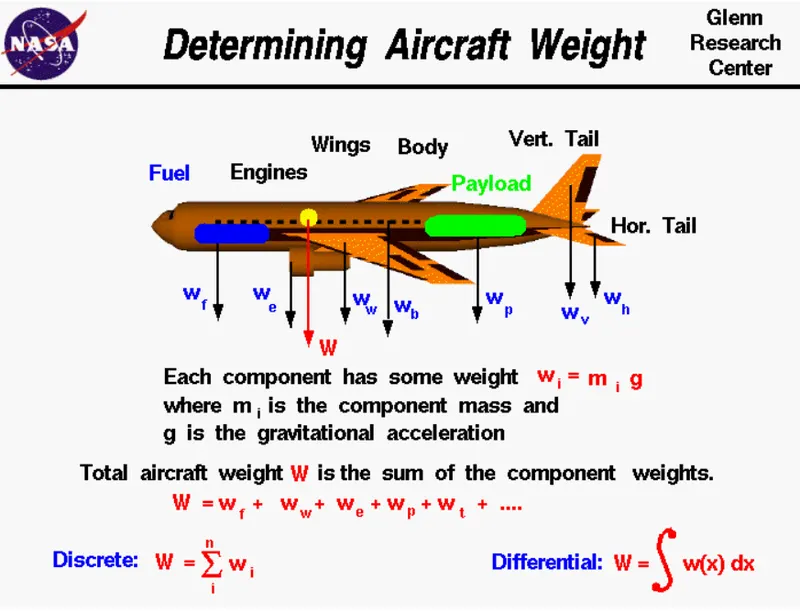
• Manufactre's Empty Weight (MEW) -> Also called Manufacturer's Weight Empty (MWE) or Licensed Empty
Weight. It is the weight of the aircraft "as built" and includes the weight of the structure, power plant, furnishings,
installations, systems and other equipment that are considered an integral part of an aircraft. This excludes any
baggage, passengers, or usable fuel.
• Zero Fuel Weight (ZFW) -> This is the total weight of the airplane and all its contents (including unusable fuel),
but excluding the total weight of the usable fuel on board. As a flight progresses and fuel is consumed, the total
weight of the airplane reduces, but the ZFW remains constant. Maximum zero fuel weight (MZFW) is the
maximum weight allowed before usable fuel and other specified usable agents (engine injection fluid, and
other consumable propulsion agents) are loaded.
• Operating Empty Weight (OEW) -> (Roughly equivalent to basic empty weight on light aircraft). It is the basic
weight of an aircraft including the crew, all fluids necessary for operation such as engine oil, engine coolant,
water, unusable fuel and all operator items and equipment required for flight but excluding usable fuel and the
payload.
• Payload -> It is the carrying capacity of an aircraft. It includes cargo, people, extra fuel. In the case of a
commercial airliner, it may refer only to revenue-generating cargo or paying passengers.
• Maximum Takeoff Weight (MTOW) -> This is the maximum weight at which the pilot of the aircraft is allowed
to attempt to take off.
• Regulated Takeoff Weight (RTOW) -> Depending on different factors (e.g. flap setting, altitude, air temperature,
length of runway), RTOW or maximum permissible takeoff weight varies for each takeoff. It can never be higher
than MTOW.
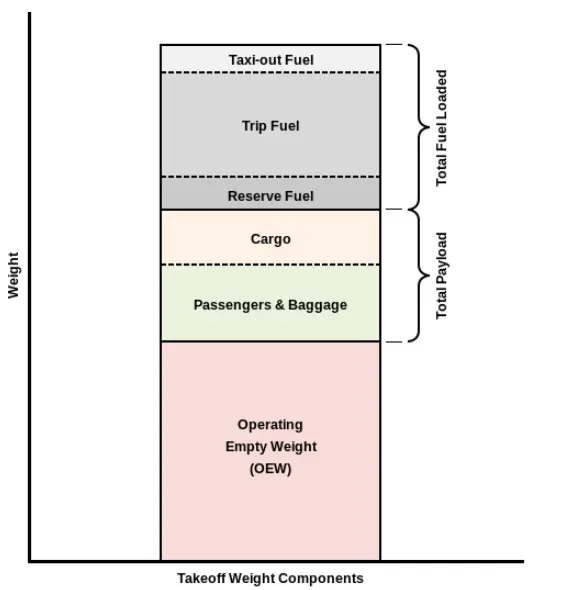
• Maximum Landing Weight (MLW) -> This maximum weight at which an aircraft is permitted to land. The
following image depicts takeoff weight components.
• Maximum Ramp Weight (MRW) > also called maximum taxi weight (MTW). It is the maximum weight authorized for maneuvering (taxiing or towing) an aircraft on the ground. • Aircraft Gross Weight -> It is the total aircraft weight at any moment during the flight or ground operation. This decreases during flight due to fuel and oil consumption.
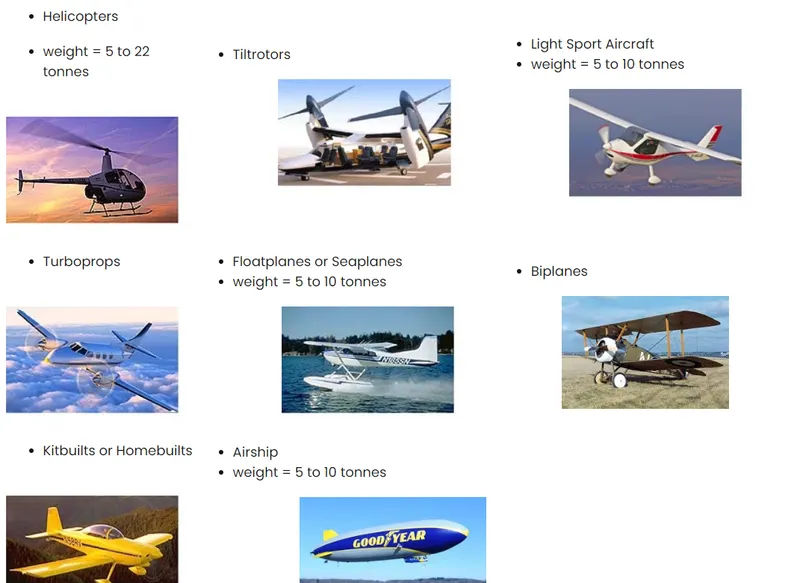
Types of Aircraft :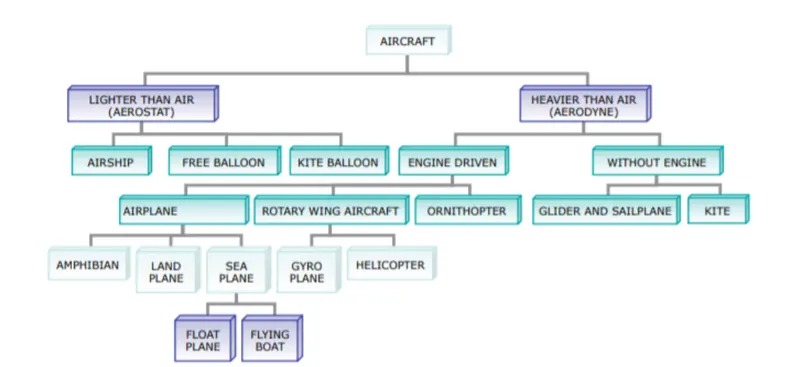
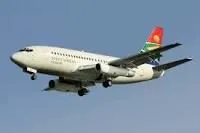
• Airbus{ A300, A310, 431
8, A319, A320,
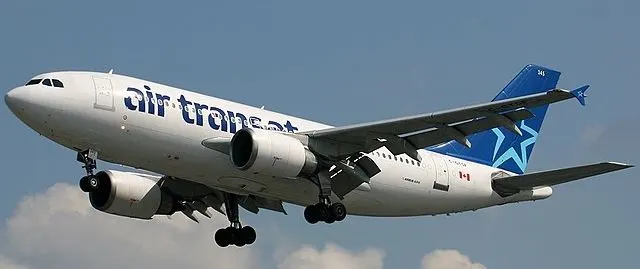
• Boeing { B737, 8747, B747-8 ,A321, A330, A340, A350,A38 B757, 8767, B777, B787}
2. Is there any difference between ground speed and air speed?
ANSWER:
Ground speed > It is when you are measuring the horizontal velocity of the plane relative to the ground. It's the speed that is shown on the speedometer of a car. If your car suddenly started levitating for God knows what reason, the speedometer reading would not take into account your vertical velocity, so a plane could be moving vertically but still have zero ground speed. It is the velocity you have in any direction perpendicular to the vertical axis.
Air speed > is the velocity of the plane relative to the winds around it. It is like having two cars, one travelling at 100 km/h and the other at 60 km/h, both towards the right. These speeds are the ground speeds of the car. The air speed is wanting to know the difference in velocity between the two cars, which is 40 km/h, or -40 km/h depending on which car you are looking at. If the 100 km/h car represents the plane, and the 60 one the winds, then the difference is 40km/h. So you are essentially measuring how fast the plane is compared to the winds. And in the example above, if the car was travelling at 60 km/h to the left instead, the speed difference would be 160 km/h.
It is the same thing for planes: when winds blow towards the plane, the plane's air speed is bigger than the ground speed, because you are adding to the ground speed, and when winds blow in the same direction as the plane, the air speed is less than the ground speed. In more technical terms, "ground speed is the velocity of the plane relative to a reference point on the ground. Wind speed is the velocity of wind with respect to that same reference point, and air speed is the velocity of the plane relative to that wind.
Thus the air speed is defined as the vector difference between the ground speed and the wind speed. Also note that for whatever reason, the three quantities have both direction and magnitude;
They are vectors despite their names': Now the reason why ground speed is important is because it lets you know how quickly you could reach your destination, in the same way that the speed of a car lets you know that. The air speed is important because it is what allows the plane to fly. The Bernoulli principle states that if a fluid like air increases its speed, then its pressure will decrease. For a plane, the plane's wings will affect the way air flows above and below them, which will cause a difference in pressure and thus cause a force, known as the lift force which is what makes the plane fly. The way the wings affect the air flow is determined by how quickly the plane is moving relative to the air, which is the air speed.
Q.3. Why is it not recommended to use aircraft engine power to move it on the ground at Airport?
ANSWER:
Although most aircraft are capable of moving themselves on the ground, it is not typically done due to the following
reasons,
• The jet blast from the engines can damage the terminal building and nearby equipment. It can even throw
away people standing nearby.
• Engines can blow sand and debris.
• Engines can suck in sand and debris which can cause serious damage to the engine.
• It is easier for the truck driver to see the surroundings better than the pilot sitting in the cockpit with limited
windows.
• The pushback truck driver knows the airport better than the pilot.
• The plane engines are very loud. This noise can add up substantially when multiple planes are moving around
the airport. It won't be a pleasant experience for people sitting inside the terminal, as most people don't even
like the sound of powerful motor-bikes.
• It saves fuel.
• Modern planes are huge. It is difficult to navigate such gigantic structures through limited space. An A380 is
eight stories high. The pilots won't be able to see anything directly in-front of them or anything behind the
wings.
Actually Pushback is for moving the aircraft backwards from the gate, and towing or taxing is the procedure to move
the aircraft. These machineries are called as aircraft tugs. Aircraft tugs are real modern marvels, moving aircraft
weight hundreds of tons all day, every day. A true pushback tug aims to allow the operator to have excellent visibility
of the attaching mechanism between airplane and tug.
while moving the aircraft in the reverse direction by applying the forward thrust, care msut be taen because reverse
thrust is unsafe when stopped or at low speed. This is because the nose may lift, dropping the tail on to the Tarmac.
The cause is the engines being at some considerable height from the ground and the aircraft centre of gravity being
just ahead of the main (rear) wheel set. Additionally, once moving backwards, if the aircraft's own brakes are used,
the same can happen, i.e., the plane can sit on its tail.
Q.4. How an aircraft is pushed to runway when its ready to take off?
ANSWER:
Aircrafts are usually 'pushed' by ground vehicles known as tow vehicles such as tow trucks. It is used mainly to reverse an airplane from the terminal area, until it is in a position to move by itself.
These tow trucks will only help move the aircraft to an area where the pilots can safely switch on the engines, not the runway! (Ground vehicles are rarely allowed to move on a runway (save for emergencies and inspection), and the aircraft is supposed to move to the runway by itself. Aircrafts don't have powered wheels, and hence cannot move in reverse (let alone forward by themselves).
Imagine a tiny jet strapped to one of your toy cars; that's essentially how airplanes work on the ground! They go where the engines push them towards.
(Note: There is a mechanism known as reverse thrusters, which allow the engine air flow to be pushed towards the front, but that is highly risky maneuver, and is only used to reduce speed immediately after landing.)
Another reason to push back an aircraft to a safe area, is for safety reasons. The engines produce tremendous thrust from the exit, and an immense vacuum from the front; enough to suck in people, small vehicles, ground equipment etc.
Hence it is a common procedure to start the engines once it is cleared away from the terminal area and lined up on a taxiway (roads that lead to the runway).
Q.5. Learn about take off power, tyre design, rolling resistance, tyre pressure, brake forces when landing.
ANSWER:
Takeoff -› is the phase of flight in which an aircraft goes through a transition from moving along the ground (taxiing) to flying in the air, usually starting on a runway.Take off power can be predicted using a simple measure of the acceleration of the aircraft along the runway based on force equilibrium.
The forces involved will be,
T -> Thrust of propulsion system pushing aircraft along runway.
D -› Aerodynamic Drag of vehicle resisting the aircraft motion.
F -> Rolling resistance friction due to the contact of wheels or skids on the ground.
During take-off run, the imbalance in these forces will produce an acceleration along the runway.
m • dv/dt = T - D - F,
where dv/dt is the acceleration along the runway and m is the mass of the vehicle.
The procedure for take-off will be that the vehicle will accelerate until it reaches a safe initial flying speed. The pilot can then rotate the vehicle to an attitude to produce climb lift and it will ascend from the ground. The determination of this safe flying speed or rotation speed,
VR is a critical factor in determining take-off performance.
Take-off rules vary slightly depending on the aircraft category.
Vr =1.1 x v STALL or Vr= 1.05 x Vmin CONTROL, whichever is great.

Take off Field Length -> The required length of runway will be the sum of the distance required to get to rotation speed and the extra length required to clear a 50ft obstacle or the extra length required to allow for rapid braking if the pilot decides to abort take-off at the decision speed V1.
This length will typically be considerably longer than the distance required to achieve rotation (flying) speed. A rough
approximation is that runway total length is around 2
Therefore, Takeoff power = force * displacement = M.dv/dt . 2. S1 = (T - D - F) • S1
Rolling Resistance The friction between aircraft and runway will be proportional to the normal force exerted by the
aircraft on the runway.
F = u(w- L)
The normal force will be the difference between Weight of aircraft and Lift, the friction coefficient will be typically of a
magnitude of 0.02 for a standard runway
Braking Forces in Landing —> The landing run can be calculated in a similar fashion to the take off distance. The aim
is again to minimise the distance.
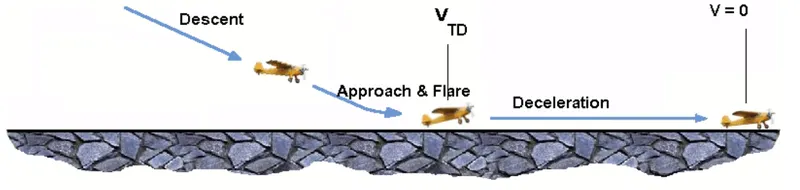
The touch down velocity should be approximately the stall speed of the aircraft in landing configuration. This will be
achieved by a pitch manoeuvre during the flare portion of the approach which which increase drag an decelerate
the aircraft to minimum flying speed. The deceleration on the landing roll from VTD to Vo will be accomplished by
braking and reverse thrust. This can be solved by the average acceleration approach that was used to estimate the
take-off roll.
M.dv/dt = -T - D - F
The negative acceleration or deceleration value will be based on friction coefficient for maximum braking and the
value of reverse thrust (if available).
Aircraft Tyre design Aircraft wheels are an important component of a landing gear system. With tires mounted
upon them, they support the entire weight of the aircraft during taxi, tkeoff, and landing.
The typical aircraft wheel is lightweight, strong, and made from aluminium alloy. Some magnesium alloy wheels also exist. Early aircraft wheels were of single piece construction, much the same as the modern automobile wheel.
As aircraft tires were improved for the purpose they serve, they were made stiffer to better absorb the forces of
landing without blowing out or separating from the rim. Stretching such a tire over a single piece wheel rim was not
possible. A two-piece wheel was developed.
Aircraft Tyre Pressure :
Aircraft tires generally operate at high pressures, up to 200 psi (14 bar or 1,400 kPa) for airliners, and even higher for business jets. The main landing gear was typically inflated to 232 psi (16.0 bar), whilst its tail bumper gear tires were as high as 294 psi (20.3 bar). The high pressure and weight load tyres were a significant factor.
Tests of airliner aircraft tires have shown that they are able to sustain pressures of maximum 800 psi (55 bar; 5,500 kPa) before bursting. During the tests the tires have to be filled with water, to prevent the test room being blown apart by the energy that would be released by a gas when the tire bursts.
Aircraft tires are usually inflated with nitrogen to minimize expansion and contraction from extreme changes in ambient temperature and pressure experienced during flight.
Dry nitrogen expands at the same rate as other dry atmospheric gases (normal air is about 80% nitrogen), but common compressed air sources may contain moisture, which increases the expansion rate with temperature.
The requirement that an inert gas, such as nitrogen, be used instead of air for inflation of tires on certain transport category airplanes was prompted by at least three cases in which the oxygen in air-filled tires had combined with volatile gases given off by a severely overheated tire and exploded upon reaching autoignition temperature. The use of an inert gas for tire inflation eliminates the possibility of tire explosion
Part B:
Q6. A. With necessary assumptions, calculate the force and power required to push / pull an aircraft by a towing vehicle
ANSWER:
Let us Assume:
Weight of the Aircraft (Airbus A-380) = 575000kg
Rolling Resistance Coefficient of an aircraft tire(Urr) = 0.004
Wight of the Towing Tractor = 50000kg
Rolling Resistance Coefficient of Towing Vehicle(Urr) = 0.001
Then,
Rolling Resistance Force of Tow Tractor = Urr x m. g = 0.001 x 50000 x 9.81 = 0.49KN
Rolling Resistance Force of aircraft = Urrx m. g = 0.004 x 575000 x 9.81 = 22.56KN
Total Rolling Resistance Force = Rolling Resistance Force of aircraft + Towing Tractor = 0.49 + 22.56
Total Rolling Resistance Force = 23.05KN
Air Drag Force-
The drag force is the force that occures due to the Air Strike effect on the vehicle when it moves. The vehicle moves
through a air medium of particular dencsity value with certain speed this causes the air strike against the vehicle
body and it causesDrag Force on the vehicle.
The Aerodynamic Drag is given by the following expression-
fad = 1/2 • p • A • V^2 • Cd
Where,
p = Density of Air Medium
A = Frontal Area Of the Vehicle which strike the Air
V = Velocity with the vehicle moves
Cd = Coefficient of Dragwhich varies different shapes of the frontal area.
Calculation:
Let us assume
The Velocity of the Aircraft while Towing = 30KMPH = 8.33m/s
Dnsity of Air medium(p) = 1.225
The Frontal area of the Aircraft = 20m2
The Coefficient of Drag of the Aircraft = 0.026
Air drag force = 0.5*rho*A*VA2*Cd = 0.022KN
The Air Drag Force of the Aircraft = 0.022KN
Therefore the total force that the motor needs to overcome = Rolling Resistance of the aircraft + Drad Force Acting onthe Aircraft hence the total forces acting = 23.05 + 0.022
nthe Aircraft hence the total forces acting = 23.05 + 0.022
The Total Force that the Motor needs to overcome in order to push/pull the Aircraft = 23.07KN
The Power Required-
The power required by the motor is given by the velocity with which the towing operation takes place.
The average speed of push/pull = 20 kmph = 5.5m/s
Power required by the motor = Total Force*Velocity = 23.07*5.5
Power Required by The Motor = 126.8kw
The torque output of the towing tractor can also be calculated by the below steps-
Fte = T. (G/r)
Where,
Fte = The Total Tractive Force(Rolling resistance force + Air drag force)
T = Torque Output
r = Radius of Tire
G = Gear Ratio
For Heavy Duty Towing Tractor we Assume,
G = 11(for delivering high torque)
r = 25inches = 0.635m
Fte = T. (G/r)
T= 23000(0.635/11)
B. Develop the model for the calculated force and power using Simulink
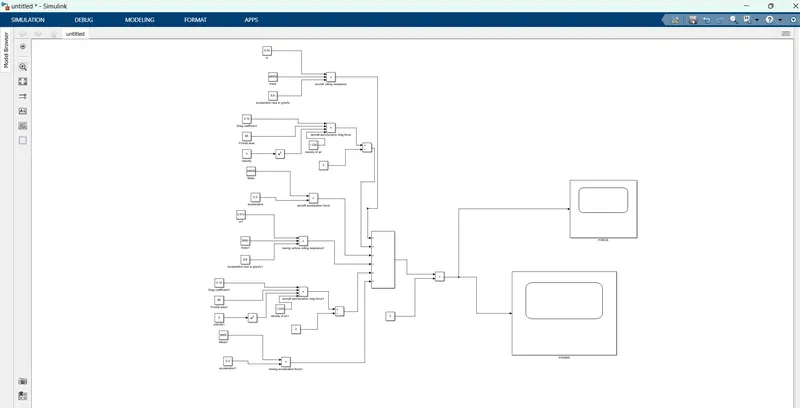
https://drive.google.com/file/d/1-kqxwc8COj3DX5pJnZpEfI6LfsxR3jsw/view?usp=sharing
Finally, all the forces are added to obtain the total tractive force and the power is obtained by multiplying the total tractive force with the velocity. • The simulation is run and the both the force and the power values are displayed using the display block. FORCE=3.232e+04
power = 9.697e+04
7. A. Design an electric powertrain with type of motor, it’s power rating, and energy requirement to fulfill aircraft towing application in Simulink. Estimate the duty cycle range to control the aircraft speed from zero to highest. Make all required assumptions. Prepare a table of assumed parameters. Draw a block diagram of powertrain.
(Hint :DC7 Block)
ANSWER:
The following are the assumed parameters:
AIRCRAFT PARAMETERS
PARAMETERS VALUES UNITS
Mass of the aircraft 48500 kg
Coefficient of rolling resistance 0.03 OHM
Frontal area of the aircraft 85 M2
Final velocity of the aircraft 3 m/s
Initial velocity of the aircraft 0 m/s
Coefficient of drag of an 0.15
aircraft
Acceleration time of the
Towing vehicle 10 Seconds
TOWING VEHICLE PARAMETERS
PARAMETERS VALUES UNITS
Mass of the Towing vehicle 8000 kg
Coefficient of rolling resistance 0.013 OHM
Frontal area of the Towing 8 m2
vehicle
Final velocity of the Towing 3 m/s
vehicle
Initial velocity of the Towing 0 m/s
vehicle
Coefficient of drag of the 0.60
Towing vehicle
Acceleration of the Towing 10 seconds
vehicle
Gear ratio 10
The total power required to push or pull the aircraft by the towing vehicle is 97.022952KW and the total tractive force is 32340.984N. To calculate the torque required by the Towing vehicle the following parameters are assumed as shown above:
shown above:
T=Fr*r/G
T = 32340.984 * 0.4 / 10
T = 1293.63 Nm
The torque required for towing the vehicle to push or pull the aircraft is 1293.63 Nm
To design the electric power train of the towing vehicle a motor is selected based on its power rating and the battery required based on energy requirement and duty cycle range to control the aircraft speed from zero to highest.
MOTOR
The motor is selected with a power rating of 97.022KW and torque of 1293.63 Nm . TECO 1E2 electric induction motor is selected which has a power output of 110 KW and torque at full load is 1420Nm that satisfies the power
output and torque needed for the vehicle.
MOTOR SPECIFICATIONS
MOTOR SPECIFICATIONS
Output power – 110 KW, 150 hp
Full load speed – 740 rpm
Full load Efficiency – 94.5%
Full load current – 210A
Full load Torque – 1420 Nm
Rated voltage – 400V/50 Hz
DUTY CYCLE
The rated voltage is 400V and the current is assumed to be 250A. So, the input power of the motor is calculated as product of voltage and current.
Pi = V * I
Pi = 400 *280
Pi = 112000W
Pi = 112KW
DUTY CYCLE
The rated voltage is 400V and the current is assumed to be 250A. So, the input power of the motor is calculated as product of voltage and current.
Pi = V * I
Pi = 400 *280
Pi = 112000W
Pi = 112KW
To calculate the duty cycle we divide output power to input power
ð = Po / Pi
ð = 97.02 / 112
ð = 0.866
ð = 86%
ENERGY
To calculate the energy required from batteries or battery pack. The energy is obtained by multiplying the output power and time. Assuming the battery usage for 5 minutes is 300 seconds.
E = Po * t
E = 97.02 * 300
E = 29106kJ
So, the battery pack provides 29106 KJ of energy to the vehicle. Since the battery are rated in kilowatt hour (KWH). We have to convert KJ to KWH we divide it by 3600.
E = 29106/3600
E= 8.08KWH
So, the battery pack should provide at least 8.08 KWH to the vehicle
Block Diagram of Powertrain:
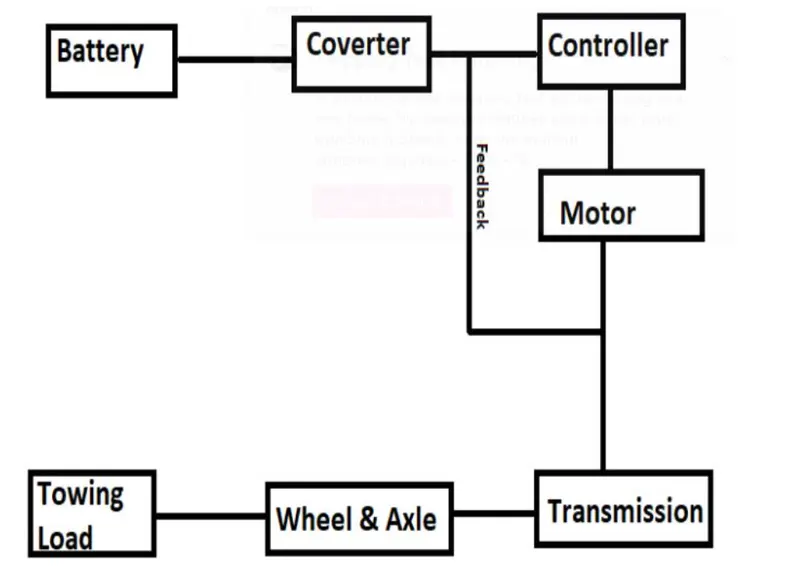
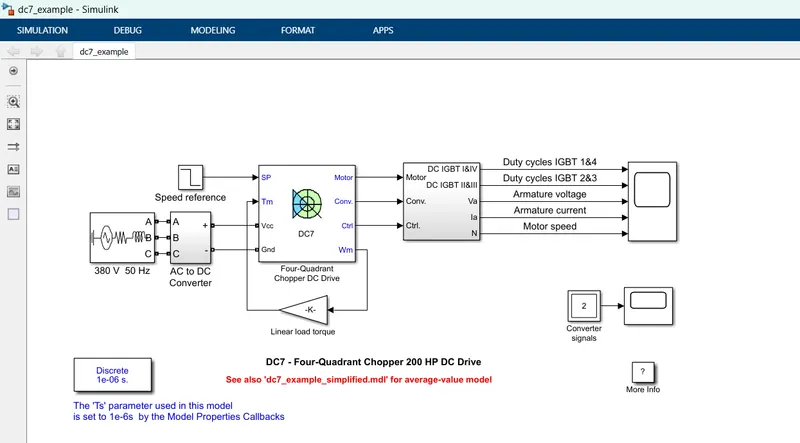
B. Also, Design the parameters in excel sheet.
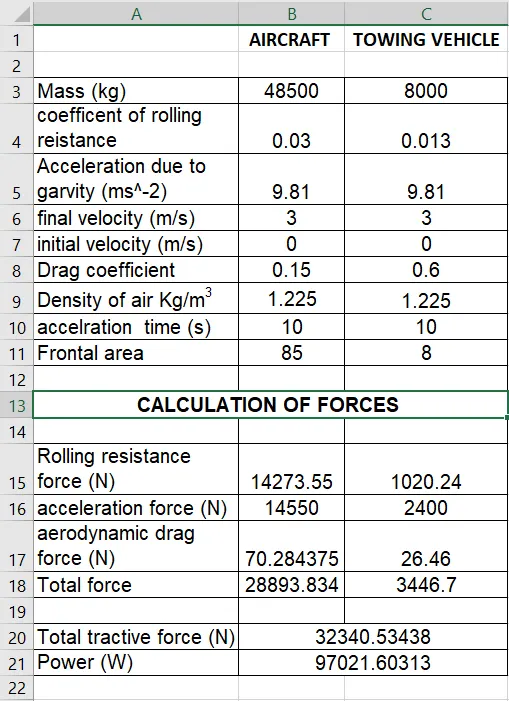
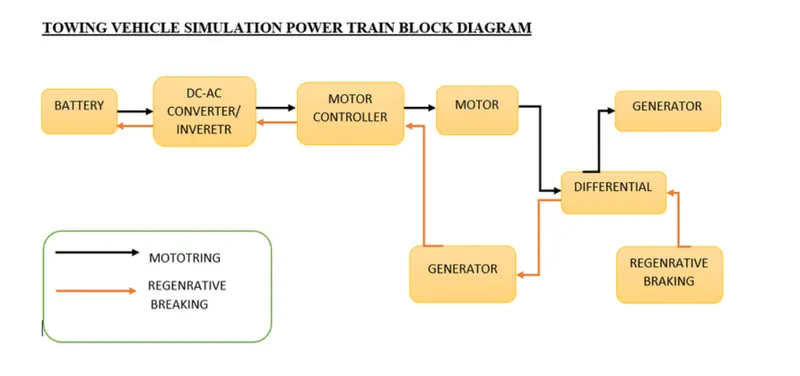
RESULTS
|
Required torque output of the motor |
1293.63 Nm |
|
Input power of the motor |
112KW |
|
Duty cycle range |
86% |
|
Energy required from the batteries |
8.08KWH |