Project-1: Powertrain for aircraft in runways
Part A:
1. Search and list out the total weight of various types of aircrafts.
Below is the list of some aircraft and thier weight (emptyweight), to this weight will come fuel weight, cargo weight and max flight weight because the weight of an airplane is very critical for flight. The aircraft gross weight (also known as the all-up weight and abbreviated AUW) is the total aircraft weight at any moment during the flight or ground operation. An aircraft's gross weight will decrease during a flight due to fuel and oil consumption.The weight of the aircraft is needed to be calculated by the pilot for every flight to ensure the aircraft remains within weight limitations set by the manufacturer. These limitations are to ensure the aircraft is able to perform and recover from all flight maneuvers and withstand structural loading.
Aircrcraft Empty weight
Antanov AN-225 285000kg
Airbus A380-800 277000kg
Boeing 747-800 220100kg
Airbus A340-500 168000kg
Boeing 777-300ER 168000kg
Boeing 787-10 135500kg
Boeing 737-900 44700kg
Airbus A320-100 42600kg
Embraer 190 28800kg
Gulfstream G650 24500kg
CRJ900 21850kg
Bombardier Q400 17800kg
LearJet 75 6300kg
Cessna Citation CJ4 4700kg
Beechcraft King Air B100 3200kg
Diamond DA50 RG 1450kg
Beechcraft Bonanza G36 1150kg
Cessna 206H 990kg
Sirrus SR22 1000kg
2. Is there any difference between ground speed and air speed?
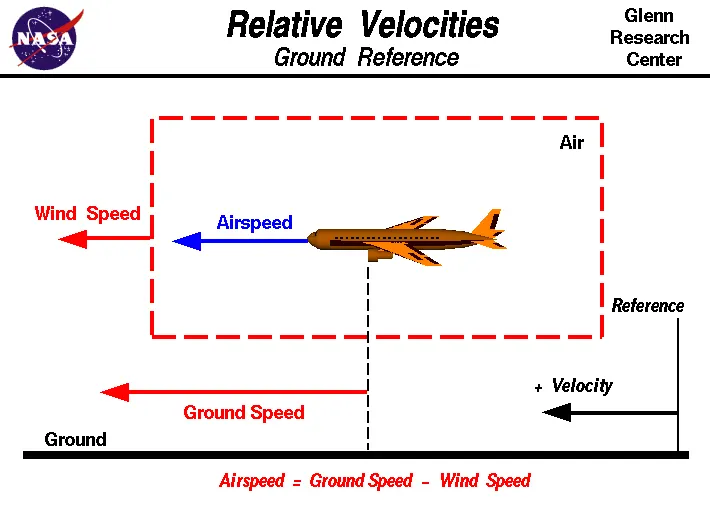
Airspeed is the vector difference between the ground speed and the wind speed. On a perfectly still day, the airspeed is equal to the ground speed. But if the wind is blowing in the same direction that the aircraft is moving, the airspeed will be less than the ground speed. For example, at cruise altitude, aeroplanes might have a ground speed of 300–600 knots (555-1,110 kmph). However, the wind can alter the speed at which the aircraft passes over the ground. A tailwind pushes the aircraft along at a faster speed while a headwind slows down the aircraft speed across the ground. Hence ground speed is how fast an airplane's shadow would move across the land. ... On a perfectly still day, the airspeed is equal to the ground speed. But if the wind is blowing in the same direction that the aircraft is moving, the airspeed will be less than the ground speed.
3. Why is it not recommended to use aircraft engine power to move it on the ground at Airport?
Taxiing (rarely spelled taxying) is the movement of an aircraft on the ground, under its own power, in contrast to towing or pushback where the aircraft is moved by a tug. The aircraft usually moves on wheels, but the term also includes aircraft with skis or floats (for water-based travel). But most of the time the plane will rather be towed or pushed by a tug for the following reasons, expercial for larger aircrafts.
-Jet blast or prop wash might cause damage to the terminal building or equipment.
-Engine close to ground may also blow sand and debris forward and then suck them into the engine, causing damage to the engine.
-Loss of control could happen expercial when egine is runed under high power or under very extreme weather conditions
-It saves fuel cause the plane will consume relative more fuel than the tug who pushes or tows him around.
-Airport personel finding themselves in very close proximity to the plane might be injured since pilots view to his plane sarounding is very limitted.
4. How an aircraft is pushed to runway when its ready to take off?
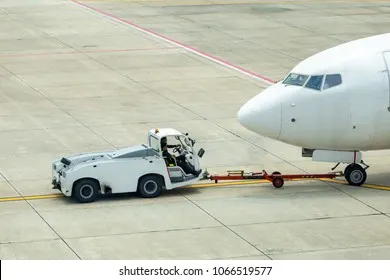
A so-called pushback truck reverses the aircraft into taxiing position, pushing it with a towbar attached to the nose-wheel strut. Or, in the most modern versions, by actually lifting the wheel. The aircraft taxis to the runway to depart at the agreed time. The airplane may be pushed or pulled by landing gear or wing struts since they're known to be strong enough to drag the airplane through the air. To allow for turns, a person may either pick up or push down on the tail to raise either the nose wheel or tail wheel off the ground, then rotate the airplane by hand. Airplanes are pushed back from the gate to prevent reverse thrust from the engines being used. Reverse thrust requires high engine power creating high-speed jet blast. Any debris can damage airport terminals, jetways & ground vehicles.
5. Learn about take off power, tyre design, rolling resistance, tyre pressure, brake forces when landing.
take off power:
If the runway is long enough, though the minimum thrust needed for takeoff would be indeed about 1/18th of weight. For light aircraft, usually full power is used during takeoff. Large transport category (airliner) aircraft may use a reduced power for takeoff, where less than full power is applied in order to prolong engine life, reduce maintenance costs and reduce noise emissions. Most takeoffs use "derated" thrust to save engine wear. For each takeoff, performance is calculated, the necessary power setting is determined and the thrust setting is made. "Most takeoffs use 'derated' thrust to save engine wear. For each takeoff, performance is calculated, the necessary power setting is determined, and the thrust setting is made. Usually, this is below the maximum available level, and is known as a derated thrust takeoff.
tyre design:
When it comes to safety, tyres are one of the most important components of aircraft. They help to absorb the shock of landing and provide cushioning. It also provides the necessary traction for braking and stopping of an aircraft.Unlike an automobile or truck tyre, Aircraft tyres do not have to carry a load for a long period of continuous operation. However, an aircraft tyre absorbs the high impact loads of landing, and also it’s operating at high speeds for a short time when required. The number of wheels required for aircraft increases with the weight of the aircraft, as the weight of the aeroplane needs to be distributed more evenly. Aircraft tires are made from natural rubber and are much less susceptible to weathering, thus providing a greater life expectancy and keeping your equipment protected longer.
-The Breakers are reinforcing plies of rubber-coated favric placed under the buff lin cushion to protect casing plies, they strengthen and stabilize the tread area.
-The Tread is made of rubber mixed with other additives to obtain the desired level of toughness,durability and resistance to wear.
-The Sidewall is a protective layer of rubber that covers the outer casing ply. It extends from the road edge to the bead area.
-The Casting Plies ia an altanate rubber layer coated fabric which provides the strength of the tires.
-The Ply Turnups are formed when the plies are wrapped around the wire beads .
-Wire Beads are hoops of high tensile strength still wires that anchors the casing plies and provide a film mounting surface on the wheel. the outer edge of the beads that fits to the wheel flange is called the bead heel. the inner edge is called the bead toe.
Aircraft tires indeed are filled with nitrogen to mitigate temperature fluctuations. An aircraft tyre is constructed for the purpose it serves.
- They support the weight of an aircraft while it is on the ground.
- It also provides the necessary traction for braking and stopping of an aeroplane.
- Tyre also helps to absorb the shock of landing and provide cushioning the roughness of takeoff, roll-out, and taxi operations.
rolling resistance:
In the broad sense, specific "rolling resistance" (for vehicles) is the force per unit vehicle weight required to move the vehicle on level ground at a constant slow speed where aerodynamic drag (air resistance) is insignificant and also where there are no traction (motor) forces or brakes applied. In other words, the vehicle would be coasting if it were not for the force to maintain constant speed. Rolling resistance of and aircraft is the combination of forces that work against the forward motion of the aircraft. The weight of the plane, gravity and inertia, the amount of friction between the tires and the road surface, and air drag all play a part. Rolling Resistance Coefficient μR is defined by μR = F/G, where F is the force necessary to pull the axle of a tire horizontally in the direction of travel, and G is the vertical load on the tire which is assumed to roll on a flat horizontal surface.
tyre pressure:
Airplane wheel/tire assemblies are inflated to high pressures (many in excess of 200 psi). In addition, the pressure in the bottle or tire-servicing cart can be as high as 3,000 psi. For example Each of the twelve Boeing 777-300ER main tires is inflated to 220 psi (15 bar; 1,500 kPa), weighs 120 kg (260 lb), has a diameter of 134 cm (53 in) and is changed every 300 cycles while the brakes are changed every 2000 cycles.
brake forces when landing:
In addition to wing spoilers, airplanes use disc brakes. Airplane disc brakes are similar to the braking system in automobiles. They consist of a pair of calipers that, when engaged, squeeze pads against the rotors of an airplane's landing gear. Disc brakes are designed to remain static at all times Modern aircraft while in some aircraft the disc rotates with the turning wheel assembly while a stationary caliper resists the rotation by causing friction against the disc when the brakes. The size, weight, and landing speed of the aircraft influence the design and complexity of the disc brake system. Small, propeller aircraft do use brakes almost exclusively to slow down while Larger turboprop aircraft have propellers that can be adjusted to produce rearward thrust after touchdown, rapidly slowing the aircraft. Small, light airplanes have much simplified brake systems on the landing gear/wheel assemblies. Large military aircraft and commercial jet airplanes have heavy, complicated wheel brake assemblies on the landing gear.
*Larger planes use either electrically activated brakes or hydraulically activated ones. Depending on the type of the plane, its weight and other factors the pilot uses the different plabe braking system (flaps, thrust, wheel brakes) to slow down the plane by landing.
Part B:
6. A. With necessary assumptions, calculate the force and power required to push / pull an aircraft by a towing vehicle.
*For the below calculations some assumptions where made. The force and power to push the.
-The pushing car has a mass of 2000kg. The plane to be pushed is an Airbus A340-800
-Hill clmbing for is 0 because climbing angle is 0 since plane run way is made as flat as possible to reduce force required to run the plane.
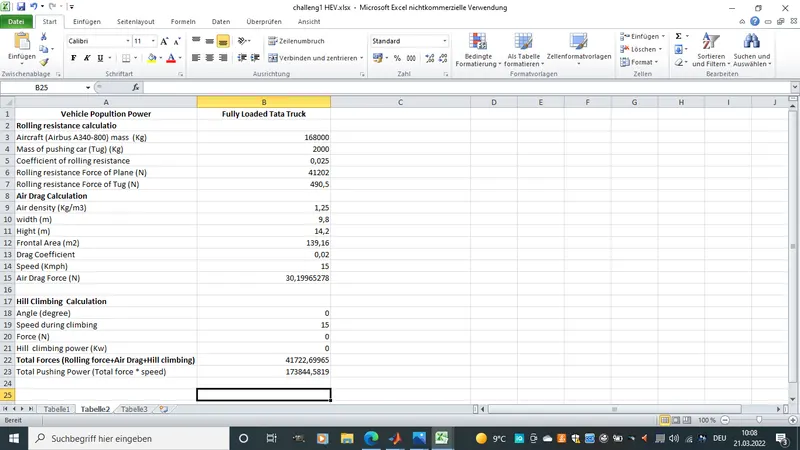
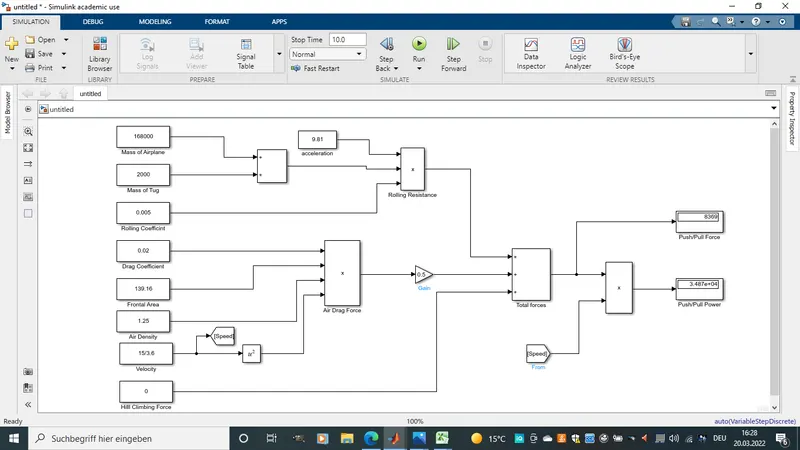
from above calculations total force needed by the Tug is 41.72KN and Power to push the plane is 173.8Kw
B. Develop the model for the calculated force and power using Simulink.
*For the model below the Constant blocks used the same constant value as our calcultion on the excel table above. We can see that the answers (force and power) have both the same value.
7. A. Design an electric powertrain with type of motor, it’s power rating, and energy requirement to fulfill aircraft towing application in Simulink. Estimate the duty cycle range to control the aircraft speed from zero to highest. Make all required assumptions. Prepare a table of assumed parameters. Draw a block diagram of powertrain.
(Hint :DC7 Block)
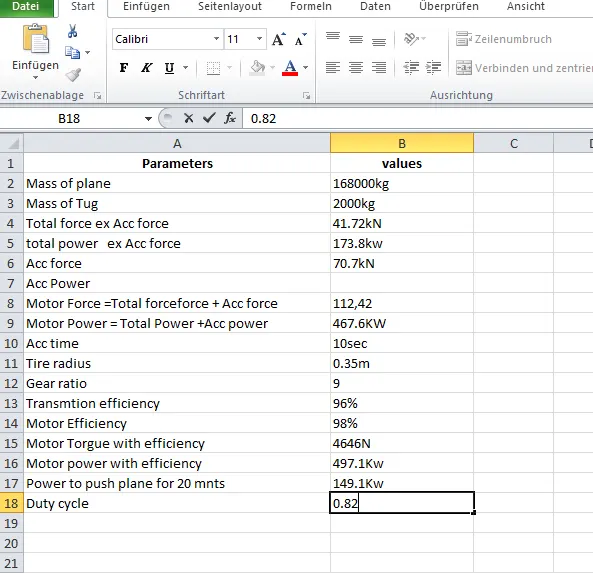
For further calculations in this question session i will consider the data values in above question 6. Hence to the above datas will be added.
acceleration time from 0 to 15km/h = 10s
Radius of will of Tug = 0.35m
gear ratio G = 9
Transmision efficiency = 96%
Motor Efficiency = 98%
Motor Torgue = Torgue on wheel /Gear ratio
*Since both vehicles will accelerate from 0 to to speed Acceleration force will be added to above total force
Fa = m*(v/t) = (168000+2000)*(4.16/10) = 70.7K
Motor Torgue Tm = (Fr*r)/G from our above calculations total force needed was 41.72kN
*Tm = ((41.72k+70.7k)*0.35)/(9*0.96) = 4554Nm Since our motor has an efficiency of 98%
Tm = 4554Nm / 0.98 = 4646Nm
total power to push the plane is (41.7KN+70.72KN)*4.16ms =467.6KW
*The total power required by the motor is 467.6kw/(0.98*0.96) = 497KW
*Hence we need a Motor capable of at least 500kw (100V, 600A)
Po=V*A =900*600=600Kw
Duty cycle = Po/Pi = 497kw/540kw = 0.82
*Assumting the pushing lasts for 20mnts (0.3hrs), power consumed from battery is
497kw*0.3hr = 149.1kw.
Hence Pushing power = 149.1KW
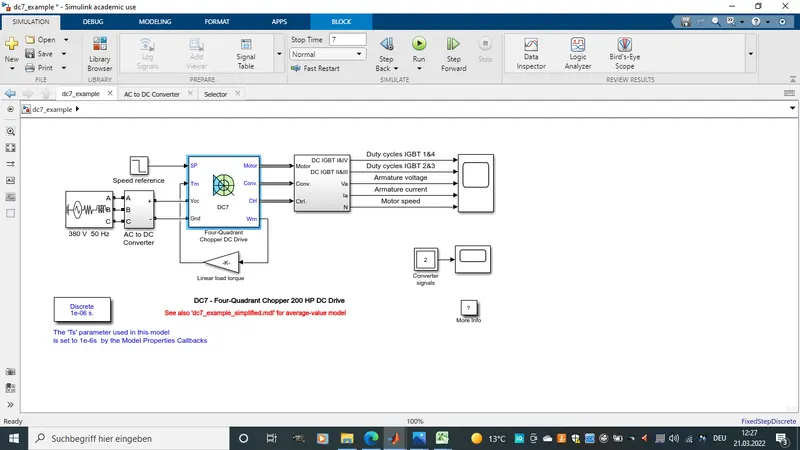
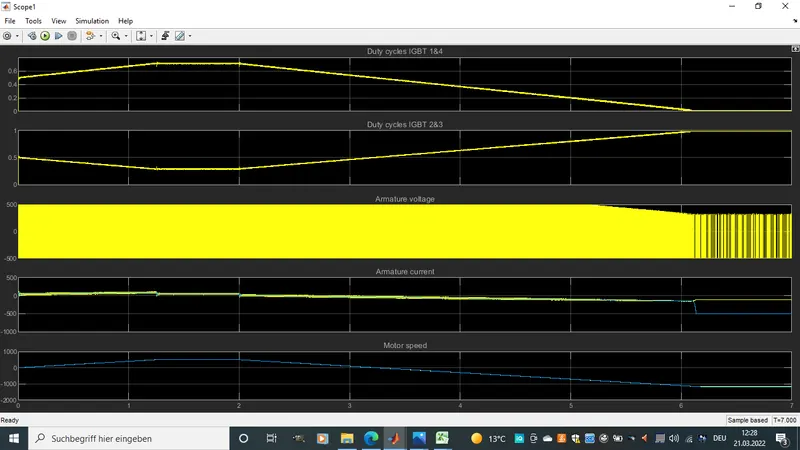
For the above model the simulation was set to run for 7sec
B. Also, Design the parameters in excel sheet.
*Here the above calculated parameters where entered into an excel sheet