Project-1: Powertrain for aircraft in runways
1. Search and list out the total weight of various types of aircraft:
Ans:
Objective: To list out the total weight of various types of aircraft.
| Aircraft Type | Weight (kg) | Image |
| Glider | 110 - 200 | |
| Powered Lift | 160 | |
| Fighter Aircrafts | 13500 | |
| Transport Planes | 250000 | |
| Aerobatic Planes (Aerodyne) | 771 |
Similarly, aircraft can be classified as:
A. Heavier-than-Air:
This type of aircraft must have a power source to provide the thrust necessary to obtain lift. Simple heavier-than-air craft includes kites.
These are usually a flat-surfaced structure, often with a stabilizing “tail,” attached by a bridle to a string that is held in place on the ground. Lift is provided by the reaction of the string-restrained surface to the wind.
B. Lighter-than-Air:
Aircraft such as balloons, nonrigid airships, and dirigibles are designed to contain within their structure a sufficient volume that, when filled with a gas lighter than air (heated air, hydrogen, or helium), displaces the surrounding ambient air and floats, just as cork does on the water.
Balloons are not steerable and drift with the wind. Nonrigid airships, which have enjoyed a rebirth of use and interest, do not have a rigid structure but have a defined aerodynamic shape, which contains cells filled with the lifting agent.
They have a source of propulsion and can be controlled in all three axes of flight. Dirigibles are no longer in use, but they were lighter-than-air craft with a rigid internal structure, which was usually very large, and they were capable of relatively high speeds.
------------------------------------------------------------------------------------------------------------------
2. Is there any difference between ground speed and air speed?
Ans:
Objective: To list of the difference between ground speed and air speed, if any.
| Ground Speed | Air Speed |
| It is the airplane`s speed relative to the surface of the earth. |
It is the speed relative to the Air it is flying in. |
| It determines how fast the aircraft will reach to it's destination. | It determines whether there is enough airflow available around the aircraft to fly. |
| Ground Speed = Air Speed + Wind Speed | Air Speed = Ground Speed - Wind Speed |
So, the answer is; there is a difference between Ground Speed and Air Speed.
------------------------------------------------------------------------------------------------------------------
3. Why is it not recommended to use aircraft engine power to move it on the ground at Airport?
Ans:
Objective: To list the reason that Why is it not recommended to use aircraft engine power to move it on the ground at Airport.
A. Reasons for not using the aircraft engine power to move it on the ground at the airport:
1. Taxiing, sometimes called “taxying”, refers to an aircraft’s movement while on the ground, under its own power. This term excludes the accelerating run along a runway before take-off and the decelerating run immediately upon landing.
2. By using jet engines as an aircraft’s primary thrust for taxiing, airlines are expending huge amounts of jet fuel while still on the ground, which could be much better used for flying. With the Cost of Fuel being their single biggest expense, many airlines plan to adopt electric taxiing to save fuel and reduce environmental impacts.
3. Electric taxiing systems use electric motors fitted inside the wheels of the aircraft’s landing gear. Electric power is supplied to these motors by an onboard Auxiliary Power Unit (APU). This innovative new approach enables airplanes to move backward and forward solely under electric power. This way, aircrafts can avoid reliance on main engines for traversing the airport taxiways while burning fuel unnecessarily.
4. Benefits of Electric Taxiing:
- Extended lifespan of aircrafts’ main jet engines
- No damage from foreign objects sucked into engines during taxiing
- Improved health and safety of groundcrew
- Decarbonizing of air transport
- Reduction of air pollutants such as carbon monoxide (CO), carbon dioxide (CO2), nitrogen oxides (NOX) and unburned hydrocarbons (UHC).
-------------------------------------------------------------------------------------------------------------------
4. How an aircraft is pushed to runway when its ready to take off?
Ans:
Objective: To list out the procedure of an aircraft pushing to runway when its ready to take off.
- Pushback is when an aircraft is pushed backwards away from the airport gate by vehicles called tugs or tractors.
- Closer to departure, an aircraft tug will park right in front of the nose wheel. The tug might be directly attached to the plane's nose gear with a tow bar, or could be a "wheel-lift" tug.
------------------------------------------------------------------------------------------------------------------
5. Learn about take off power, tyre design, rolling resistance, tyre pressure, brake forces when landing:
Ans:
Objective: To Learn about take off power, tyre design, rolling resistance, tyre pressure and brake forces.
A. Take-off power:
Take off performance can be predicted using a simple measure of the acceleration of the aircraft along the runway based on force equilibrium.
The forces involved will be,
T – Thrust of propulsion system pushing aircraft along runway.
D – Aerodynamic Drag of vehicle resisting the aircraft motion.
F – Rolling resistance friction due to the contact of wheels or skids on the ground.
During take-off run the imbalance in these forces will produce an acceleration along the runway.
where dV/dt is the acceleration along the runway,
m is the mass of the vehicle.
To maintain level flight the lift produced must equal the weight, hence the stall speed can be calculated as,
B. Tyre Design:
C. Rolling Resistance:
The friction between aircraft and runway will be proportional to the normal force exerted by the aircraft on the runway.
The normal force will be the difference between Weight of aircraft and Lift, the friction coefficient will be typically of a magnitude of 0.02 for a standard tarmac runway.
D. Tyre Pressure:
Tyre pressure is a measurement of how much air is in your pneumatic tyre, and ensures the tyres wear evenly and maintain the correct level of grip on the road surface.
This is commonly expressed as PSI, or pounds-per-square-inch.
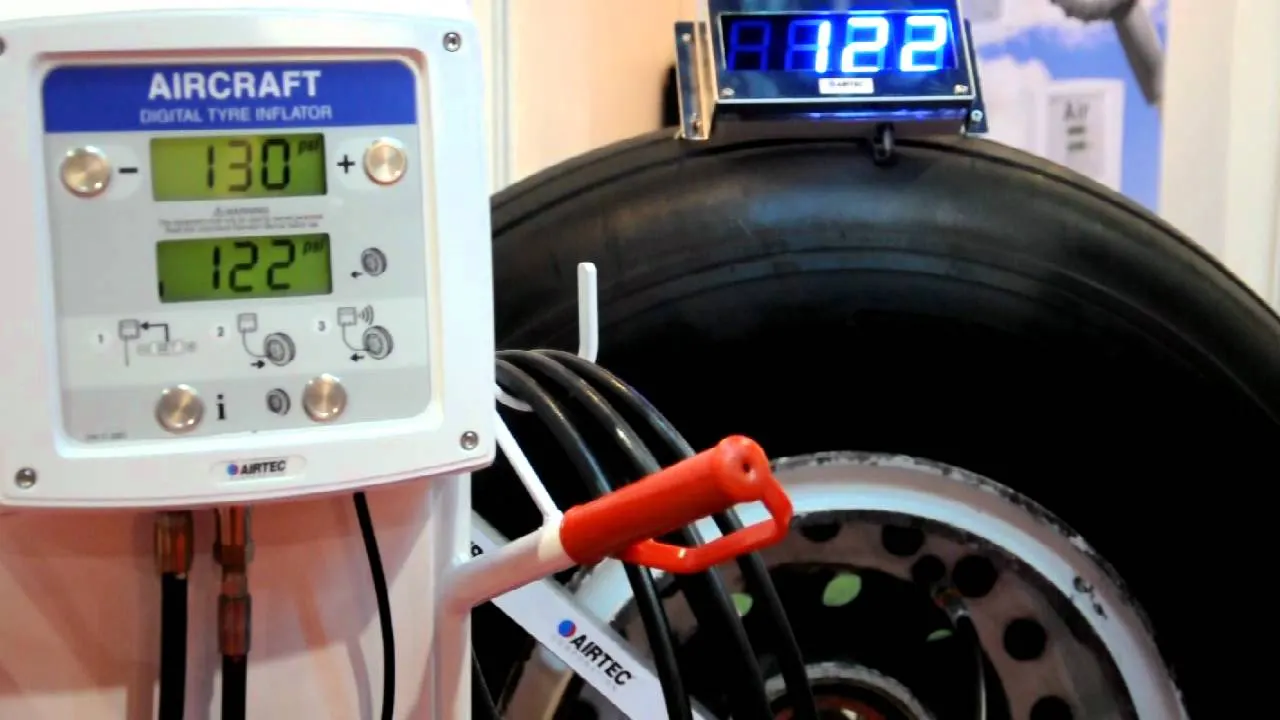
Tyre pressures are often displayed for when the tyres are cold and you haven’t driven far on them. As you drive down the road the air inside a tyre builds up, changing the pressure reading, so this is why you should check your tyre pressure psi before you hit the highway.
E. Landing:
The landing run can be calculated in a similar fashion to the take off distance. The aim is again to minimise the distance.
The deceleration on the landing roll from VTD to V0 will be accomplished by braking and reverse thrust. This can be solved by the average acceleration approach that was used to estimate the take-off roll.
The negative acceleration or deceleration value will be based on the friction coefficient for maximum braking and the value of reverse thrust (if available).
-------------------------------------------------------------------------------------------------------------------
6. With necessary assumptions, calculate the force and power required to push/pull an aircraft by a towing vehicle:
Ans:
Objective: To calculate the force and power required to push/pull an aircraft by a towing vehicle.
A. Rolling Resistance Calculation:
Fr = m.g.c
where;
Fr = Force due to rolling resistance,
m = rolling mass,
g = acceleration due to gravity,
c = coefficient of rolling resistance.
Fr = m.g.c
Fr = 0.005*40000*9.81
Fr = 1962N
B. Rolling Resistance with Towing Vehicle Calculation:
Fr = m.g.c
Fr = 0.002*66000*9.81
Fr = 1294.92N
C. Drag Force Calculation:
D = 1/2(C.R.A.V^2)
where;
D = Drag Force,
C = Drag Coefficient,
R = Constant,
A = Frontal Area,
V = Velocity of the towing vehicle.
D = 1/2(C.R.A.V^2)
D = 1/2(0.22*1.25*2*25)
D = 1/2(13.75)
D = 6.875N
D. Total Push Force Calculation:
Total Push Force = Rolling Resistance Force + Rolling Resistance Force with Towing Vehicle + Drag Force
Total Push Force = 1962 + 1294.92 + 6.875
Total Push Force = 3263.795N
E. Torque Calculation:
Torque = Force*Radius
Torque = 3263.795*0.4
Torque = 1305.518N-m
F. Power required to Pull the aircraft Calculation:
Power = Force*Velocity
Power = 3263.795*5
Power = 16318.975W = 16.319kW
------------------------------------------------------------------------------------------------------------
7. Design an electric powertrain with type of motor, it’s power rating, and energy requirement to fulfill aircraft towing application. Estimate the duty cycle range to control the aircraft speed from zero to highest. Make all required assumptions. Prepare a table of assumed parameters. Draw a block diagram of powertrain:
Ans:
Objective: To design an electric powertrain with the parameters required as listed above.
A. Electric Vehicle Powertrain Components:
The powertrain is a set of components that generate the power required to move the vehicle and deliver it to the wheel.
1. Battery Pack
2. DC - AC Converter (Inverter)
3. Electric Motor
4. On-board Charger
Apart, from the above mentioned parts, there are certain hardware and software parts like BMS others etc.
B. Motor Calculation:
| Feature | Value |
| Motor Type | BLDC |
| Rated Power | 25kW |
| Peak Power | 50kW |
| Speed | 5000rpm |
| Rated Torque | 80Nm |
| Peak Torque | 160Nm |
| Efficiency | 85% |
C. Power Calculation:
| Feature | Value |
| Rated Power | 25kW |
| Peak Power | 50kW |
| Converter | DC-AC |
| Input Voltage | 349V |
| Input Current | 70A |
| Power Input | 24.30kW |
D. Energy Requirement:
| Feature | Value |
| Power Input | 24.30kW |
| Time Taken | 15min |
| Energy | 6.075kW |
E. Duty Cycle:
| Feature | Value |
| Power Input | 24.30kW |
| Power Output | 19.94kW |
| Duty Cycle | 0.82% |
F. Block Diagram of an EV Powertrain:
-----------------------------------------------------------------------------------------------------------------