Project-1: Powertrain for aircraft in runways
Powertrain for aircraft in runways
Objectives :
1. Search and list out the total weight of various types of aircrafts.
INTRODUCTION
The choice of an aircraft is predicated upon the requirements of its mission and specific operating economics. Each aircraft type has unique capabilities and limitations that dictate its optimum deployment within a carrier’s network. One method employed by airlines to assess aircraft selection involves the evaluation of its payload and range performance. Ideally, there should be a match between the stage lengths in an airline’s network and the optimum payload-range of the aircraft employed. This report
discusses the components that affect aircraft payload-range performance, which includes analysis of the airplane operating weights and fundamentals of interpreting its associated payload-range diagram
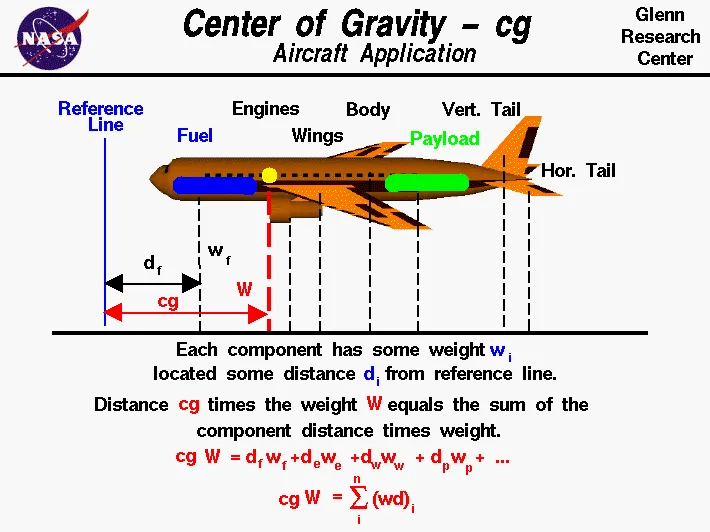
- The aircraft gross weight (also known as the all-up weight and abbreviated AUW) is the total aircraft weight at any moment during the flight or ground operation.
- An aircraft's gross weight will decrease during a flight due to fuel and oil consumption. An aircraft's gross weight may also vary during a flight due to payload dropping.
- At the moment of releasing its brakes, the gross weight of an aircraft is equal to its takeoff weight. During flight, an aircraft's gross weight is referred to as the en-route weight or in-flight weight.
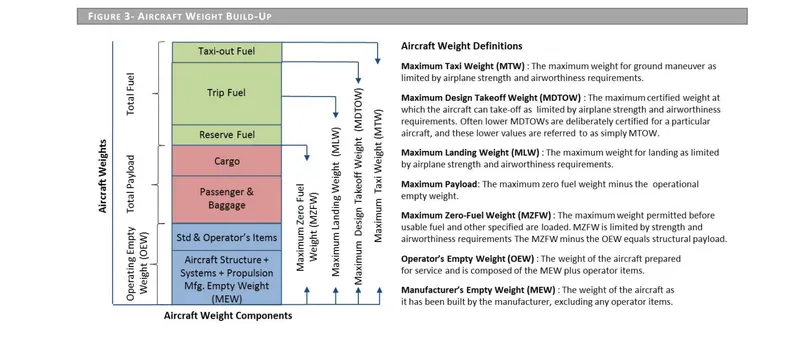
MTOW = Maximum take-off weight, MLW = Maximum landing weight, TOR = Take-off run (SL, ISA+15°, MTOW), LR = Landing run (SL, ISA+15°, MLW)
| Type | MTOW [kg] | MLW [tonnes] | TOR [m] | LR [m] | ICAO category | FAA category |
|---|---|---|---|---|---|---|
| Antonov An-225 | 640,000 | 591.7 | 3500 | Heavy | Super | |
| Scaled Composites Model 351 Stratolaunch | 589,670 | 3660 | Heavy | Super | ||
| Airbus A380-800[1][2][3] | 575,000 | 394 | 3100 | 1930 | Super | Super |
| Boeing 747-8F | 447,700 | 346.091 | 3100 | 1800 | Heavy | Heavy |
| Boeing 747-8 | 443,613 | 306.175 | 3100 | Heavy | Heavy | |
| Boeing 747-400ER | 412,770 | 295.742 | 3090 | Heavy | Heavy | |
| Antonov An-124-100M | 405,060 | 330 | 2520 | 900 | Heavy | Heavy |
| Boeing 747-400 | 396,900 | 295.742 | 3018 | 2179 | Heavy | Heavy |
| Lockheed C-5 Galaxy[4][5][6] | 381,000 | 288.417 | 2530 | 1494 | Heavy | Heavy |
| Boeing 747-200[7] | 377,840 | 285.700 | 3338 | 2109 | Heavy | Heavy |
| Boeing 747-300[7] | 377,840 | 260.320 | 3222 | 1905 | Heavy | Heavy |
| Airbus A340-500[8] | 371,950 | 240 | 3050 | 2010 | Heavy | Heavy |
| Airbus A340-600[8] | 367,400 | 256 | 3100 | 2100 | Heavy | Heavy |
| Boeing 777F | 347,800 | 260.816 | 2830 | Heavy | Heavy | |
| Boeing 777-300ER | 351,800 | 251.29 | 3100 | Heavy | Heavy | |
| Boeing 777-200LR | 347,450 | 223.168 | 3000 | Heavy | Heavy | |
| Boeing 747-100[7] | 340,200 | 265.300 | Heavy | Heavy | ||
| Airbus A350-1000 | 308,000 | 233.5 | Heavy | Heavy | ||
| Boeing 777-300 | 299,370 | 237.683 | 3380 | Heavy | Heavy | |
| Boeing 777-200ER | 297,550 | 213.00 | 3380 | 1550 | Heavy | Heavy |
| Airbus A340-300[8][9] | 276,700 | 190 | 3000 | 1926 | Heavy | Heavy |
| McDonnell Douglas MD-11 | 273,300 | 185 | 2990 | 1890 | Heavy | Heavy |
| Airbus A350-900 | 270,000 | 175 | 2670 | 1860 | Heavy | Heavy |
| Ilyushin Il-96M | 270,000 | 195.04 | 3115 | 2118 | Heavy | Heavy |
| McDonnell Douglas DC-10 | 256,280 | 183 | 2990 | 1890 | Heavy | Heavy |
| Boeing 787-9[10] | 254,000 | 192.777 | 2900 | Heavy | Heavy | |
| Boeing 787-10[10] | 254,000 | 201.849 | Heavy | Heavy | ||
| Airbus A340-200[8][11] | 253,500 | 181 | 2990 | Heavy | Heavy | |
| Airbus A330-900 | 251,000 | 191,000 | 3100 | Heavy | Heavy | |
| Ilyushin IL-96-300 | 250,000 | 175 | 2600 | 1980 | Heavy | Heavy |
| Airbus A330-300[12][13] | 242,000 | 185 | 2500 | 1750 | Heavy | Heavy |
| Airbus A330-200[12][13] | 242,000 | 180 | 2220 | 1750 | Heavy | Heavy |
| Lockheed L-1011-500 | 231,300 | 166.92 | 2636 | Heavy | Heavy | |
| Boeing 787-8[10] | 228,000 | 172.365 | 3300 | 1695 | Heavy | Heavy |
| Lockheed L-1011-200 | 211,400 | Heavy | Heavy | |||
| Ilyushin IL-86 | 208,000 | 175 | Heavy | Heavy | ||
| Boeing 767-400ER | 204,000 | 158.758 | 3414 | Heavy | Heavy | |
| Airbus A300-600R[14] | 192,000 | 140 | 2385 | 1555 | Heavy | Heavy |
| Boeing 767-300ER | 187,000 | 136.08 | 2713 | 1676 | Heavy | Heavy |
| Concorde | 185,000 | 111.1 | 3440 | 2220 | Heavy | Heavy |
| Airbus A300-600[14] | 163,000 | 138 | 2324 | 1536 | Heavy | Heavy |
| Boeing 767-300 | 159,000 | 136.078 | 2713 | 1676 | Heavy | Heavy |
| Airbus A310-300[14] | 157,000 | 124 | 2290 | 1490 | Heavy | Heavy |
| Vickers VC10 | 152,000 | 151.9 | Heavy | Heavy | ||
| Boeing 707-320B[15] | 151,000 | 97.5 | Heavy | Heavy | ||
| Boeing 707-320C[15] | 151,000 | 112.1 | Heavy | Heavy | ||
| Douglas DC-8-61 | 147,000 | Heavy | Heavy | |||
| Airbus A310-200[14] | 142,000 | 123 | 1860 | 1480 | Heavy | Heavy |
| Airbus A400M | 141,000 | 122 | 980 | 770 | Heavy | Heavy |
| Douglas DC-8-32 | 140,000 | Heavy | Heavy | |||
| Douglas DC-8-51 | 125,000 | Medium | Large | |||
| Boeing 757-300 | 124,000 | 101.6 | 2550 | 1750 | Medium | Large |
| Boeing 707-120B[15] | 117,000 | 86.3 | Medium | Large | ||
| Boeing 757-200 | 116,000 | 89.9 | 2347 | 1555 | Medium | Large |
| Boeing 720B[16] | 106,000 | 79.5 | Medium | Large | ||
| Boeing 720[16] | 104,000 | 79.5 | Medium | Large | ||
| Tupolev Tu-154M | 104,000 | 80 | Medium | Large | ||
| Tupolev Tu-204SM | 104,000 | 87.5 | 2250 | Medium | Large | |
| Convair 880 | 87,500 | Medium | Large | |||
| Boeing 737-900 | 85,000 | 66.36 | 2500 | 1704 | Medium | Large |
| Boeing 737-900ER | 85,000 | 71.35 | 2804 | 1829 | Medium | Large |
| Boeing 727-200 Advanced[17] | 84,000 | 70.1 | Medium | Large | ||
| Airbus A321-100[18] | 83,000 | 77.8 | 2200 | 1540 | Medium | Large |
| Boeing 737-800 | 79,000 | 65.32 | 2308 | 1634 | Medium | Large |
| Boeing 727-200[17] | 78,000 | 68.1 | Medium | Large | ||
| McDonnell-Douglas MD-83 | 73,000 | 63.28 | Medium | Large | ||
| Boeing 727-100[17] | 72,500 | 62.4 | Medium | Large | ||
| Boeing 727-100C[17] | 72,500 | 62.4 | Medium | Large | ||
| McDonnell-Douglas MD-90-30 | 71,000 | 64.41 | 2165 | 1520 | Medium | Large |
| de Havilland Comet 4 | 70,700 | Medium | Large | |||
| Boeing 737-700 | 70,000 | 58.06 | 1921 | 1415 | Medium | Large |
| Airbus A320-100[18] | 68,000 | 66 | 1955 | 1490 | Medium | Large |
| Boeing 737-400 | 68,000 | 54.9 | 2540 | 1540 | Medium | Large |
| de Havilland Comet 3 | 68,000 | Medium | Large | |||
| Boeing 377 | 67,000 | Medium | Large | |||
| Boeing 737-600 | 66,000 | 54.66 | 1796 | 1340 | Medium | Large |
| Airbus A220-300 | 65,000 | 57.61 | 1890 | 1494 | Medium | Large |
| Hawker Siddeley Trident 2E | 65,000 | Medium | Large | |||
| Airbus A319[18] | 64,000 | 62.5 | 1850 | 1470 | Medium | Large |
| Boeing 737-300 | 63,000 | 51.7 | 1939 | 1396 | Medium | Large |
| Boeing 737-500 | 60,000 | 49.9 | 1832 | 1360 | Medium | Large |
| Airbus A220-100 | 59,000 | 50.80 | 1463 | 1356 | Medium | Large |
| Airbus A318[18] | 59,000 | 57.5 | 1375 | 1340 | Medium | Large |
| Boeing 717-200HGW | 55,000 | 47.174 | 1950 | Medium | Large | |
| Douglas DC-7 | 55,000 | Medium | Large | |||
| de Havilland Comet 2 | 54,000 | Medium | Large | |||
| Boeing 717-200BGW | 50,000 | 46.265 | 1950 | Medium | Large | |
| de Havilland Comet 1 | 50,000 | Medium | Large | |||
| Douglas DC-6A | 48,600 | Medium | Large | |||
| Douglas DC-6B | 48,500 | Medium | Large | |||
| Embraer 190[19] | 48,000 | 43 | 2056 | 1323 | Medium | Large |
| Caravelle III | 46,000 | Medium | Large | |||
| Fokker 100 | 46,000 | 39.95 | 1621 | 1350 | Medium | Large |
| Douglas DC-6 | 44,000 | Medium | Large | |||
| Avro RJ-85 | 42,000 | 36.74 | Medium | Large | ||
| Handley Page Hermes | 39,000 | Medium | Large | |||
| Embraer 175[20] | 37,500 | 32.8 | 2244 | 1304 | Medium | Large |
| Bombardier CRJ900[21] | 36,500 | 33.345 | 1778 | 1596 | Medium | Large |
| Embraer 170[22] | 36,000 | 32.8 | 1644 | 1274 | Medium | Large |
| Bombardier CRJ700 | 33,000 | 30.39 | 1564 | 1478 | Medium | Large |
| Douglas DC-4 | 33,000 | Medium | Large | |||
| Vickers Viscount 800 | 30,400 | Medium | Large | |||
| Bombardier Q400 | 28,000 | 28.01 | 1219 | 1295 | Medium | Large |
| Bombardier CRJ200 | 23,000 | 21.319 | 1918 | 1479 | Medium | Large |
| ATR 72-600 | 22,800 | 22.35 | 1333 | 914 | Medium | Large |
| Saab 2000 | 22,800 | 21.5 | 1300 | Medium | Large | |
| Embraer ERJ 145 | 22,000 | 19.3 | 2270 | 1380 | Medium | Large |
| ATR 42-500 | 18,600 | 18.3 | 1165 | 1126 | Medium | Small |
| Saab 340 | 13,150 | 12.930 | 1300 | 1030 | Medium | Small |
| Embraer 120 Brasilia | 11,500 | 11.25 | 1560 | 1380 | Medium | Small |
| BAe Jetstream 41 | 10,890 | 10.570 | 1493 | 826 | Medium | Small |
| Learjet 75[23] | 9,752 | 8.709 | 1353 | 811 | Medium | Small |
| Pilatus PC-24[24] | 8,300 | 7.665 | 893 | 724 | Medium | Small |
| Embraer Phenom 300[25] | 8,150 | 7.65 | 956 | 677 | Medium | Small |
| Beechcraft 1900D | 7,765 | 7.605 | 1036 | 853 | Medium | Small |
| Cessna Citation CJ4[26] | 7,761 | 7.103 | 1039 | 896 | Medium | Small |
| de Havilland Hercules | 7,000 | Medium | Small | |||
| Embraer Phenom 100 | 4,800 | 4.43 | 975 | 741 | Light | Small |
2.find out Is there any difference between ground speed and air speed?
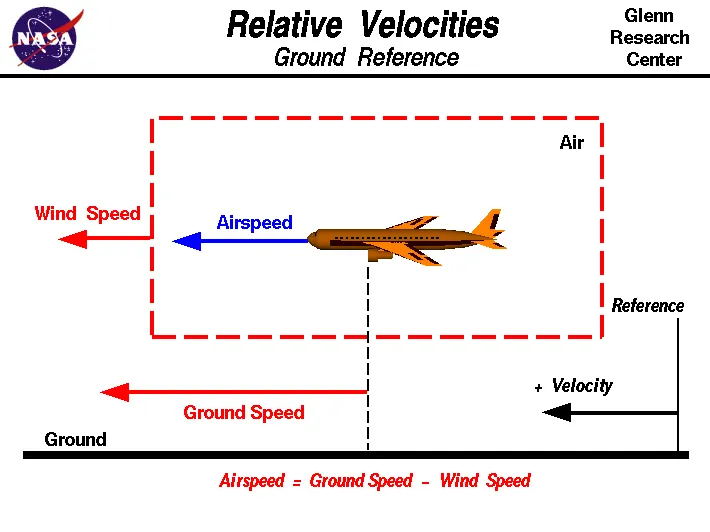
Wind Speed
For a reference point picked on the ground, the air moves relative to the reference point at the wind speed. Notice that the wind speed is a vector quantity and has both a magnitude and a direction. Direction is important. A 20 mph wind from the west is different from a 20 mph wind from the east. The wind has components in all three primary directions (north-south, east-west, and up-down). In this figure, we are considering only velocities along the aircraft's flight path. A positive velocity is defined to be in the direction of the aircraft's motion. We are neglecting cross winds, which occur perpendicular to the flight path but parallel to the ground, and updrafts and downdrafts, which occur perpendicular to the ground.
Ground Speed
For a reference point picked on the ground, the aircraft moves relative to the reference point at the ground speed. Ground speed is also a vector quantity so a comparison of the ground speed to the wind speed must be done according to rules for vector comparisons.
Airspeed
The important quantity in the generation of lift is the relative velocity between the object and the air, which is called the airspeed. Airspeed cannot be directly measured from a ground position, but must be computed from the ground speed and the wind speed. Airspeed is the vector difference between the ground speed and the wind speed.
Airspeed = Ground Speed - Wind Speed
On a perfectly still day, the airspeed is equal to the ground speed. But if the wind is blowing in the same direction that the aircraft is moving, the airspeed will be less than the ground speed.
3. Why is it not recommended to use aircraft engine power to move it on the ground at Airport?
Unlike ground based vehicles, airplanes do not have a direct connection between the engine power and the wheels. The engines of an aircraft produce a thrust by sucking in air from the front and accelerating it backwards through a jet engine or propeller. This thrust action is what allows the aircraft to move forward. Whether an aircraft is travelling in the air or on the ground, the way in which it uses the propulsive power from the jet engines is the same whether it has to move forwards or backwards. This means to say that an aircraft uses its jet engines for propulsion in the air and on the ground.
Pushback is the procedure in which a tug vehicle is towed to the front of the airplane and are used to help reverse the airplane to tug it to a safe distance from the terminal/gate before takeoff. Tug vehicles are used for this purpose because even though they have a small size compared to the airplane, they have high torque and mass. In spite of using the tug vehicles for the pushback procedure, the engines of an airplane are more than capable of performing this procedure on their own. This can be done by using a 'reverse thrust' wherein the blades of the propeller are twisted in order for them to be able to take in air from behind the aircraft as opposed to the front and accelerate it forward. In this way, the airplane can use this propulsive power to move backwards however, it is very rarely used.
This is because using the reverse thrust to push back from the terminal/gate consumes a lot of engine power and is also a very noisy operation when done on the ground. The usage of reverse thrust to push back from the terminal/gate is also potentially hazardous. This is because the usage of the reverse thrust can cause debris to blow toward the airplane which creates a foreign object hazard. This foreign object hazard is dangerous in many ways. For instance, the ground staff are at risk, because the reverse thrust can create an air flow which can blow them away and damage their ground operations equipment. The passengers in the airplane are also at risk because the debris can damage the jet engines of the aircraft which can create a fire hazard that can create an explosion due to the flammability of the fuel. The debris can also pose a risk to the potential passengers waiting at the terminal/gate because it can break through the glass windows. Due to the possible dangers, the tug vehicle is used for reversing the airplane until it is a safe distance from the terminal/gate and the airport ground staff. By using the taxiing vehicle, the fuel can be saved, and it can save the lives of the ground staff and their equipment and people at the terminal/gate.
In addition, some airplanes e.g. A380s or 747s, are very huge in size and their pilots would have great difficulty in reversing their airplanes from the terminal/gate. The person who maneuvers the tug vehicle has better visibility of the ground and will be more aware of the space around the airplane. Because of this, it is better that for the push back from the terminal/gate, a tug vehicle is used. From here, the airplane will use its own engine power to propel itself along the runway and this continues on to takeoff as well.
4. How an aircraft is pushed to runway when its ready to take off?
Push Back
- In aviation, pushback is an airport procedure during which an aircraft is pushed backwards away from an airport gate by external power. Pushbacks are carried out by special, low-profile vehicles called pushback tractors or tugs.
- Pushbacks at busy aerodromes are usually subject to ground control clearance to facilitate ground movement on taxiways. Once clearance is obtained, the pilot will communicate with the tractor driver to start the pushback. To communicate, a headset may be connected near the nose gear.
- Since the pilots cannot see what is behind the aircraft, steering is done by the pushback tractor driver and not by the pilots. Depending on the aircraft type and airline procedure, a bypass pin may be temporarily installed into the nose gear to disconnect it from the aircraft's normal steering mechanism.
- Once the pushback is completed, the towbar is disconnected, and any bypass pin removed. The ground handler will show the bypass pin to the pilots to make it clear that it has been removed. The pushback is then complete, and the aircraft can taxi forward under its own power.
Taxiing
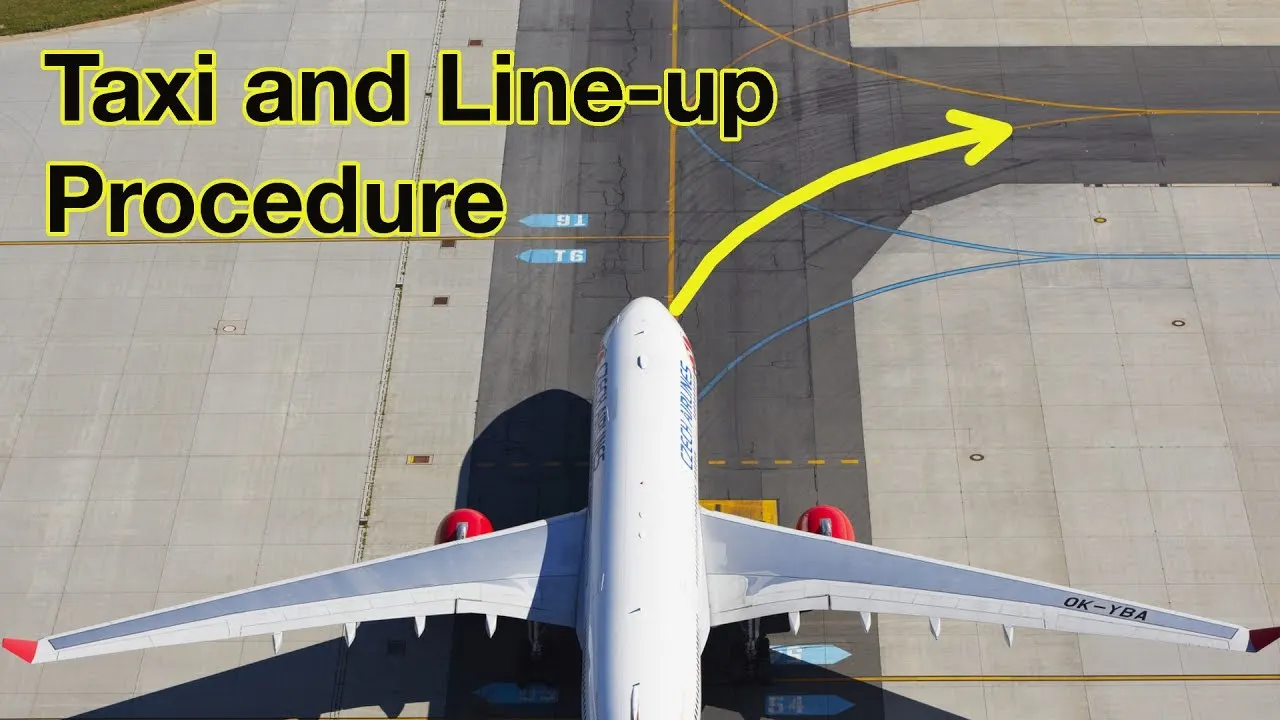
- Taxiing refers to the movement of an aircraft on the ground, under its own power. The aircraft moves on wheels. An airplane uses taxiways to taxi from one place on an airport to another; for example, when moving from a terminal to the runway.
- The aircrafts always moves on the ground following the yellow lines, to avoid any collision with the surrounding buildings, vehicles or other aircrafts. The taxiing motion has a speed limit. Before making a turn, the pilot reduces the speed further to prevent tire skids. Just like cars, there is a certain list of priorities during taxiing. The aircrafts that are landing or taking off have higher priority. The other aircrafts have to wait for these aircrafts before they start or continue taxiing.
- The thrust to propel the aircraft forward comes from its propellers or jet engines. Steering is achieved by turning a nose wheel or tail wheel/rudder; the pilot controlling the direction travelled with their feet. The use of engine thrust near terminals is restricted due to the possibility of jet blast damage. This is why the aircrafts are pushed back from the buildings by a vehicle before they can start their own engines for taxiing.
5. Learn about take off power, tyre design, rolling resistance, tyre pressure, brake forces when landing.
Take of power :
- Take off Power is the phase of flight in which an aerospace vehicle leaves the ground and becomes airborne On take-off, in order to position the aircraft to a safe height away from terrain and obstacles the engine thrust is set to a high ‘take-off power’ setting and the aircraft attitude is pitched up by to maintain a specific speed by fulfilling the task is know as the take off power.
- Take off performance can be predicted using a simple measure of the acceleration of the aircraft along the runway based on force equilibrium.
The forces involved will be,
T – Thrust of propulsion system pushing aircraft along runway.
D – Aerodynamic Drag of vehicle resisting the aircraft motion.
F – Rolling resistance friction due to the contact of wheels or skids on the ground.
During take-off run the imbalance in these forces will produce an acceleration along the runway.
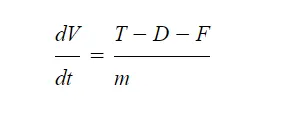
where dV/dt is the acceleration along the runway and m is the mass of the vehicle.
Whereas, Power = ( T - D - F ) V
tyre design
- An aircraft tire or tyre is designed to withstand extremely heavy loads for short durations. The number of tires required for aircraft increases with the weight of the aircraft, as the weight of the airplane needs to be distributed more evenly. Aircraft tire tread patterns are designed to facilitate stability in high crosswind conditions, to channel water away to prevent hydroplaning, and for braking effect.
- A tyre is made from rubberized fabric piles over a rubber liner and the edges of the piles are wrapped around a wire bead, which holdsthe tyre to the wheel rim. The fabric piles are covered with a rubber compound tread and a different rubber compound for the side walls. The tyre is cured in a mould to vulcanize the parts into a single unit and form the tread design.
- Unlike an automobile or truck tyre, it does not have to carry a load for a long period of continuous operation. However, an aircraft tyre absorbs the high impact loads of landing and also it’s operating at high speeds for a short time when required.
- Aircraft tyres may be Radial or Bias – Almost all airliners are using Radial tyre. Bias is an older design, and it’s mainly used for road vehicles. Radial tyres have the word RADIAL on the sidewall. Radial tires are more expensive than bias-ply tyres. Radial tires are in demand because of their lower life cycle cost and long term value.
rolling resistance
The rolling resistance or rolling friction is a force that resists the motion of a body that rolls on a surface. In the case of aircrafts, the rolling resistance force exists between the aircraft tires and the runway surface it rolls upon. For a given body, its rolling resistance is mathematically expressed as the product of the coefficient of rolling resistance and the normal force, which is the force that is acting perpendicularly to the surface on which rolling action occurs.
Frr=urr*N
Where
Rolling resistance - Frr
Coefficient of rolling resistance - μ
Normal Force - N
The above expression for the rolling resistance can only be considered when there are no other vertical forces acting on the rolling body. However during takeoff, we must consider the effect of the lift force as well. In this case, the normal force would be equal to the difference between the weight of the aircraft acting on the tire and the lift force acting on the wheel. This can be written mathematically as:
Frr=μrr⋅(W−L)
In general, a standard tarmac runway is considered to have a coefficient of rolling resistance of 0.02.
tyre pressure
- Aircraft tires are inflated with an inert gas and the most commonly used is Nitrogen. Inert gases are used for inflation because they are non – reactive and not flammable.
- Aircraft tires operate at such high extremes of pressure, load, and speed, their care and service is critically important. The most important action an operator can take to prevent tire-related events is to maintain proper tire inflation pressure.
- Aircraft tires are usually inflated with nitrogen to minimize expansion and contraction from extreme changes in ambient temperature and pressure experienced during flight.Dry nitrogen expands at the same rate as other dry atmospheric gases,but common compression air source may contain moisture,which increases the expansion rate expansion rate with temperature.
- Aircraft tires generally operate at high pressure, up to 200psi(14 bar.1400 kPa) for airliners and even higher for business jets.
- The main landing gear on the concorde was typically inflated to 232 psi (16.0 bar), whilst its tail bumper gear tires were as high as 294 psi (20.3 bar).
- Tests of airliner aircraft tires have shown that they are able to sustain pressures of maximum 800 psi (55 bar; 5,500 kPa) before bursting. During the tests the tires have to be filled with water, to prevent the test room being blown apart by the energy that would be released by a gas when the tire bursts.
brake forces when landing
- All The commercial aircraft have automatic brake systems. Just like a car, these systems also have Anti-Lock Braking System(ABS) that prevents the tires from sliding down a wet runway.
- The advantage of the automatic brake system is that the aircraft brakes comfotably at a constant deceleretion. Pessengers experience a constant force that presses them into their seats.
- The brake system automatically applies the wheel brakes just enough to create a constant deceleration independent of the air resistance, spoilers and reversers. It is only in the last phase of brakes by pressing on both brake pedals. This deactivates the automatic brake system. Immediately after landing, the aircraft is still moving fast enough that aerodynamic devices are much more efficient.
- The brake units are powered by the hydraulics system. An electrical signal is sent from the flight deck to hydraulic actuators near the main landing gear. Here, hydraulic fluid at 3,000 pound per square inch is used to force the brake unit against the wheel,thus slowing it down.
6. A. With necessary assumptions, calculate the force and power required to push / pull an aircraft by a towing vehicle.
Here the pushback truck experience two kinds of force acting on them when they try to push/pull the aircraft.
- Rolling resistance
- Aerodynamic drag force.
The rolling force acts on both the pushback truck and the aircraft.
Let's as assume,
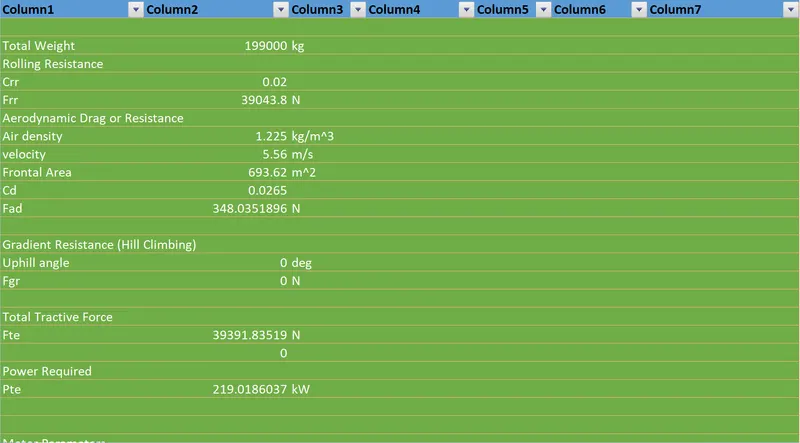
Towing Vehicle mass = 35000kg
Aircraft mass = 164000kg
Total mass of the vehicle = (35000+164000)=199000kg
Speed of the vehicle(V) = 20 km/hr=5.56m/s
Tyre size = R22.5
=5.5715m
Rolling resistance force:
- The formula of the rolling resistance
Frr = u*m*g
=0.02*199000*9.8
=39043.8N
Where,
u=coeffcient of rolling resisitance,
m=mass,
g=acceleration due to gravity.
Aerodynamic force:
- The aerodynamic force to move an airplane on a absolute flat runway with no wind at constant low speed is usually very low
Where,
p=air density kg/m^3,
a=front area in m^2
C= drag cofficient
V= velocity in m/s.
Fd=1/2.p.A.Cd.V^2
=199000 * 9.8 * sin 0
So, from the above equation we have got the required
torque(T) = Fte*r/1000
=(39391.83*0.5715)/1000 = 22.512 KN-m.
Required Energy(E) for towing application based on the assumed time, that is
here, t = time taken for towing is 20 min
E = P * t
= 219*(1200/3600) = 73 KWh
B. Develop the model for the calculated force and power using Simulink.
here, i calculate the value by using simulink.
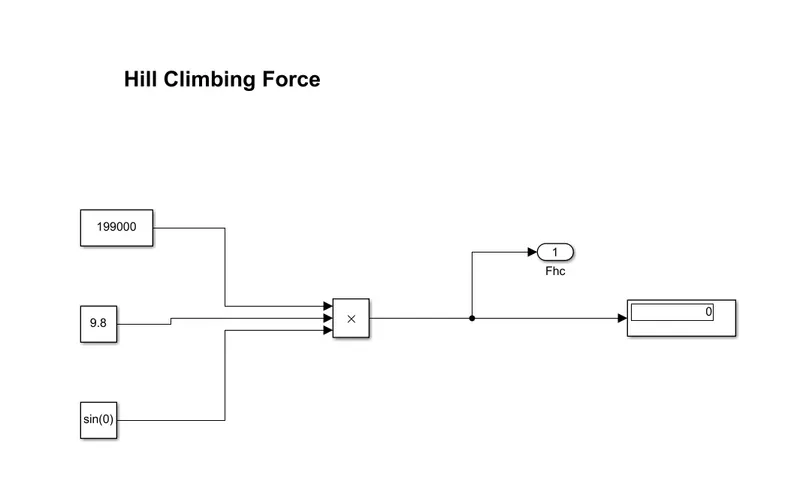
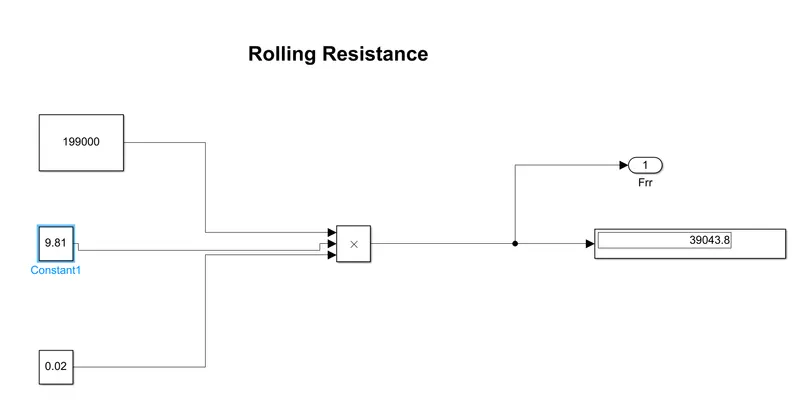
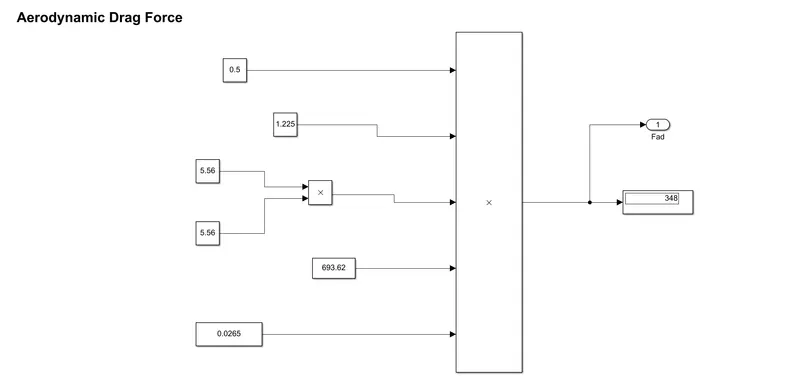
MODEL:
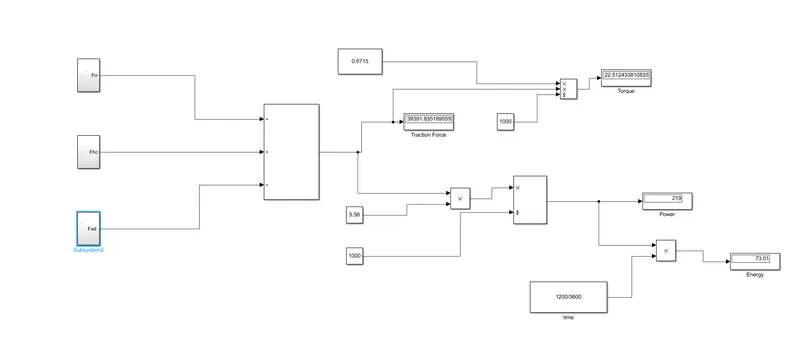
- from model, we can see that i divide the three forces in subsystem then take all three output.
- then connect it together to find total traction force
- then as per Q6.A follow the calculation and find power, torque and energy.
7. A. Design an electric powertrain with type of motor, it’s power rating, and energy requirement to fulfill aircraft towing application in Simulink. Estimate the duty cycle range to control the aircraft speed from zero to highest. Make all required assumptions. Prepare a table of assumed parameters. Draw a block diagram of powertrain.
(Hint :DC7 Block)
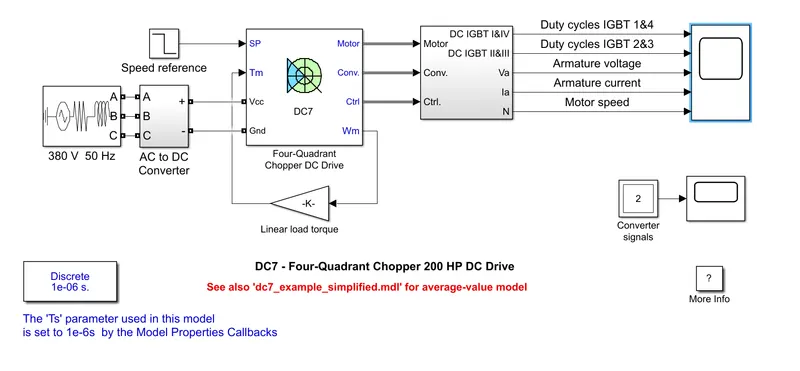
- This example shows the DC7 four-quadrant chopper DC drive during speed regulation.
- The 200 HP DC motor is separately excited with a constant 150 V DC field voltage source. The armature voltage is provided by an IGBT converter controlled by two PI regulators.
- The converter is fed by a 515 V DC bus obtained by rectification of a 380 V AC 50 Hz voltage source. In order to limit the DC bus voltage during dynamic braking mode, a braking chopper has been added between the diode rectifier and the DC7 block.
- The first regulator is a speed regulator, followed by a current regulator. The speed regulator outputs the armature current reference used by the current controller in order to obtain the electromagnetic torque needed to reach the desired speed.
- The speed reference change rate follows acceleration and deceleration ramps in order to avoid sudden reference changes that could cause armature over-current and destabilize the system.
- The current regulator controls the armature current by computing the appropriate duty ratios of the 5 kHz pulses of the four IGBT devices (Pulse Width Modulation). For proper system behaviour, the instantaneous pulse values of IGBT devices 1 and 4 are opposite to those of IGBT devices 2 and 3. This generates the average armature voltage needed to obtain the desired armature current.
- In order to limit the amplitude of the current oscillations, a smoothing inductance is placed in series with the armature circuit.
OUTPUT :
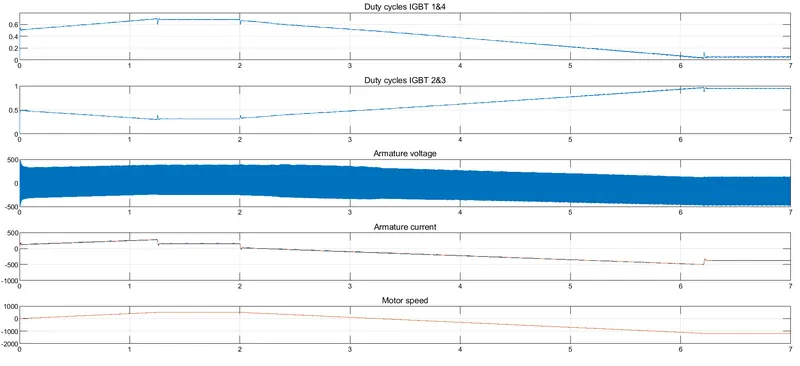
for finding duty cycle range to control the aircraft speed from zero to highest:
i already calculate the power,torque, force and energy aswell in Q.6 so here i am using same model and find the duty cycle with the help of electric components.
The formula of the duty cycle is given below.
Duty cycle = Power input/Power output
power = voltage*current
assuming,
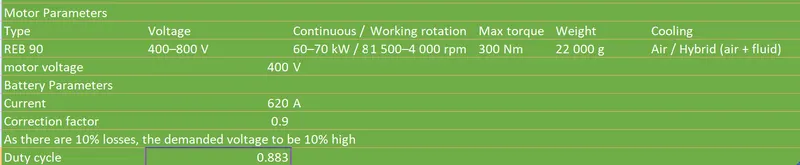
input voltage supply (battery)(V)= 400V
input current value(i) = 620A
for, Power = V*i
=400*620
=248000W
power input = 248KW
i already calculate the power output in Q.6 which is 219KW
Duty cycle = Power input/Power output
=219/248
=0.883
=88%
Therefore the Efficiency of the Duty cycle = 0 to 88%
Block Diagram of HEV powertrain :
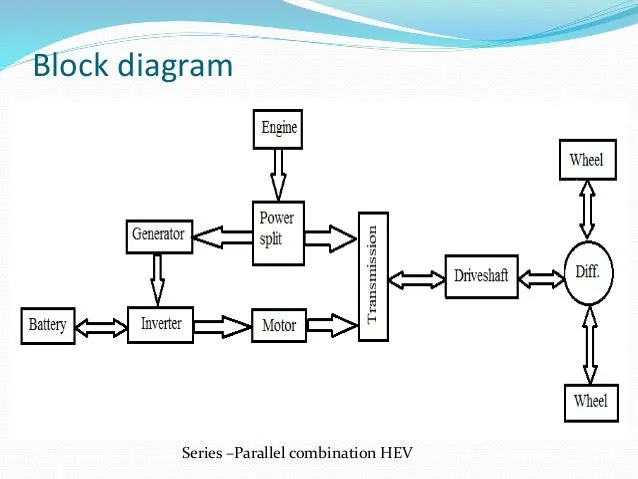
B. Also, Design the parameters in excel sheet.
CONCLUSION :
- here, we Find out the weight of the aircraft,speed diffrence
- learn about aircraft tractor important
- learn about aircraft characterstics like take off power, tyre design, rolling resistance, tyre pressure, brake forces when landing.
- Develop the model for the calculated force and power using Simulink
- The reference Aircraft taken here is the Heavy Aircraft build and so our designed towing tractor is a heavy duty operational vehicle. The power requirements are calculated for the particular load to be pushed/pulled and to achieve this power at the motor output, the motor type and its voltage at the terminals are discussed.
- Finally the speed control of the vehicle is done with switching techniques where the Duty Cycle adjustment can change the motor speed from the minimum to maximum.
References :
- https://en.wikipedia.org/wiki/Aircraft_gross_weight
- https://www.grc.nasa.gov/www/k-12/airplane/weight2.html
- google photos
- MATLAB : DC7 BLOCK