Project-1: Powertrain for aircraft in runways
Part A:
1. Search and list out the total weight of various types of aircrafts.
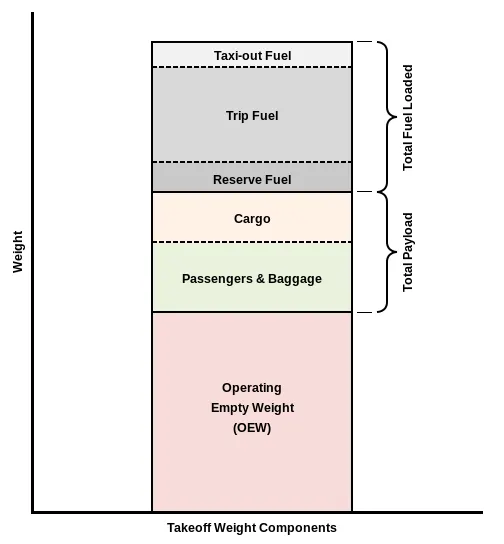
The aircraft gross weight (also known as the all-up weight and abbreviated AUW) is the total aircraft weight at any moment during the flight or ground operation.An aircraft's gross weight will decrease during a flight due to fuel and oil consumption. An aircraft's gross weight may also vary during a flight due to payload dropping or in flight refueling .At the moment of releasing its brakes, the gross weight of an aircraft is equal to its takeoff weight. During flight, an aircraft's gross weight is referred to as the en-route weight or in-flight weight.
Design weight limits:
An aircraft's gross weight is limited by several weight restrictions in order to avoid overloading its structure or to avoid unacceptable performance or handling qualities while in operation.Aircraft gross weight limits are established during an aircraft's design and certification period and are laid down in the aircraft's type certificate and manufacturer specification documents.The absolute maximum weight capabilities of a given aircraft are referred to as the structural weight limits. The structural weight limits are based on aircraft maximum structural capability and define the envelope for the CG charts (both maximum weight and CG limits).An aircraft's structural weight capability is typically a function of when the aircraft was manufactured, and in some cases, old aircraft can have their structural weight capability increased by structural modifications.
Maximum design taxi weight (MDTW):
The maximum design taxi weight (also known as the maximum design ramp weight (MDRW)) is the maximum weight certificated for aircraft manoeuvring on the ground (taxiing or towing) as limited by aircraft strength and airworthiness requirements.
Maximum design takeoff weight (MDTOW):
Is the maximum certificated design weight when the brakes are released for takeoff and is the greatest weight for which compliance with the relevant structural and engineering requirements has been demonstrated by the manufacturer.
Maximum design landing weight (MDLW):
The maximum certificated design weight at which the aircraft meets the appropriate landing certification requirements. It generally depends on the landing gear strength or the landing impact loads on certain parts of the wing structure. The MDLW must not exceed the MDTOW. The maximum landing weight is typically designed for 10 feet per second (600 feet per minute) sink rate at touch down with no structural damage.
Maximum design zero-fuel weight (MDZFW):
The maximum certificated design weight of the aircraft less all usable fuel and other specified usable agents (engine injection fluid, and other consumable propulsion agents). It is the maximum weight permitted before usable fuel and other specified usable fluids are loaded in specified sections of the airplane. The MDZFW is limited by strength and airworthiness requirements. At this weight, the subsequent addition of fuel will not result in the aircraft design strength being exceeded. The weight difference between the MDTOW and the MDZFW may be utilised only for the addition of fuel.
Minimum flight weight (MFW):
Minimum certificated weight for flight as limited by aircraft strength and airworthiness requirements.
Authorised weight limits:
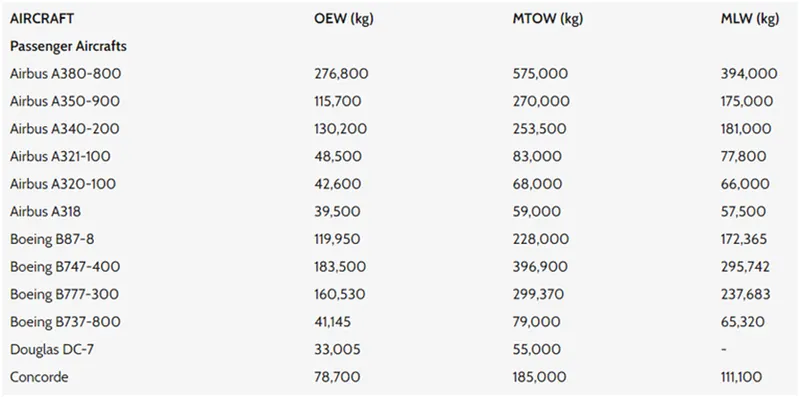
Aircraft authorised gross weight limits (also referred to as certified weight limits) are laid down in the aircraft flight manual (AFM) and/or associated certificate of airworthiness (C of A). The authorised or permitted limits may be equal to or lower than the structural desgin weight limit. The authorised weight limits that can legally be used by an operator or airline are those listed in the AFM and the weight and balance manual. The authorised (or certified) weight limits are chosen by the customer/airline and they are referred to as the "purchased weights". An operator may purchase a certified weight below the maximum design weights because many of the airport operating fees are based on the aircraft AFM maximum allowable weight values. An aircraft purchase price is, typically, a function of the certified weight purchased.
Maximum weights established, for each aircraft, by design and certification must not be exceeded during aircraft operation (ramp or taxying, takeoff, en-route flight, approach, and landing) and during aircraft loading (zero fuel conditions, centre of gravity position, and weight distribution). Weights could be restricted on some type of aircraft depending on the aircraft handling requirements; for example aerobatic aircraft, where certain aerobatic manoeuvres can only be executed with a limited gross weight. In addition, the authorised maximum weight limits may be less as limited by centre of gravity, fuel density, and fuel loading limits.
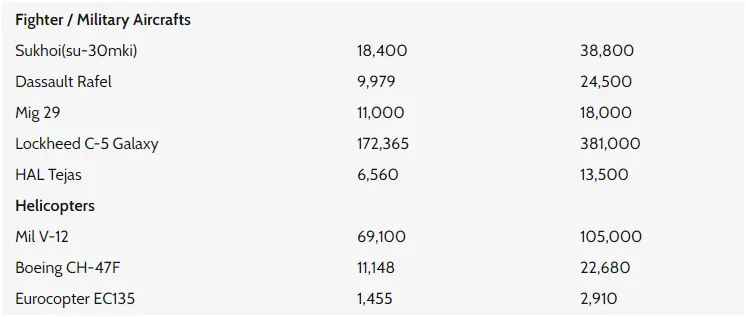
MTOW = Maximum take-off weight, MLW = Maximum landing weight
2. Is there any difference between ground speed and air speed?
Airspeed vs. Ground Speed:
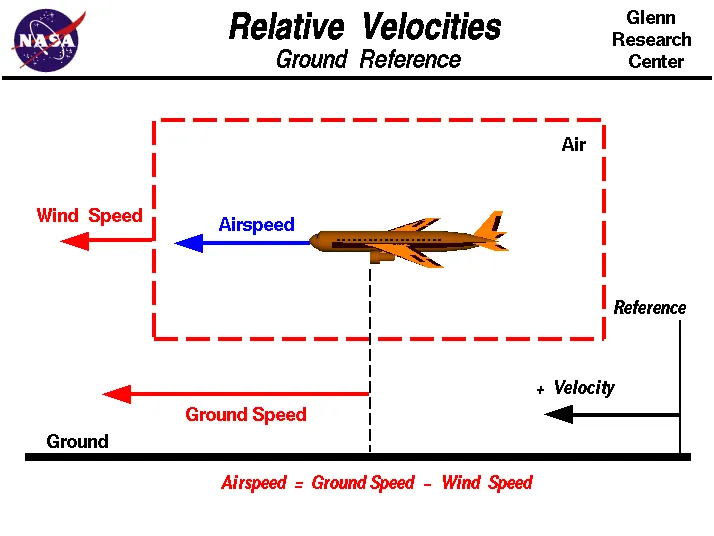
As mentioned above, true airspeed is simply the speed at which an aircraft is moving relative to the air it is flying in. As such, it’s also the speed at which the air is flowing around the aircraft’s wings. Ground speed, on the other hand, is the aircraft’s speed relative to the ground. One thing that should be noted here is that it’s its horizontal rather than vertical speed – an aircraft climbing completely vertically would have a ground speed of zero. In other words, while airspeed is what determines whether there is enough airflow around an aircraft to make it fly, ground speed is what determines how fast an aircraft will get to its destination.
3. Why is it not recommended to use aircraft engine power to move it on the ground at Airport?
Taxiing is the movement of an aircraft on the ground, under its own power, in contrast to towing or pushback where the aircraft is moved by a tug. The aircraft usually moves on wheels, but the term also includes aircraft with skis or floats (for water-based travel).
An airplane uses taxiways to taxi from one place on an airport to another; for example, when moving from a hanger to the runway. The term "taxiing" is not used for the accelerating run along a runway prior to takeoff, or the decelerating run immediately after landing, which are called the takeoff roll and landing rollout, respectively.
Generally aircrafts move with the help of Engine power on the ground at airport. The difference being that the engine power is not used at its full performance as obtained during the flight of the aircraft. The engine is operated under throttle 1 condition which uses engine power to obtain less speed. Sometimes it is not recommended to use the engine power to move the aircraft on the ground at Airport. There are multiple reasons for this one of which is that there are a lot of things as well as airport crew members surrounding the aircraft. If the aircraft uses its engine power in such an environment, the engine turbine or fan may suck or throw the surrounding objects, trash or even human beings which are accidental.
he air intake of a jet engine is powerful enough to suck in a human body. Even at a distance, the jet engine suction is strong enough to devour loose debris e.g., rags, bolts, paper, stones, catering foils, plastic cups and bags. All these will damage the jet engine. In case of Jet exhaust, the temperatures of the exhaust can severely burn the skin of a person standing too close. The jet blast or prop wash can exceed 100 mph and is capable of moving or toppling heavy persons or equipment. Other reasons being the noise of the engine which are at very high decibels as well as the fumes emitted by the burning of the fuel, the fuel consumption of an aircraft and also the risk of damage to the engine due to foreign objects.
4. How an aircraft is pushed to runway when its ready to take off?
There are two ways through which an aircraft is pushed to the runway on Airport.
Pushback – In aviation, pushback is an airport procedure during which an aircraft is pushed backwards away from an airport gate by external power. Pushbacks are carried out by special, low-profile vehicles called pushback tractors or tugs. Although many aircraft are capable of moving themselves backwards on the ground using reverse thrust (a procedure referred to as a power back), the resulting jet blast or prop wash might cause damage to the terminal building or equipment. Engines close to the ground may also blow sand and debris forward and then suck them into the engine, causing damage to the engine. A pushback is therefore the preferred method to move the aircraft away from the gate. Closer to departure, an aircraft tug will park right in front of the nose wheel. The tug might be directly attached to the plane's nose gear with a tow bar, or could be a wheel-lift tug. These tugs cradle the nose gear, then lift it up before moving the plane. That gives the tug driver control over the plane's direction during pushback. New taxi technologies are appearing, like pilot-controlled tugs, and electric motors mounted to the plane's landing gear. Both promise to save fuel, and reduce airport noise. When the aircraft is stopped, the brakes of the towing vehicle alone should not be relied upon to stop the aircraft. The man in the cockpit should coordinate the use of the aircraft brakes with those of the towing vehicle.
Taxiing is the movement of an aircraft on the ground, under its own power, in contrast to towing or push-back where the aircraft is moved by a tug. The aircraft usually moves on wheels, but the term also includes aircraft with skis or floats for water-based travel. An airplane uses taxiways to taxi from one place on an airport to another; for example, when moving from a hangar to the runway. The term taxiing is not used for the accelerating run along a runway prior to take-off, or the decelerating run immediately after landing, which is called the take-off roll and landing rollout, respectively. When taxiing, aircraft travel slowly. This ensures that they can be stopped quickly and do not risk wheel damage on larger aircraft if they accidentally turn off the paved surface. Taxi speeds are typically 30 to 35 km/h.
5. Learn about take off power, tyre design, rolling resistance, tyre pressure, brake forces when landing
Take-Off Power : Take-off is the phase of flight in which an aerospace vehicle leaves the ground and becomes airborne. For aircraft that take off horizontally, this usually involves starting with a transition from moving along the ground on a runway. For light aircraft, usually full power is used during take-off. Large transport category aircraft may use a reduced power for take-off, where less than full power is applied in order to prolong engine life, reduce maintenance costs and reduce noise emissions. The aircraft is permitted to accelerate to rotation speed. The term rotation is used because the aircraft pivots around the axis of its main landing gear while still on the ground, usually because of gentle manipulation of the flight controls to make or facilitate this change in aircraft attitude and once proper air displacement occurs under or over the wings, an aircraft will lift off on its own.
Generally, the T-O phase is split into the segments shown in the figure below. The ground roll is the distance from brake release to the initiation of the rotation, when the pilot pulls the control wheel (or stick or yoke) backward in order to raise the nose of the aircraft. This maneuver is required to increase the area of attack of the airplane to help it become airborne. The aircraft typically remains in this attitude for some 1-3 seconds, depending on aircraft size, before the tires lose contact with the ground. This segment is called the rotation. The rotation phase concludes as the aircraft lifts off the ground and begins the transition and subsequent climb phase.
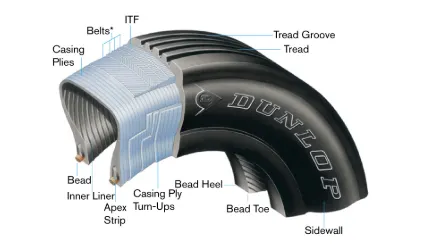
Tyre Design – An aircraft must withstand a wide range of operational conditions. When on the ground, it must support the weight of the aircraft, during taxied it must provide cushioned ride. At take off the tire structure must be able endure forces generated at higher angular velocities. Landing requires the tire to absorb impact shocks. These extreme demands require a tire which is highly engineered and precisely manufactured. For these tires are made of various rubber, fabric and steed material. To meet the aircraft demands tire are manufactured in two distinct categories Bias tire and radial tire.
Bias Tyre construction – these types of tire consist casing plies which is running diagonally at approximate right angle to one another. The number of plies and the angles at which they are laid decide strength and load capacity.
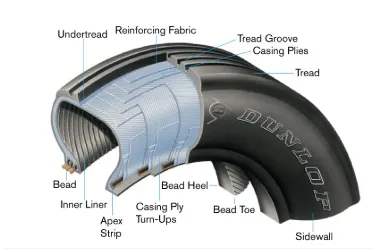
Radial Tyre construction – these are the most modern design of aircraft tyres.in radial tires each carcass ply is laid at right angle. The radial tire offers more landings per thread and lighter weight than a bias tire.
Tyre Pressure : Aircraft tires generally operate at high pressures, up to 200 psi (14 bar; 1,400 kPa) for airliners, and even higher for business jets. Tests of airliner aircraft tires have shown that they are able to sustain pressures of maximum 800 psi (55 bar; 5,500 kPa) before bursting. During the tests the tires have to be filled with water, to prevent the test room being blown apart by the energy that would be released by a gas when the tire bursts. Aircraft tires are usually inflated with nitrogen to minimize expansion and contraction from extreme changes in ambient temperature and pressure experienced during flight. Dry nitrogen expands at the same rate as other dry atmospheric gases (normal air is about 80% nitrogen), but common compressed air sources may contain moisture, which increases the expansion rate with temperature. The requirement that an inert gas, such as nitrogen, be used instead of air for inflation of tires on certain transport category airplanes was prompted by at least three cases in which the oxygen in air-filled tires had combined with volatile gases given off by a severely overheated tire and exploded upon reaching auto ignition temperature. The use of an inert gas for tire inflation eliminates the possibility of tire explosion.
Rolling resistance – when a tire rolls on the road, mechanical energy is converted to heat as a result of phenomenon referred to as rolling resistance. The term rolling resistance is often mistaken as a measure of the force opposing tire rotation, when instead is actually a measure of rolling energy loss.i in another terms we can say rolling resistance is the effort required to keep a given tire rolling. Its magnitude depends on the tire used, roughness of road, inflation pressure, load and speed. Generally rolling resistance is given by following formula –
F = Cr ⋅ R
F = Rolling resistance force Cr = rolling resistance coefficient
R = Normal force between surface and tire
Brake forces when landing : One of the effective parameters in fluencing landing run is the brake force, while it is ineffective during take-off operation.
The airspeed during approach is decreased by increasing the angle of attack, but airspeed during ground roll is decreased by applying brakes. The mechanical brakes present at the wheels are of two common kinds; drum brakes and disc brakes. Drum brakes usually reside inside the wheel, which reduces their frontal area and, if mounted on retractable landing gear, makes them a possible solution for space-claim issues in thin wings. Disc brakes have superior performance, are lighter, and easier to maintain. The brake force is sometimes reinforced with other means such as parachute, engine thrust reversal, hook and string, and spoiler. These factors will reduce the landing run. The maximum aircraft angle of attack during landing is often 2°–4° less than the maximum aircraft angle of attack during take-off (e.g., 10°–15°). To compensate for this angle of attack reduction, a higher flap detection is employed. In most cases, flap de tection during landing is between 30° and 60°, while during take-off it is between 5° and 30°.
Part B:
6. A. With necessary assumptions, calculate the force and power required to push / pull an aircraft by a towing vehicle.
To push or pull an aircraft by a towing vehicle is have three types of forces will act on that vehicle.
Those are
- Rolling Resistance Force
- Aerodynamic Drag Force
- Hill Climbing Force.
Push/Pull Power Calculation of Towing Vehicle:
Let's assume,
Towing Vehicle mass = 50000 kg
Aircraft mass = 183700 kg
Total mass of the vehicle = (50000+183700)= 233700 kg
Speed of the vehicle (V)= 10 km/hr = 2.77 m/s
Rolling Resistance Force
F_(rr) = `mu*m*g`
=0.013*233700*9.8
= 29,773.38 N
Aerodynamic Drag Force
F_(ad) = (1/2)*rho*v^2*A*Cd
= (1/2)*1.225*(2.778)^2*20*(0.5+0.045)
= 51.514 N
Hill Climbing Force
F_(hc) = m*g*sinphi
= 233700*9.8* sin0
= 0 N
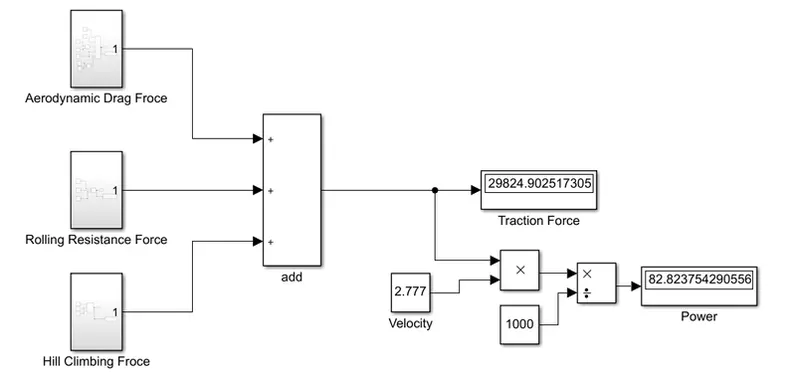
Total Traction Force
F_(te ) = F_(rr)+F_(ad)+F_(hc)
= 29773.38+51.514+0
= 29824.894 N
Total Power = (F_(te)*V)/1000
= 82.84 KW
B. Develop the model for the calculated force and power using Simulink.
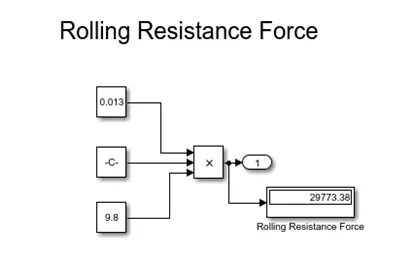
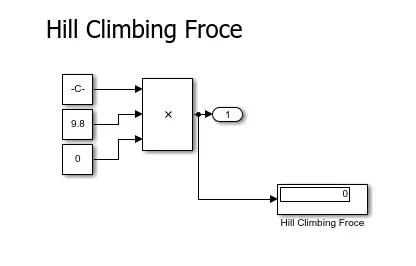
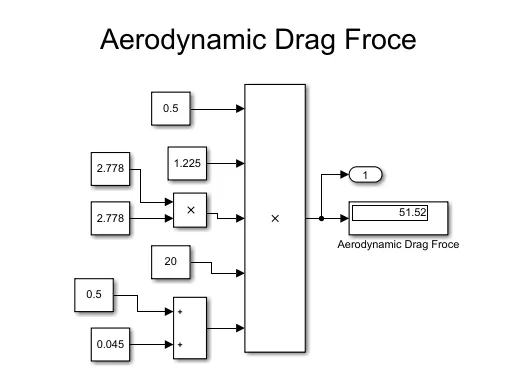
Main Model-
7. A. Design an electric powertrain with type of motor, it’s power rating, and energy requirement to fulfill aircraft towing application in Simulink. Estimate the duty cycle range to control the aircraft speed from zero to highest. Make all required assumptions. Prepare a table of assumed parameters. Draw a block diagram of powertrain.
(Hint :DC7 Block)
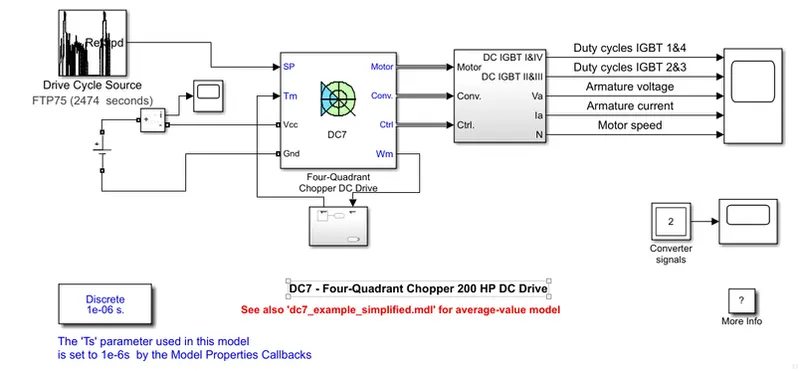
Block Diagram -
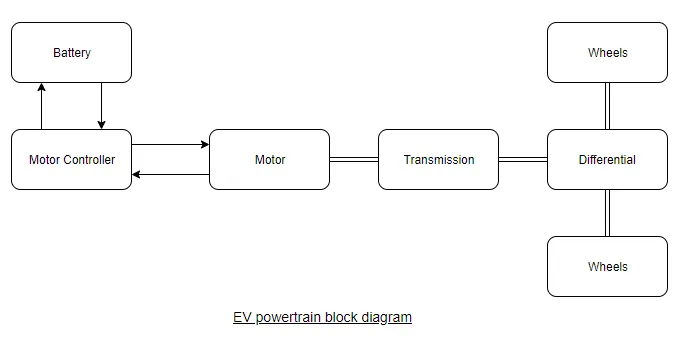
B. Also, Design the parameters in excel sheet.
I have upload Excel File and below share link
https://drive.google.com/file/d/1vDmtyVkltNOroqDSoe9LRVkE6OYHC4wr/view?usp=sharing