Project 1 - Parsing NASA thermodynamic data
Main Code:-
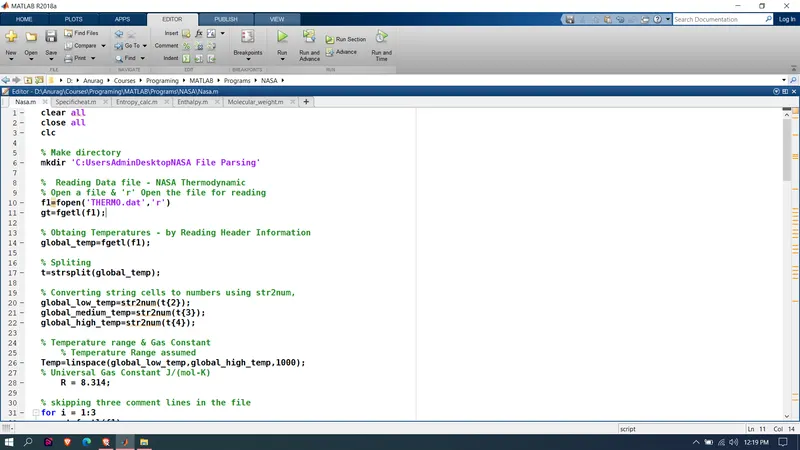
clear all
close all
clc
% Make directory
mkdir 'D:\Anurag\Courses\Programing\MATLAB\Programs\NASA'
% Reading Data file - NASA Thermodynamic
% Open a file & 'r' Open the file for reading
f1=fopen('THERMO.dat','r')
gt=fgetl(f1);
% Obtaing Temperatures - by Reading Header Information
global_temp=fgetl(f1);
% Spliting
t=strsplit(global_temp);
% Converting string cells to numbers using str2num,
global_low_temp=str2num(t{2});
global_medium_temp=str2num(t{3});
global_high_temp=str2num(t{4});
% Temperature range & Gas Constant
% Temperature Range assumed
Temp=linspace(global_low_temp,global_high_temp,1000);
% Universal Gas Constant J/(mol-K)
R = 8.314;
% skipping three comment lines in the file
for i = 1:3
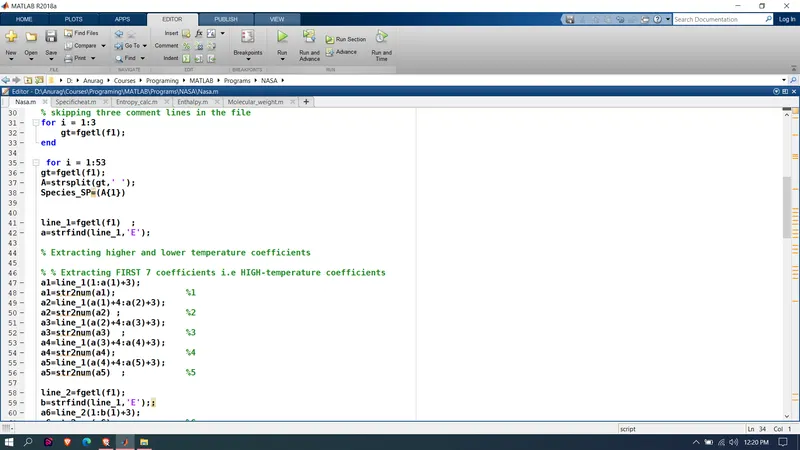
gt=fgetl(f1);
end
for i = 1:53
gt=fgetl(f1);
A=strsplit(gt,' ');
Species_SP=(A{1})
line_1=fgetl(f1) ;
a=strfind(line_1,'E');
% Extracting higher and lower temperature coefficients
% % Extracting FIRST 7 coefficients i.e HIGH-temperature coefficients
a1=line_1(1:a(1)+3);
a1=str2num(a1); %1
a2=line_1(a(1)+4:a(2)+3);
a2=str2num(a2) ; %2
a3=line_1(a(2)+4:a(3)+3);
a3=str2num(a3) ; %3
a4=line_1(a(3)+4:a(4)+3);
a4=str2num(a4); %4
a5=line_1(a(4)+4:a(5)+3);
a5=str2num(a5) ; %5
line_2=fgetl(f1);
b=strfind(line_1,'E');;
a6=line_2(1:b(1)+3);
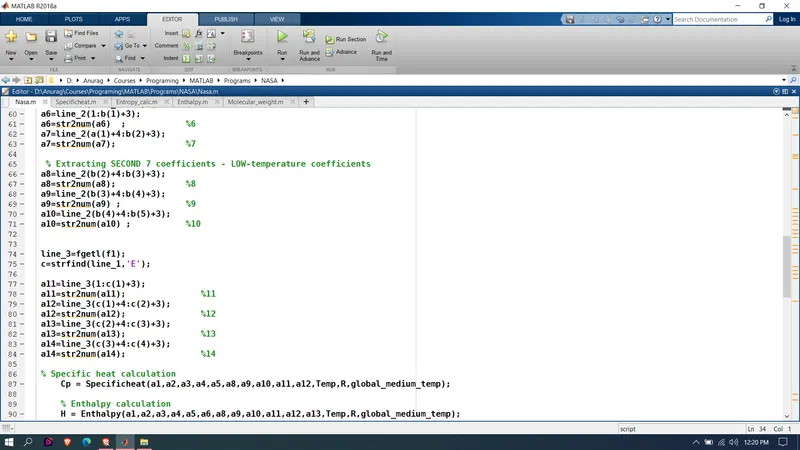
a6=str2num(a6) ; %6
a7=line_2(a(1)+4:b(2)+3);
a7=str2num(a7); %7
% Extracting SECOND 7 coefficients - LOW-temperature coefficients
a8=line_2(b(2)+4:b(3)+3);
a8=str2num(a8); %8
a9=line_2(b(3)+4:b(4)+3);
a9=str2num(a9) ; %9
a10=line_2(b(4)+4:b(5)+3);
a10=str2num(a10) ; %10
line_3=fgetl(f1);
c=strfind(line_1,'E');
a11=line_3(1:c(1)+3);
a11=str2num(a11); %11
a12=line_3(c(1)+4:c(2)+3);
a12=str2num(a12); %12
a13=line_3(c(2)+4:c(3)+3);
a13=str2num(a13); %13
a14=line_3(c(3)+4:c(4)+3);
a14=str2num(a14); %14
% Specific heat calculation
Cp = Specificheat(a1,a2,a3,a4,a5,a8,a9,a10,a11,a12,Temp,R,global_medium_temp);
% Enthalpy calculation
H = Enthalpy(a1,a2,a3,a4,a5,a6,a8,a9,a10,a11,a12,a13,Temp,R,global_medium_temp);
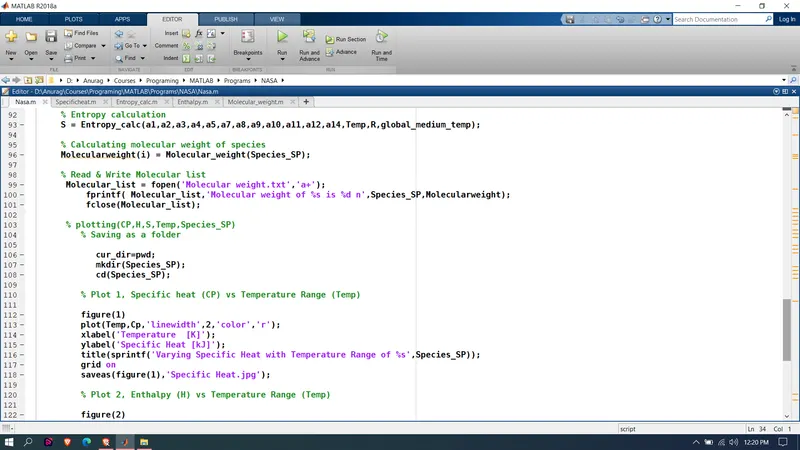
% Entropy calculation
S = Entropy_calc(a1,a2,a3,a4,a5,a7,a8,a9,a10,a11,a12,a14,Temp,R,global_medium_temp);
% Calculating molecular weight of species
Molecularweight(i) = Molecular_weight(Species_SP);
% Read & Write Molecular list
Molecular_list = fopen('Molecular weight.txt','a+');
fprintf( Molecular_list,'Molecular weight of %s is %d n',Species_SP,Molecularweight);
fclose(Molecular_list);
% plotting(CP,H,S,Temp,Species_SP)
% Saving as a folder
cur_dir=pwd;
mkdir(Species_SP);
cd(Species_SP);
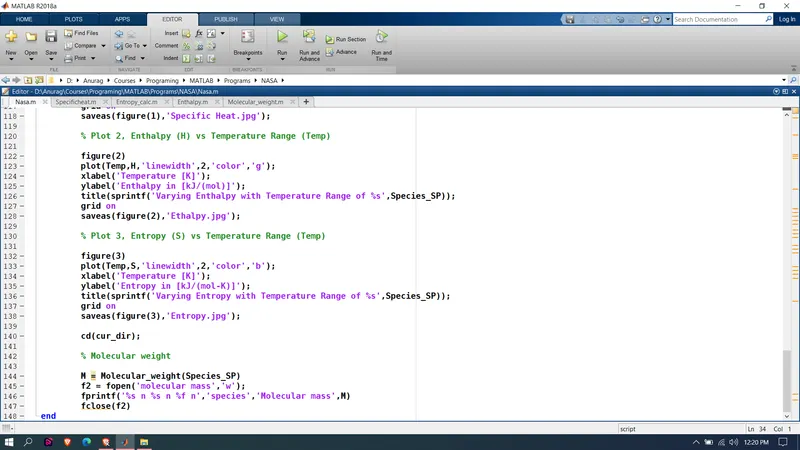
% Plot 1, Specific heat (CP) vs Temperature Range (Temp)
figure(1)
plot(Temp,Cp,'linewidth',2,'color','r');
xlabel('Temperature [K]');
ylabel('Specific Heat [kJ]');
title(sprintf('Varying Specific Heat with Temperature Range of %s',Species_SP));
grid on
saveas(figure(1),'Specific Heat.jpg');
% Plot 2, Enthalpy (H) vs Temperature Range (Temp)
figure(2)
plot(Temp,H,'linewidth',2,'color','g');
xlabel('Temperature [K]');
ylabel('Enthalpy in [kJ/(mol)]');
title(sprintf('Varying Enthalpy with Temperature Range of %s',Species_SP));
grid on
saveas(figure(2),'Ethalpy.jpg');
% Plot 3, Entropy (S) vs Temperature Range (Temp)
figure(3)
plot(Temp,S,'linewidth',2,'color','b');
xlabel('Temperature [K]');
ylabel('Entropy in [kJ/(mol-K)]');
title(sprintf('Varying Entropy with Temperature Range of %s',Species_SP));
grid on
saveas(figure(3),'Entropy.jpg');
cd(cur_dir);
% Molecular weight
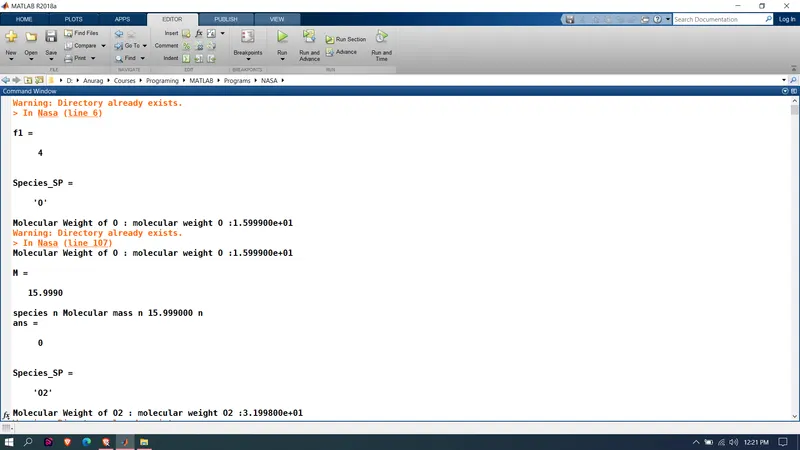
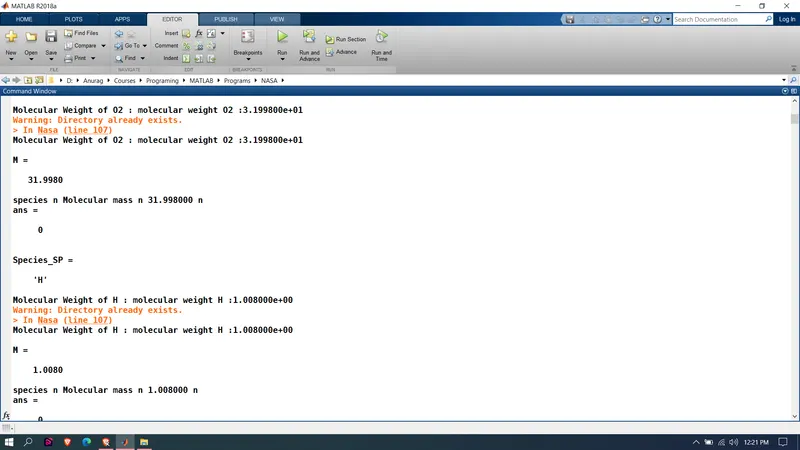
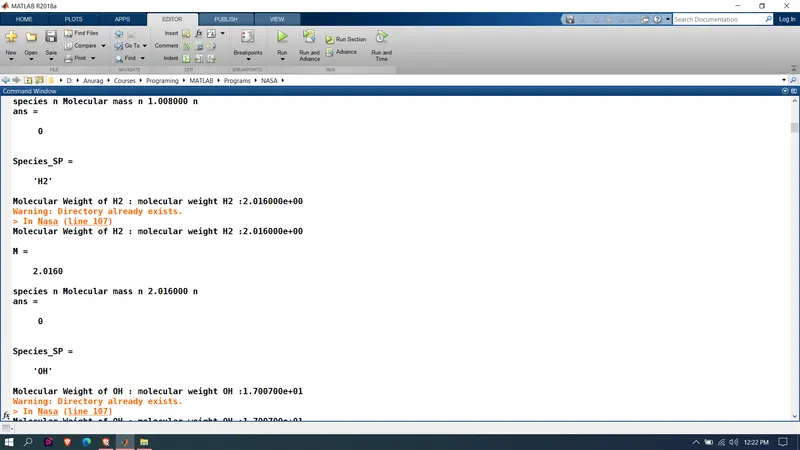
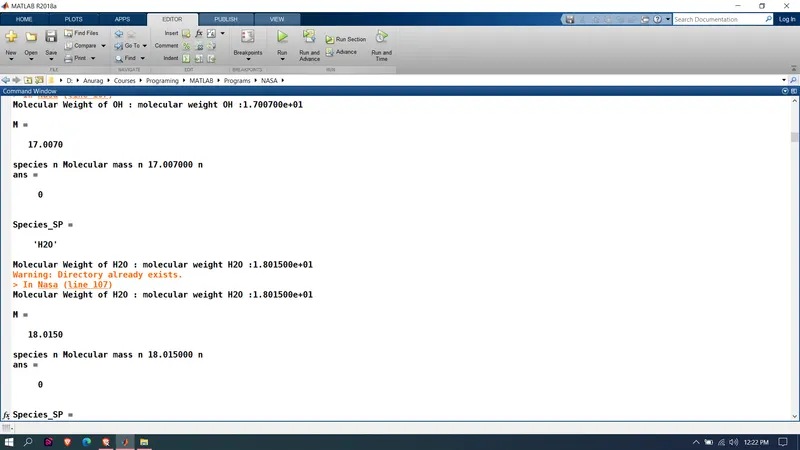
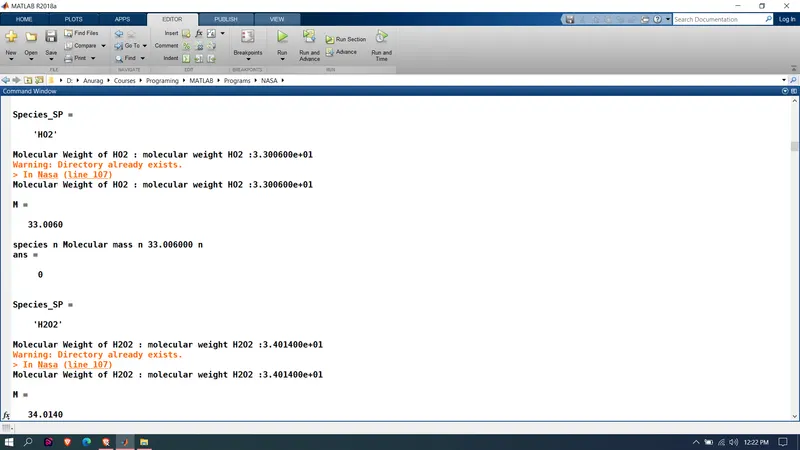
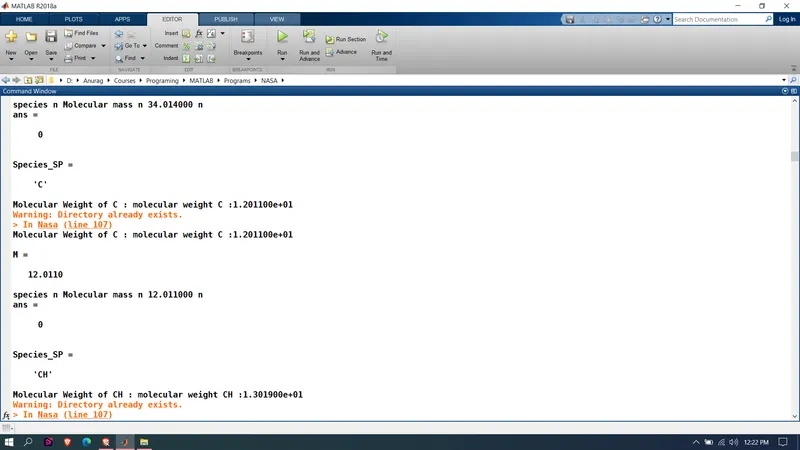
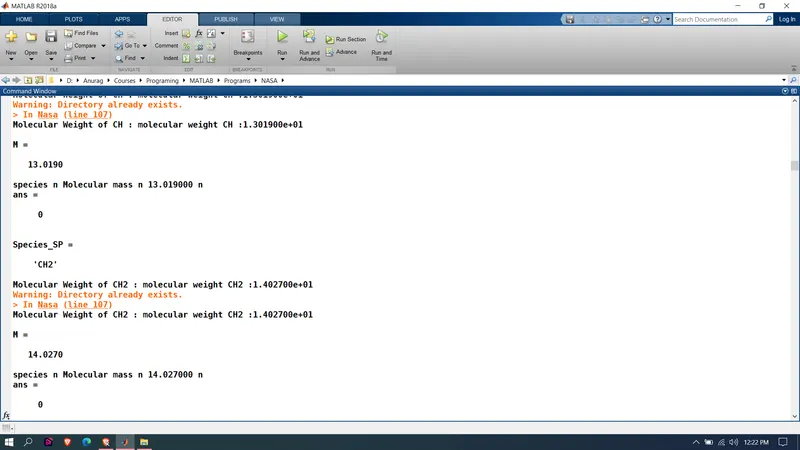
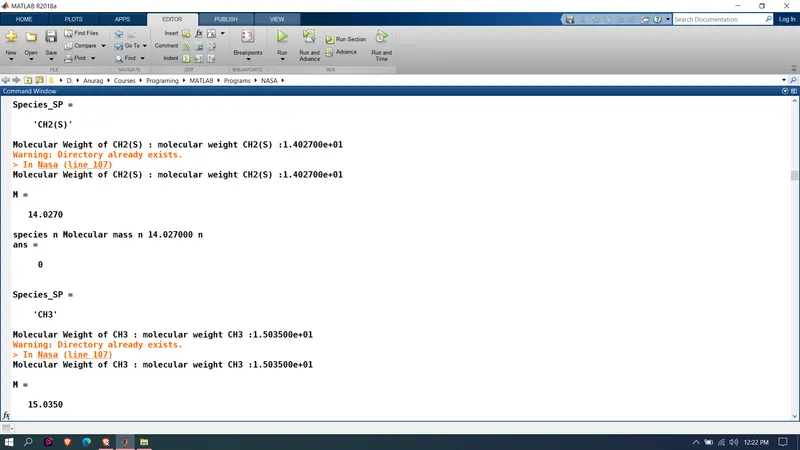
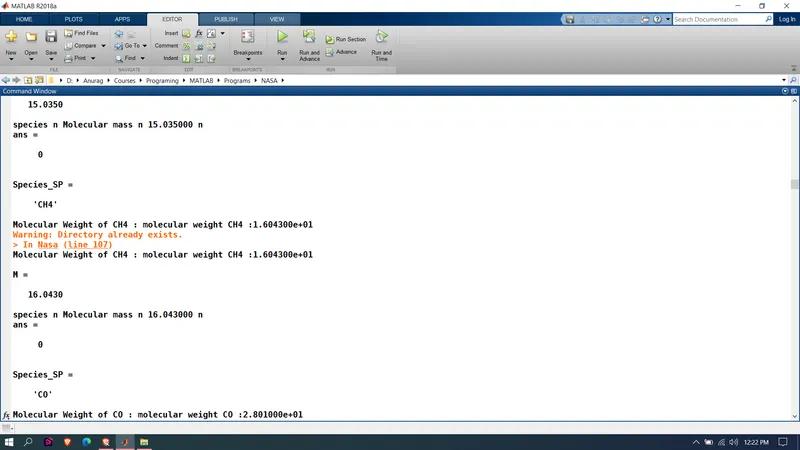
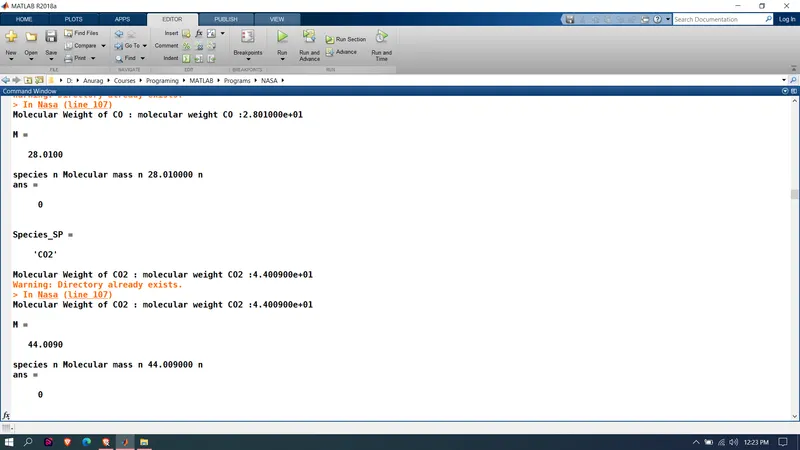
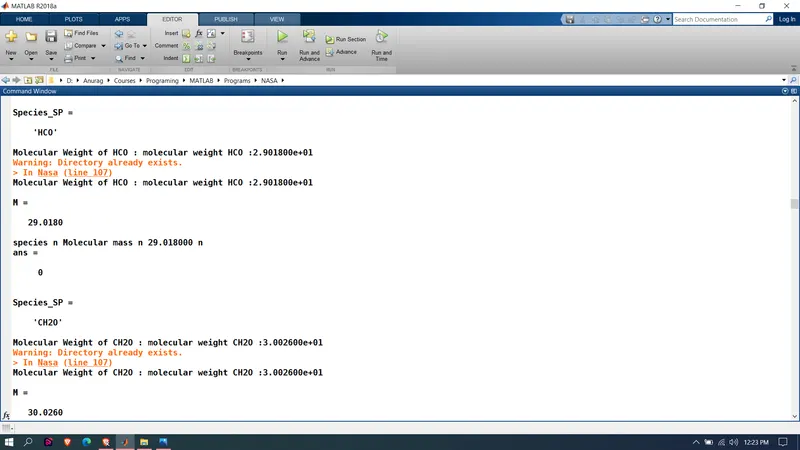
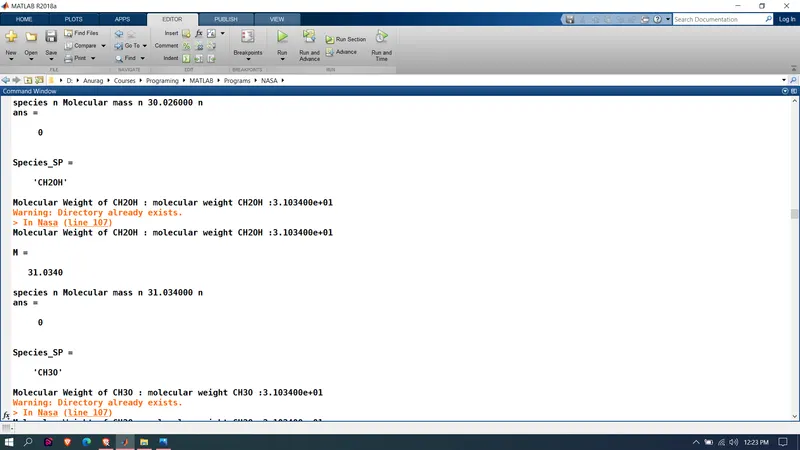
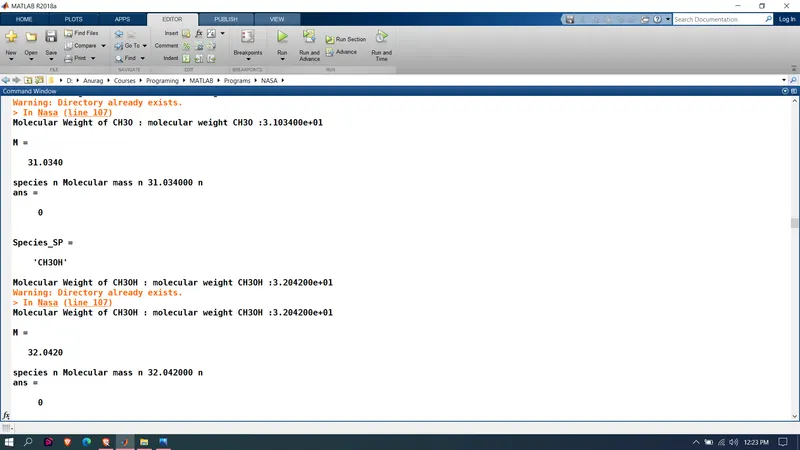
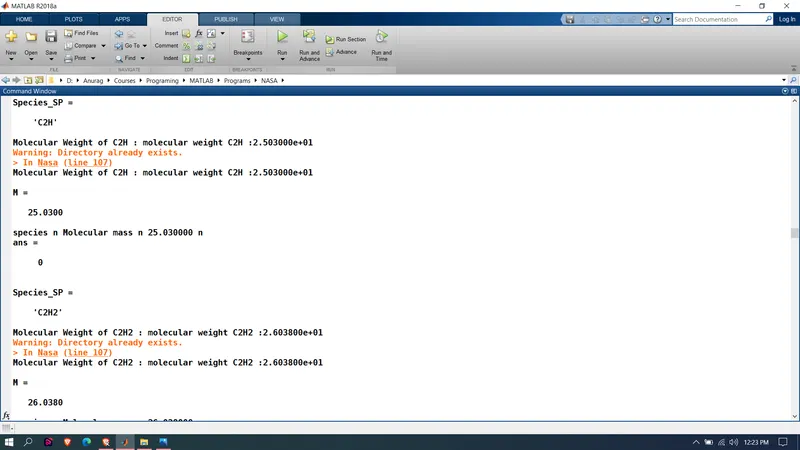
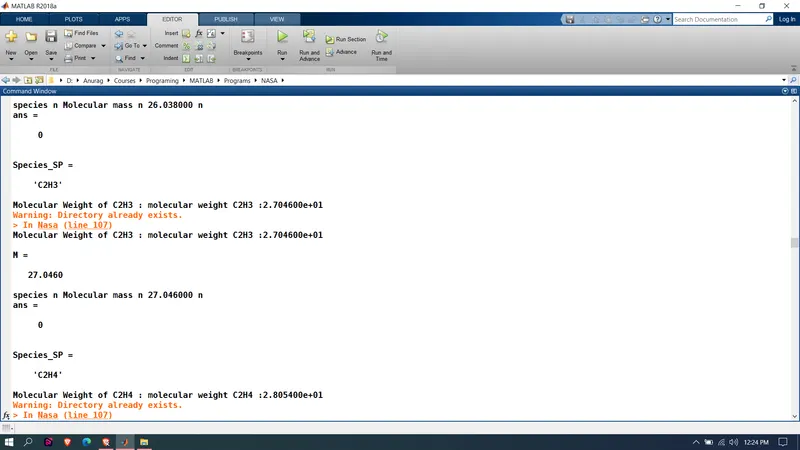
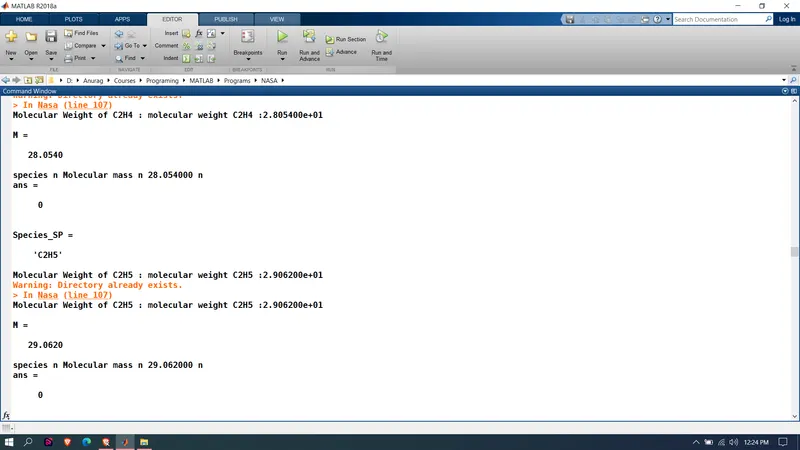
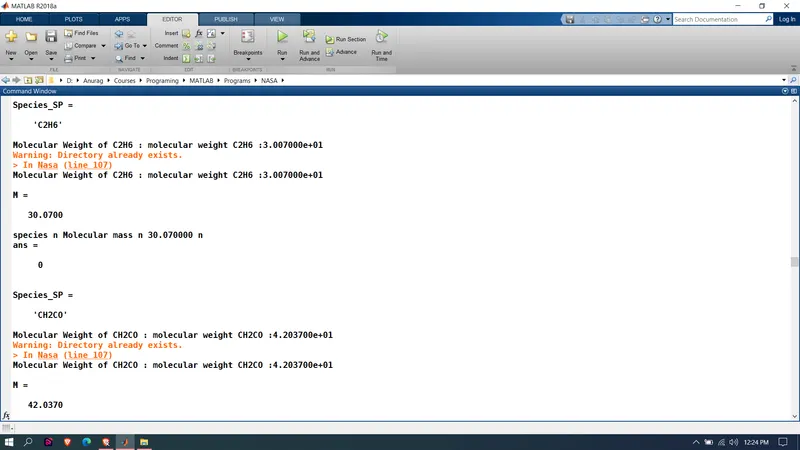
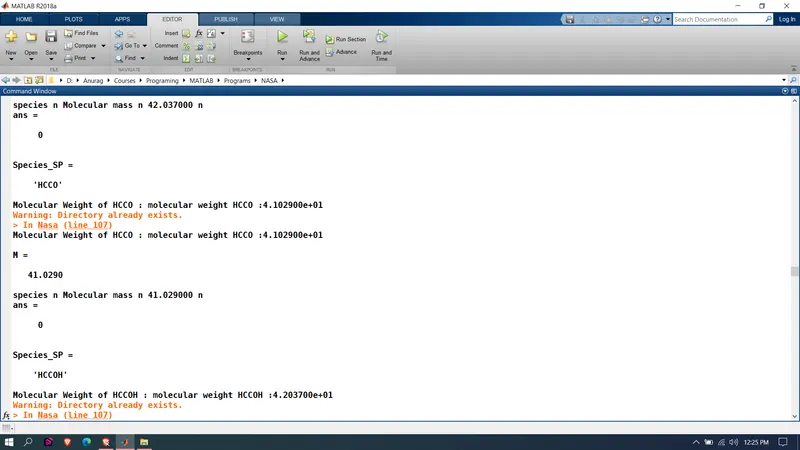
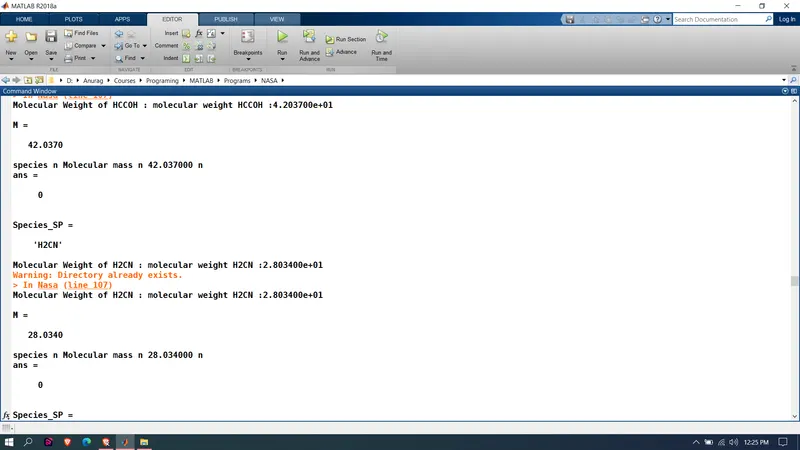
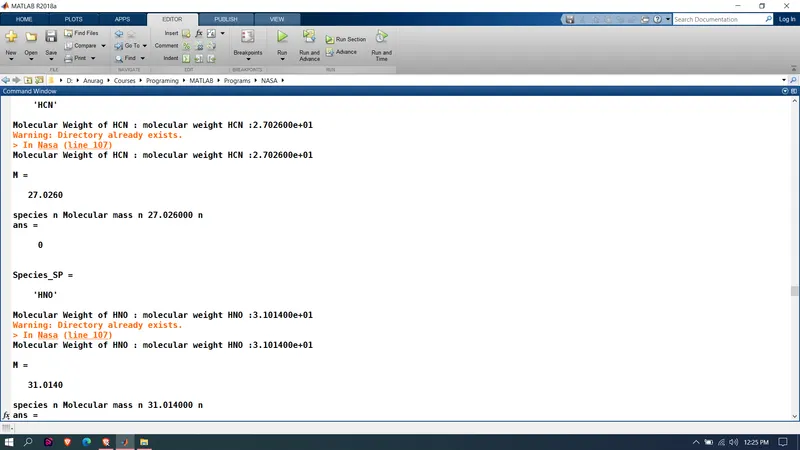
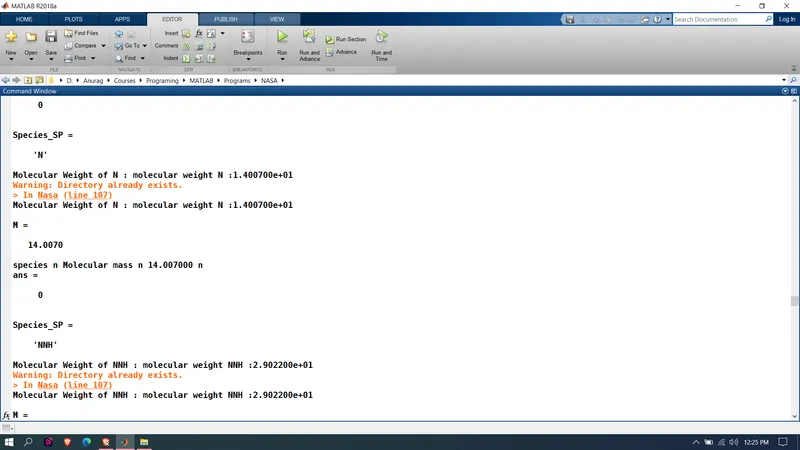
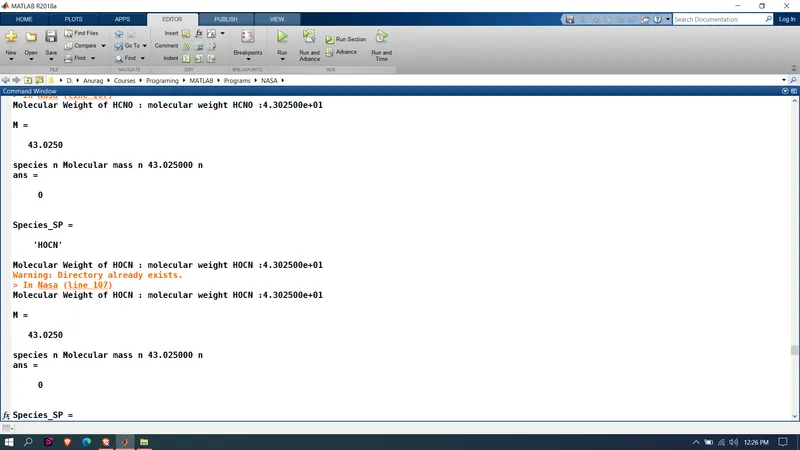
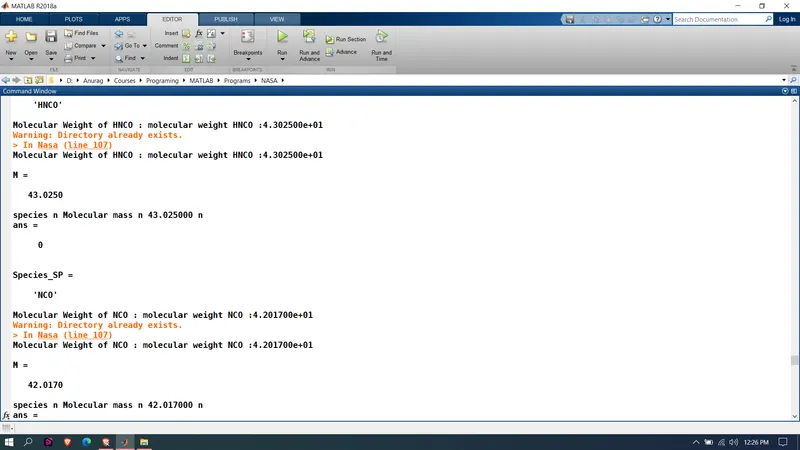
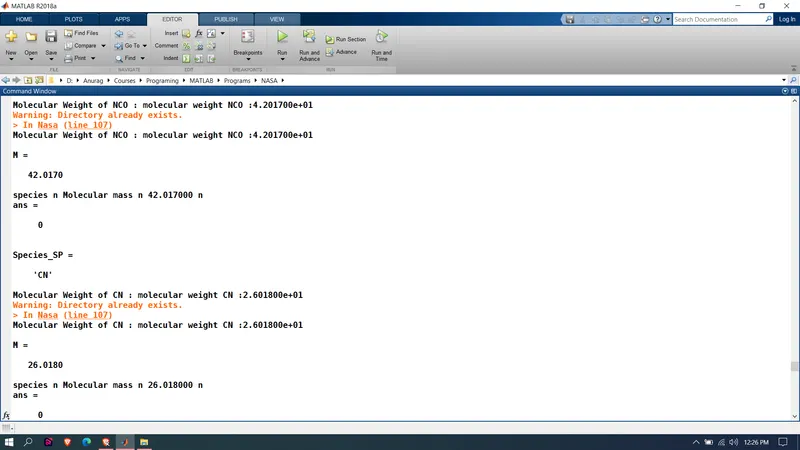
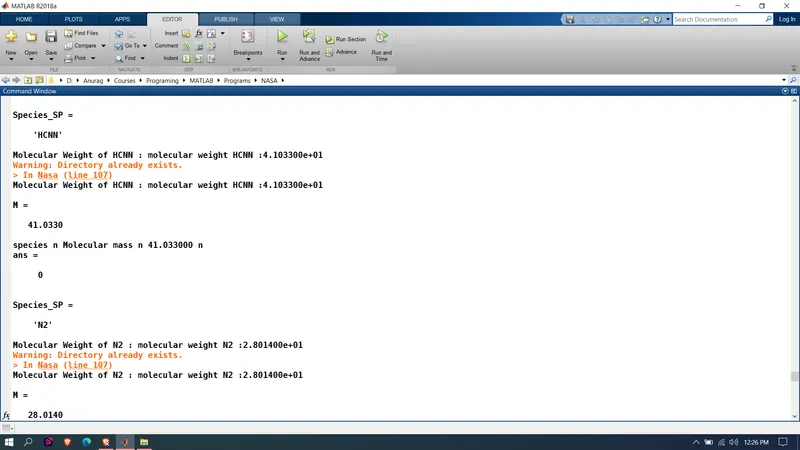
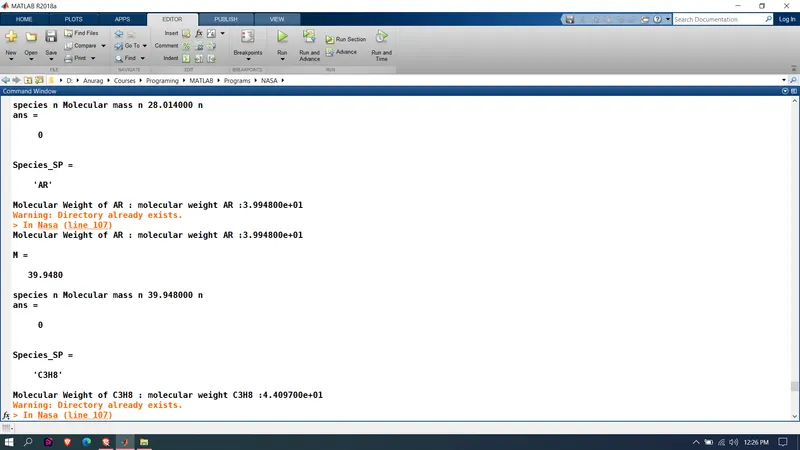
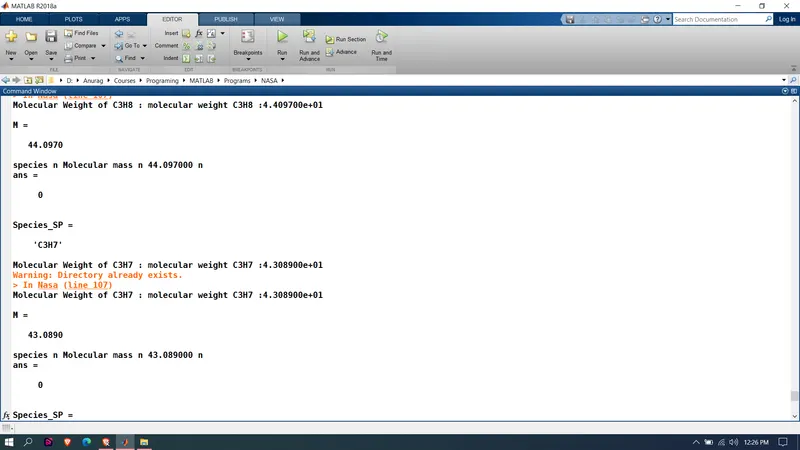
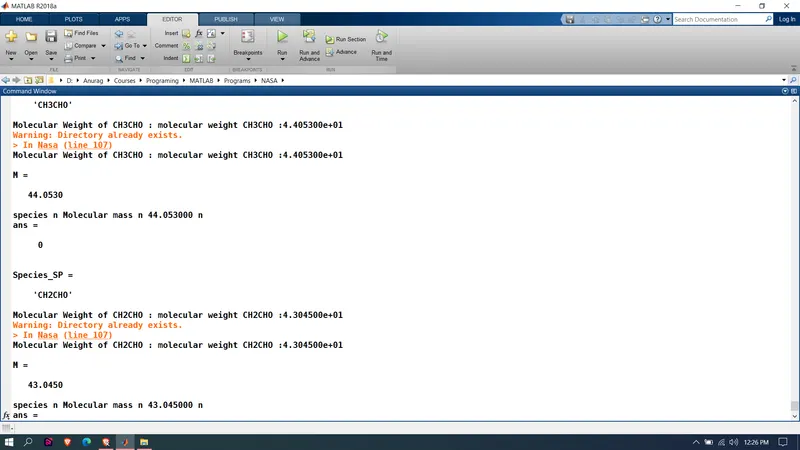
M = Molecular_weight(Species_SP)
f2 = fopen('molecular mass','w');
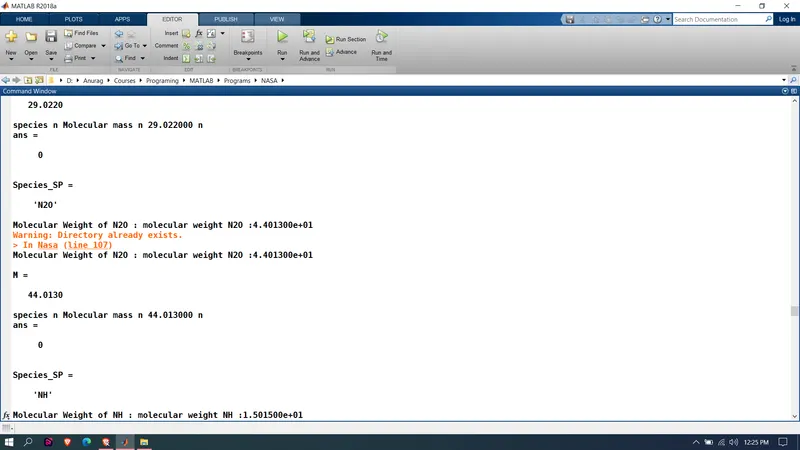
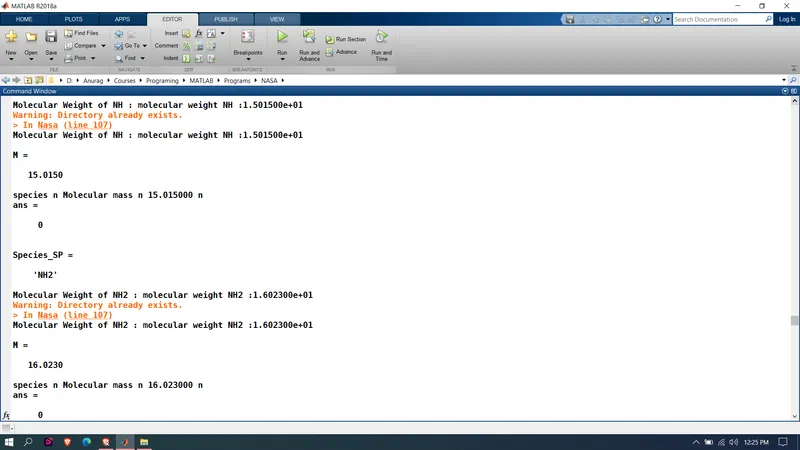
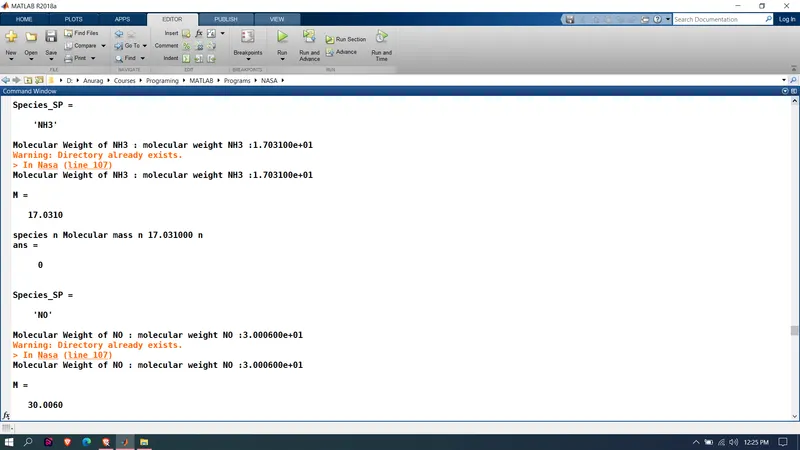
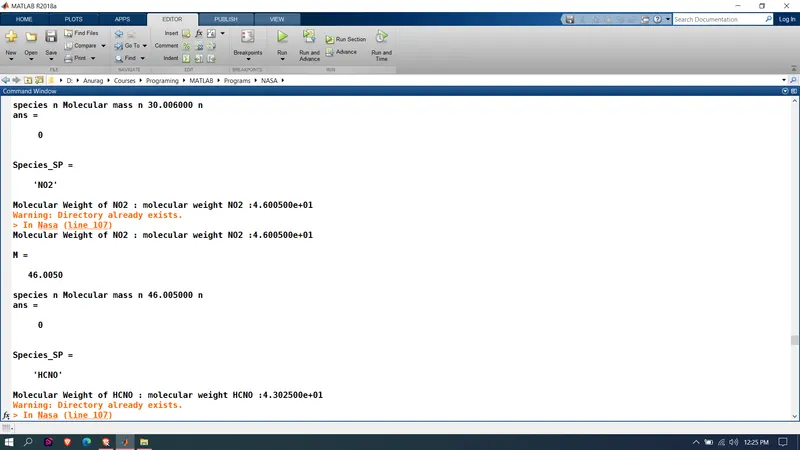
fprintf('%s n %s n %f n','species','Molecular mass',M)
fclose(f2)
end
Function Codes:-
1.Specific heat calculation function
% Specific heat calculation function
function Cp = Specificheat(a1,a2,a3,a4,a5,a8,a9,a10,a11,a12,Temp,R,global_medium_temp)
% Comparing with global temperature
% If less than global temperature - minimum coefficients are taken
if Temp <= global_medium_temp
Cp = R*(a8 + (a9*Temp) + (a10*(Temp).^2) + (a11*(Temp).^3) + (a12*(Temp).^4));
else
Cp = R*(a1 + (a2*Temp) + (a3*(Temp).^2) + (a4*(Temp).^3) + (a5*(Temp).^4));
% Else maximum coefficients are taken
end
2.Entropy Calculation function
%Entropy Calculation function
function S = Entropy_calc(a1,a2,a3,a4,a5,a7,a8,a9,a10,a11,a12,a14,Temp,R,global_medium_temp)
% Comparing with global temperature
% If less than global temperature - minimum coefficients are taken
if Temp <= global_medium_temp
S = R.*(a8.*log(Temp) + (a9.*Temp) + (a10*((Temp).^2)/2) + (a11*((Temp).^3)/3) + (a12*((Temp).^4)/4) + a14);
else
% Else - maximum coefficients are taken
S = R.*(a1.*log(Temp) + (a2.*Temp) + (a3*((Temp).^2)/2) + (a4*((Temp).^3)/3) + (a5*((Temp).^4)/4) + a7);
end
3.Enthalpy Calculation function
% Enthalpy Calculation function
function H = Enthalpy(a1,a2,a3,a4,a5,a6,a8,a9,a10,a11,a12,a13,Temp,R,global_medium_temp)
% Comparing with global temperature
% If less than global temperature - minimum coefficients are taken
if Temp <= global_medium_temp
H = R*Temp.*(a8 + ((a9*Temp)/2) + ((a10*(Temp).^2)/3) + ((a11*(Temp).^3)/4) + ((a12*(Temp).^4)/5) +((a13./Temp)));
else
% Else maximum coefficients are taken
H = R*Temp.*(a1 + ((a2*Temp)/2) + ((a3*(Temp).^2)/3) + ((a4*(Temp).^3)/4) + ((a5*(Temp).^4)/5) +((a6./Temp)));
end
4.Molecular Weight Calculation function
% Molecular Weight Calculation function
function Molecularweight = Molecular_weight(Species_SP)
% Standard - Atomic Name
atomic_name = ['H','C','O','N','A'];
% Hydrogen, Carbon, Oxygen, Nitrogen, Argon
fprintf('Molecular Weight of ');
fprintf(Species_SP);
fprintf(' : ');
% Standard Atomic Number
Atomic_Weight = [1.008 12.011 15.999 14.007 39.948];
% Starting Range of Molecule
Molecularweight = 0;
% Adding Atomic number to obtain particular value
for i = 1:length(Species_SP)
for j = 1:length(atomic_name)
if strcmpi(Species_SP(i),atomic_name(j))
Molecularweight = Molecularweight +Atomic_Weight(j);
position = j;
end
end
n = str2num(Species_SP(i));
if n>1
Molecularweight = Molecularweight + Atomic_Weight(position)*(n-1);
end
end
fprintf('molecular weight %s :',Species_SP);
fprintf('%d',Molecularweight);
disp(' ');
end
Step-wise Explanation of Code:-
Code Explanation:
-
'clear all' - clear all the variables in the workspace,
'close all' - closes all the plots and figures and
'clc' - clears the command window.
- Making a directory using 'mkdir' with location address.
- After that, reading the text file 'Thermo.dat' file and opening it by using ‘fopen’ and 'r' as the reading command.
- For reading the line in a text file using ‘fgetl’.
- To obtain the temperature range from the Thermo.dat file, using ‘strsplit’ to split the temperature into a particular string cell.
- Used ‘str2num’ for converting string cells to numbers.
- Divided the temperature into a string and then converted it to a number to use temperature values separately to solve the NASA thermodynamics.
- Using ‘for & end’ loops to skip the next three comment lines in the text file.
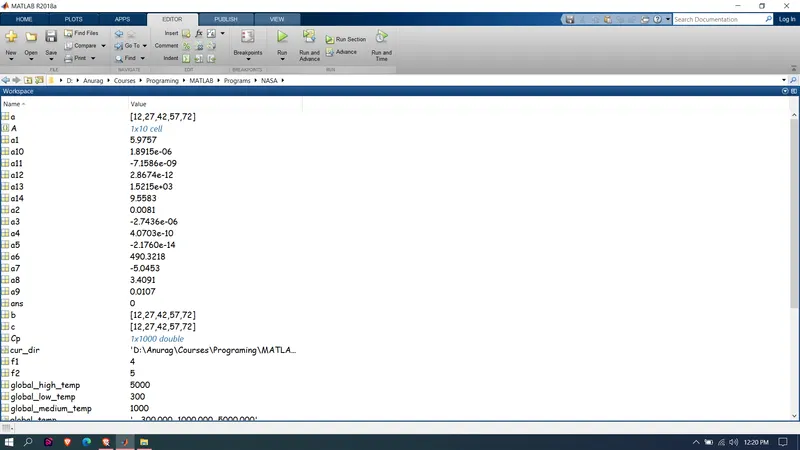
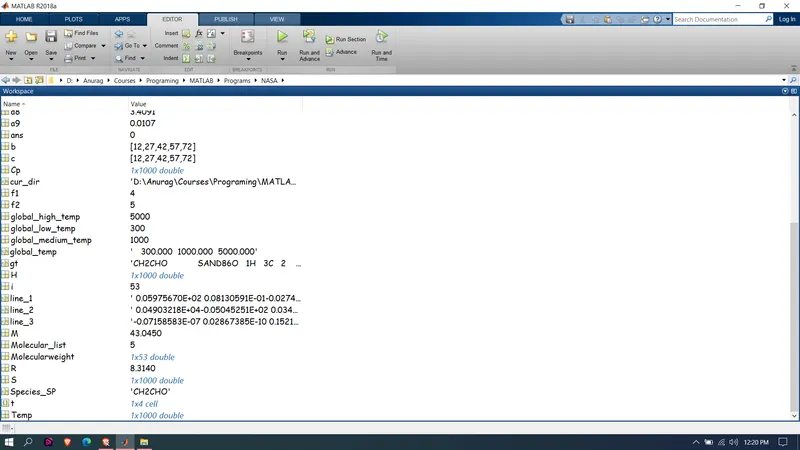
- Reading all the 53 species to plot specific heat(cp), enthalpy(H), and entropy(S), with temperature values, and to find the molecular weights.
- Used ‘for’ loop to read 53 species.
- Used ‘strfind’ to find string.
- Using 'linspace' specified the temperature range from low to high.
- Adding universal gas constant value ‘R’.
- Extracted higher and lower temperature coefficients by reading line by line from the species.
- Calling specific heat, enthalpy, entropy function codes.
- Calculating Molecular weight.
Syntax Used during Coding
|
fopen : |
Open a file or obtain information about open files |
|
‘r’ : |
Open the file for reading |
|
fgetl |
Read line from file |
|
strsplit |
Split string or character vector at the specified delimiter |
|
str2num |
Convert character array or string to numeric array |
|
strfind |
Find one string within another |
|
linspace |
Generate linearly spaced vectors |
|
fprintf |
Write formatted data to file |
|
pwd |
Identify current directory |
|
mkdir |
Make new directory |
|
cd |
Change working directory |
References:-
https://in.mathworks.com/help/matlab/ref/mkdir.html
https://in.mathworks.com/matlabcentral/answers/317006-create-new-folders-by-mkdir
https://in.mathworks.com/help/matlab/ref/saveas.html
https://in.mathworks.com/matlabcentral/answers/17580-how-to-define-a-path-in-saveas-command
https://in.mathworks.com/help/matlab/ref/msgbox.html
https://in.mathworks.com/matlabcentral/answers/151692-display-value-in-message-box
https://in.mathworks.com/help/matlab/ref/fprintf.html
https://in.mathworks.com/help/matlab/ref/sprintf.html
http://combustion.berkeley.edu/gri-mech/data/nasa_plnm.html
https://ntrs.nasa.gov/archive/nasa/casi.ntrs.nasa.gov/19940013151.pdf
https://link.springer.com/chapter/10.1007/978-1-4684-0186-8_8