Challenge

Project-1: Modelling an electric Car with Li-ion battery

AIM: Modelling an Electric Car with Li-ion Battery:-

System Level Configuration:-
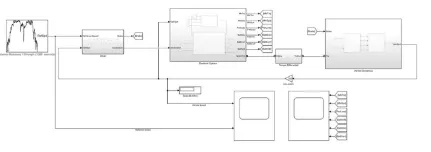
Electric Vehicle Model-

The Electric vehicle Model is represented by using MATLAB/SIMULINK, this model is a complete representation of an Electric Vehicle which is been build using powertrain block sets.

This model has vehicle dynamics and electrical system, the vehicle dynamics contains subsystem relates to the vehicle body and tire whereas the electrical system contains a subsystem related to motor and battery pack.

This subsystem contains various other components, lets's understand each and every component in details.

Vehicle Dynamics-

Vehicle Dynamics is nothing but the study of the vehicle in motion and how the vehicle behaves in motion. The Vehicle Dynamics consist of two main subsystems which are

1. Vehicle Body 2. Wheels
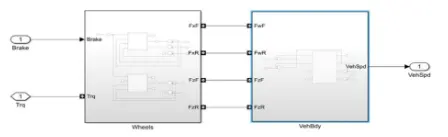
1. Vehicle Body-

In this model vehicle body (1DOF) longitudnal block is implemented. This bock helps us to determine the vehicle inertia and drag load. There are mainly two forces acting on the wheels which are Longitudnal Force and Normal Force. These forces act on the rear and front of the wheels, the longitudnal forces on rear and front is given by (FwF & FwR). Whereas the normal forces are given by (FzF & FZR). This forces is connected to the respective axle of the wheels.
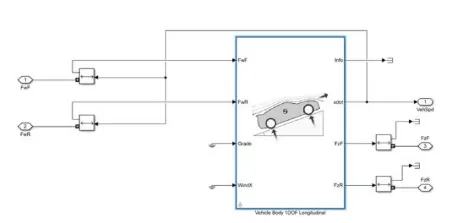
The Vehicle Body consist of grade and wind input ports which can be used to simulate slope and wind drag but this port are been grounded to minimize the complexity of the model. The dot output port is a longitudnal force in the X-Axis which acts as the velocity/speed of the vehicle in m/s.

Parameters of the Vehicle Body-

1. No. of Wheels on the Front/Rear = 2

2. Mass of the Vehicle = 1500(kg)

3. Frontal Area 4m^2

4. CG hieght above Axle = 0.35m

5. Drag cofficient = 0.3

Vehicle & Brakes:-

The wheels used in this vehicle are longitudnal wheels have brakes of disc type brakes have great stopping power and cause less wear and tear and provide precises braking. This block implements the longitudnal behaviour of actual wheels.

This vehicle is rear wheeled drive hence the axle torque is connected to the rear of the wheels and the axle of the front wheel is Grounded.
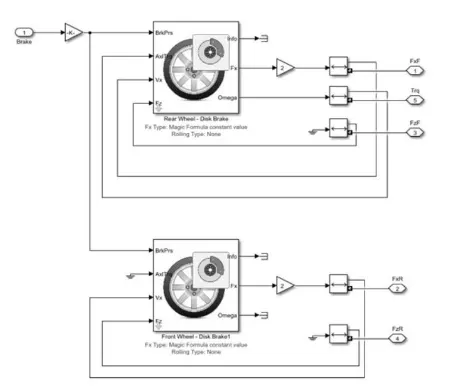
The longitudnal forces of the tires are set to magic formula constant the magic formula is a separate from of a characteristics function of stiffness, shape, peak and curvature. (BCDE)

Magic Formula is given as (

= Fb = f(k, Fz) = Fz Dsin( Otan - 1 (Bx - E|Bx - tan - 1(B.) IH)

The Brake input command for the front and rear wheels are connected commonly as one input port. Omega is the angular velocity of the wheels in the y-axis, hence this force is considered as torque input to the wheels.

Parameters for Wheels-

1. Wheels Inertia = 0.8kg*m^2

2. Wheel Radius = 0.3m

3. Tire Pressure = 220000

4. Brake Pad Radius = 0.117m

Torque Differential-

The Torque Differential block is connected between the motor shaft and the axle of the wheels the block consist of an open differential block and a torsional compliance. The open differential block is basically a set of planetary gear system it matches the drive shaft to the crown gear and the transmission driveshaft to the wheel axle. The block uses a coordinate system that produces a positive tire and vehicle motiom.

Input for the open differential is drive shaft torque which accepts input from the motor drive shaft and ale torque which are connected to the axle of the wheels. on the other side torsional compliance is basically a spring damper which is a shaft that connect between the open differential and axle wheels.

Parameters for Torque Differential-

1. Drive Shaft Ratio = 3.4

2. Axle 1 Inetia = 0.3 kg*m^2

3. Carrier Inertia 0.25kg*mA2

4. Torsional Stiffness = 5000 n*m*s/rad

5. Torsional Damping = 10 N*m*s/rad

Electrical System-

The Electrical system is the most important system in the whole drive cycle. The Electrical System is subdivided by-

1. Motor (Induction Motor)

2. Battery (Lithium ion Battery)

LITHIUM Ion Battery:

The Battery is the energy source of any system the battery used in the system is a Datasheet battery which implements a model for the lithium-ion battery. The question arise that why most of the EV uses lithium-ion cells a source, like any other battery because battery like a lead acid battery which required constant maintenance and monitoring, hydrogen cells which are quite bulky and expensive also capacitor banks are used as a battery pack but they have a high discharge rate and drain quickly. Hence the Lithium-Ion Battery eliminates all such disadvantages and equires fewer maintenance and operational cost are less.

Longevity-

The average lithium-ion battery life span for large capacity is mre than 8 years. Safety-reduce the risk of accidents by eliminating exposures to flammable fuels able to withstand even in the high temperature without explosions.

Environment Impact- Lithium-Ion Battery provide significaant environmental benefits over fossil fuels. with the steady increase in the electric vehicle, we can see an immediate impact on the reduction in carbon emission. Hence knowing all such advantages of lithium-ion manufacturers prefer using lithium cells as their main source of energy.

The battery pack is packed with 30 numbers of cells in series and 2 numbers of cells in parallel each.

Rated capacity of the battery (Ah) = 100

Output Voltage = 12V

The Battery rated capacity is 100 Ah and rateed voltage is 12 volt the battery provides 1200kwh considering its charging/ discharging.

Charging of battery: If the applied current is 10 amperes, then it would be 100Ah/10A=10 hrs. approximately.

Discharging: Battery Ah X Battery Volt/ Applied load say, 100Ah X 12V/100 watts = 12 hrs. (with at 40% loss at the max =12x 40/100 = 4.8 hrs). The Backup will last up to 4.8 hrs.

Formula to calculate soc = soc(1) = soc(t-)+ it/ Caute

Where SOc(t)= State of charge at timet

soc(t-1) = Initial state of charge

I = charge/discharge current (A)

T = time(H)

The BattCurr and the Batt Volt are connected to the motor controller respectively, the batt SOC con be determined by the bus selector SOC is scaled to 100 by using a gain block.

Parameter for Battery:

1. Battery Type= Lithiumn ion Battery

2. Battcharge Max= 100Ah

3. No of Cells in Series= 30

4. No of Cells in Parallel= 2

5. Output Battery Voltage= 12V

Driver:-

The Driver block is basically a controller for the vehicle, it controls the acceleration, and braking of the vehivle. The block is implemented with a PID controller which is basically the main controller in the whole drive cycle. The PID controller works as colsed loop speed control, it takes the input as a reference speed and correct the erroe genereted by the vehicle speeds. PID conroller is tuned for the adequate acceleration and deacceleration command itis done by limiting its output to upper and lower saturation. Separting the output of the PID to accelerate and deacceleration command we use a saturation block for each command, for acc command we use an upper saturation value and for the deaccelerate command, we use a lower saturation value.

Tuning is Proportional, derivative and integral values we should be able to track the reference speed. The below table gives us an idea for the manual tuning of the controller.

Result:-

Taking all the above factors into consideration we now run the simulation the reference speed here is Artemis Motorway (130Kmph)

The simulation was run for about 1068 sec and we have obtaoned result shown above. There are 6 individual graphs showing the result for motor nd the bateery in this result, we see that max torque of about 400Nm was obtained and a max speed of the motor was about 1500rpm at 130kmph. The graph of the battery SOC shows a linear and a slow discharge rate, we alwo observe a peak of charging spike at about 950 sec as a cause by the regeneretive braking of the vehicle. The Result for the Vehicle speed and reference speed is shown below-

We can see that the vehicle speed tracks the reference speeds Artemis Motorway thanks to the PID controller, the manual tuning of the PID controller help to track the reference speeds.

Conclusion-

The Efficiency of the Electrical Vehicle is more compare to normalIC vehicle of HEV Vehicle, Also the run time cost of the vehicle is very low-e.g.-

Full Range =130km

Total consumption of electricity at full charge = 16.5 units

Electricity usage per km = 1+.5/130 = 0.12units

Cost of 1 unit electricity:

4.5RS

Total cost of runing for 1 km = .12^4.5=0.54p

Total cost of runing for 130km 15.6Rs

The power losses are comaratively less than a conventional vehicle as they use a complex gear system but to use the EV at the full potential there is a need to increase a public charging station. The Manufacturing of Electric vehicles is domestic, for instance, come at a high cost, production of battery is largely expensive due to material like cobalt hence there is a need to find an alternate for such materials.

There is a need for adoption of thr electric vehicle especially for india as it could save up to $300bn in oi; imports and 1 gigaton of co2 emmision.

Your portfolio, next

Ship work like this
in your own course.

Talk to a career counsellor

Free 20-minute call. We'll map the right course to where you want to work.

By submitting you agree to our Terms and Privacy Policy.

Talk to a career counsellor

Free 20-minute call. We'll map the right course to where you want to work.

By submitting you agree to our Terms and Privacy Policy.