Project 1 Mechanical design of battery pack
Aim: Mechanical design of battery pack
Battery Pack capacity: 18kWh
Cell:ANR26650M1-B
Introduction:Battery pack is the fundamental source of electric vehicle,and for high perfoemance of vehicle it must supply energy at high power.Thermal consideration are also important while designing battery pack.Mechanical robustness is also a critical challenge as it has to withstand vibration and loads from normal driving conditions,acceleration and decceleration but also maintain structural integrity in crash analysis.This is very much important for battery safety because impacting lithium ion batteries can be very dangerous and cause entire failure of battery pack.
Details of Battery:
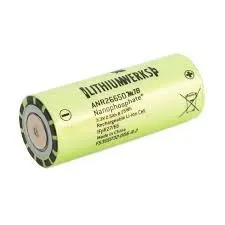
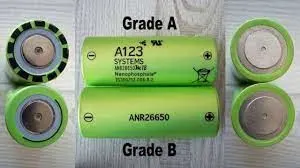
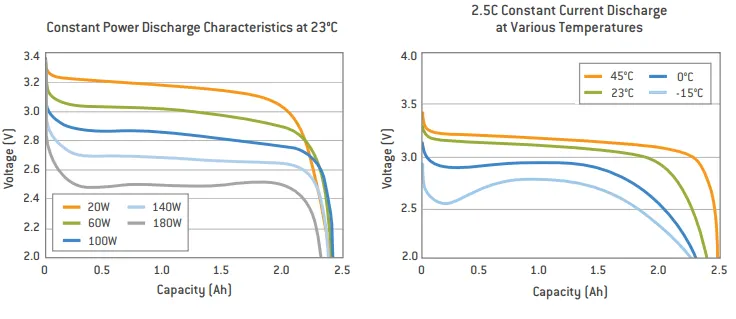
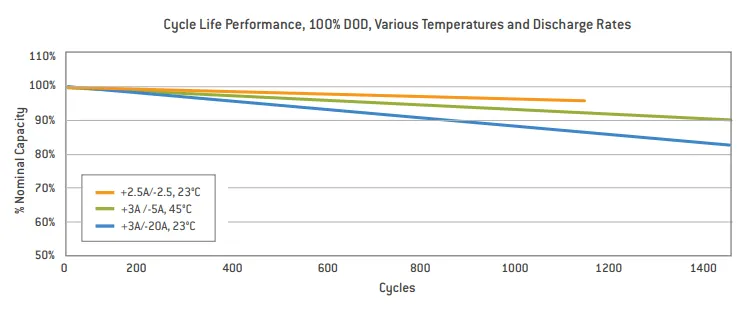
Lithium ion 26650 cells are capacble of delivering high powerdue to its use of patented Nano phosphate battery technology.Based on LiFePO4 chemistry the cells are inherently safe over a wide range of temperature and conditions.The Lithiom ion 26650 cells are suitable for wide variety of power,pulse or stand by applications.
Nanophosphate battery technology offers stable chemistry,faster charging ,consistent output,ecxellent lifr cycle and superior cost performance.
Applications:
1.Energy Storage
2.Communication Technologies
3.Military power grids
4.Medical devices
5.Datacenter UPS
6.Commercial vehicle
7.Passenger vehicle
8.Industrial equipment.
Components of Battery pack:
1.Cells
2.BMS
3.Connection system
4.Housing
1.Cells: A cell refers of a single anode and cathode seperated by electrolyte to produce voltage and current.A battery can be made up of one or more cells.
A pack can contain one or more cells to acheive high power depending on application.The battery pack can be arranged in series or parallel configuration.
Calculation of Battery:
1.Energy:18kWh (Required)
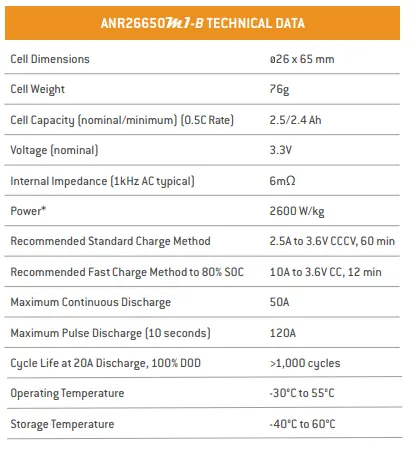
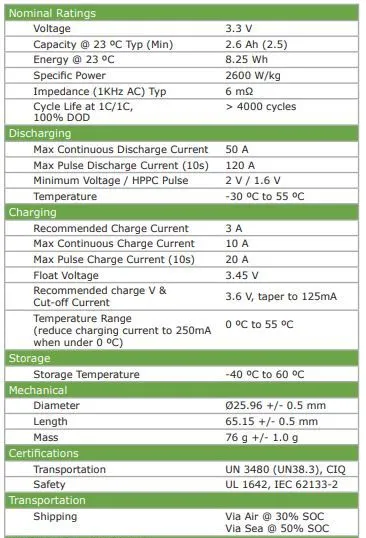
2.No.of cells: Energy/(Nominal voltage*capacity)
N=18000/(3.3*25)
N=2182
we need a minimum of 2182 cells to get required power of 18kWh.Now based on that we need to decide series or parallel configuration..
As we know in series configuration voltage gets adds up and capacity remains same,whereas in parallel configuration the capacity increases and voltage remains constant.
Lets conside 330V to ren our vehicle.
The nominal voltage of one cell is 3.3V.
Therefore no. of cells required to connect cells in series is 100.
Ns=330/3.3
Ns=100.
The capacity of whole module will be 2.5Ah.
We need to find no. of cells to be connected in parallel configuration.
Np=Total cell/Ns
Np=2182/100
Np=21.82
we take 22 cells for each pallel row,although it is exceeding limit but its negligible.
Cell Architecture: 100 series and 22 parallel=100S22P
3.Battery Capacity:
Battery Capacity=Parallel Cell row*Individual cell capacity
Capacity=22*2.5
Capacity=55.0 Ah
4.Current Supplied by battery:55 Current amphere per hour which can be considered as C-rate.
5.Range:
Let power train energy consumption =129Wh/Km at 70% power train effeciency.
Range=capacity/energy consumed per Km
Range=18000/129
Range=139Km
So our vehicle will be able to run 139 Km with current parameters.
Internal Resistance of battery: The resistance flowing through negative terminal of battery to positive terminal of battery.
6.Battery Dimension:
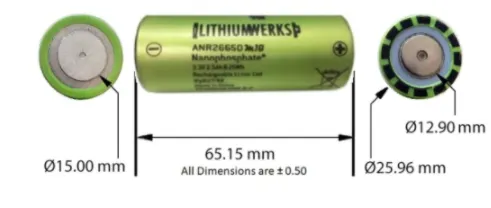
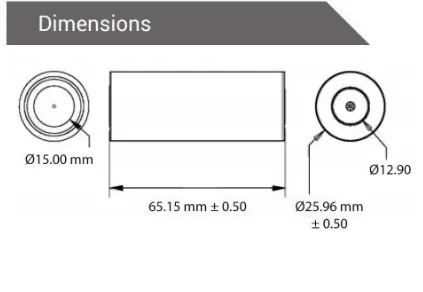
ANR26650 cell has 26mm diameter and 65mm height.On the basis of that we need to decide battery size of battery casing.
Length of Battery Casing (L): number of cells at mid*(cell diameter(26)+ margin at both side of cell(4))+clearence at side(diameter of edged cell+margin)
L=98*30+60
L=3000mm
Breadth of casing(B): cell diameter(26)+margin at both side of cell(4)+clearence at side(diameter of edged cell+margin)
B=20*30+60
B=660mm
Height of Casing: 65+35(height of cell+margin of wiring,cell holders, metal strips)
H=100mm
7.Weight of Battery pack:
Cell weight:76g
No of cells=2182
battery pack weight=cell weight*no. of cells+weight of accessories
W=76*2182+4.5=165.8+4.5=170.3Kg.
B.Battery Pack Assembly:
The battery pack can be connected in series ,parallel or mixture of both series and parallel.
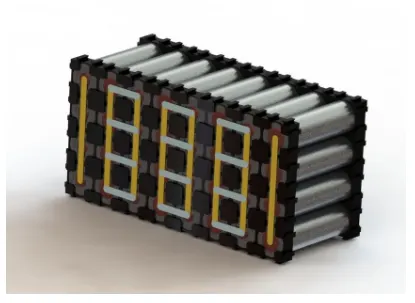
fig.Cells Connected in series and parallel configuration to form a battery pack.
C.Required components of battery pack Assembly:
Required 2200 cells,Nickle strips,PVC heat sink film,spot welder,Connectors,Cell holder and solder.
Step1:We are going to start with snapping square cell holder together.One can use cell terminal block but it will consume more space than hexagonal holder.
Put insulator gasket on positive side of cell.
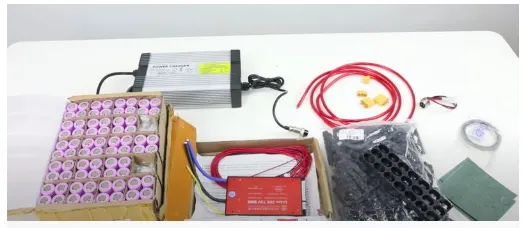
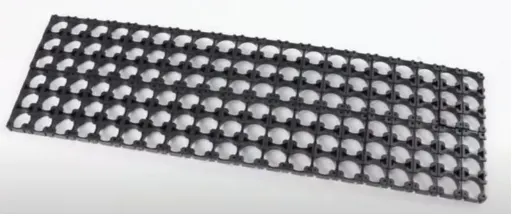
Fig: Cell holder matrix
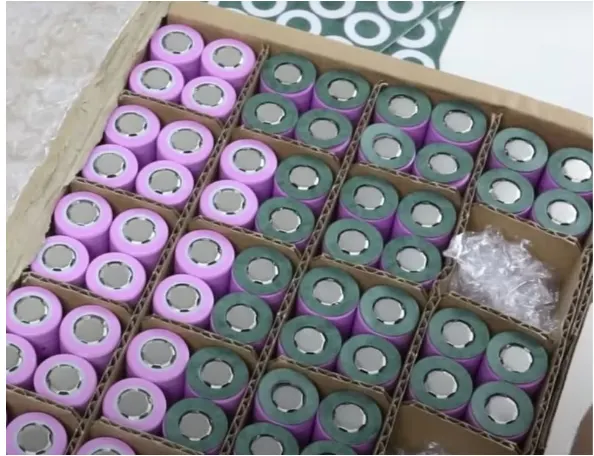
Fig:Cell with Insulator gasket.
Step 2:
Now place cell in cell holder matrix.After loading all cells put second cell connector block to other side.
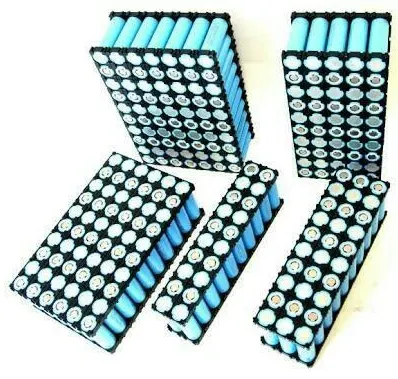
Fig:Loaded cell into holder
Step 3: Connect cell with nickel strip using spot welder.Series connection will be made by connecting cell positive to cell negative and parallel connection will be made by connecting same terminals.Weld some nickel strips to terminal cells,which will be later used to attach wires.
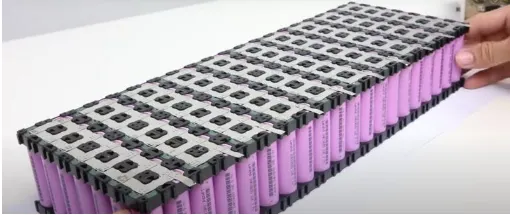
Fig:Cell connection with nickel strip
Step 4: After connection,Stick PVC heat sink film to cell.Solder balancing wires to terminals and battery management system current supply wire to battery pack.
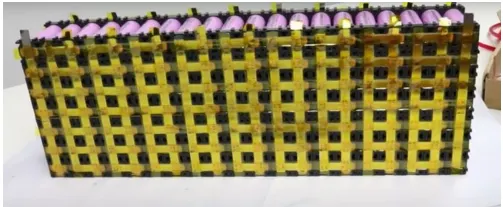
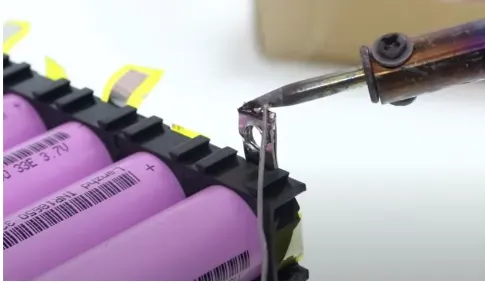
Fig:Soldering of balancing wires.
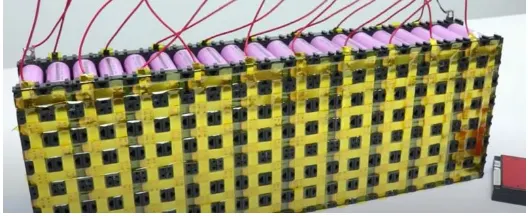
Fig:Pack with balancing wires
Step 5: Connect balancing wires pin to BMS and glue it to side of battery pack with BMS.
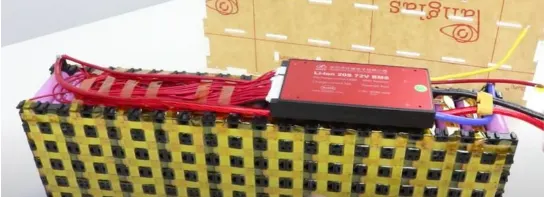
Fig: Battery Pack with BMS.
Step 6: Now put Battery pack in an enclose that can be made up of plastic,metal or battery pack can be wraped in plastic
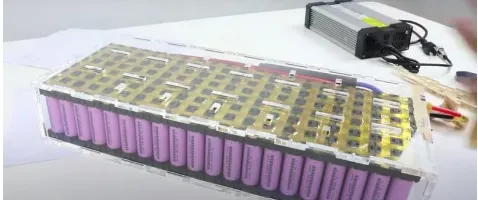
The Battery pack Overall view from start to end.
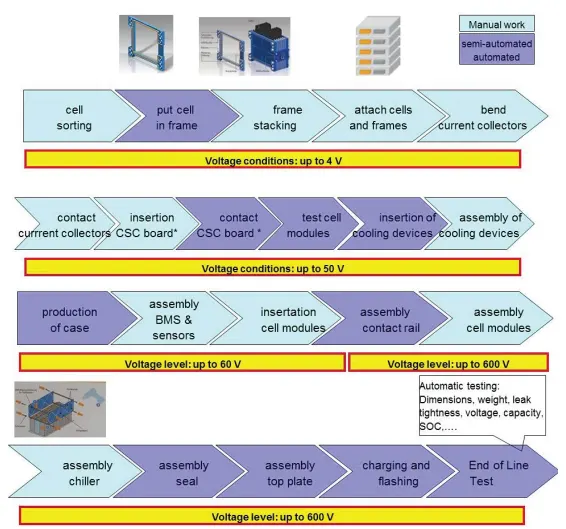
Battery Pack Enclosure View:
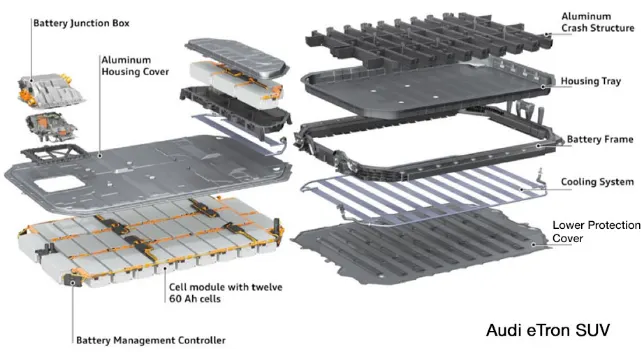
Enclosure Design:
1.The Energy density improvement in LI-ion cell is more prominent but we are seeing increase in battery pack level energy density at a greater rate.
2.Manufacturers are improving their battery design.The mass of material being used around the cells reduced, allowing for more battery pack.
3. The choice for material also affects improvements.
4.The thermal management strategy also impacts these choices with increase energy density and consumer demand for fast charging, the thermal management must be more effective but in smaller and lighter package.
5.Battery Management material includes Alluminium,copper,Thermal managment materials, thermal interface materials,steel,glass reinforced polymers,carbon fibre reinforced polymers,inter-cell insulation,foams,housing and pack fire retardant materials.
6.Enclosure made from injection moulded plastics are most commonly used for battery packs.For these enclosed battery design,two or more plastic parts are moulded and then assembled with pack and circuit.
They can be sealed using glues,fasteners,or ultrasonic welding.
7.Li-ion batteries are great source for projects but they require care during charge and discharge.