Project 1 Mechanical design of battery pack
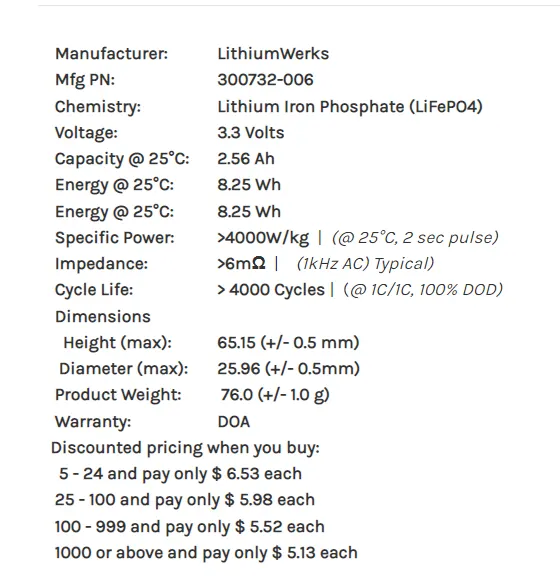
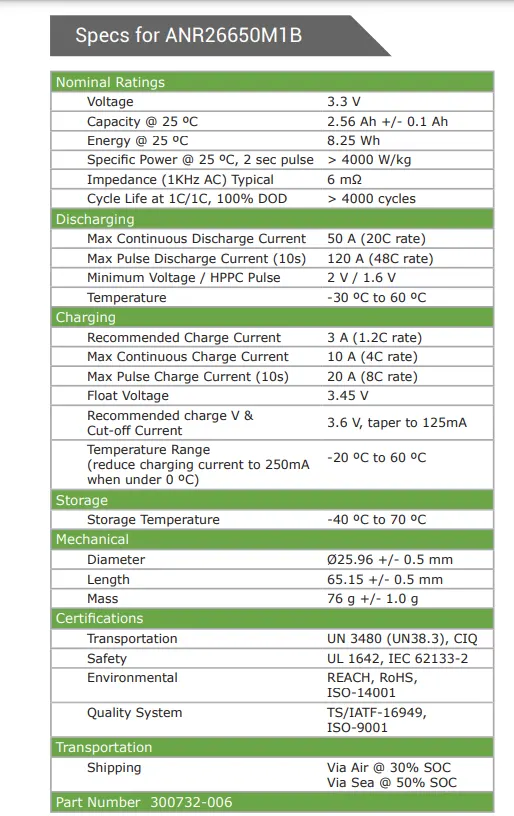
LithiumWerks ANR26650M1-B, 3.3 Volt, 2.5Ah Lithium Iron Phosphate (LiFePO4) Battery
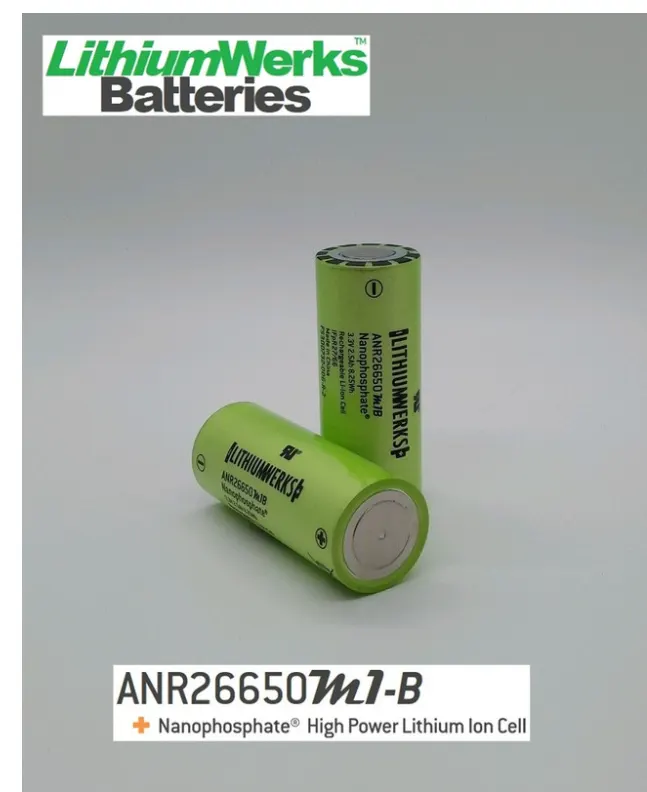
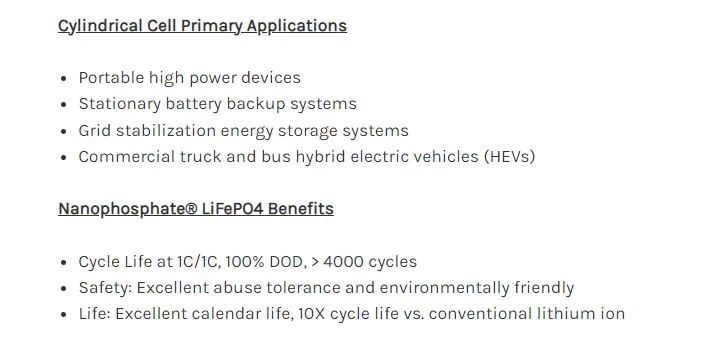
A123’s high-performance Nanophosphate®
lithium iron phosphate (LiFePO4) battery
technology delivers high power and energy
density combined with excellent safety
performance and extensive life cycling in a
lighter weight, more compact package. Our cells
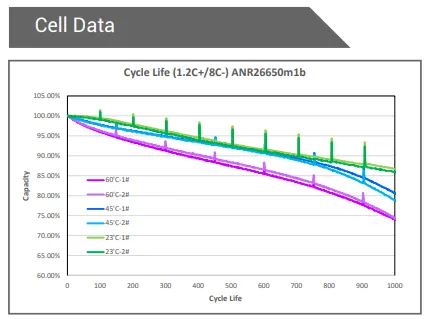
have low capacity loss and impedance growth
over time as well as high usable energy over a
wide state of charge (SOC) range, allowing our
systems to meet end-of-life power and energy
requirements with minimal pack oversizing.
A battery is a source of electric power consisting of one or more electrochemical cells with external connections for powering electrical devices. When a battery is supplying power, its positive terminal is the cathode and its negative terminal is the anode. The terminal marked negative is the source of electrons that will flow through an external electric circuit to the positive terminal. When a battery is connected to an external electric load, a redox reaction converts high-energy reactants to lower-energy products, and the free-energy difference is delivered to the external circuit as electrical energy. Historically the term "battery" specifically referred to a device composed of multiple cells; however, the usage has evolved to include devices composed of a single cell.
Chemistry and principles
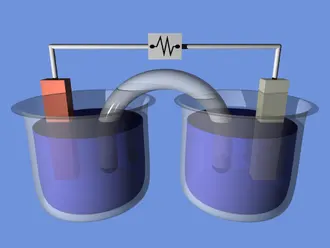
Batteries convert chemical energy directly to electrical energy. In many cases, the electrical energy released is the difference in the cohesive or bond energies of the metals, oxides, or molecules undergoing the electrochemical reaction. For instance, energy can be stored in Zn or Li, which are high-energy metals because they are not stabilized by d-electron bonding, unlike transition metals. Batteries are designed so that the energetically favorable redox reaction can occur only when electrons move through the external part of the circuit.
Types:
Primary and secondary batteries
Batteries are classified into primary and secondary forms:
- Primary batteries are designed to be used until exhausted of energy then discarded. Their chemical reactions are generally not reversible, so they cannot be recharged. When the supply of reactants in the battery is exhausted, the battery stops producing current and is useless.
- Secondary batteries can be recharged; that is, they can have their chemical reactions reversed by applying electric current to the cell. This regenerates the original chemical reactants, so they can be used, recharged, and used again multiple times
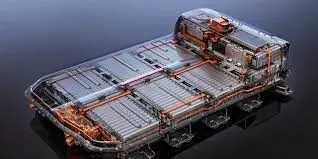
Battery pack
A battery pack is a set of any number of (preferably) identical batteries or individual battery cells. They may be configured in a series, parallel or a mixture of both to deliver the desired voltage, capacity, or power density. The term battery pack is often used in reference to cordless tools, radio-controlled hobby toys, and battery electric vehicles.
Components of battery packs include the individual batteries or cells, and the interconnects which provide electrical conductivity between them. Rechargeable battery packs often contain a temperature sensor, which the battery charger uses to detect the end of charging. Interconnects are also found in batteries as they are the part which connects each cell, though batteries are most often only arranged in series strings.